In this guide
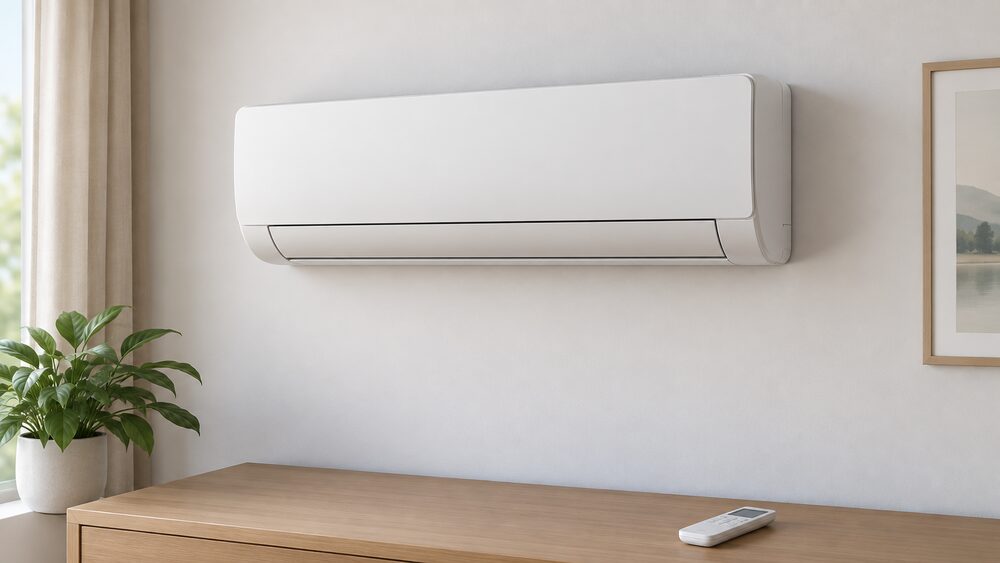
Powrmatic is a UK manufacturer of heating, cooling and ventilation equipment, and its residential cooling line is the Vision range: self-contained air conditioning units built for homes and apartments. The defining feature of the range is that several models need no outdoor condenser at all. The Vision 3.1 DW is described by the maker as a "stylish, low-profile solution with no external unit required", the Vision Compact DW as "a slim, space-saving unit with no external condenser required", and the Vision Maxi/DW as "a fully self-contained system, eliminating the need for an outdoor unit"1.
That matters for a household because the outdoor unit is usually the part that creates planning questions, noise complaints and lease problems in flats. A self-contained unit sidesteps all three. The trade-off is that the heat removed from the room has to go somewhere, and in a water-based model such as the Vision H2O it goes into water rather than into outside air, which the maker describes as "eliminating the need for an external condenser cooling method"1.
The range is not only a cooling range. Every system in the Vision collection offers both heating and cooling modes, and the Vision Horizontal 3.1DW uses built-in heat pump technology to deliver "cooling in summer and efficient heating during colder months"1. For a household thinking about energy independence, that dual function is the central fact: the same unit can cool in a heatwave and take some of the heating load in a cold snap, from electricity rather than gas.
The Powrmatic range for domestic use
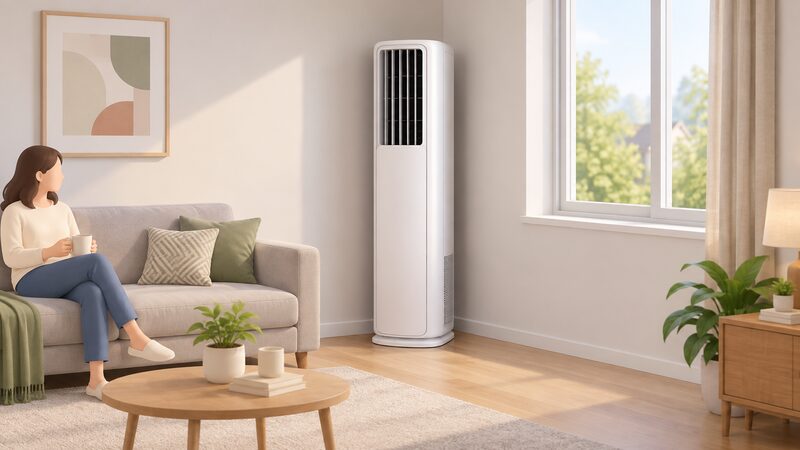
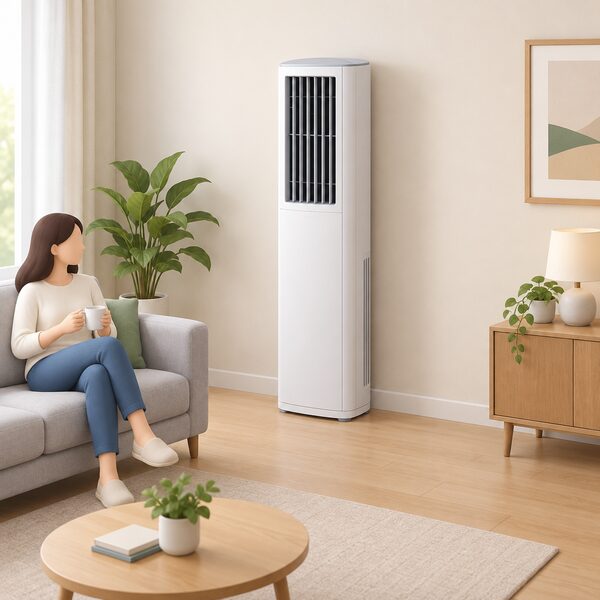
The Vision collection is the domestic-facing part of the Powrmatic cooling line, and it is organised around installation constraints rather than around output alone. The Vision 3.1 DW is a low-profile wall unit with no external unit required. The Vision Compact DW is a slim, space-saving unit, again with no external condenser. The Vision Maxi/DW is a fully self-contained system with no outdoor unit. The Vision Verticool is a floor-standing, fully self-contained unit, which the maker positions for "areas with limited wall space". The Vision H2O uses a water-based system instead of an external condenser1.
Read together, these five models cover the situations where a conventional split system is difficult: a flat where the freeholder will not allow an outdoor unit, a room with no accessible external wall, a listed or conservation-area property, or a garden room where running refrigerant pipework is impractical. The Verticool's floor-standing format and the Compact's slim casing are both answers to the same problem, which is where the hardware can physically go.
The range is not the whole of what Powrmatic makes. The company's wider business is heating and ventilation equipment, and the residential cooling products sit alongside that. For a household, the practical point is that the Vision range is the part of the catalogue aimed at domestic rooms rather than at commercial premises.
How Powrmatic cooling fits a household energy setup
Cooling equipment sits inside a wider picture of how a home manages heat, and the official and independent guidance is consistent that cooling is not only about adding a machine. The National Energy Action recommended improvements for homes are to keep them "warm in winter and cool in summer", to invest in ventilation, shading and passive cooling, to ensure energy is affordable for essential needs including cooling, and to provide targeted support for vulnerable households5. A Powrmatic unit is one part of that list, not a substitute for the rest.
The same logic runs through the building standards. Passivhaus buildings use mechanical ventilation with a heat recovery system attached, which is a ventilation strategy rather than a cooling appliance6. Thermostatic radiator valves let a household adjust the temperature in different rooms so that unused spaces are not heated more than necessary7. Evaporative air coolers use water to cool air slightly and are more effective than fans in dry conditions8. Heat pumps, in the independent framing, keep a home "warm and cosy in the winter and cool and comfortable in the summer"9.
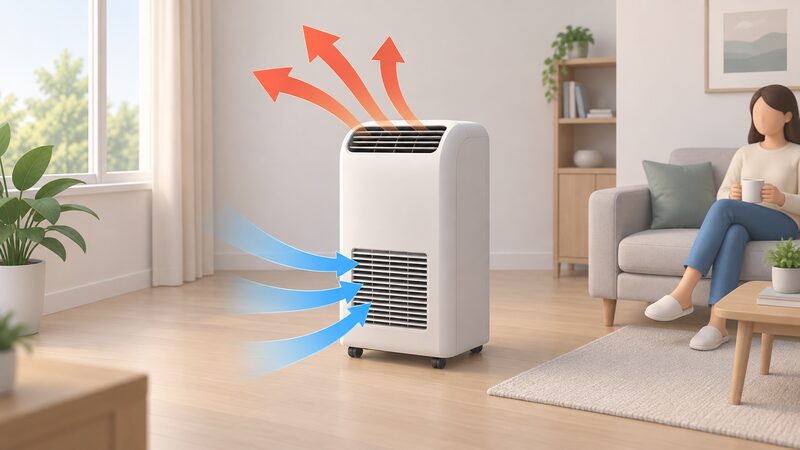
Where a Powrmatic unit fits is at the active end of that spectrum. It provides mechanical cooling and, in the Vision models, mechanical heating as well. What it does not do is reduce the heat load in the first place. A well-insulated and ventilated home helps to keep heat out as well as in, and that is the cheapest cooling measure available before any equipment is switched on10. The household that shades, ventilates at night and then runs a self-contained unit for the worst hours is using the equipment where it earns its place.
Specifications to check before choosing a unit
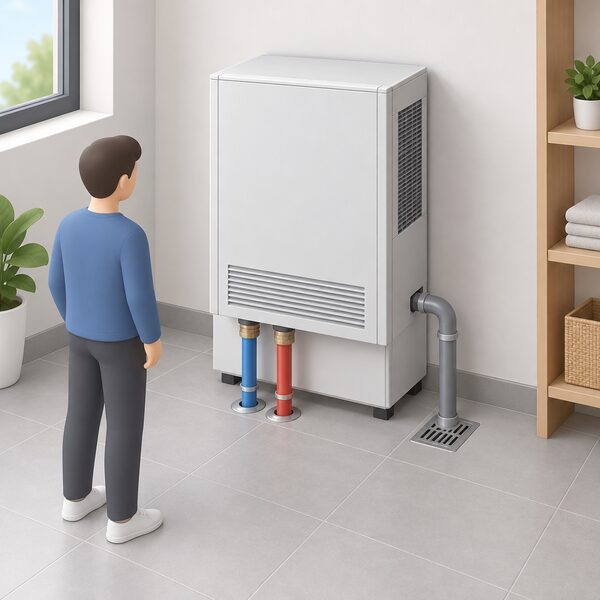
The specification that matters most for a self-contained unit is where the heat goes and what services the unit needs. A water-based model such as the Vision H2O rejects heat into water rather than outside air, which is the reason it can be installed without an external condenser1. That has implications for the water connection and for the drainage arrangements, and those are the things to establish before committing to a position in the room.
For comparison, the wider UK market shows how much specification varies across cooling and heating equipment. The Daikin 4MWXM52A9 multi air conditioner has an operating range for cooling of up to 46°C and for heating down to minus 15°C11. The LG Therma V R290 Monobloc places its hydronic components, including the plate heat exchanger, water pump, flow sensor, pressure sensor, deaerator and safety valve, inside the outdoor unit12. The SolaX Thermal R290 Series offers three indoor configuration options: a hydraulic integrated unit, a hydraulic unit, or a control unit13.
Those examples are not Powrmatic products, but they show the questions worth asking of any unit: what is inside the box, what is outside it, what the operating temperature range is, and how the indoor and outdoor parts are configured. On the regulatory side, Approved Document L Volume 1 states that primary storage systems should meet the insulation requirements of the Hot Water Association's Performance Specification for Thermal Stores14. That is a storage standard rather than a cooling standard, but it is the kind of document that governs how equipment is specified in a new or renovated home.
| Check | What to establish |
|---|---|
| Heat rejection | Air or water, and whether an external condenser is needed1 |
| Operating range | Cooling and heating limits for the specific model11 |
| Indoor configuration | What is inside the unit and what sits outside it12 |
| Storage, where fitted | Insulation to the HWA thermal store specification14 |
| Controls | Whether the unit is controlled locally or remotely |
Running costs and efficiency
Running costs for cooling split into two categories, and the difference between them is larger than the difference between brands. Passive cooling has minimal running costs, while active cooling costs more, though it is still described as efficient2. The same source puts passive cooling at around 50p per day to run for 8 hours, based on energy prices of 27p per kWh2. That figure is for passive measures, not for a powered air conditioning unit, and it should be read as the floor rather than as a forecast for a Vision unit.
For a sense of what cooling costs in a supported context, the Northern Ireland Sustainable Energy Programme annual report for 2023-24 gives a cost effectiveness figure for Thermal Comfort 2 of 2.009 pence per kWh15. That is a scheme metric rather than a domestic tariff, and it is not comparable with a household electricity price, but it shows the order of magnitude that scheme administrators work with when they fund thermal comfort measures.
The efficiency of any active cooling unit depends on how it is used. A unit run continuously in a room with unshaded south-facing glazing will use more electricity than the same unit run for the hottest hours with blinds closed. The independent guidance on heat pumps makes the same point in reverse: a heat pump runs efficiently when the system it serves is set up to let it, and the same principle applies to a reverse-cycle cooling unit3. There is no published running cost figure for a Powrmatic Vision unit in the material reviewed here, so any estimate would be installer or maker supplied rather than independently verified.
Installation and servicing in the UK
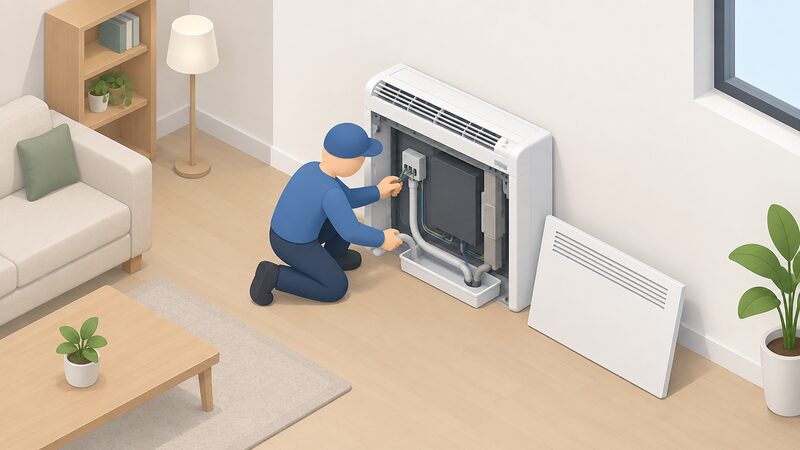
Installation of a self-contained unit is a different job from installing a split system, because there is no outdoor unit to site, no refrigerant pipework to run through a wall, and no external condenser to bracket. That is the whole point of the design. It does not, however, make the work a DIY task. Electrical connection, condensate management and, where a water-based system is used, plumbing all fall within the scope of a competent installer.
The UK installer market for this kind of work is established. Boiler Plumbing Installations Ltd lists radiators and central heating among its services16, and Trust Electric Heating Ltd lists central heating systems, installation and servicing17. Those are examples of the general heating and cooling trade rather than Powrmatic specialists, and they illustrate the point that the installation route for domestic climate equipment runs through the existing heating trade.
Servicing follows the same annual pattern as other domestic heating and cooling equipment. Heat pumps should be serviced once a year, preferably before winter3, and an annual service is the recommendation for heat pumps generally18. A unit that provides both heating and cooling is used in both seasons, so the case for an annual visit is at least as strong. Servicing covers filters, the refrigerant circuit, condensate drainage and controls, and it is also the point at which any warranty condition about maintenance is satisfied.
On the manufacturer's side, UK-based support shortens the distance between a fault and a fix. Ideal Heating's customer service and warranty team is based in the UK19, and the same UK-based support model is a reasonable expectation of a UK manufacturer such as Powrmatic. For a household, that matters most in the years after the warranty ends, when the question is whether parts and engineers are reachable.
What owning Powrmatic equipment means for energy independence
The independence question for any cooling unit turns on three things: what fuel it uses, who controls it, and what happens when it fails. On fuel, a Powrmatic Vision unit runs on electricity. It does not burn gas, and it does not depend on a gas supplier or on the gas network. That is a genuine shift in the household's exposure, because it moves the cooling and part of the heating load onto the electricity supply.
On control, a self-contained unit is a local device. There is no outdoor condenser to be shared with neighbours, no refrigerant pipework running through common parts, and no dependence on a landlord or freeholder granting permission for an external box. For a flat, that is the difference between being able to cool a room at all and not being able to. The Vision Verticool's floor-standing format and the Compact's slim casing exist precisely to make that possible in constrained spaces1.
On failure, the position is less independent. A powered cooling unit depends on the manufacturer for parts, on an installer for service, and on the electricity supply for operation. The passive alternatives carry no such dependence: passive cooling needs no refrigerants or energy-intensive cooling units and produces lower emissions2, and it has minimal running costs2. A household that combines shading, night ventilation and a self-contained unit for the worst hours keeps the dependence small and the benefit where it is needed.
The wider UK picture supports the same conclusion. Electric heating technologies, covering heat pumps, direct electric and storage technologies, are already widely used globally and available in the UK4. The direction of travel in domestic heat is towards electricity, and a cooling unit that also heats is part of that shift rather than apart from it. What remains is the grid itself, and the fact that a cooling unit is at its most useful on the hottest days, which are also the days when the grid is under most strain.
"A well-insulated and ventilated home will actually help with keeping the heat out too."
Sources19 cited
- Compact air conditioning units for flats and apartments, Cooleasy
- Cooling, Kensa, 2026-09-17
- How to ensure a heat pump runs efficiently, Energy Saving Trust, 2026-07-01
- Delivering low carbon heat, BEAMA, 2023-11-22
- Tips for babies in a heatwave, National Energy Action, 2026-08-11
- Passivhaus: what you need to know, Energy Saving Trust, 2026-02-16
- Maintaining the ideal home temperature, Smart Energy GB, 2026-08-17
- Summer energy tips, National Energy Action, 2026-08-13
- Level up your lifestyle with a heat pump, Plymouth Energy Community, 2026-09-20
- How fuel poverty is still an issue during the summer, End Fuel Poverty Coalition, 2025-08-31
- Daikin 4 port multi air conditioner 4MWXM52A9, Quiet Mark, 2026-09-17
- LG Therma V R290 Monobloc 12kW 1 phase HM121HF UB60 heat pump, Quiet Mark, 2026-09-17
- SolaX Thermal R290 Series STN1-C02 indoor air to water heat pump, Quiet Mark, 2026-09-17
- Building Regulations Approved Document L Volume 1 2026, Welsh Government, 2026-04
- NISEP Annual Report 2023-24, Utility Regulator Northern Ireland, 2025-07
- Boiler Plumbing Installations Ltd, Which? Trusted Traders, 2026-09-17
- Trust Electric Heating Ltd, Which? Trusted Traders, 2026-09-17
- Is now a good time to get a heat pump, Energy Saving Trust, 2025-12-12
- Ideal Logic Air 10kW heat pump, Quiet Mark, 2026-09-17