
In this answer
Short answer
Northern Ireland is the one part of the UK where the Smart Export Guarantee does not apply. The SEG scheme is not available in Northern Ireland, though energy can be exported direct to a supplier or through an agent1. What replaces it is a smaller, supplier-led arrangement: Power NI's Microgen tariff, which pays 9.64p per kWh for exported electricity and carries no fixed-term contract2.
The rate is not set in isolation. The tariff for renewable generation is approved by the Utility Regulator (NIAUR) each year, and new rates are published towards the end of September, with prices subject to fluctuation each year2. The export tariff year runs from 1 October to 30 September, while the ROC year runs from 1 April to 31 March each year2. Two different twelve-month cycles govern two different income streams.
For a household, the practical consequence is that export income in Northern Ireland depends on a commercial contract with a supplier rather than on a statutory scheme. The guidance for the rest of the UK is to speak to your energy supplier to see if they offer an export tariff, and that advice applies with more force in Northern Ireland, where no licence condition compels a supplier to offer one3.
Power NI's Microgen tariff: 9.64p per kWh with no fixed-term contract
The Microgen tariff is the anchor of export income in Northern Ireland. It pays 9.64p per kWh for electricity exported to the grid and is described as having no fixed-term contract2. That absence of a term matters: it means the arrangement is not structured as a multi-year commitment in the way some export deals are elsewhere.
The rate sits within a market where the price paid for exporting is almost always less than the price to buy electricity from the grid6. That gap is the central economic fact of any export arrangement, and it holds in Northern Ireland as much as in Great Britain. An export tariff is simply the rate paid to households or businesses for the electricity they export back to the grid7.
Because the tariff is approved by the Utility Regulator (NIAUR) each year, the rate is not purely a commercial decision by the supplier2. The regulator's annual approval gives the figure a stability that a purely competitive export market would not, but it also means the rate moves on an annual cycle rather than tracking wholesale prices continuously.
For a household's energy independence, the Microgen tariff converts surplus generation into a small revenue stream but does not remove dependence on the grid. The household still imports when generation is low, still relies on a supplier for the export contract, and still depends on NIE Networks for the physical connection. Export income offsets cost; it does not substitute for supply.
How the export tariff year works and when rates are set
The export tariff year runs from 1 October to 30 September, and new rates are published towards the end of September, with prices subject to fluctuation each year2. The publication timing is deliberate: the new rate is known just before the year it governs begins.
This differs from the ROC year, which runs from 1 April to 31 March each year2. A household receiving both an export payment and a ROC-based payment is therefore working to two overlapping cycles, and a rate change in October does not coincide with a change in the ROC period.
The wider UK context is that export tariffs generally offer a fixed rate for every unit of electricity sold back to the grid8. That fixed-rate structure is what makes the annual reset significant: the rate is locked for the tariff year rather than floating with the market.
In Northern Ireland specifically, the guidance is to get in touch with your energy supplier to see what export tariffs they might be able to offer9. There is no central register of export rates as there is under the SEG, so the published Power NI figure is the clearest reference point available, and other suppliers' terms must be established directly.
| Cycle | Period | Set by |
|---|---|---|
| Export tariff year | 1 October to 30 September | Utility Regulator (NIAUR) annual approval2 |
| ROC year | 1 April to 31 March | Annual cycle2 |
ROCs and the renewable generation tariff: what else you can be paid
Beyond the export rate, Northern Ireland generators can be paid through the renewable generation tariff, which is ROC-based. Power NI lists £71.76 per ROC for a non-agent generator for the period 1 October 2025 to 30 September 20262. That figure is approved by the Utility Regulator (NIAUR) each year2.
The ROC route exists because the Feed-in Tariff did not extend to Northern Ireland in the same form. Instead, a change to the Northern Ireland Renewables Obligation (NIRO) Order put additional incentives into place for generating stations of certain technologies and installed capacities10. The NIRO is therefore the mechanism through which Northern Ireland's support for larger and specified installations runs.
Separately, Renewable Energy Guarantee of Origin (REGO) certificates can be sold separately from the renewable energy and assigned by other suppliers to units of energy they sell to the public11. REGOs carry a small additional cost and represent an environmental attribute rather than a unit of electricity, so they are a distinct income stream from both the export tariff and the ROC.
For a household, the ROC route is generally relevant only where the installation meets the technology and capacity conditions set under the NIRO Order. A domestic solar array exporting under the Microgen tariff is not automatically a ROC generator. The two systems run in parallel, and which applies depends on the installation rather than on the household's preference.
"Instead, a change to the Northern Ireland Renewables Obligation (NIRO) Order put additional incentives into place for generating stations of certain technologies and installed capacities"
The Community and Smaller-scale Electricity Export Guarantee Scheme: what it requires of exporters
The Smart Export Guarantee requires electricity suppliers to pay small-scale generators for low-carbon electricity which they export back to the National Grid12. It was designed to ensure small-scale generators are paid for the renewable electricity they export to the national grid, and it enables small-scale generators to receive payments from electricity suppliers for electricity which they export back to the National Grid, providing certain criteria are met13.
The obligation falls on all licenced energy suppliers with over 150,000 customers, who must offer an export tariff to small-scale electricity generators15. The SEG requires electricity suppliers with over 150,000 customers to offer an export tariff16. Under the scheme, SEG generators are paid by their chosen SEG Licensee for the electricity which they export back to the National Grid17.
None of this applies in Northern Ireland. The SEG scheme is not available in Northern Ireland, though energy can be exported direct to a supplier or through an agent1. That is the single most important structural fact for a Northern Ireland household considering export: the statutory backstop that guarantees an offer in Great Britain has no equivalent there.
What remains is the commercial route. Under the G98/NI Stage 1 connections process, the customer must approach an electricity supplier to enter into a purchase contract to export electricity to the grid, with no NIE Networks involvement in that contract18. The network operator handles the connection; the supplier handles the payment.

Smart Export Guarantee in Northern Ireland: which suppliers must offer one
No supplier is required to offer an export tariff in Northern Ireland, because the SEG does not extend there1. The 150,000-customer threshold that triggers the obligation in Great Britain has no effect in Northern Ireland15.
The practical guidance is consistent across independent sources: speak to your energy supplier to see if they offer an export tariff3. Energy Saving Trust repeats the same advice for Northern Ireland, and its separate guidance on renewable technology tariffs points households to their supplier for the rates available4.
This is where the Northern Ireland position is weakest for a household. In Great Britain, a generator with a qualifying installation and a half-hourly meter can expect an offer from any large supplier. In Northern Ireland, the offer depends on the individual supplier's commercial decision, and the published reference point is Power NI's Microgen tariff2.
Getting paid: registration, metering and payment method
The connection process in Northern Ireland runs through NIE Networks. In Northern Ireland, your installer will register your system with NIE Networks3. NIE Networks handles connections for businesses or farms and for solar, wind and other generation19.
For a new meter connection, the requirement is to register with an electricity supplier and submit your connection card to NIE Networks20. Where a pay-as-you-go or keypad meter is fitted, the meter information is used to keep your account up to date21. If a bill goes unpaid, the Third Party Payment scheme involves the Northern Ireland Housing Executive, Northern Ireland Electricity, Land & Property Services and Housing Associations22.
On metering for payment, the Feed-in Tariff model gives the clearest statement of principle: you must be able to measure the electricity generated, and exported where applicable, by the installation separately from all other sources to receive generation payments and, if metered, export payments23. Where export is deemed rather than metered, you must still provide a valid generation meter reading in order to receive deemed export payments10. The amount of generation deemed to be exported is set by the Secretary of State for the Department of Energy Security and Net Zero each year in their annual determinations24.
A tariff paying on half-hourly readings generally requires a smart meter25. Northern Ireland does not have that option at present: there are currently no smart electricity meters in Northern Ireland, although they have already been rolled out in Great Britain and the Republic of Ireland5. Smart meters are expected to reduce electricity costs, give more accurate bills, support a more reliable electricity network and help Northern Ireland meet its net zero emissions targets, but that rollout has not yet reached households5.
On payment itself, the FIT model describes an export payment as a fixed payment made by the FIT Licensee to the FIT Generator or Nominated Recipient for every kWh exported to the National Grid10. Outside FIT, the payment channel is a matter for the supplier contract, and the published Northern Ireland rate pages do not specify one.
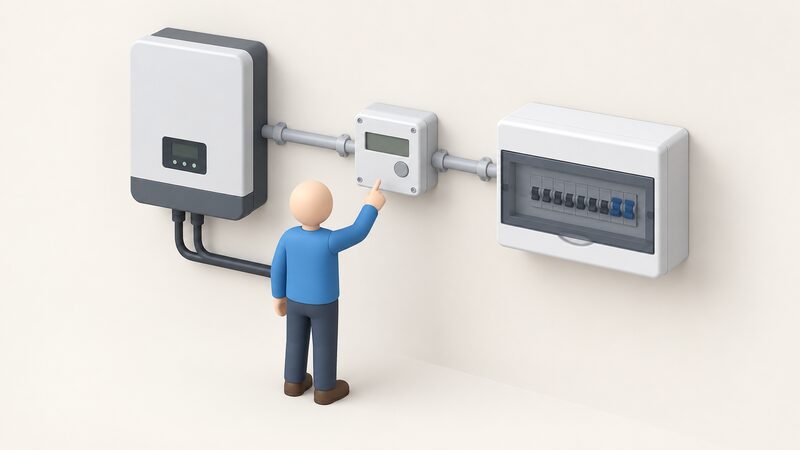
Sources25 cited
- Are solar panels worth it?, Which?, 2026
- Microgeneration tariff rates, Power NI, 2026
- Solar panels, Energy Saving Trust, 2026
- Wind turbines, Energy Saving Trust, 2026
- Smart meters, Consumer Council, 2026
- Making the most of your solar PV panels, Centre for Sustainable Energy, 2026
- Solar photovoltaic (PV), MCS Certified, 2026
- Tariffs for renewable technology, Energy Saving Trust, 2026
- Top energy saving ideas for your home improvement project, Energy Saving Trust, 2026
- Guidance for FIT Generators V18, Ofgem, 2024
- Green electricity tariffs, Centre for Sustainable Energy, 2026
- Feed-in Tariffs: scheme closure, Ofgem, 2026
- Energy incentives and schemes, South Cambridgeshire District Council, 2026
- Smart Export Guarantee generators, Ofgem, 2026
- Export payments, Electricity North West, 2026
- Research briefing CBP-9585, House of Commons Library, 2026
- Smart Export Guarantee, Ofgem, 2026
- Your connections journey: G98/NI installations, NIE Networks, 2026
- Connections, NIE Networks, 2026
- Connections FAQs, NIE Networks, 2026
- What will the meter information reading be used for?, NIE Networks, 2026
- Overdue utility bills, nidirect, 2026
- Feed-in Tariffs: generators, Ofgem, 2026
- Feed-in Tariffs: tariffs and payments, Ofgem, 2026
- Smart meter problems and solutions, Which?, 2026
 Solar Export PaymentsIf you have solar panels, how do you actually get paid for the electricity you send back to the grid?
 Community Energy in NICan a community group in Northern Ireland sell power to its neighbours, and is there funding to get a project off the ground?
 The Full Solar Panels GuideHow much do solar panels cost, and what could they save you each year?
 Utility Regulator NIWho sets your energy prices in Northern Ireland and who can you complain to?
 Suppliers in Northern IrelandNorthern Ireland runs its own energy market, with its own regulator, its own suppliers and no price cap.
 Home Energy Planning Rules in NIDo you need planning permission for solar panels or a heat pump in Northern Ireland?