
In this guide
Power NI is the largest electricity supplier in Northern Ireland, and its tariff structure is unlike anything on the Great Britain market. There are no fixed term contracts and no exit fees, so a household can switch or swap tariff at any point without penalty1. The company's standard Home Energy tariff is the default, and the Eco Energy tariff costs the same as the standard rate while sourcing the equivalent of all electricity from renewable sources2.
The figures that matter for a Northern Ireland household are these. The Consumer Council's price comparison table puts Power NI Standard at £1,093 a year using 3,200 units, and Power NI Monthly Direct Debit at £1,049 on the same basis, both dated 18 September 20263. On Economy 7, the Power NI Standard Rate unit price is 39.650p per kWh, falling to 38.860p with online billing4. The online account discount is 4% off the standard rate for Monthly Direct Debit customers and 2.5% for Quarterly Direct Debit customers5.
Northern Ireland runs its own electricity market, separate from the Great Britain price cap, and Power NI's tariffs are approved through the Utility Regulator rather than set by the Ofgem cap that governs suppliers in England, Scotland and Wales6. That separation is the single most important thing to understand about a Power NI bill: the numbers on it are not comparable line for line with a British Gas or Octopus quote, and the standing charge structure differs too.
Power NI tariffs: no fixed contracts, no exit fees
Power NI does not sell fixed term contracts. The company states plainly that it does not tie customers down to a contract, and that the flexibility to switch or swap means a household can always be on the tariff that suits it1. There is no exit fee and no hidden charge for switching, and the same terms apply to the Eco Energy tariff, which carries no contracts, tie-ins or exit fees2.
That structure has a direct consequence for how a household manages its bill. In Great Britain, a fixed tariff locks a unit rate for a set period and charges an exit fee if the household leaves early. In Northern Ireland, the Power NI rate can move when the Utility Regulator approves a change, and the household can leave at any time without cost. The trade-off is that there is no fixed price to shelter behind when wholesale costs rise.
The tariff range itself is small. The standard Home Energy tariff is the default for credit meter customers, Eco Energy is the green variant at the same price, and Microgen is the export arrangement for households with their own generation2. Pay as you go customers use the Keypad tariff, which has its own top-up mechanics and its own price change process7.
For a household thinking about energy independence, the absence of a contract cuts both ways. It removes the lock-in that keeps a household tied to a supplier, but it also means the price is not fixed, so the household carries the wholesale risk rather than the supplier. The only way to reduce exposure to that risk is to reduce consumption or generate some of the electricity on site.
Standard, Eco-Energy and Microgen: which plan fits which home
The choice between Power NI's tariffs is narrower than the range of products on the Great Britain market. Eco Energy costs the same as the standard Home Energy tariff, and the same discounts apply depending on how the household pays2. The difference is the sourcing: Power NI states it will source the equivalent of all the electricity from renewable sources, and the upgrade to Eco Energy is at no extra cost1.
That makes the decision straightforward for most households. A home on the standard tariff that wants a green supply can move to Eco Energy without paying more, and the payment discounts follow the same rules. The tariff is not a different price, it is a different label on the same supply, backed by renewable sourcing arrangements.
Microgen is the third element, and it is not a supply tariff in the ordinary sense. It is the route by which a household with its own generation, typically solar panels, is paid for electricity exported to the grid. The rate is set separately and approved by the Utility Regulator each year, which is covered below.
| Tariff | What it is | Price position |
|---|---|---|
| Home Energy (standard) | Default credit tariff | £1,093 a year at 3,200 units3 |
| Eco Energy | Same price, renewable sourcing | Same as standard, same discounts2 |
| Microgen | Export payment for own generation | 9.64p per kWh2 |
| Keypad | Pay as you go prepayment | Top-up by website or app1 |
A household on a bill pay meter with no generation has two real choices, standard or Eco Energy, and they cost the same. A household with solar has a third: the export tariff, which turns the roof into a small income stream rather than only a saving.
Standing charges and unit rates: how the bill is built
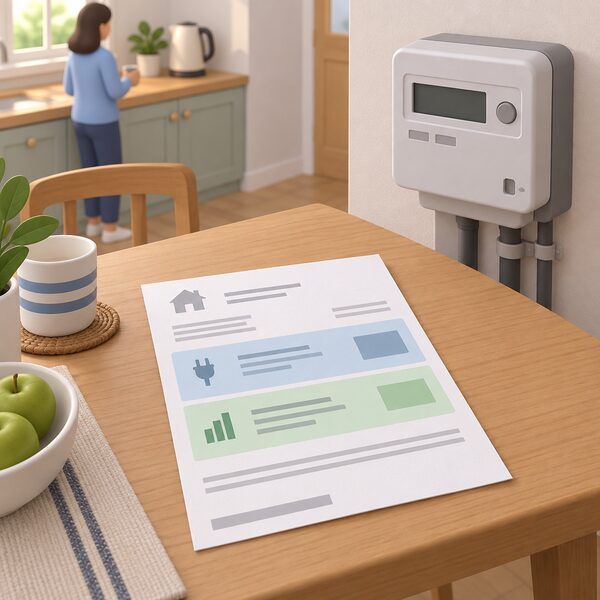
A Power NI bill is built from a standing charge and a unit rate, the same two-part structure used across the UK. The standing charge is a fixed amount quoted in pence per day, and it covers the supplier's fixed costs, including the supply of electricity through the distribution and transmission network and metering services8. It is charged each quarter as part of the quarterly electricity bill8.
The important detail for Power NI customers is which tariffs carry a standing charge. Power NI states that for customers on its Home Energy tariffs there is no additional standing charge applied to the tariff9. Economy 7 and Electric Vehicle tariffs do have a separate daily standing charge, billed quarterly along with electricity usage9. Standing charges also apply to Business and Farm tariffs9.
That is a meaningful difference from the Great Britain market, where a standing charge applies to essentially every domestic tariff and has risen sharply. Ofgem's benchmark for the Northern region under the price cap from 1 July to 30 September 2026 is a £223.48 standing charge and an £824.03 annual bill at 2,500 kWh on a single-rate tariff, or a £220.70 standing charge and £986.44 at 3,400 kWh on a multi-rate tariff10. Those are Great Britain figures and do not govern Power NI, but they show how large a standing charge has become elsewhere.
The unit rate is where the consumption cost sits. On Economy 7, the standard rate unit price is 39.650p per kWh and the online billing rate is 38.860p per kWh4. The Consumer Council's comparison table gives the annual figures that follow from those rates: £1,093 for Standard and £1,049 for Monthly Direct Debit, both at 3,200 units3.
For a household, the absence of a standing charge on the standard tariff matters most at low consumption. A home that uses very little electricity pays nothing for the privilege of being connected beyond the unit rate, which is the opposite of the position under a no-standing-charge tariff in Great Britain, where the first two units each day are charged at a much higher rate11. The structure of a Power NI bill is therefore closer to a pure consumption charge than most British tariffs, and the way to reduce it is to reduce units used.
Keypad prepayment: top-ups, price change codes and registration
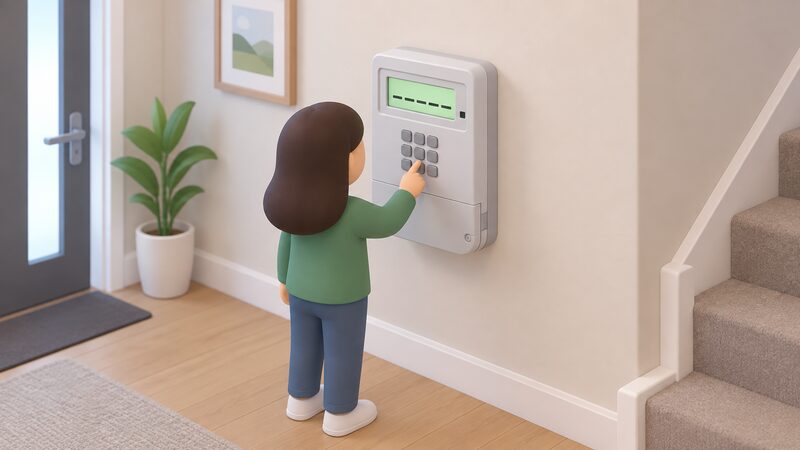
Keypad is Power NI's pay as you go product, and it works through a code rather than a card or a smart meter app. A household tops up the keypad using the Power NI website or app, and the top-up produces a Powercode, usually a 20-digit number, which is entered at the meter7. The company describes the website and app as the route for control and convenience1.
There is a reward for topping up that way. Keypad customers can take up the Keypad Reward by topping up online or through the Power NI App, which gives £1 free on a £50 top-up7. That is a small but concrete return on using the digital route rather than a retail outlet.
The price change process is the part that catches people out. When electricity prices change, a top-up produces a special 40 or 60-digit Powercode instead of the usual 20-digit one7. That longer code carries the new price into the meter. From 1 July 2026, any credit already on a Power NI Keypad is charged at the new rate once the customer enters the 40-to-60-digit price change code, and the new electricity price for Keypad customers applies from that date7.
For a household, Keypad is the clearest form of prepayment dependence. The supply stops when the credit runs out, the household has to keep the meter fed, and the price change mechanism depends on the household entering a code correctly. The reward scheme and the app top-up reduce the friction, but the underlying position is that the household manages its own credit rather than receiving a bill after the event.
Discounts: Direct Debit plus the online account's 2%
Power NI's discount structure rewards two things: paying by Direct Debit and managing the account online. Online account customers with Monthly Direct Debit get 4% off the Power NI standard rate, and online account customers with Quarterly Direct Debit get 2.5% off the standard rate5. On top of that, those customers receive a further 2% off the standard rate, capped at £5 per quarter, equivalent to £20 a year5.
The online billing figures published separately give the same structure with the caps stated in pounds. Online billing customers with Monthly Direct Debit get 4% off the standard rate, up to £10 per quarter, equivalent to £40 a year, and online billing customers with quarterly Direct Debit get 2.5% off the standard rate, up to £6.50 per quarter, equivalent to £26 a year6. Both sets of figures describe the same discount ladder, and the caps are what limit the benefit for a high-usage household.
| Payment method | Discount off standard rate | Cap |
|---|---|---|
| Online account, Monthly Direct Debit | 4% plus a further 2% | £5 per quarter, £20 a year5 |
| Online account, Quarterly Direct Debit | 2.5% plus a further 2% | £5 per quarter, £20 a year5 |
| Online billing, Monthly Direct Debit | 4% plus a further 2% | £10 per quarter, £40 a year6 |
| Online billing, Quarterly Direct Debit | 2.5% plus a further 2% | £6.50 per quarter, £26 a year6 |
The practical effect is visible in the Consumer Council's comparison. Power NI Standard costs £1,093 a year at 3,200 units, while Power NI Monthly Direct Debit costs £1,049 on the same consumption, a difference of £443. That gap is the discount working through the bill, and it is the reason the payment method matters as much as the tariff choice for a household trying to hold its bill down.
The discount is not a loyalty scheme in the ordinary sense. It is a price reduction conditional on how the household pays and where it manages the account, and it can be lost if the payment method changes. Power NI also runs Power NI Perks, offering deals and discounts from brands and retailers as a thank-you to customers1, but that sits outside the tariff and does not affect the unit rate.
Export tariff: 9.64p/kWh, approved by the Utility Regulator each year
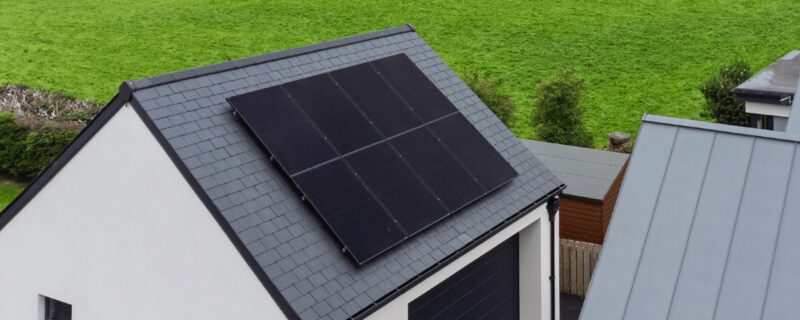
A household with its own generation, typically solar panels, can be paid for electricity exported to the grid through Power NI's Microgen export tariff. The rate is 9.64p per kWh, and it is approved by the Utility Regulator each year2. That annual approval is the key feature: the rate is not set by the supplier alone and is not fixed for the life of an installation.
The comparison with Great Britain is stark. Feed-in Tariff export rates there are currently around 5 to 7p per kWh, fixed but rising in line with inflation12. The Power NI rate of 9.64p per kWh is higher, though the two are set under different arrangements and the Northern Ireland rate is reviewed annually rather than indexed.
For a household weighing energy independence, the export tariff is the point at which a Power NI customer stops being purely a consumer. A solar installation reduces the units bought at the unit rate and earns 9.64p per kWh on what is exported2. The household remains connected to the grid and to Power NI for the periods when generation is short, so the dependence is reduced rather than removed. The rate being approved annually also means the export income is not guaranteed at 9.64p beyond the current approval period.
Moving home, closing an account and switching
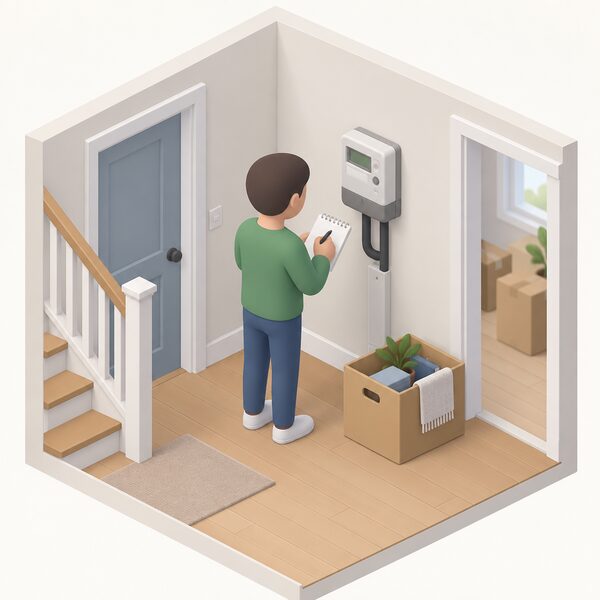
Moving house with Power NI requires a specific set of information, and the company splits it between the old address and the new one. For an existing customer moving, Power NI asks for the account number and Meter Point Reference Number or Keypad Premise Number for the existing address, the new address with its MPRN or KPRN and the moving in date, a final meter read if the old property has a bill pay meter, an opening meter read if the new property has one, and bank details if the new property has a bill pay meter7.
Closing an account is simpler. Power NI asks for the date you are moving out, a closing meter read if the property has a bill pay meter, and a forwarding address8. The company confirms the move has been processed by emailing a confirmation that the account has been closed8. If the property being moved to is registered with another electricity supplier, Power NI asks to be contacted so the transfer can be arranged8.
The final bill timing is not settled in the published guidance. One Power NI support article describes a final bill around 5 working days after the account has been closed, while another refers to up to 8 weeks after a switch.
Switching away from Power NI carries no exit fee and no hidden charge1. The Consumer Council publishes an electricity price comparison table for Northern Ireland households weighing suppliers3, and the practical steps are the same as anywhere else: take a final reading, give the new supplier the MPRN or KPRN, and let the transfer complete. A household with solar panels can switch supplier and keep the export arrangement, though the terms of the new supplier's export tariff need checking12.
Support if you struggle to pay: payment plans and vulnerable customer services
Northern Ireland households in difficulty have a specific set of routes. The government's advice service states that suppliers can refer customers who are struggling to pay to organisations like Advice NI, which offers free, independent debt advice13. Beyond referral, a supplier can agree a payment plan, a payment break or reduction, review payments and debt repayments, and give access to hardship funds14.
The wider support options available through suppliers include affordable repayment plans, hardship funds and grants, debt write-off schemes, energy efficiency support, and emergency credit or payment assistance15. The Energy Ombudsman lists a review of payments and debt repayments, payment breaks or reductions, more time to pay, access to hardship funds, energy saving advice and the Priority Services Register as the things a supplier can put in place16.
For Northern Ireland specifically, NI Energy Advice provides referrals to energy grants and other sources of help17. Northern Ireland Electricity Networks runs a Critical Care information service for vulnerable customers18, and its power cut advice line is the same 03457 643 643 number used for urgent meter faults19. The Priority Services Register, which is a GB arrangement, offers income and benefit support, energy and tariff advice, energy efficiency help, grant and heating solutions, ways to save advice, and health and wellbeing support20.
For a household in arrears, the sequence that matters is: contact the supplier before the debt builds, ask for a payment plan or a review of payments, and ask about hardship funds and the Priority Services Register. The support exists, but it is not applied automatically, and the household has to ask. A household that does nothing is the one that ends up on a repayment arrangement it did not choose.
Sources20 cited
- Power NI electricity tariff, Power NI, 2026-09-20
- Eco Energy tariff, Power NI, 2026-09-20
- Electricity price comparison table, Consumer Council, 2026-09-18
- Economy 7, Consumer Council, 2026-09-18
- Online account discount, Power NI, 2026-09-20
- Viewing your bill online, Power NI, 2026-09-20
- Services for prepayment meter customers, Power NI, 2026-09-20
- I'm moving house, what do I need to do?, Power NI, 2026-09-20
- What is a standing charge?, Power NI, 2026-09-20
- Energy price cap levels, 1 July to 30 September 2026, Ofgem, 2026
- Should I get a no standing charge tariff?, Uswitch, 2026-08-26
- Can I switch supplier if I have solar panels?, Uswitch, 2026-06-04
- Advice if you're struggling to pay your energy bills, nidirect, 2026-09-17
- Get help with your energy bills, Ofgem, 2026
- Worried about your energy bills, Energy Ombudsman, 2026-03-24
- Energy saving grants in your area, nidirect, 2026-09-17
- Power cut advice, NIE Networks, 2026-09-20
- Power cut help, NIE Networks, 2026-09-20
- Standing charges, National Energy Action, 2026-04-28
- Energy price cap explained, Welsh Government, 2026
 Power NIPower NI is Northern Ireland's largest household electricity supplier and the only one whose domestic tariffs are scrutinised by the Utility Regulator.