In this guide
A phase-change material stores heat by melting. Instead of raising the temperature of a large mass of water, a phase change material (PCM) absorbs energy at a fixed temperature while it turns from solid to liquid, holds that energy as latent heat, and gives it back when it freezes again. The Energy Saving Trust distinguishes two families of heat battery: one that stores heat in a material which changes from solid to liquid and back, called phase change materials, and another that stores heat in a material such as a ceramic where there is no phase change1.
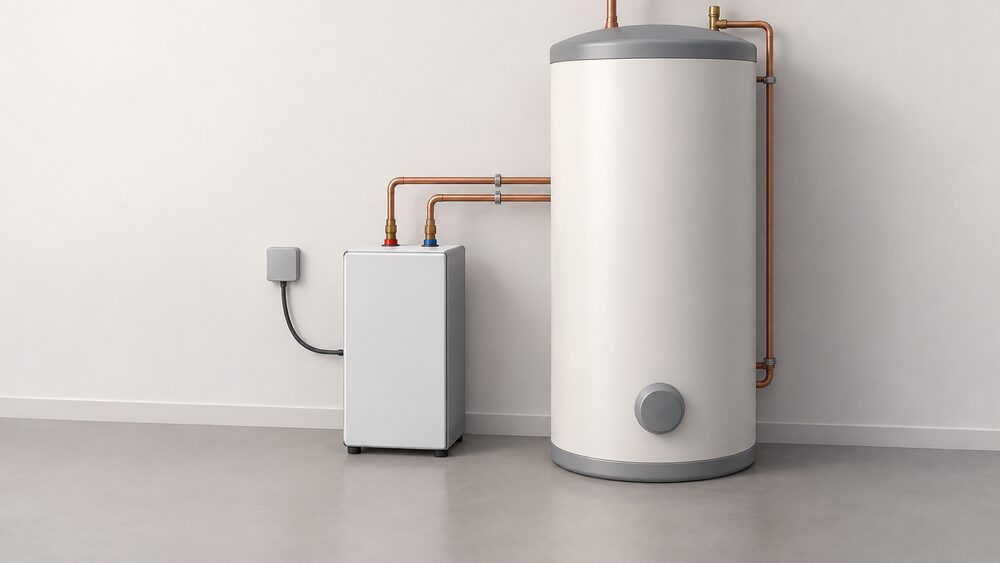
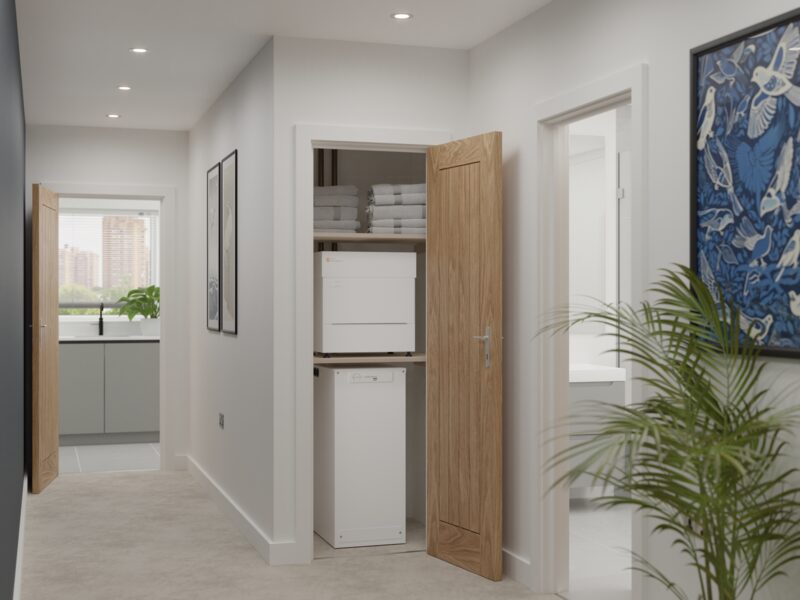
The practical consequence is volume. Sunamp, the Scottish manufacturer whose Thermino heat batteries dominate the small UK market for this technology, states that melting and freezing its Plentigrade P58 formulation stores up to four times more energy than heating and cooling hot water, and that its units are therefore up to four times smaller than the equivalent hot water cylinder. Scottish Government research reaches the same conclusion from the other direction, describing PCMs as particularly well suited to small apartments because of their high volumetric latent heat storage capacity and small space footprint.
The idea is not new. Sunamp states that storing heat in a phase change material has been around since the 1940s, but that the existing materials did not perform well enough for reliable, high flow rate hot water. What has changed is the chemistry and the cycling stability, not the physics. Two things temper the picture for a UK household: analysis by LCP found a limited range of products available on the market for use in the heating market, and current Warm Homes scheme guidance states that PCM heat batteries for hot water cannot currently be installed through the scheme until there is a formally approved convention or they are a formally recognised technology category in SAP.
Heat stored in a melting material, not in water
Thermal energy storage is the general category: storing thermal energy in a medium such as water, molten salts, or phase-change materials9. Most UK homes use the first of those. The Energy Saving Trust describes a thermal store as heated water usually kept in a large, well-insulated cylinder often called a buffer or accumulator tank10, and Which? notes such a store can hold heat, from multiple sources if necessary such as solar thermal panels or a wood-fired boiler, in the form of hot water for several hours11.
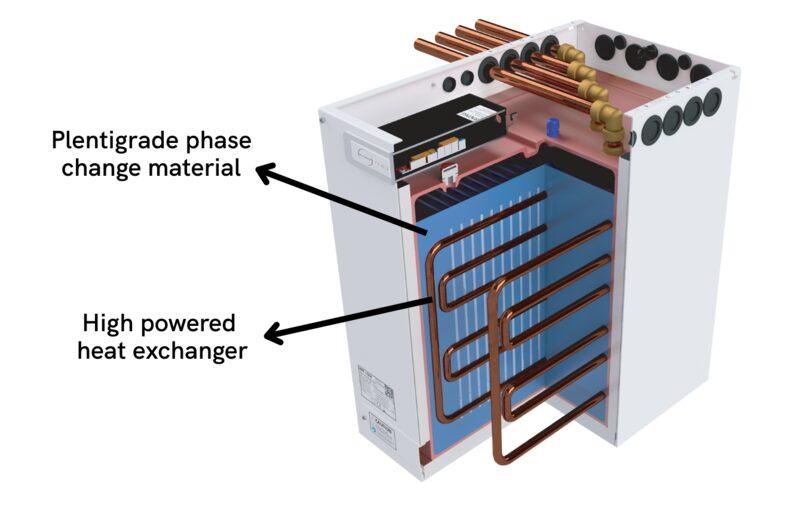
Water works because it has a high heat capacity, but the heat it holds is sensible heat: the store is only usefully charged to the extent its temperature has been raised, and it discharges by cooling. A phase-change store behaves differently. Sunamp describes PCMs as materials that absorb, store and release large amounts of latent heat when changing state between solid and liquid, with heat absorbed on melting and released on freezing2. The temperature barely moves through the transition, so a small volume can take in a large quantity of energy.
This is why the ECO guidance treats heat batteries as their own category. Ofgem and the department's guidance list storage as taking several forms, including the heat stored in the fabric of the building, hot water storage, electric battery storage and heat batteries using phase change materials12. The building fabric itself is a sensible-heat store; so are the clay and ceramic cores of electric storage heaters. A PCM store is the only one of the group that exploits a change of state.
LCP, analysing the product class independently, put the mechanism plainly: PCMs absorb and release energy when they change state, for example from liquid to solid, and are therefore attracting increasing interest14. The same analysis noted that when combined with heating solutions such as heat pumps, PCM batteries can offer increased efficiencies and reduced peak loads14.
The latent heat cycle: melt to charge, freeze to discharge
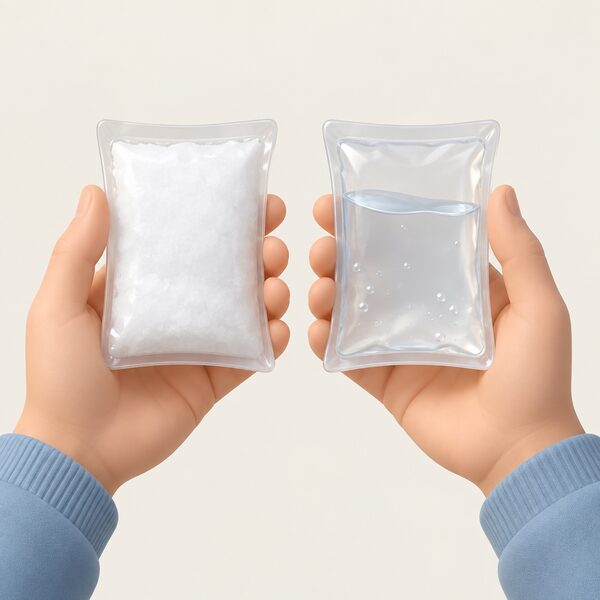
Charging and discharging a PCM store is a melting and freezing cycle. Sunamp describes Plentigrade as absorbing and releasing thermal energy during a melting and freezing process in a similar way to the gel in a pocket handwarmer2. The handwarmer analogy is apt for a reason that matters technically: a salt hydrate handwarmer stays liquid below its freezing point until it is triggered, and getting a material to crystallise predictably, cycle after cycle, is the hard part of the engineering.
That is the difference between the 1940s concept and a saleable product. Sunamp's own account is that the idea has been around since the 1940s but the existing materials did not perform well enough for reliable, high flow rate hot water6. The company states that Plentigrade PCMs perform reliably over thousands of cycles in real-world thermal storage systems5, and Energy Systems Catapult records that Sunamp heat batteries use a patented phase change material16. Cycle stability, meaning that the material still melts and freezes at the same temperature and with the same capacity after years of daily use, is the claim a buyer of any PCM product should look for, and it is a maker's claim here rather than an independently published test figure.
In a domestic hot water heat battery the cycle runs roughly like this:
- A heat source, grid electricity, a heat pump, solar thermal or a boiler, raises the material above its melting point and it melts, absorbing latent heat.
- The melted material sits in a vacuum insulated case, losing heat slowly.
- When a tap is opened, cold mains water passes through a heat exchanger, drawing heat out.
- The material freezes as it gives up its latent heat, and hot water leaves at mains pressure.
Because the water is heated as it passes through rather than stored, the unit does not hold a large standing volume of stored water. Sunamp describes the Thermino as not storing large volumes of water, instead storing heat in a compact, high-energy-density material and transferring that heat to mains water when hot water is required17. A similar description is offered by tepeo of PCM batteries generally: they store raw thermal energy inside internal materials rather than actual water, heating cold water on demand when a tap is turned on18.
Energy density: four times the heat in a quarter of the space
The headline number across Sunamp's published material is consistent: up to four. The company states that Thermino heat batteries store up to four times more energy per unit volume compared to standard hot water cylinders19, that they take up to four times less space than an equivalent hot water cylinder because the energy is stored as latent heat4, and that they are up to four times smaller than the equivalent hot water tank because they are filled with energy-dense phase change material3. The Thermino brochure puts the same claim as storing up to four times more energy than water20.
These are the maker's figures, expressed as an upper bound rather than a typical result. They describe the storage material, not a whole system: a heat battery also needs a casing, insulation, heat exchangers and controls, so a real installed unit is not a quarter of the footprint of the cylinder it replaces in every case. Sunamp itself uses the phrasing "up to" throughout.
| Claim | Figure stated | Product named | Source type |
|---|---|---|---|
| Energy per unit volume vs standard cylinder | Up to four times more19 | Thermino heat batteries | Maker |
| Energy stored vs heating and cooling hot water | Up to four times more2 | Plentigrade P58 | Maker |
| Physical size vs equivalent hot water tank | Up to four times smaller3 | Thermino range | Maker |
| Relative heat loss vs conventional cylinder | Less than a quarter4 | Thermino heat batteries | Maker |
Standing loss is the second half of the density argument and the less-quoted one. Sunamp states its PCM heat batteries have a minimal heat loss rate, less than a quarter of a conventional hot water cylinder, attributing this to the construction4. Two things drive that: a smaller external surface area for the same stored energy, and vacuum insulation. The company describes Thermino as storing heat in a modular, compact and vacuum insulated unit4. The maker's product material also frames the space and loss benefits together, stating that Plentigrade takes up less space and loses less heat than traditional hot water cylinders thanks to high energy density PCM storage21.
For a household this matters most where the alternative is a cylinder in a heated part of the home, because a cylinder's standing loss is only partly wasted in winter and wholly wasted in summer. It matters least where there is no space pressure at all.
From the 1940s laboratory to a domestic product
Phase-change heat storage has a long pre-history and a short commercial one. The concept dates from the 1940s6. What households actually got instead, from the 1960s, was the sensible-heat storage heater: electric storage heaters were mass produced from the 1960s to make use of electricity outside peak hours22, storing heat in cores of ceramic or clay. Which? records that storage heaters fell out of favour in the 80s and 90s as electricity prices increased and people wanted their heat to be on a more flexible schedule23.
That history is directly relevant, because it explains what a PCM store has to beat. A brick core stores sensible heat and leaks it continuously whether the household wants heat or not. A latent-heat store holds its charge at a fixed temperature behind vacuum insulation and releases it only when drawn upon. The barrier to getting there was material behaviour, not the principle, and the stated breakthrough is a formulation that performs well enough for reliable, high flow rate hot water6.
"The idea of storing heat in a phase change material has been around since the 1940s but the existing materials didn't perform well enough"
Plentigrade: the material inside Sunamp's heat batteries
Plentigrade is Sunamp's name for its phase change material. The company describes it as its high-performance phase change technology platform that delivers heating or cooling reliably, safely and at scale15, and as the material inside its thermal batteries which absorbs and releases thermal energy during a melting and freezing process2. The formulation used for domestic hot water is Plentigrade P58, described as being at the core of Thermino heat batteries19.
Sunamp lists the equipment Plentigrade is paired with across different temperature ranges21:
| Application | Paired equipment |
|---|---|
| Hot water and heating | Low-temperature heat pump; solar thermal |
| High-temperature heat recovery | High temperature heat pump; boilers and burners; CHP or co-generation; resistance heating |
| Freezing and cooling | Chiller; air conditioner; reversible heat pump |
The breadth of that list is the point of calling it a platform rather than a single material: different formulations melt at different temperatures, and the melting point is what determines which heat source can charge it and what the store can deliver. Every Thermino variant is stated to use Plentigrade24, and Sunamp describes it as much more energy dense than water, which is what makes its thermal batteries much smaller than the equivalent hot water cylinder6. The material is patented16, which means a household buying one is buying into a single manufacturer's chemistry and supply chain.
The Thermino range: ePlus, xPlus and TS
Sunamp describes Thermino as compact, energy-efficient thermal storage systems that use high-performance phase change material to deliver reliable, mains-pressure hot water24. Three variants appear in the company's material, and the division between them is how the store is charged.
| Model | How the maker describes it | Storage material |
|---|---|---|
| Thermino ePlus | A compact heat battery that can be powered by grid27 | Plentigrade26 |
| Thermino xPlus | Named alongside ePlus and TS as a Thermino battery that, with a heat pump, can replace a combi boiler28 | Plentigrade17 |
| Thermino TS | The energy-efficient alternative to indirect vented and unvented hot water cylinders29 | Plentigrade25 |
The TS is the model positioned against a cylinder charged by an external heat source; Sunamp states that thanks to the highly energy dense Plentigrade phase change material, Thermino TS is up to four times smaller than the hot water cylinder it replaces29. Both the TS and the ePlus are described as modular and scalable, able to be connected in series or in parallel to increase heat storage capacity25, which is how a larger household demand is met without a single oversized unit.
Sunamp markets the range for domestic hot water in social housing, new-build and holiday home applications30, and frames the retrofit proposition as a heat pump, or even a modern electric storage heater, plus a Thermino battery replacing a combi boiler28. No published prices are given for these units here; they are installer-quoted. Further detail on the manufacturer and on how the units compare with a tank is set out on the pages covering Sunamp heat batteries, heat battery vs hot water cylinder and heat battery trials and field results.
Where PCM storage fits: flats, heat pumps and solar thermal
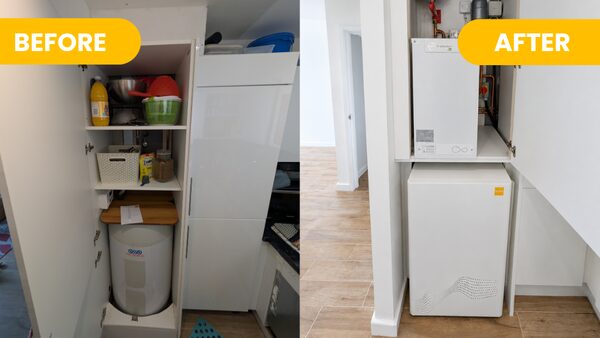
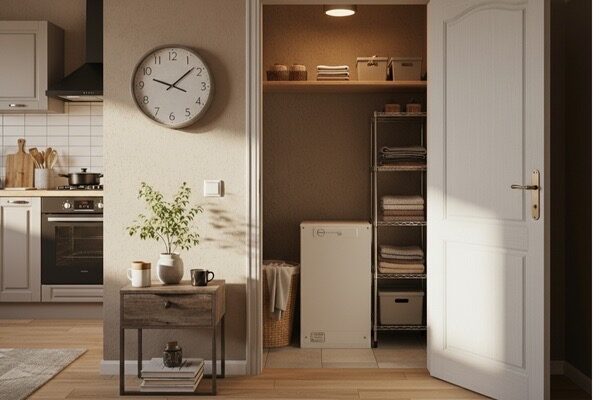
The clearest fit is where space, not capacity, is the binding constraint. Scottish Government research states PCMs are particularly well suited for small apartments due to their high volumetric latent heat storage capacity and small space footprint31. The Centre for Sustainable Energy puts it in terms of the whole system: heat batteries are most suitable for smaller homes that do not have space for an outdoor heat pump unit32. A tepeo description of the same product class calls the space-saving design significantly smaller than a traditional cylinder, suitable for apartments or tight cupboards18.
Field examples bear this out. Energy Systems Catapult's Electrification of Heat case studies record a 2000s Edinburgh flat where a heat battery, which stores energy using a phase change material, was installed instead of a hot water cylinder because of space constraints33. An Energy Saving Trust case study on an air source heat pump quotes the householder's description: a heat battery is smaller than a hot water tank and stores energy in phase change material, usable for space heating or hot water when needed34.
The heat pump pairing is significant because government guidance is explicit that to provide hot water, heat pumps require a water storage cylinder, similar to older generations of gas boiler systems35. A PCM battery is one route to meeting that requirement where a cylinder will not fit, and LCP's analysis notes increased efficiencies and reduced peak loads as benefits when PCM batteries are combined with heat pumps14.
On solar thermal, Sunamp lists solar thermal alongside low-temperature heat pumps as equipment paired with Plentigrade for hot water and heating21. More generally, thermal stores can be used with solar, wind, biomass and hydro renewable systems36, and the Energy Saving Trust treats both conventional thermal storage, such as additional tanks for hot water, and more innovative heat battery technologies as part of the same group37. The engineering caveat is temperature: a store charges only when the source can push the material above its melting point, so collector performance and control strategy decide whether a solar thermal array can actually charge a given formulation.
Scheme recognition and the SAP problem
The most consequential limit is administrative rather than technical. Guidance for the Warm Homes: Social Housing Fund states that PCM heat batteries for hot water cannot currently be installed through the scheme until there is a formally approved convention or they are a formally recognised technology category in SAP7. The Warm Homes: Local Grant guidance published in July 2026 repeats the same position8.
The underlying issue is that the national calculation methodology has no agreed way to credit the measure, so it cannot be scored or funded. This is a different question from whether storage is recognised at all: ECO guidance already lists heat batteries among the forms storage can take12. The practical effect is that in the grant-funded retrofit market, a PCM heat battery has to be paid for outside the scheme. Households should check the position for their own nation and scheme, since Warm Homes schemes are English programmes and Scotland, Wales and Northern Ireland run separate support; the scheme documents here are the England-facing ones. The related questions of certification and of scheme eligibility are covered on the pages about standards for emerging energy products and MIS 3008 and heat batteries.
LCP's finding that there is a limited range of products available on the market for use in the heating market14 compounds this: a small product field and no scheme route together keep volumes low, which in turn keeps prices installer-quoted rather than published.
What PCM heat storage does, and does not do, for energy independence
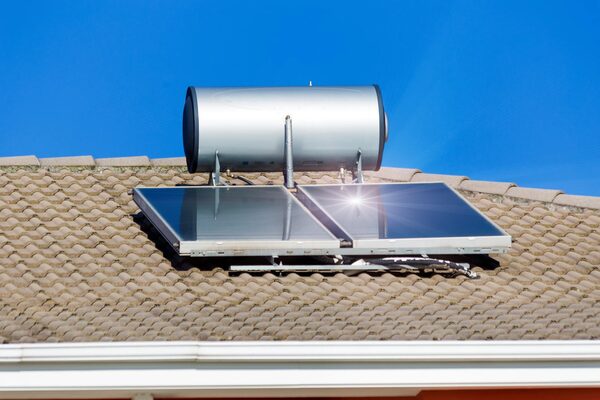
A phase-change heat battery changes when a household uses energy, not whether it needs to buy it. It is a store, and a store is only as useful as what charges it. The Energy Saving Trust's framing of thermal energy storage is a way of storing and managing renewable heat until it is needed10. Charged from a rooftop solar array through an immersion or a heat pump, it converts on-site generation into hot water that is available hours later. Charged from the grid at an off-peak rate, it shifts cost and grid load but leaves the household fully dependent on a supplier and a tariff.
What it genuinely buys is flexibility and a smaller footprint. Where a cylinder will not fit, a PCM store can make a heat pump or an all-electric system viable at all, which is the more substantial independence gain: it removes gas from the house. The lower standing loss, stated by the maker as less than a quarter of a conventional cylinder4, means less of what is stored is wasted between charge and use.
The dependencies that remain are worth naming precisely:
- Electricity. Every charging route in domestic use is electric or solar, so the household's heat is tied to the grid unless it is generating and storing enough itself.
- A single manufacturer. The material is patented16 and the UK product range is limited14. Spares, servicing and warranty rest on one company continuing to trade, an issue discussed for the sector generally under energy technology company failures.
- Cycle life claims. Reliable performance over thousands of cycles is the maker's statement5, not an independently published UK field result.
- Scheme recognition. No Warm Homes funding while the SAP position is unresolved7.
Energy Systems Catapult has described the technology as the heat battery technology developed by Scottish innovator Sunamp, which stores energy using a phase change material, used in properties such as flats with space constraints instead of hot water cylinders38. That is a fair statement of where the technology currently sits: a proven answer to a specific constraint rather than a general replacement for the hot water cylinder. How it compares with other stored-heat options is set out on the pages for heat battery or heat pump and Sunamp vs Caldera, and the wider context sits on the emerging home energy technology pillar.
Sources38 cited
- Storing energy, Energy Saving Trust, 2026-07-15
- How thermal batteries work, Sunamp, 2026-09-17
- Thermino hot water overview, Sunamp, 2026-03-19
- What ECO cuts and the Warm Homes Plan mean for housing associations, Sunamp, 2025-12-10
- Plentigrade, Sunamp, 2026-08-18
- How we developed our Plentigrade phase change material, Sunamp, 2023-07-20
- Warm Homes: Social Housing Fund wave 3 scheme guidance addendum, GOV.UK, 2026-06
- Warm Homes: Local Grant policy guidance, GOV.UK, 2026-07
- What is energy storage, Duracell Energy, 2024-11-22
- Thermal energy stores, Energy Saving Trust, 2025-05-15
- Heating your home with renewable energy, Which?, 2025-09-22
- Energy Company Obligation guidance 2022 to 2026, GOV.UK, 2022-07
- ECO4 guidance on new measures and products, Ofgem, 2022-07-04
- Product analysis of phase change material batteries, LCP, 2024
- How heat batteries work, Sunamp, 2024-07-28
- Sunamp heat batteries, Energy Systems Catapult, 2021-09-24
- Reliable hot water in a social housing retrofit, Sunamp, 2026-09-03
- How to heat your water when switching from a combi boiler, tepeo, 2026-07-16
- Cut hot water costs with off-peak electricity, Sunamp, 2025-07-03
- Thermino brochure, Sunamp, 2025-02
- Plentigrade applications: hot water and heating, Sunamp, 2026-03-31
- History of electrical heating, Electrical Safety First
- Electric central heating, Which?, 2025-09-22
- Thermino frequently asked questions, Sunamp, 2026-08-17
- Thermino TS, Sunamp, 2026-03-24
- Thermino ePlus, Sunamp, 2026-03-27
- Optimino and compact heat batteries, Sunamp
- Retrofitting Britain's hard-to-heat homes, Sunamp, 2025-11-12
- Thermino TS product page, Sunamp, 2026-03-24
- Residential heat batteries, Sunamp, 2026-05-06
- Research on electricity network constraints and the New Build Heat Standard, Scottish Government, 2021-10-07
- Electric heating, Centre for Sustainable Energy, 2026-06
- Electrification of Heat case studies on heat pump experiences, Energy Systems Catapult, 2021-12-16
- Michael and Joan's air source heat pump, Energy Saving Trust, 2022-04-20
- Heat pumps for domestic heating, GOV.UK, 2023-11-21
- Energy storage, Electricity North West, 2026-09-19
- Response to the Treasury consultation on VAT relief for energy saving materials, Energy Saving Trust, 2025-10-08
- Pump it up: innovation in low carbon heating, Energy Systems Catapult, 2022-12-23
 Heat Batteries with Heat PumpsCan a heat battery replace a hot water cylinder if you have no space for one?
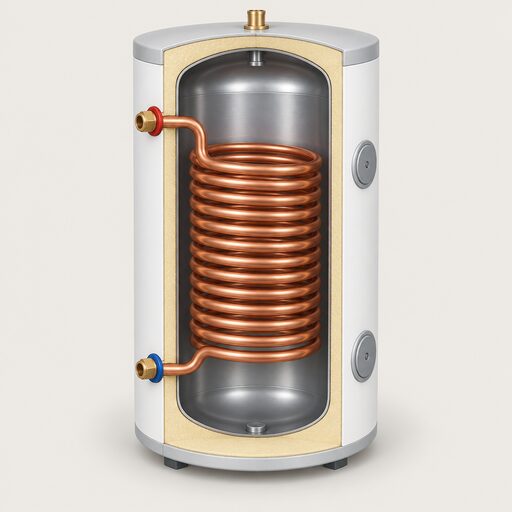 Hot Water CylindersA heat pump needs a cylinder to store hot water, so swapping a combi means getting one.
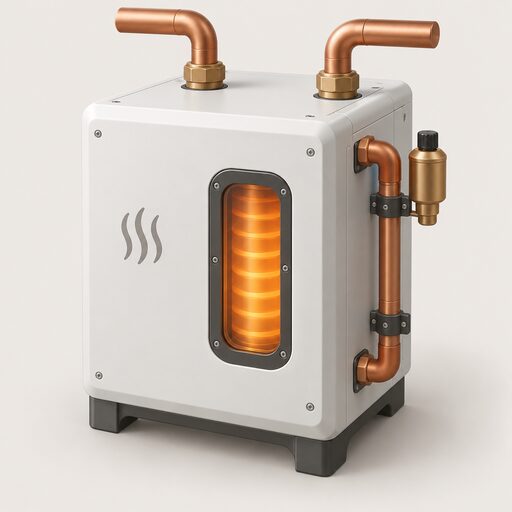 Heat Batteries and Zero EmissionA heat battery stores cheap overnight electricity as heat, then releases it to warm your home or your hot water.
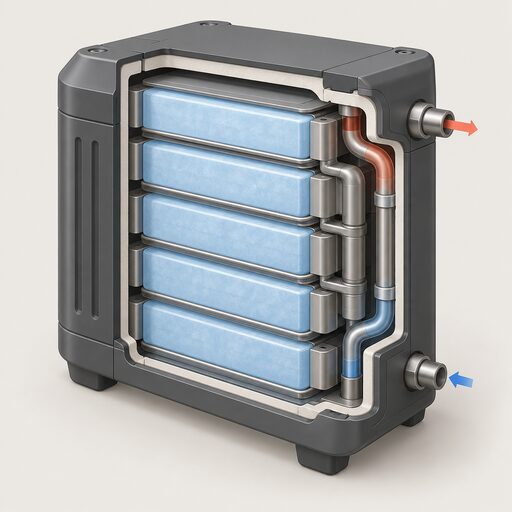 Heat Battery Trials and ResultsDo heat batteries actually work in real UK homes, and what did the trials find?
 Ventilation and TemperatureWhere can you put a home battery so it stays warm enough in winter and cool enough in summer?
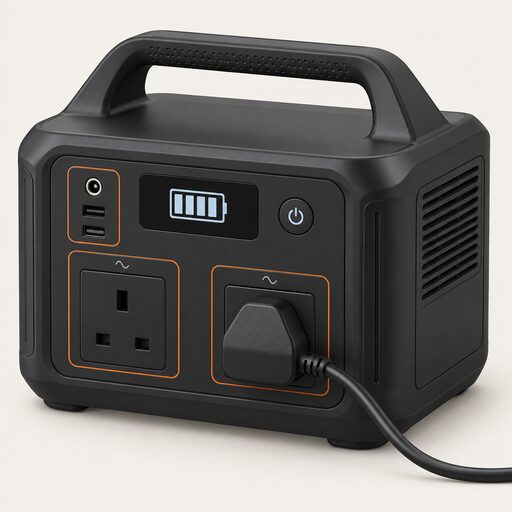 Backup Power for HeatingWhy gas boilers, heat pumps and storage heaters stop in a power cut, what a portable power station can and cannot carry, how to size one, and what home battery systems do when the mains fails.