

In this guide
Ripple Energy went into administration in early 2025. The Graig Fatha co-operative, the Welsh wind farm the company built its model around, remained active after that date1. For anyone searching the name now, that is the answer that matters: the company is not trading, no share offer is open, and no account can be created with it.
What Ripple Energy was is still worth understanding, because the model it pioneered, consumer ownership of offsite generation, is the one route to owning wind power that does not require a roof, a field or a grid connection of your own. The Graig Fatha wind farm in Wales launched in 2020 under a structure allowing energy consumers to own a wind turbine1. Members bought a share in the generating asset and the output was credited against their electricity bill.
The scale was real while it lasted. Ripple reported that from March 2022 to August 2024 its members saved over £1.4M on their bills2. The company was led by founder and CEO Sarah Merrick3. The failure of the company and the survival of the co-operative are two separate facts, and the distinction runs through everything below.
Ripple Energy has gone into administration
The administration is the first thing a household needs to know, and it changes what the name means. Ripple Energy went into administration in early 20251. A company in administration is under the control of administrators rather than its directors, and its ongoing obligations, including any service commitments, warranty or account relationship, cannot be treated as reliable. Nothing in the record suggests members lost the generating asset itself, because the co-operative structure held it separately.
That separation is the important structural point. The Graig Fatha co-operative remained active after the company failed1. A co-operative is a distinct legal entity with its own members and its own asset. When the company that promoted and administered it fails, the co-operative can continue to generate, and its members can continue to hold their shares, even though the commercial layer that linked generation to billing has gone.
For prospective buyers, the practical position is that there is nothing to buy. No share offer is open. For existing members, the position is that the asset survived but the administrative machinery did not, and any query about billing credits, account access or company commitments has no trading company behind it.
The wider lesson for the sector is about where risk sits in a consumer-owned generation model. The household's money buys a share in an asset, and the asset is ring-fenced inside a co-operative. The company around it, which handles share offers, member administration and the link to a supply tariff, carries ordinary commercial risk. A household weighing any community energy share offer is weighing two things at once: the durability of the generating asset and the durability of the organisation administering it. More on how these structures work is at community energy share offers and community energy.
What Ripple Energy was: consumer-owned wind power
Ripple Energy built a model in which domestic energy consumers owned a share of an offsite wind farm rather than generating on their own property. The Graig Fatha wind farm in Wales launched in 2020 under a model allowing energy consumers to own a wind turbine1. That launch date matters: it predates the period of high wholesale prices that made the proposition attractive to a much wider group of households, and it established the template that later share offers followed.
The appeal was structural rather than technical. A rooftop solar installation is limited by the roof: its orientation, its shading, its area and the fact that the householder must own the building. An offsite wind share has none of those constraints. The generation sits where the wind is, and the household's participation is financial rather than physical.
The trade-off is equally structural. A household with its own panels consumes its own generation directly, which is the cheapest electricity it will ever use. A household with an offsite share does not consume its own generation at all. The output is sold, and the value comes back as a credit against a bill. That means the member remains fully dependent on the grid, on a supplier and on the settlement arrangements that turn generation into a bill reduction. The independence gained is ownership of a generating asset, not independence from the supply system.
That distinction is the one to hold on to when comparing routes. A share in an offsite wind farm changes who owns generation. It does not change how the home is supplied. The comparison between joining a scheme and generating at home is set out at community energy vs own solar, and the wider picture of what a household can and cannot supply for itself is at household energy independence.
How the ownership model worked
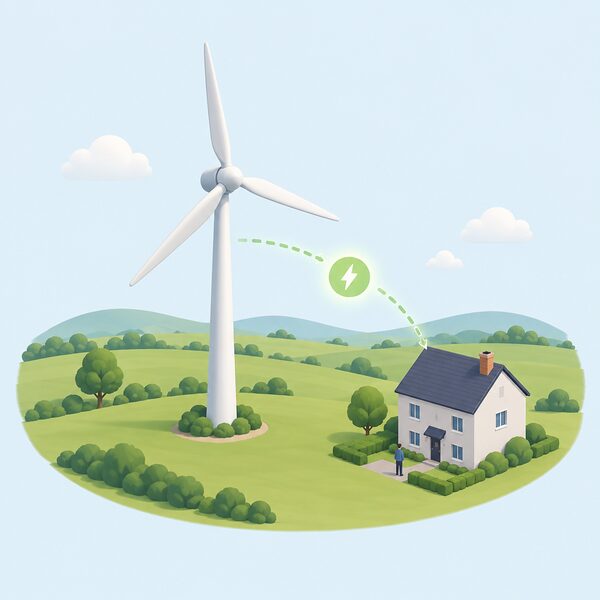
The model combined two things that are usually separate: a share in a generating asset and an ordinary domestic energy tariff. A household bought a share in the co-operative that owned the wind farm, and the electricity the farm produced was sold, with the value credited against the member's bill2. The household did not become a self-supplier and did not take delivery of its own electrons.
The supply relationship stayed conventional. An energy supplier is responsible for providing energy to homes and businesses5. A household that pays a supplier directly for the electricity or gas it uses can choose to switch to a different supplier or tariff at any time6. Nothing about holding a generation share changed either of those facts. The member remained a customer of a supplier, on a tariff, with the share acting as a credit against consumption rather than a replacement for supply.
That is why the model worked for so many households and why it carried the risk it did. The credit depended on the commercial arrangements between the co-operative, the company administering the scheme and the supply partner. Those arrangements are the part that administration disrupts. The turbine keeps turning; the mechanism that converts its output into a line on a bill is the part that depends on a functioning company.
"benefits for the consumer often coming by being sold the generated electricity at a reduced rate to market prices."
That description of how a consumer benefits from locally generated electricity, sold at a reduced rate to market prices, is the general principle the Ripple model applied at national rather than building scale. The household's gain comes from the price at which generation is made available to it, not from physical delivery.
Who could join: renters, flat-dwellers and households without a roof
The clearest advantage of the offsite model was who it let in. A household that rents, or lives in a flat, or has a roof facing the wrong way, or lives in a listed building, cannot install its own generation. An offsite share has no such requirement, because the asset is not on the property. That is the structural reason the model attracted members who had no other route to owning generation.
Government energy schemes draw the tenure line differently, and the contrast is instructive.
| Scheme | Nation | Tenure rule | Income or other condition |
|---|---|---|---|
| Nest | Wales | Owner-occupiers and private renters; local authority and housing association tenants excluded8 | Scheme eligibility rules apply8 |
| ECO4 | Great Britain | Private domestic premises, meaning not owned or let by a social landlord, unless let at or above market rate9 | Supplier obligations, not household application9 |
| Warmer Homes Scotland | Scotland | Owner-occupiers and some private rented sector tenants10 | Living in or at risk of fuel poverty, qualifying criteria met10 |
| Better Energy Homes Plus | Northern Ireland | Owner occupiers11 | £28,000 gross single person; £35,000 gross couple or single parent family11 |
Those rules govern grant funding for physical measures installed in a property. They do not govern membership of a co-operative, which is why an offsite share reached households that every one of those schemes excludes. The tenure rules that shape home energy funding across the four nations are set out at community energy in England, community energy in Scotland, community energy in Wales and community energy in Northern Ireland.
The joining process, from share to savings

The process ran in a sequence that is common to co-operative generation schemes:
- Buy a share in the co-operative during a share offer.
- Link the share to a domestic electricity account.
- Track the bill reductions as the wind farm generates, with output sold and the value credited against the member's bill2.
Each step carried a different kind of risk. Buying a share is a capital commitment to an asset. Linking it to an electricity account ties the benefit to a continuing supply relationship. Tracking the savings depends on the administrator's systems remaining available, which is precisely what administration ends.
The savings themselves were reported in aggregate. Ripple reported that from March 2022 to August 2024 its members saved over £1.4M on their bills2. That figure covers the whole membership across that period, and no per-household annual figure is published alongside it. A household reading it should treat it as evidence that the mechanism produced real reductions at scale, not as a forecast of what any individual member received.
For context on what bill reductions look like elsewhere in the system, the figures vary enormously by measure and scheme. ECO4 requires energy suppliers to achieve a total of £224.3 million in annual bill savings for domestic premises9. Upgraded homes in Cumberland under the ECO4 Flex scheme are estimated to be saving £1,516 per year on their energy bills12. Those are grant-funded fabric and heating measures, a different mechanism from a generation share, and the comparison shows only that bill reduction figures are not interchangeable between schemes.
Savings and scale: over 20,000 members and £1.4M in reductions
The cumulative figure is the headline: over £1.4M saved by members between March 2022 and August 20242. The period is significant. It spans the wholesale price spike that followed early 2022, when the value of generation was unusually high, and it ends before the administration. A member's savings in that window reflect both the volume generated and the price at which it was valued.
Aggregate figures of this kind are difficult to translate into a household expectation, and the record does not support doing so. What can be said is that the mechanism produced measurable reductions across a membership reported at over 20,000, and that the reductions were delivered as bill credits rather than as payments or physical supply.
The scale of the membership is itself the point of interest for the sector. A co-operative that reaches tens of thousands of households is operating at a different order from a village scheme. It demonstrates that consumer ownership of generation can be sold at national scale, and it also demonstrates the concentration of risk that comes with a single company administering a large membership. When that company fails, a large number of households are affected at once.
For a household weighing any comparable offer, the questions that matter are the same ones the Ripple case exposes: who owns the asset, who administers the scheme, what happens to the asset if the administrator fails, and how the benefit reaches the bill. The general framework for these questions is at community energy funding and local energy supply and energy local clubs.
How the electricity reached your home
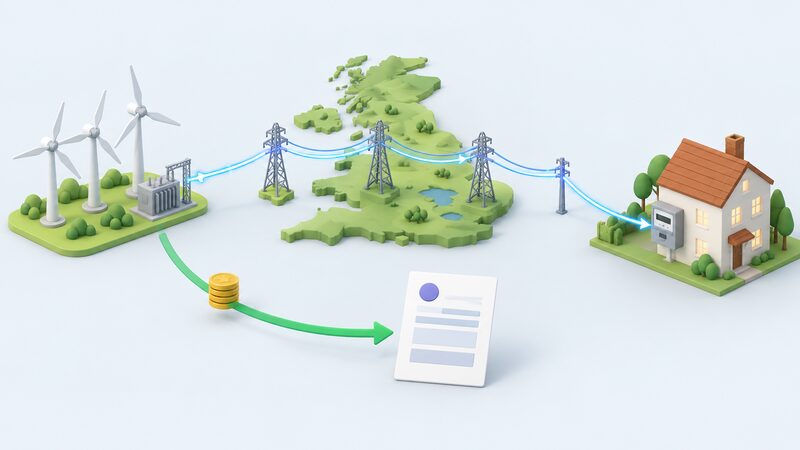
It did not, in any direct sense. The generation was sold, and the value was credited against the member's bill2. The household continued to draw its electricity from the grid through its supplier, exactly as before. The share changed the economics of the bill, not the physical route of the electrons.
This is the dependence that remains, and it is worth stating plainly. A member of an offsite generation co-operative is dependent on the grid for every unit consumed, on a supplier for the supply relationship, and on the settlement and billing arrangements that convert generation into a credit. An energy supplier is responsible for providing energy to homes and businesses5, and a household that pays a supplier directly can switch supplier or tariff at any time6. Neither of those facts is altered by holding a share.
The model also depends on the grid in a second way: the wind farm exports into it. There is no private wire from a Welsh wind farm to a member's home in another part of the country. The output enters the national system and is valued there. That is what makes the model scalable and what makes it indirect.
For households interested in the direct version, where generation and consumption sit behind the same meter, the mechanics are set out at behind-the-meter systems and self-consumption. The difference between the two routes is the difference between owning generation and using it.
The company behind the model
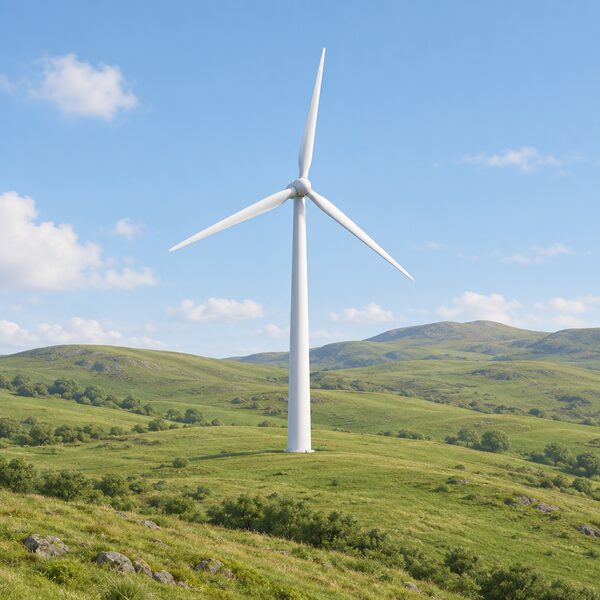
Ripple Energy was led by founder and CEO Sarah Merrick, named in a 2022 announcement about the company's work3. The company's origins lie in the Graig Fatha wind farm in Wales, which launched in 2020 under a model allowing energy consumers to own a wind turbine1. That project established the template: a co-operative owning the asset, a company running the share offers and member administration, and a supply arrangement converting output into bill credits.
The company's trajectory ended in administration in early 20251. The co-operative outlasted it. That outcome is the clearest available evidence about where the durable value in this model sits. The generating asset, held in a member-owned entity, continued. The commercial layer, held in a company, did not.
A later project shows the model continuing in a different form. A 200kW wind farm that a family invested in is scheduled to begin generation at the end of 20264. That is a much smaller installation than a utility-scale wind farm, and it indicates that consumer investment in offsite wind generation has continued beyond the failure of the largest promoter of the idea.
For a household, the lesson is about which entity to look at when assessing any share offer. The asset and the administrator are separate, and their fates can diverge. The same principle applies to the digital layer of a home energy system, where local control can survive the failure of a manufacturer's cloud service and remote features cannot, as set out at local control versus cloud.
Sources12 cited
- What are the benefits of community-owned wind power, Energy Saving Trust, 2025
- How it works, Ripple Energy, 2024
- SUNAMP funding for living lab trial, Energy Systems Catapult, 2022-11-28
- A family's journey toward energy independence and sustainability, Powervault, 2026
- Complain about your energy supplier, Ofgem, 2026
- Switch your home energy supplier, Ofgem, 2026
- Behind-the-meter energy systems guidance, Welsh Government, 2026-06-29
- Get free home energy efficiency improvements: Nest eligibility, Welsh Government, 2026-09-17
- ECO4 delivery guidance v3.2, Ofgem, 2025-12-08
- Energy saving home improvements, Scottish Government, 2026-09-17
- NISEP list of schemes 2026-27, Utility Regulator Northern Ireland, 2026-04
- More households benefitting from free energy saving home improvements, Cumberland Council, 2025-12-08