

In this answer
Short answer
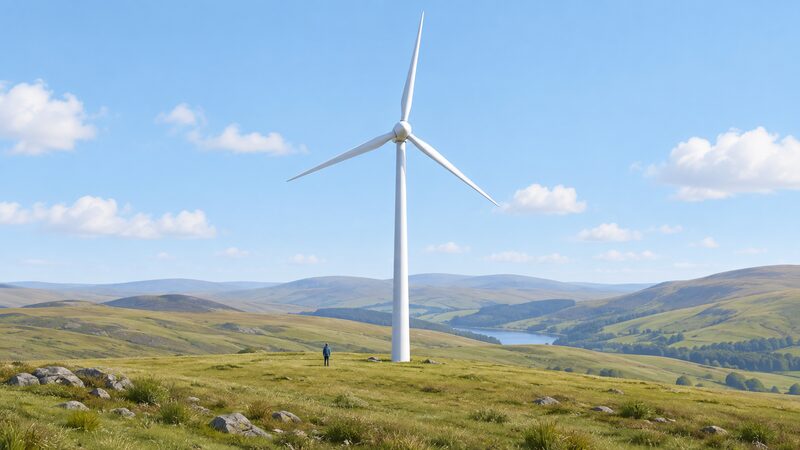
Bro Dyfi Community Renewables is a community generation society in the Dyfi Valley in mid Wales, built around community-owned wind generation. It grew out of an experimental turbine operated by the Centre for Alternative Technology, and a few years later the society replaced that machine with a second community-owned turbine1. That sequence matters: the society is not a single asset but a continuing local body that has already been through one replacement cycle.
For a householder, the significance is indirect but real. Community energy allows people and communities to take democratic control over their energy future, by understanding, generating, using, owning and saving energy in their communities, as well as working together across regions and nationally2. The electricity itself is sold, and the money it earns is what reaches the community, often funnelled into local energy efficiency and fuel poverty initiatives3. Living near a turbine does not change a household's meter reading.
What follows sets out what the society is, how community-owned generation is governed, what the assets are, what the model does and does not do for nearby homes, how members take part, and where the scheme sits in the wider UK community energy sector.
What Bro Dyfi Community Renewables is
Bro Dyfi Community Renewables is a community energy society, which places it in a defined category rather than a general one. Community energy uses social enterprise, cooperative and charitable business models, backed by community shares and crowdfunding from local people, retail, public sector and social impact investors2. That combination of a social purpose and a share-based ownership structure is what distinguishes it from a commercial wind developer that happens to be local.
The society's history runs through the Centre for Alternative Technology. An older experimental turbine was operated by CAT, and a few years later Bro Dyfi Community Renewables replaced it with a second community-owned turbine1. The society therefore sits at the point where a research and demonstration machine became a community-owned generating asset, which is a different proposition for the households around it: the output is sold and the surplus is governed by members rather than by a single owner.
Community energy is also described as delivering citizen-led and owned renewable energy projects6. The phrase carries the two halves of the model. Citizen-led means local people initiated and control it; owned means they hold the asset, not merely the right to be consulted about it. For a household in the Dyfi Valley, that is the practical difference between a scheme that pays a community benefit fund and one whose members decide what happens to the surplus.
The wider Welsh policy context supports the model. The Ynni Cymru Grant Capital Scheme is aimed at helping communities use clean energy to cut costs, create jobs and build stronger local infrastructure4. That is a statement of purpose rather than a figure, and it indicates the direction of Welsh government support for locally owned generation.
Community ownership and how the scheme is governed
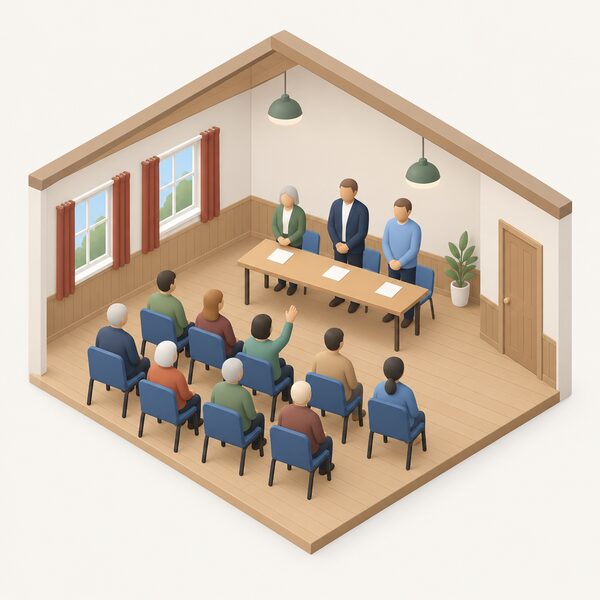
Governance in this part of the Dyfi Valley has a documented history. A community consultation led to a broader community regeneration remit and a governance system where the membership elects the board of directors at an annual general meeting1. That structure, adopted in 2002 by Ecodyfi, is the template that local community bodies in the valley work to: a membership, an elected board, and an annual general meeting as the point at which control is exercised.
For a generation society, that matters because the board holds the contracts. The society owns the turbine, sells the output, and decides what happens to the surplus. Community energy organisations are noted for having a strong understanding of their local community, its characteristics and needs6, which is the argument for local control rather than a distant owner: the people deciding how the money is used are the people who live with the consequences.
The sector's funding architecture is built around the same principle. Community energy enterprises are backed by community shares and crowdfunding from local people, retail, public sector and social impact investors2. Capital for renewable projects has also come from revolving loan funds, with one such fund covering renewable energy projects between 100kW and 5MW, including loans for development costs, bridging loans from planning stage to construction, and short-term loans to cover construction7. Those are the mechanisms by which a society funds a replacement turbine without handing over control.
"A few years later, BDCR replaced an older experimental turbine operated by CAT with a second community-owned turbine."
The generating assets and where they operate
The asset base is wind, on upland in the Dyfi Valley, and it has been through at least one replacement. The second community-owned turbine replaced an older experimental machine operated by CAT1. That is the whole of the asset history the record supports: an experimental turbine, then a community-owned replacement.
Scale in this sector is modest by commercial standards and that is the point. One Oxfordshire community energy organisation reports 56 renewable energy installations and more than 50 community groups, with profits from those installations supporting its work5. A single society with one or two turbines is at the smaller end of that range, and the economics of a single machine are correspondingly sensitive to wind resource, grid connection terms and the price at which the output is sold.
Grid connection is the constraint that shapes community generation more than anything else. Network operators describe their work as making customers' supplies more robust and resilient, and increasing network capacity to support electric vehicle chargers, heat pumps and other low carbon technologies8. Where capacity is scarce, a community generator competes for it, and the terms of connection determine whether a project proceeds.
The regulatory framework for selling output has also changed. Feed-in Tariff accreditation rules distinguish ROO-FIT installations, which are solar PV and wind installations with a declared net capacity above 50kW and all anaerobic digestion and hydro installations9. Co-location guidance now covers storage and hydrogen production alongside assets accredited under the Renewables Obligation, Feed-in Tariffs, Renewable Energy Guarantees of Origin and Smart Export Guarantee10. For a society considering adding storage to an existing turbine, that guidance is the relevant starting point.
What community energy means for householders nearby
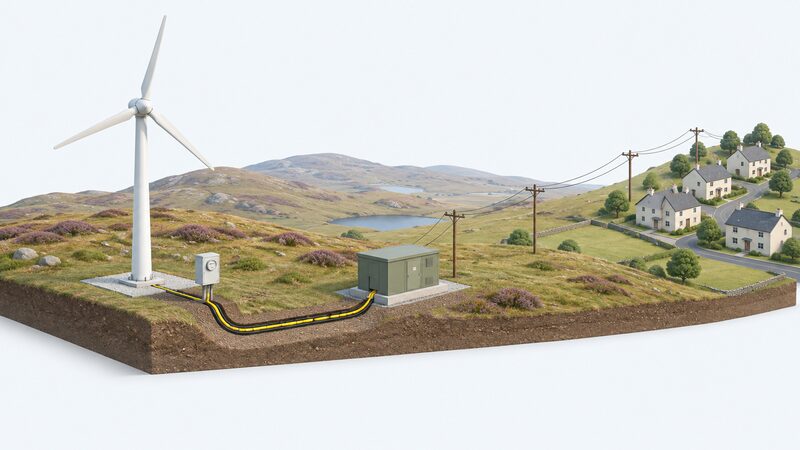
The honest answer is that proximity to a community turbine does not reduce a household's bill. Community energy is about delivering citizen-led and owned renewable energy projects6, and the benefit arrives through the revenue the project distributes rather than through the meter. Renewable energy can cut your electricity bills where a household generates or buys it11, and renewable energy technologies help you to meet your own energy requirements and reduce your home's carbon dioxide emissions12, but those are outcomes of a household's own installation, not of a neighbour's turbine.
What the community model does deliver is described in the sector's own terms: community energy provides clean, efficient and affordable ways to power schools, hospitals, local government buildings, high streets and so on13. That is a statement about local buildings and shared infrastructure rather than about domestic tariffs, and it is the realistic scope of the benefit.
The distribution mechanism varies. Revenue generated from community energy generation projects is often funnelled into local energy efficiency and fuel poverty initiatives3, and community projects fund more local projects that benefit the community using the income from the electricity generated7. Brixton Energy Solar Co-operative, the first urban community energy project in the UK, funnelled surplus revenue into home energy efficiency and fuel poverty initiatives to benefit local residents3. South East London Community Energy delivers energy advice and energy efficient improvements to help local people reduce their energy bills and address fuel poverty6.
For a household in the Dyfi Valley, the practical route to a lower bill runs through the household's own measures, and the community route runs through the society's surplus. The two are separate, and conflating them is the most common misunderstanding about community generation. A household that wants to cut its imports should look at its own generation and consumption; a household that wants a say in local generation should look at membership.
How members and the local community take part

Membership is the mechanism, and it is a shareholding rather than a subscription. Community energy enterprises are backed by community shares and crowdfunding from local people, retail, public sector and social impact investors2. The society's own share documents set the minimum holding, the term and the withdrawal rules, and those terms are what a prospective member needs to read.
Participation in the wider sector takes several forms. Community energy groups have acted as intermediaries between professional parties and local residents, as Carbon Co-op did in a South Manchester area-based retrofit scheme6. Collective purchasing has been organised through bodies that work with community leaders helping households select energy and solar power suppliers14. Local supply arrangements have started small: Energy Local Broughton-in-Furness began with about 50 households, recruited with Cumbria Action for Sustainability15.
Funding routes for community activity are also open. Bristol City Leap's Community Energy Fund was open as of September 2026, and its stated purposes include reducing carbon emissions, supporting collective action to reduce, manage and generate energy, developing community-led approaches, providing direct benefit to the local community, building capacity and empowering communities, generating income or having strong potential to be self-financing, and helping increase the resilience of communities vulnerable to the impacts of climate change and energy supply16. Baywind Energy Co-operative has made £1 million available for solar and hydro sites, actively looking for solar sites above 20kW and hydro sites, focused in Cumbria but open to projects across the country7.
Bro Dyfi in the wider community energy sector
The sector Bro Dyfi belongs to is being actively expanded by policy. Great British Energy has set out two new funding opportunities designed to support the growth of community energy and strengthen collaboration between community energy organisations and public sector partners7. Its five-year strategic plan includes a priority described as GBE Local, supporting community-owned and local energy projects to ensure residents and public services directly benefit from the infrastructure they host17.
In Scotland, the Community and Renewable Energy Scheme is delivered by Local Energy Scotland and has a network of development officers across Scotland providing free, expert and impartial advice and support to community groups, charities and other eligible organisations seeking to explore their renewable energy options18. A pilot scheme has also been set up to provide new opportunities for communities to benefit from renewable energy developments, with dedicated guidance for repowering projects covering financing, evaluation and governance, and targeted support from Local Energy Scotland through CARES including help to develop proposals18. Repowering is directly relevant to a society that has already replaced one turbine.
In Wales, the Ynni Cymru Grant Capital Scheme is aimed at helping communities use clean energy to cut costs, create jobs and build stronger local infrastructure4. Distribution network operators also work with the sector: Electricity North West states that it is there to help community energy groups set up their own local energy projects13.
The sector's scale is uneven. One Oxfordshire organisation reports 56 renewable energy installations and more than 50 community groups5, while a local supply project in Cumbria began with about 50 households15. Bro Dyfi sits in the smaller, asset-owning part of that landscape: a society with a turbine, a membership and a surplus to allocate, rather than a portfolio or an advice service.
For a household, the wider sector matters because it determines what support is available. Advice, capital grants, loan funds and repowering guidance all exist, and they are the routes by which a community generation society renews its assets. The independence a scheme like Bro Dyfi offers is local and partial: it takes a slice of generation out of distant ownership, and it leaves the household still connected to the grid, still buying most of its energy, and still exposed to the prices set in a national market.
Sources18 cited
- Domestic wind power, Centre for Alternative Technology, 2023-10-01
- What is community energy?, Community Energy England, 2026-09-20
- Community energy delivers affordable power, Energy Saving Trust, 2025-09-22
- Bristol City Leap Community Energy Fund, Community Energy England, 2026-09-02
- Renewables revolution: Cotswold region sees spike in installations, MCS Certified, 2025-04-23
- Delivering warm homes through community power, Energy Saving Trust, 2025-10-09
- Obtaining funding, Community Energy England, 2026-09-20
- What is the grid edge?, Low Carbon Hub, 2025-03-10
- Guidance for generators: co-location of electricity storage and hydrogen production, Ofgem, 2024-03-20
- Domestic RHI participants, Ofgem, 2026
- Home energy generation, Planning Portal, 2026
- Cost of living help from your local council, GOV.UK, 2026-09-17
- What is community and local energy?, Electricity North West, 2026-09-19
- The energy system and net zero, House of Commons Library, 2026-07-10
- Digital energy advice tools help thousands save money, Energy Saving Trust, 2025-09-22
- Renewable energy, Consumer Council, 2026
- Green energy, Uswitch, 2026-09-04
- £10 million to help Welsh communities cut energy bills, Welsh Government, 2026-03-03
 Community Energy in EnglandCommunity energy lets neighbours own their own power together, often through solar panels, and share the money it makes.
 Community Energy in WalesWales wants more of its energy owned by local people, not big companies.
 Community Wind and HydroExplains how community-owned wind and hydro projects are organised, financed and shared with local households, and the scale of installed community capacity across the UK.
 Community Energy in NICan a community group in Northern Ireland sell power to its neighbours, and is there funding to get a project off the ground?
 Local Energy Supply ClubsJoining a local energy club means your area's wind or hydro power is matched to your home's use, so you pay less for the electricity you use when it is being generated nearby.
 Community Energy in the UKWhat community energy means in practice, the legal structures used, and the types of project householders can join or benefit from.