
In this guide
Carbon Co-op is a member-owned community benefit society based in Greater Manchester that helped establish householder-led whole house retrofit as a practical route in the UK. It is best known for two things: the Community Green Deal, a demonstration project that retrofitted 12 homes to a deep retrofit standard specified with the residents themselves, and a set of open source home assessment tools that let a householder understand their own property before commissioning work.
Membership costs £35 a year. The organisation does not operate an approved tradesperson list and does not recommend or accredit installers, which is a deliberate design choice rather than an omission: the model equips householders to specify and procure work themselves. Its area-based work in South Manchester tested an intermediary role, sitting between households and the supply chain, and its emerging work covers aggregator and ESCO models, verification and funding partnerships.
For a household's energy independence, the value is in knowledge and procurement leverage rather than in hardware. A whole house plan and a home assessment reduce the risk of spending on the wrong measure first, and a group of neighbours buying together can reach work that individual households cannot. What remains is dependence on the gas grid, on a supplier and on the trades that actually install the measures: Carbon Co-op changes how a household buys retrofit, not what the home runs on.
What Carbon Co-op is: a member-owned society in Manchester
Carbon Co-op is a community benefit society, a mutual form registered in England in which members own the organisation and any surplus is applied to its stated social purpose rather than distributed to shareholders. It is not a charity and not a private company with outside investors. That structure shapes everything about how it works: it is accountable to a membership rather than to a funder or a parent group, and its advice is not tied to selling a product.
The organisation grew out of Greater Manchester's climate and retrofit activity and has stayed rooted there, though its tools and publications circulate far beyond the city region. Its work sits in the same territory as the public retrofit programmes: the Optimised RetroFit Programme in Wales describes itself as "a whole house, pragmatic, approach to decarbonising existing homes"2, and the Welsh programme's later guidance frames the aim as "affordable warmth and decarbonisation achieved through the best path for each individual home"3. Carbon Co-op arrived at a similar position from the householder side rather than the government side.
The distinction matters for a household trying to place the organisation. It is not a grant scheme, not an installer and not a regulator. It is a membership body that develops methods, runs projects and publishes what it learns, and it is one of the few UK organisations whose starting point is what the occupant can specify and control. For the wider landscape of advice bodies and their different roles, regional retrofit advice services sets out how the public services compare.
The whole house approach and the open source tools
The whole house approach means treating the property as one system rather than a list of separate measures. Fabric, ventilation, heating and hot water interact: insulation without attention to ventilation can trap moisture, and a heat pump sized before fabric work is done will be sized wrongly. Public retrofit programmes have converged on the same logic. The Welsh Optimised RetroFit Programme describes a whole house, pragmatic approach to decarbonising existing homes2, and its Year 4 guidance puts the best path for each individual home at the centre of the programme3. Green Homes Wales offers fully funded access to a Retrofit Coordinator to create a detailed home assessment covering energy efficiency and decarbonisation4.
Carbon Co-op's contribution is to put the householder at the start of that process rather than at the end. Its open source home assessment tools are designed so that an occupant can gather the information a retrofit coordinator would need, understand the sequence of measures, and hold a conversation with trades on equal terms. That is the same function a paid assessment performs: home energy assessments explains the types available and what each one tells you, and retrofit assessors and coordinators covers who does what under the formal roles.
The practical effect is a plan. A household that has a whole house plan knows which measures are worth doing, in what order, and which are not worth doing at all in that property. Whole house plans covers what one contains and who writes it, and what order should retrofit measures be done in deals with sequencing. The independence gain here is real but indirect: it is independence from a sales conversation, not from the grid.

The Community Green Deal: 12 homes, householder-led
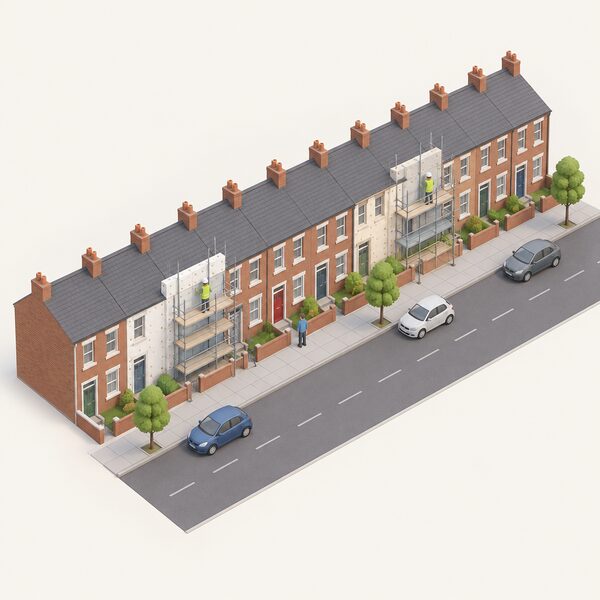
The Community Green Deal is Carbon Co-op's best known project and its clearest evidence base. It retrofitted 12 homes. The design was householder-led: residents were involved in specifying the work rather than receiving a finished package, and the project tested whether a group of owner-occupiers could procure whole house retrofit together.
Twelve homes is small, and it is worth setting that against the national schemes to see what it does and does not demonstrate. By December 2022, around 2.4 million households had benefited from ECO, 35,300 households had funded measures through the Green Deal Home Improvement Fund, 15,600 households had measures funded under Green Deal Communities, and around 13,800 households had funded measures through Green Deal Finance Plans1. The Community Green Deal's contribution is not scale but method: it showed how work can be planned as a whole rather than bought measure by measure.
Other documented deep retrofits give a sense of what whole house work can achieve. In Edinburgh, modelling of Cables Wynd House coupled with electrification of the heating system showed significant carbon emission reductions between 67-85%5. In Bristol, the City Leap partnership is spending around £1.4 million to replace ageing fossil fuel heating in 10 council-owned buildings with low carbon electric alternatives, saving an estimated 271 tonnes of carbon each year6. Different measures, different baselines, but the same pattern of outcome when fabric and heating are addressed together.
"coupled with electrification of the heating system has shown that significant carbon emission reductions between 67-85%"
The South Manchester scheme and the intermediary role
The South Manchester area-based scheme tested a different question from the Community Green Deal: what happens when an organisation acts as intermediary for a whole street or neighbourhood rather than for individual households. The intermediary role means aggregating demand, specifying work once for many homes, and negotiating with the supply chain on behalf of a group. It is the same logic that sits behind area-based public programmes.
The costs of that role are the reason it is hard to sustain commercially. An intermediary carries coordination, specification and quality assurance costs that a single household would otherwise absorb itself, and those costs have to be recovered somewhere. Public programmes show the range. The Social Housing Decarbonisation Fund's Wave 2.1 was set to improve around 90,000 social homes7, and a West Midlands consortium secured £7.5M from the fund8. In Edinburgh, the estimated average cost of energy efficiency interventions in Delivery Area 15 at Craigour Place was £4,300 per home5. Those are programme-level figures, and they show why aggregation matters: the per-home coordination cost falls as the number of homes in a scheme rises.
For a household, the lesson from the South Manchester work is about what an intermediary can and cannot do. It can reduce the transaction cost of finding and briefing trades, and it can hold a specification across several homes. It cannot remove the dependence on those trades, on the funding that pays for coordination, or on the household's own decision to proceed. The wider question of what a whole house retrofit costs is covered in what a whole-house retrofit costs in the UK, and the choice between doing work in one go or in stages is set out in retrofit all at once or in stages.
Membership: what £35 a year gets you
Membership is £35 a year. It is a subscription to a member-owned organisation, not a service contract, and it does not buy a survey, an installer or a guarantee of work. What it buys is access to the organisation's learning resources, events and member network, and a say in how the society is run.
The membership model is the point rather than a side effect. A community benefit society is owned by its members, so the people who join are the people the organisation answers to. That is a different accountability structure from a commercial retrofit service, where the customer relationship ends when the invoice is paid, and from a grant scheme, where accountability runs to the funder. It also means the organisation's priorities are set by what members want to learn and do.
Who joins tends to be owner-occupiers with an interest in doing the work properly, often in older solid-walled properties where the sequencing decisions are hardest. Owner-occupiers account for around 62% of households, and a parliamentary committee noted that encouraging them to adopt low carbon heating would require a broad approach9. That is the gap Carbon Co-op addresses: the owner-occupier who wants to act but has no obvious route to a specification.
For households weighing whether membership is worth it, the honest comparison is against the free alternatives. Free home energy advice in England and the equivalent pages for Scotland, Wales and Northern Ireland cover what is available at no cost. Membership adds the tools, the member network and the group procurement route on top of that.
Workshops, publications and learning resources
Carbon Co-op's workshops and publications are how the method travels beyond its own projects. The organisation runs sessions on retrofit topics and publishes guides and tools that a householder can work through without being a member of anything. The open source tools are the most durable output: they encode the whole house method into something an occupant can use on their own property.
That publishing role matters because the formal knowledge base is technical. The Committee on Climate Change's work on embodied and sequestered carbon in the building standards framework, for example, was produced by AECOM for the Committee10, and it is written for a professional audience. The gap between that literature and a householder standing in a cold hallway is where Carbon Co-op operates.
The workshop model also has a limit worth stating. A workshop teaches a householder what to ask and what to avoid; it does not install anything, and it does not create a supply of trades. Households that come out of a session with a clear specification still have to find someone competent to do the work. Official guidance on solar installations is to always use a qualified installer11, and the same principle applies across retrofit trades: verification of competence is the householder's job, and no workshop removes it.

Emerging work: aggregator models, verification and funding
Carbon Co-op's newer work moves from advising individual households to building the infrastructure that lets groups of households act together. Aggregator and ESCO models are the core of this: an aggregator bundles demand from many homes so that a supplier or installer has a reason to engage, and an energy service company model sells an outcome, such as a warm home, rather than a set of installed measures.
Verification is the other strand. If a household or a group is paying for a stated outcome, someone has to check that the outcome was delivered, and that requires measurement rather than assumption. This is where the organisation's work overlaps with the public programmes' growing interest in proving savings. The Heat Pump Ready Programme's Stream 2 projects include Advanced Modelling for Heat as a Service, led by City Science Corporation Limited, with no project partners listed12, and a separate project on homeowner loans, led by Home Infrastructure Technology Limited, also lists no partners12. Those are official scheme records of the same territory Carbon Co-op works in.
Funding for this kind of development comes from a mix of sources. Membership subscriptions provide a base. Project funding and partnership work provide the rest, and the organisation's structure means income is recycled into its purpose rather than distributed. The public funding landscape it sits alongside is large: the Social Housing Decarbonisation Fund is administered by the Department for Energy Security and Net Zero7, and the 2025 Spending Review confirmed support for energy programmes including Carbon Capture, Usage and Storage13.
For a household, the aggregator model is the one with practical relevance. If a group of neighbours can buy retrofit together, the per-home cost of specification and coordination falls, and the household's dependence on finding a single trusted installer weakens. That is the same logic as a fuel club, where households in Wales buy heating oil collectively through clubs such as Carway and Capel Iwan14. The mechanism is different, the principle is identical.
Why there is no approved tradesperson list
Carbon Co-op does not operate an approved tradesperson list, and it does not recommend or approve installers. This is a deliberate position and it is worth understanding rather than working around. An approved list creates a relationship between the organisation and the trades on it, and it transfers a measure of responsibility for the work to the organisation. A member-owned society that exists to help householders specify work independently is poorly placed to take on that liability.
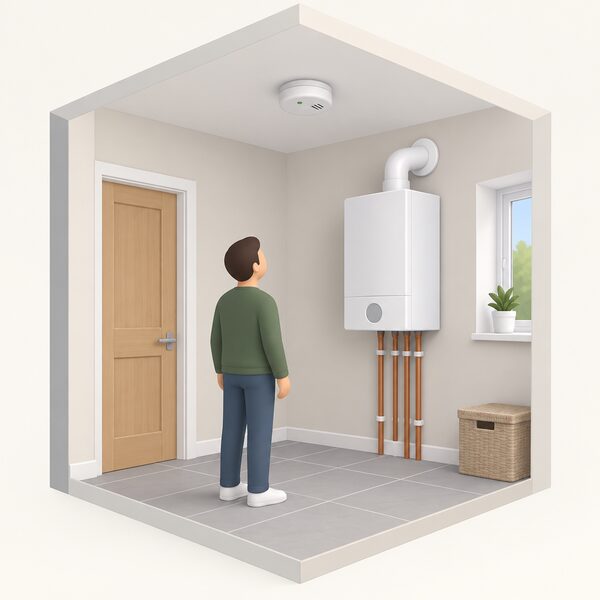
The practical consequence is that a householder using Carbon Co-op's tools still has to verify competence themselves. Official guidance is explicit on the principle: on solar installations, always use a qualified installer11. The same applies to gas work, where the Health and Safety Executive sets out the carbon monoxide risk from combustion appliances15, and to Northern Ireland, where guidance covers gas safety and carbon monoxide and advises installing an audible alarm meeting British or European standards, available from as little as £2016.
The verification burden is real, and it is the main dependence that remains after a household has a good plan. A plan tells you what to do and in what order; it does not tell you who should do it. Households should expect to check trade registration, ask for evidence of comparable work, and keep the paperwork from every stage. The paperwork to keep from every energy improvement covers what to retain, and DIY or professional sets out which measures are realistically within a householder's own competence.
Sources16 cited
- Household Energy Efficiency Statistics, detailed release March 2023, Department for Energy Security and Net Zero, 2023
- Optimised RetroFit Programme, Welsh Government, 2021
- Optimised Retrofit Programme 3 Year 4 guidance 2025 to 2026, Welsh Government, 2025
- Green Homes Wales, Development Bank of Wales, 2026
- Edinburgh Local Heat and Energy Efficiency Strategy delivery plan, City of Edinburgh Council, 2023
- Our climate action on buildings, Bristol City Council, 2026
- Social Housing Decarbonisation Fund, Department for Energy Security and Net Zero, 2024
- Local couple slash household fuel bill by £1,000 a year, West Midlands Combined Authority, 2022
- Environmental Audit Committee report on energy efficiency, UK Parliament, 2025
- Options for incorporating embodied and sequestered carbon into the building standards framework, Committee on Climate Change, 2026
- Solar panels, East Hertfordshire District Council, 2026
- Heat Pump Ready Programme Stream 2 projects, Department for Energy Security and Net Zero, 2026
- Spending Review 2025, HM Treasury, 2025
- Fuel clubs, Carmarthenshire County Council, 2026
- Carbon monoxide, Health and Safety Executive, 2026
- Gas safety and carbon monoxide, nidirect, 2025