
In this answer
Short answer
A zero carbon village is not a single project or a badge. It is a direction of travel in which the energy used to heat, light and power homes in a community generates no net carbon emissions. The definition used in English policy for zero carbon homes is precise: "there should be no carbon emissions generated from the energy required to heat and light a home"1. For an existing village, that means cutting demand first, then switching the remaining demand to low carbon sources.
The scale of the task is national as well as local. The Climate Change Committee estimates that the share of homes with low carbon heating must rise from 9% to 39% in the next decade2. By 2050, 28 million homes across Great Britain will need to be using low carbon heating systems to meet net zero targets3. A village that starts now is working ahead of a curve that will reach every community eventually.
The good news is that the tools exist and the evidence base is growing. A measured case study recorded an 83% drop in heating energy consumption over 18 months after installing two KRONOTERM ADAPT heat pumps4. Ember analysis found that electric vehicles and heat pumps cut UK fossil fuel consumption in 2023 by the equivalent of 14 million barrels of oil1. The sections below set out how a community group can move from intention to measured action.
What 'zero carbon village' means in practice
The term carries several meanings, and a community group needs to choose which one it is pursuing. In English planning policy, zero carbon homes are defined by operational carbon: no emissions from the energy used to heat and light the home1. The Future Homes Standard takes a different approach, describing new homes as "zero carbon-ready", meaning they will be zero carbon once the electricity grid has decarbonised6. These are not the same claim, and the difference matters for how a village measures success.
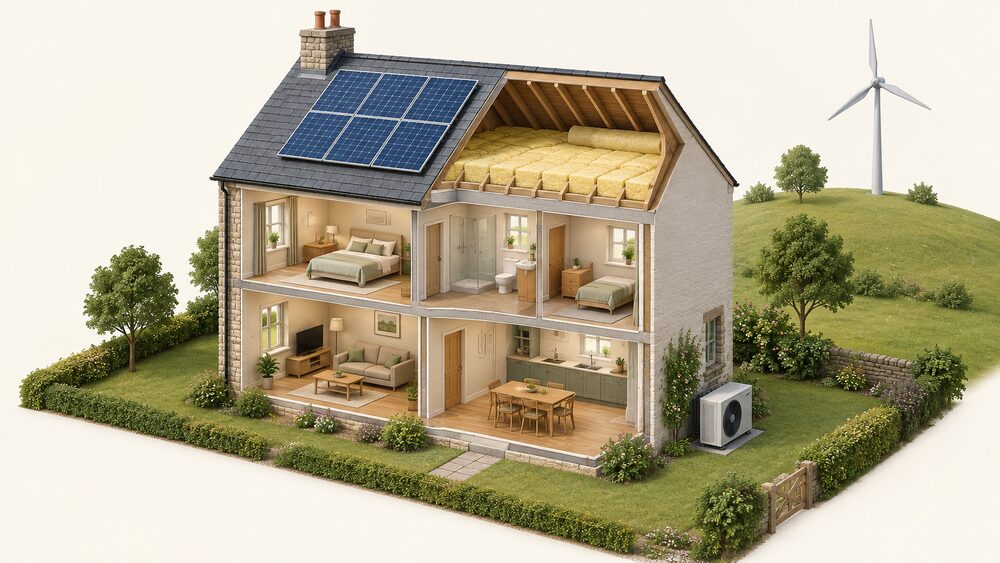
A village-scale definition usually combines three elements. First, reducing the energy demand of the existing housing stock through retrofit. Second, supplying the remaining demand from low carbon sources, whether that is heat pumps, solar, wind or heat networks. Third, addressing the operational carbon of community buildings and transport alongside homes. The Centre for Alternative Technology's CAPZero project was set up "to understand how the area might move toward a zero-carbon local energy system"7, and it was described as the first such community action plan in the UK8.
The distinction between zero carbon in operation and zero carbon across the whole life cycle is important. A village that installs heat pumps and solar panels may reach zero operational carbon while still depending on grid electricity that is not yet fully decarbonised, and on equipment manufactured elsewhere. That is a real limit, not a failure. The Future Homes Standard's "zero carbon-ready" framing acknowledges it directly6.
For a community group, the practical starting point is to define the boundary: which buildings, which energy uses, which time frame. A village that says "zero carbon in operation for domestic heating and electricity by 2040" has a measurable target. A village that says "zero carbon" without a boundary has a slogan.
Start with measured demand: the 83% heating savings case

The most persuasive argument for starting with demand reduction is that the savings can be very large. A homeowner with properties in Ljubljana and Gauting recorded an 83% drop in heating energy consumption after installing two KRONOTERM ADAPT 0416 heat pumps over 18 months4. That is a single well-instrumented case, not a village average, but it shows what is achievable when a heat pump is matched to a well-retrofitted building.
The Centre for Alternative Technology targets a 50% average reduction in heating demand across new and existing buildings in its Zero Carbon Britain scenario5. The gap between 50% and 83% reflects the difference between a national modelling assumption and a best-case measured result. A village should expect its own average to fall somewhere between the two, depending on the starting condition of its housing stock.
Measuring demand before acting is what separates a community energy plan from a wish list. The Stoke Climsland Carbon Zero Homes Project used funding from the Community Leveling up programme to produce 85 separate survey reports covering 45 properties in and around the village9. That is the model: survey first, then prioritise. Without measured baseline data, a village cannot know whether its interventions are working.
Heat first: heat pumps and retrofit across the housing stock
Heating dominates household energy use, and it is where the largest carbon reductions are available. Official guidance states that heat pumps produce up to 70% less CO2 over 15 years than a gas boiler, with zero emissions at the point of use10. The Heat Commission recommendation is that all new heating installations will need to be zero-carbon by 2035, with only net-zero compatible technologies such as air source or ground source heat pumps, hydrogen boilers or heat networks deployed11.
For social housing, the Warm Homes: Social Housing Fund Wave 3 sets out a priority order for low carbon heating technologies: heat pumps and low carbon heat networks optimised for operation with a low flow temperature below 55°C, then shared ground loops or ground source heat pumps, air to air heat pumps, heat batteries, high retention electric storage heaters in electrically heated flats and small dwellings, or solid biomass12. With the £20,000 grant funding, installation of a low carbon heating measure is mandatory in each home, and energy efficiency measures such as solar PV or insulation are also expected to ensure bills do not go up12.
The current legal position is that there is no legal requirement for existing homes to be retrofitted or for low-carbon heating technologies to be installed in existing homes, with exceptions for privately rented homes and homes owned by local authorities and housing associations in some parts of the UK13. That means village action is voluntary action, at least for owner-occupiers. The Social Housing Net Zero Heat Fund supports zero direct emission heating systems and energy efficiency measures for the retrofit or refurbishment of existing housing stock, but not for new build social housing14.
Northern Ireland faces a specific constraint: there needs to be sufficient supply chain capacity for the maintenance and repair of zero carbon heating systems as well as installation15. A village in Northern Ireland planning a heat pump programme needs to consider who will service the equipment after installation, not just who will fit it.
Local generation: solar, wind and domestic turbines
Once demand is reduced, local generation can supply a share of what remains. The Energy Performance of Buildings Directive lists photovoltaics, micro-wind turbines, combined heat and power, community heating and heat pumps together as low or zero carbon technologies for new buildings16. For a village, that means solar and wind are not competing options but complementary ones, with different output profiles across the year.
Solar is the more straightforward domestic option. Surplus energy can be sold back to the grid17, and solar panels qualify for a lower rate of VAT8. The connection of low carbon technologies such as domestic solar generation and electric vehicle chargers has implications for local voltage limits, which is why the grid edge matters for community planning18. A village that adds significant solar capacity may need to coordinate with the distribution network operator.
Wind is more constrained. In Northern Ireland, there is no financial support available for homeowners who wish to generate their own electricity through domestic renewable technologies, though those technologies may offer an attractive payback without grant support19. The same principle applies across the UK: the absence of a grant does not mean the absence of a return, but it does mean the household carries the upfront cost.
The Warm Homes: Local Grant funds energy efficiency installations including solar photovoltaic panels and battery storage, air source heat pumps, loft insulation, cavity wall insulation, smart heating controls and external wall insulation20. For a village, this is one of the few funding streams that explicitly supports both generation and demand reduction in the same programme.
Why household choices add up to village-scale change
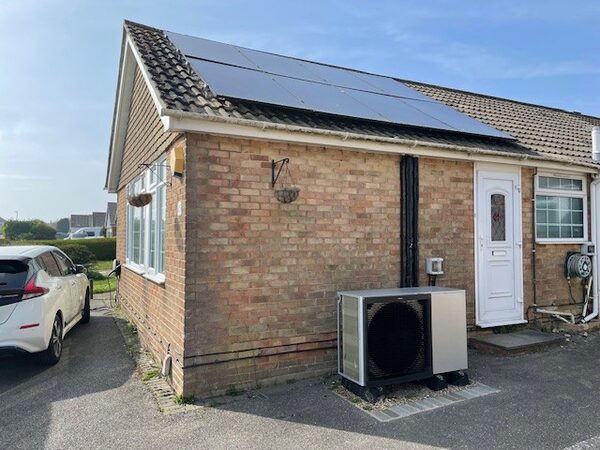
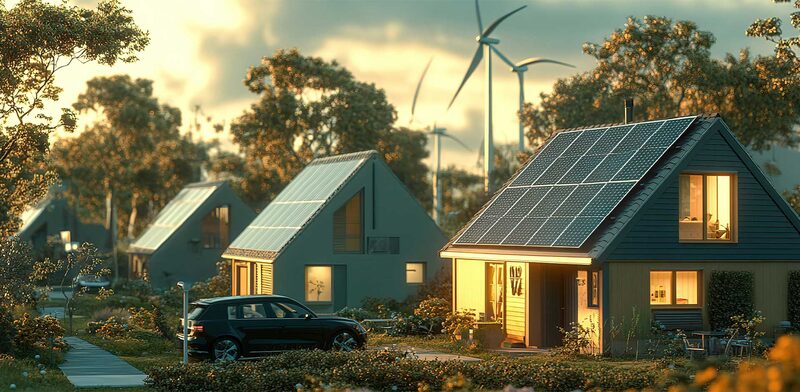
Individual household decisions aggregate into village-scale outcomes, and the evidence for this is now strong. Ember analysis found that electric vehicles and heat pumps reduced UK fossil fuel consumption in 2023 by the equivalent of 14 million barrels of oil1. The Energy and Climate Intelligence Unit found that households with heat pumps and EVs are less dependent on foreign oil and gas imports, while higher oil and gas use means higher import dependence1. Every household that switches is contributing to a national reduction in import dependence.
The Scottish Government's update to the Climate Change Plan states that by 2030 over a million households will need to convert to a zero or low emissions heating system21. That is a national target built from household-level decisions. A village that converts 100 homes is not just reducing its own emissions; it is building the supply chain and installer base that the national target depends on.
Community energy has a distinct role. The case for community energy rests on understanding the added value of a community energy approach and why support for community energy is vital for the success of the UK's transition to net zero22. The Birmingham City Council Switch Together programme aims to achieve net zero carbon emissions and support residents to transition to sustainable ways of living23, and it explored funding mechanisms spanning group buying, affordable loan options, property linked finance, community-led investment models and carbon-based funding approaches24.
The limit is that household choices are constrained by income, tenure and building type. Fuel-poor households, including households in island, rural and remote communities, are the target of energy efficiency investment25. A village plan that assumes every household can participate equally will miss the households that need support most.
Funding, valuation and the economics for households
The funding landscape for village-scale action is a patchwork of national schemes, local authority programmes and community-led models. The Energy Company Obligation (ECO4) is designed to tackle fuel poverty while also reducing carbon emissions through supporting whole house energy efficiency improvements for eligible households26. The Social Housing Net Zero Heat Fund provides capital support for social housing providers, though the sources give that support as either up to 50% or 60% of costs14.
For individual households, the economics depend on the measure. Solar panels qualify for a lower rate of VAT8, and surplus energy can be sold back to the grid17. When a property with solar is sold, valuation methods such as Net Present Value discount future electricity savings into today's money to show buyers the financial benefit27. There is no single mandated formula, and the value depends on the system's age, output and remaining warranty.
The National Planning Policy Framework directs decision makers to give significant weight to the benefits associated with renewable and low carbon energy generation, and proposals' contribution to meeting a net zero future in England28. That planning direction supports village-scale generation proposals, though it does not guarantee approval.
For a village group, the practical funding sequence is: survey the housing stock, identify eligible households for national schemes, explore group buying and community-led investment for those who fall outside eligibility, and use local authority programmes where they exist. The Stoke Climsland project shows the survey-first model in practice9, and the Peterborough Accelerated Net Zero work shows the range of funding mechanisms that can be explored24.
Where a village plan meets its limits
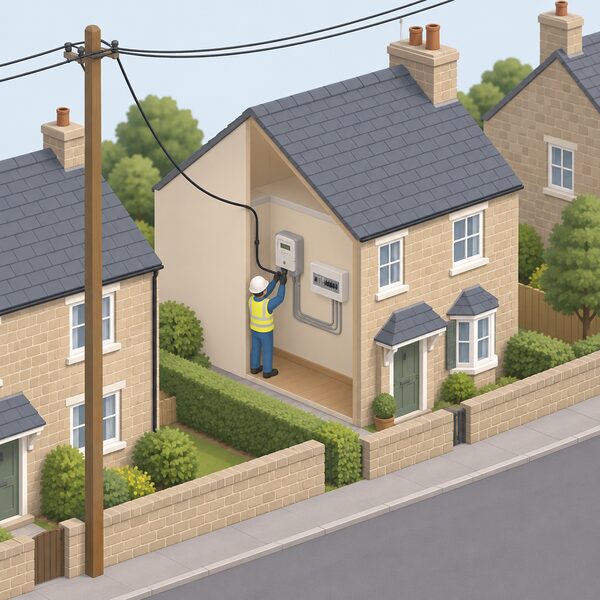
A zero carbon village cannot disconnect from the national grid, the gas network or the supply chain. The grid edge remains the boundary where household generation meets network constraints18. Off-grid homes will need to transition in order to meet Government objectives on Net Zero29, but most village homes will remain connected. The dependence that remains is on the grid for backup and export, on installers and manufacturers for maintenance, and on national policy for the framework within which local action happens.
The honest position is that a village can cut its operational carbon substantially, can reduce its import dependence measurably, and can build the local capacity that national targets require. It cannot become an island. The value of the zero carbon village approach is that it makes the national transition tangible, measurable and locally owned, one household and one street at a time.
Sources29 cited
- Household energy: buying British, ECIU, 2024
- Improving the energy efficiency of socially rented homes in England, Energy Saving Trust, 2025
- Heat GB: calculating the network costs for low carbon heating, Citizens Advice, 2050
- 83% energy savings with the ADAPT heat pump, Kronoterm, 2024
- Eco retrofit, Centre for Alternative Technology, 2025
- Electric vehicles and heat pumps reduced UK fossil fuel consumption, Ember, 2024
- Energy efficiency and comfort in an 18th century home, Low Carbon Hub, 2026
- Tax on shopping: energy-saving products, GOV.UK, 2026
- Stoke Climsland Carbon Zero Homes Project, Cornwall Council, 2025
- Heat pump, UK Government, 2026
- No new conventional gas boilers in homes after 2025, HPA UK, 2035
- Warm Homes: Social Housing Fund Wave 3 scheme guidance, DESNZ, 2026
- Research briefing: CBP-8830, House of Commons Library, 2026
- Government-funded schemes and ECO4, Energy Saving Trust, 2025
- NI low carbon heating in buildings, Energy Saving Trust, 2025
- Energy Performance of Buildings Directive 2002/91/EC, legislation.gov.uk, 2026
- Solar panels, Oxfordshire County Council, 2026
- Statutory voltage limits, Energy Networks Association, 2026
- Support to generate your own electricity, nidirect, 2025
- Warwick Warm Homes local grant, Act on Energy, 2026
- Heat in Buildings Strategy: fairer Scotland duty, Scottish Government, 2021
- The case for community energy, Community Energy England, 2025
- Switch Together Birmingham, Birmingham City Council, 2026
- How to break down the barriers to heat pump adoption, Energy Systems Catapult, 2026
- Heat in Buildings Strategy: strategic environmental assessment, Scottish Government, 2021
- ECO4 scheme, West Lindsey District Council, 2025
- Do solar panels increase property value, Spirit Energy, 2026
- UK Solar Roadmap, DESNZ, 2025
- Rural households and net zero, Liquid Gas UK, 2026
 Community Energy in EnglandCommunity energy lets neighbours own their own power together, often through solar panels, and share the money it makes.
 Community Energy in NICan a community group in Northern Ireland sell power to its neighbours, and is there funding to get a project off the ground?
 Carbon Budgets and Net ZeroThe UK has promised to cut its emissions to almost nothing by the middle of the century.
 Community Energy in ScotlandCommunity energy in Scotland lets you join a local scheme for cheaper, greener heat and power, or get advice and funding to make your own home warmer and cheaper to run.
 Local Energy Supply ClubsJoining a local energy club means your area's wind or hydro power is matched to your home's use, so you pay less for the electricity you use when it is being generated nearby.
 Planning Energy IndependenceCutting what you use, moving heating off gas, putting solar on the roof and adding a battery all help, but none of them takes you off the grid completely.