
In this guide
"Going off-grid" covers two quite different situations in the UK. The common one, and the one almost all official statistics describe, is a house with no mains gas connection: four million UK households, 15% of the stock, are off the mains gas grid and depend on alternative fuel sources for heating and cooking1. The rarer one is a house with no mains electricity connection either, generating and storing all its own power. The electrical grid is simply the system that handles the distribution of electricity around the UK3, and a house that steps outside it takes on, in full, the jobs that system does invisibly: matching supply to demand every second, covering winter, and covering breakdowns.
The scale of the off-gas picture is well documented. An estimated 4.8 million households across Great Britain were not connected to the gas grid in 2024, and the proportion was highest in inner London at 26.6%4. That last figure is a useful corrective: off-grid is not only a rural condition. In Scotland's rural areas, though, 55% of dwellings are not within the coverage of the gas grid5. So the majority of British "off-grid" homes are ordinary houses on electric, oil, LPG or solid-fuel heating, still fully dependent on an electricity supplier.
A genuinely off-electricity-grid home is a different project: generation, storage, charge control, an inverter and usually a fuelled backup, sized for the worst few weeks of the year rather than the average. This page sets out what each part does, what the published evidence says about its limits, and what dependence remains after all of it is installed.
What "off-grid" means in the UK context
The definitions in official and industry use are narrower than everyday speech. MCS defines an off-gas-grid household plainly as "A household that is not connected to the gas network."9 Written evidence to Parliament puts it at approximately 15% of the 28 million properties in the UK10, and an industry body describes the same four million properties as depending on alternative fuel sources for heating and cooking2. One independent analysis gives approximately 16% across Great Britain11. The figures differ because the denominators and survey years differ, not because the underlying picture is in dispute.
None of these households is off the electricity grid. That distinction matters for anyone planning, because the grant schemes, the statistics and most of the published advice are built around the gas question. Being off gas usually increases electrical dependence, since heat, hot water and cooking are more likely to be electric.
A house that was never connected to mains electricity, typically because the cost of a line was prohibitive, sits in a different position from one that chooses to disconnect. The first has no connection to lose and no export route to give up. The second is trading a two-way relationship, import when short and export when surplus, for self-reliance. The trade is examined in more detail on disconnecting from the electricity grid and disconnecting from the gas grid, and the legal position on is it legal to go off-grid in the UK.
Who off-grid systems suit: remote homes and businesses

Off-grid electricity supply makes most sense where a connection is expensive or absent: isolated dwellings, farm buildings, moorings, remote business premises and small installations such as monitoring equipment. Home Energy Scotland describes hydroelectricity schemes as "one of the most reliable alternatives to mains supply for isolated properties"12, which is the clearest statement in the official literature of the case for going it alone: a site with a suitable watercourse has a generation source that works at night and in still weather, which solar and wind do not.
Government support, by contrast, has been aimed at the off-gas population rather than the off-electricity one. The Home Upgrade Grant targeted off-gas grid properties13, specifically low income households living off the mains gas grid in England14, focusing on the worst-quality off-gas grid homes15; the same briefing noted 1.5 million households off the gas grid who will need further support to upgrade their homes15. Its successor, the Warm Homes: Local Grant, is directed at low income households in private housing in England, including off-grid homes16, and the upgrades are open to all fuel types, including on-gas-grid and off-gas-grid households17. Independent policy work has argued a loan offer should cater to a range of households including those in rural or off-grid areas18.
There is also a group who are affected by supply decisions without being a connected customer at all. National Grid notes that customers not directly connected to the network, such as care homes or multi-occupancy accommodation where a landlord is responsible for the electricity supply, are covered by separate guidance for landlords and non-connected customers19. Being behind someone else's meter is not independence.
The core components: generation, storage and power management
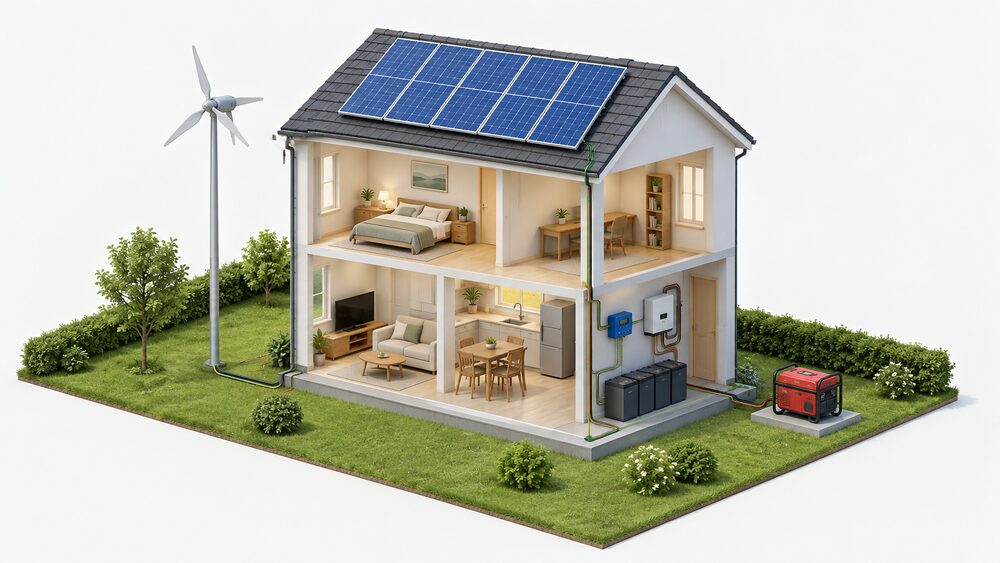
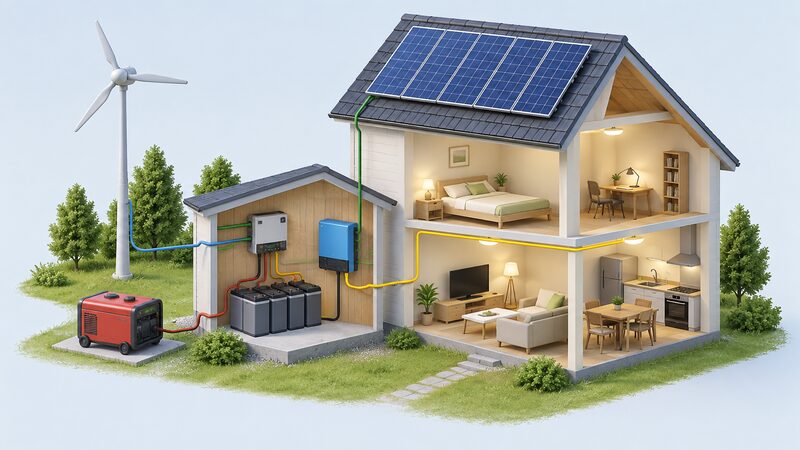
An off-grid electricity system has four functional layers, and every one of them has to work for the lights to stay on:
- Generation. One or more sources, most commonly solar photovoltaics and small wind, with hydro where the site allows12.
- Storage. Batteries, which MCS describes as essential for off-grid systems7.
- Power management. A charge controller between generation and battery, and an inverter converting stored direct current to mains-voltage alternating current for the house.
- Backup. A fuelled generator, or a second generation source, for the periods the first three cannot cover.
On-grid, these functions are shared with a national system that absorbs surplus and covers deficit. The scale of that system is worth stating: UK electricity demand is met by electricity from around 38% renewable sources, 15% nuclear, 7% biomass and 30% fossil gas21, and government plans have low or zero-carbon power, largely wind, solar and nuclear, accounting for 95% of Great Britain's electricity generation in 203022. An off-grid house replaces that diversity with two or three sources and a battery. Design guidance for the whole set is on designing a whole-home energy system and sizing generation and storage.
Energy sources: solar panels and windchargers
Solar is the default first source, and it is now mainstream: more than 1.5 million homes in the UK have solar panels6, a figure the government's UK Solar Roadmap also gives as over 1.5 million domestic solar installations23. Even so, the Climate Change Committee has judged that the roll-out of solar appears significantly off track and will need to improve to deliver its contribution to a decarbonised system24. For an off-grid household the relevance of solar is its shape rather than its total: output is concentrated in the months when heat demand is lowest, which is the central difficulty discussed on the winter gap.
Small wind, the traditional windcharger of remote UK sites, complements solar because its seasonal profile is closer to demand. The Energy Saving Trust notes that with battery storage you can store excess electricity from wind turbines and solar panels to use later20, which is exactly the arrangement an off-grid house needs: two uncorrelated sources feeding one store. Planning is the harder part for wind. For England and Scotland the rules are described as more complex, with permission not needed only in some specific situations20.
End-of-life is a live gap. The Solar Roadmap records that the UK currently has a handful of solar panel disposal companies beginning to recycle using crushing techniques23. A household that owns its whole supply also owns the disposal problem.
The choice between the two sources for a single site is compared on solar panels vs small wind.
Batteries: storing power for when generation is low
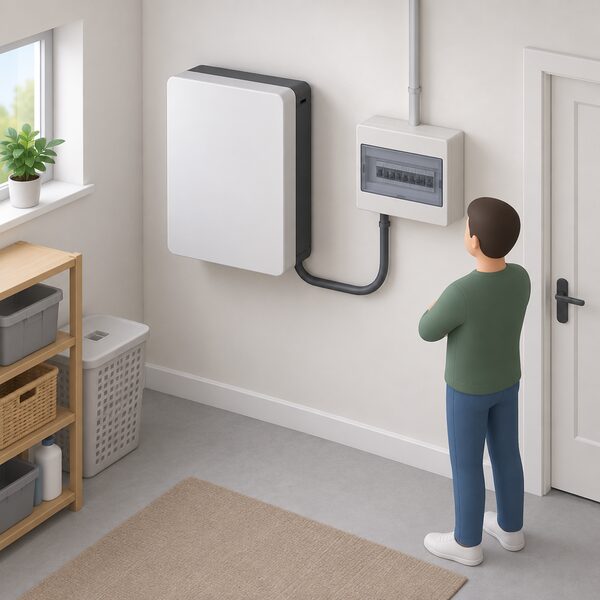
Storage is not optional off-grid. MCS states flatly that "For off-grid systems, batteries are essential and will need replacing every six to 10 years."7 That replacement cycle is the single most consequential number in off-grid ownership, because it recurs for the life of the house while panels and turbines do not.
Two further points shape how much capacity is actually available. First, usable capacity is less than installed capacity: the Energy Saving Trust explains that when the battery gets down to a set level, maybe 20% of the total storage capacity, the system stops discharging25. Second, on-grid batteries are commonly used to store excess solar generation or to charge when the tariff is cheap, then to supply the house at night or when prices are high25. An off-grid battery has only the first of those two options. There is no cheap overnight import to fall back on, so the store must be sized against the worst run of poor generation the household is willing to tolerate, not against a typical day.
Related reading: how much a battery increases solar self-consumption and home battery vs hot water tank.
Charge controllers, inverters and the power management layer
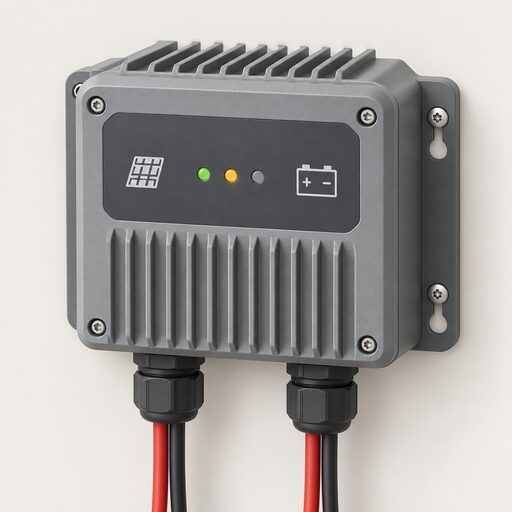
Between generation and battery sits the charge controller, which regulates what the array or turbine delivers into the store; between battery and house sits the inverter, converting stored direct current into mains-voltage alternating current. Off-grid, this layer does something a grid-tied inverter never has to do: it sets the voltage and frequency of the house itself. There is no grid reference to follow. That is why a grid-tied system normally shuts down in a power cut, a behaviour explained on islanding and anti-islanding, and why off-grid and hybrid equipment is specified differently, as set out on hybrid inverter vs AC-coupled battery.
Every conversion step loses a little energy, and the inverter draws power continuously simply to stay awake. Off-grid, that standing draw is met from the battery, so it comes straight out of the household's own generation. The practical consequence is that reducing the always-on load matters more off-grid than on it, which is the subject of base load.
Two contextual points bear on the economics of this layer. Electricity unit prices under the price cap are 38% higher than in mid-202126, which raises the value of every kilowatt hour a household supplies itself. And on-grid households can exploit the fact that at off-peak times, overnight and when it is windy, demand is lower and more electricity comes from renewable sources27. An off-grid house cannot use that flexibility, because it has no import to shift.
Backup generators: covering the gaps
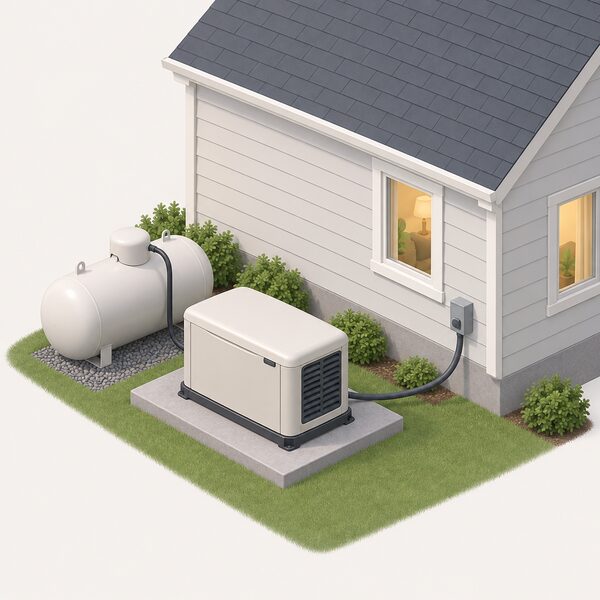
Backup exists because generation and storage will at some point both run short. The duration involved is not a matter of hours. The system operator records that "Last summer we saw a period of 16 weeks with very little wind."8 A national system rides that out with gas, nuclear and imports; a house with one turbine and a battery cannot.
Network operators themselves use mobile generation as a fallback, restoring supplies with mobile generation when an alternate supply is not possible28. The household equivalent is a fuelled generator, and it reintroduces dependence in the most direct form: a delivered fuel, stored on site, bought from a supplier. Where that fuel is oil, official guidance in Northern Ireland is to arrange for the boiler and tank to be serviced at least once a year by an OFTEC technician, including any underground pipework29. Any fuel store brings a maintenance and safety regime with it.
For most households the cheaper form of backup is the grid connection itself. Keeping it means that a poor generation week costs money rather than comfort, and it preserves the regulated protections that come with being a connected customer, including Guaranteed Standards payments of an extra £100 where power has gone off more than four times between 1 April and 31 March the following year, each cut lasting at least three hours30. Disconnected households have no such entitlement. Winter management for those who do go without is covered on getting through a UK winter off-grid.
Where disconnection sits in law
Disconnection is not something a householder performs alone. In Great Britain, network operators disconnect supplies under defined legal procedure: UK Power Networks states it would be "legally instructed by National Grid ESO, to disconnect power supplies using established procedures set out by the government in the Electricity Supply Emergency Code"31, and it is the network operator for London, the East and South East31. Northern Ireland has its own regulations, under which a distributor may disconnect the supply to a consumer's installation, another distributor's network or a street electrical fixture without the usual notice where disconnection can be justified on grounds of safety33.
The wider legal and consent picture, including whether a dwelling can be occupied without a connection, is dealt with on off-grid legality and rules and, for lenders and insurers, on mortgages, insurance and valuation.
Planning permission: usually not needed for roof solar, harder for wind
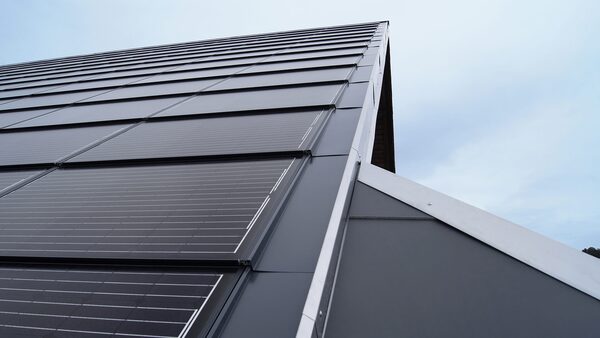
For solar on a house, permitted development does most of the work. Councils state that installing solar panels and equipment on residential buildings and land may be permitted development with no need to apply to the council for planning permission34, and that planning permission is not normally needed for solar panels on domestic roofs, with some exceptions, because they are covered by permitted development rights35. One council notes that in many cases, even in conservation areas, homes can have solar panels without requiring planning permission36.
The exceptions are real. Which? advises that if you live in a listed building, a conservation area or World Heritage Site, or other designated area, you may need planning permission6. Local listed building consent order guidance for one conservation area sets out the split precisely:
"Planning permission will not be required for solar PV or solar thermal equipment consented under this Order on residential houses and flats provided it complies with Class A, part 14, Schedule 2 of the General Permitted Development Order 2015 (as amended). For non-residential listed buildings, planning permission will still be required. For both residential and non-residential listed buildings, the installation of solar panels on buildings within the listed building's curtilage will require planning permission"
Wind is different: for England and Scotland the rules are more complex, and only in some specific situations might permission not be needed20.
Beyond the home: shelters, signage, canopies and public buildings
The same generation-plus-storage logic appears wherever a mains connection would cost more than it is worth: bus shelters, signage and lighting on standalone solar with a small battery. Policy has begun to reflect this at larger scale. In December 2023 the government introduced a new permitted development right for the installation of solar canopies in non-domestic, off-street car parks in England38.
Public estates are following a fuller version of the same approach. Bristol's City Leap partnership has run a project to decarbonise the Belbrook Children's Respite Unit, Ridingleaze House and Symes House by installing air source heat pumps, loft insulation, LED lighting, solar PV panels and building management system upgrades39. That combination, fabric, efficient lighting, generation, heat and controls, is the non-domestic mirror of what an independent household assembles, and the shared and local-ownership routes are described on microgrids and local energy systems and community energy.
Staying connected while generating: the partial route
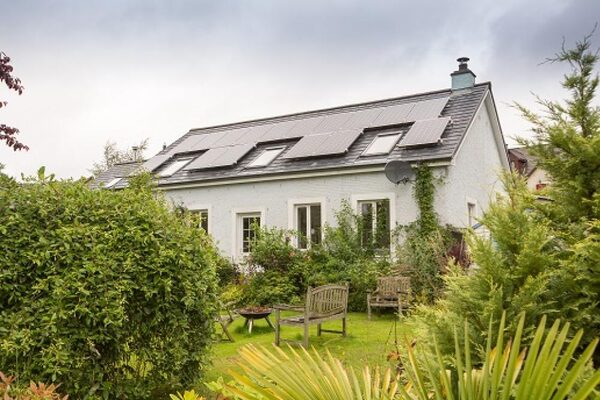
Most households that want independence keep the wire. Welsh Government guidance on behind-the-meter systems states that while not mandatory, a grid connection enhances the value of such systems by enabling the export of surplus electricity40. Parliamentary briefing reports that the Solar Roadmap states there is grid capacity available for an additional 10 GW of solar, should it be required41.
The export routes are Great Britain schemes. The Feed-in Tariffs scheme covered small-scale renewable and low carbon technologies up to a total installed capacity of 5 MW in Great Britain42, and the Smart Export Guarantee supports solar photovoltaics, wind, micro-combined heat and power, hydropower and anaerobic digestion up to 5 MW in capacity, or up to 50 kW for micro-CHP, with installations required to be located in Great Britain16. Households in Northern Ireland are outside both.
Building in stages, solar first, then storage, then heat, then a second generation source, keeps the fallback in place while self-consumption rises. The measurement of progress is set out on self-sufficiency ratio and self-consumption, and the honest answer on the end point is on can a UK home be completely energy self-sufficient.
What it costs: thinking in total cost of ownership
No published price for a domestic off-grid system appears in the evidence available here, so any figure would be invented: costs are installer-quoted and site-specific. What can be stated is the shape of the spend and the benchmark it is measured against.
The recurring cost that distinguishes off-grid from grid-tied ownership is battery replacement every six to 10 years7. Generation hardware, the charge controller and the inverter are largely one-off; the store is not. Backup fuel, annual servicing where a fuelled appliance is involved29, and eventual panel disposal into a recycling sector that amounts to a handful of companies beginning to use crushing techniques23 all belong in the same column.
The benchmark is what the household would otherwise pay. Under the Ofgem price cap for 1 October to 31 December 2025, annual electricity caps varied by region and payment method:
| Region and payment method | Nil consumption | At 3,100 kWh, single-rate |
|---|---|---|
| Southern, prepayment | £155.12 | £912.8043 |
| Yorkshire, prepayment | £203.87 | £928.8243 |
| East Midlands, other payment method | £170.63 | £925.0843 |
| N Wales and Mersey, other payment method | £243.15 | £1,061.6443 |
Separately, a benchmark maximum charge of £988.31 a year at 3,100 kWh on single-rate metering is published for Southern Scotland electricity44.
Two points follow. First, regional variation of well over £100 a year at the same consumption means the avoided cost of going off-grid is not the same everywhere. Second, electricity unit prices under the cap are 38% higher than in mid-202126, so the comparison shifts with policy and wholesale markets, not with the hardware. A fuller treatment is on how much an off-grid home system costs and what energy independence costs.
The dependence that remains
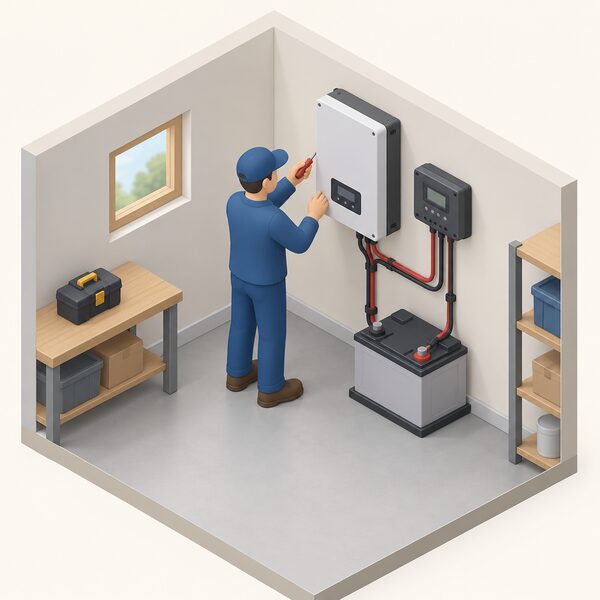
An off-grid house removes the supplier, the standing charge and, in the fully disconnected case, the wire. It does not remove dependence. What is left is a manufacturer, for inverters, controllers and a battery that must be replaced every six to 10 years7; an installer and a service technician; a fuel supplier if there is a generator or an oil-fired appliance29; and, often, an app or a cloud service for monitoring and control, the risks of which are set out on local control versus the manufacturer's cloud.
There is also the loss of the things the connection quietly provided. Regulated protections such as the £100 Guaranteed Standards payment for repeated cuts apply to connected customers30. The ability to import cheaply when the wind blows and renewables dominate the mix27 disappears with the meter. And the national system a household leaves is itself changing: coal has been phased out of UK electricity generation alongside ongoing expansion of the second largest national offshore wind capacity24, renewables were 51% of UK generation in 202445, and roughly 42% of the UK power grid is estimated to come from renewable sources with wind the biggest contributor46. Independence is a choice about who carries the risk, not an escape from risk. For the broader framework, see household energy independence in the UK and, for the parts of off-grid living outside electricity and heat, off-grid water, drainage and waste.
Sources46 cited
- Off-gas grid households, House of Commons Library, 2026-09-17
- LPG in the home, Liquid Gas UK, 2026-09-20
- Balancing the grid, Uswitch, 2026-02-09
- Off gas grid households briefing, House of Commons Library, 2024
- Scottish House Condition Survey 2023 key findings, Scottish Government, 2023
- Solar panel myths debunked, Which?, 2026-06-09
- Small wind turbines for consumers, MCS, 2026-08-18
- How does storage help us balance the grid, NESO, 2026-09-17
- MCS data dashboard glossary, MCS, 2026-07-23
- Written evidence on off-grid properties, UK Parliament, 2026
- Uptake of net zero technologies in Scottish homes, ECIU, 2026-06-22
- Hydroelectricity, Home Energy Scotland, 2026-09-20
- Home Upgrade Grant Phase 1 evaluation, GOV.UK, 2024-12-19
- Equality impact assessment for the Heat and Buildings Strategy, GOV.UK, 2023-03-01
- Energy Audit Committee report on home energy, UK Parliament, 2021-03-22
- Home energy efficiency schemes briefing, House of Commons Library, 2026-09-17
- Heat pump deployment tables Q2 2026, DESNZ, 2026-09-10
- Investing in Great British homes, E3G, 2024-07-04
- Customer service advice and guidance, National Grid, 2026-09-17
- Wind turbines, Energy Saving Trust, 2026-05-20
- What's in an energy bill: wholesale costs, Nesta, 2024-11-22
- Solar at the centre of new energy security measures, Solar Energy UK, 2026
- UK Solar Roadmap, DESNZ, 2025-06
- Progress in reducing emissions 2025 report to Parliament, Climate Change Committee, 2025-06-25
- Battery storage advice, Energy Saving Trust, 2026-08-19
- Domestic energy prices briefing, House of Commons Library, 2026-09-20
- Should I switch to a time of use tariff, Energy Saving Trust, 2026-01-23
- Why do you use generators, UK Power Networks, 2026-09-17
- Check your oil tank, nidirect, 2026-09-17
- Check if you can get a payment for a power cut, Ofgem, 2026
- Emergency power cuts, UK Power Networks, 2026-09-17
- Make a plan to be winter ready, UK Power Networks, 2026-09-17
- Electricity Safety, Quality and Continuity Regulations (NI), Article 27, legislation.gov.uk, 2026-09-17
- Solar panels planning guidance, Lambeth Council, 2026-09-17
- Solar power debate pack, House of Commons Library, 2024
- Solar panels and permitted development, Richmond Council, 2026-07-06
- Clifton local listed building consent order guidance, Bristol City Council, 2025-02
- Solar car parks and EV charging call for evidence, DESNZ, 2023-12
- Our climate action on buildings, Bristol City Council, 2026
- Behind-the-meter energy systems guidance, Welsh Government, 2026-06-29
- Rooftop solar POSTnote, UK Parliament, 2026-06-25
- Feed-in Tariffs guidance for licensed electricity suppliers, Ofgem, 2024-09-06
- Energy price cap levels 1 October to 31 December 2025, Ofgem, 2025
- Benchmark maximum charges for charge restriction period 13a, Ofgem, 2025
- Electricity generation debate pack, House of Commons Library, 2024
- Home energy efficiency key terms explained, Development Bank of Wales, 2024-10-17
 The Full Energy Independence GuideCan you really run your home on your own power in the UK, and how far can that go before the grid still matters?
 Off-Grid Water and WasteWhere does your water come from if there is no mains supply, and where does everything you flush away actually go?
 Off-Grid in a UK WinterHow does a home with no mains connection keep the lights on through the darkest, stillest weeks of a UK winter?
 Is Off-Grid Living Legal?Can you legally live without mains gas or electricity in the UK?
 Off-Grid System CostWhat does going off grid really cost, and what makes up most of that figure?
 Off-Grid SolarOff-grid solar means your home, cabin or boat runs on its own power, with no connection to the grid.