

In this guide
Most of the energy a British household burns or draws is a commodity bought on an international market, and a large share of it physically arrives from abroad. Gas and oil account for 78% of household energy costs in the UK, and 47% of that gas and oil relies on imports1. Imported gas alone makes up around 50% of the UK's natural gas supply3. Since 84% of domestic properties are connected to the gas grid, and natural gas accounts for 62% of household energy consumption, the exposure runs through the majority of homes rather than a minority4.
A typical dual fuel home gives the shape of it. The energy price cap is set against annual use of 9,500 kWh of gas and 2,900 kWh of electricity for a household in Great Britain, with a further reference figure of 12,000 kWh sometimes used for annual gas use6. Gas is therefore the larger volume by a wide margin, and gas is the fuel with the direct import link. Electricity is a step removed: about 42% of the UK power grid is estimated to come from renewable sources, with wind the biggest contributor, so the imported share of a unit of electricity is smaller and falling, though gas generation and interconnectors keep it from being zero7. Homes matter nationally as well as individually: a quarter of the UK's total energy consumption was spent in homes in 20238.
The figures below are drawn from official statistics, parliamentary briefings and independent analysis. Where documents disagree, as they do on the number of off-grid households and on the carbon saving claimed for LPG, both figures are given.
What counts as imported energy in a household
Imported energy, at household level, means the part of the gas, electricity and liquid fuel a home consumes whose origin is outside the UK, plus the much larger part whose price is set by international trading regardless of where the molecules came from. The distinction matters because a household can be buying North Sea gas and still pay a price driven by events in Asia or the Middle East. As one independent analysis puts it:
"Households' energy bills over the past two years have provided a stark reminder that much of the energy consumed in British homes does not originate in Britain and its price is often dictated by international markets"
The UK as a whole is described in official Treasury material as "a net energy importer with a high dependence on gas and oil"10. Household demand is a substantial part of that. Homes use around 35% of the UK's energy by one guidance figure, and were responsible for more than a quarter (26%) of overall energy consumption in 202211. Home heating alone accounts for around 14% of the UK's total greenhouse gas emissions on the most recent Ofgem statement, against 15% in the previous year's report12.
Three dependencies sit behind a bill. The first is the fuel itself: gas, oil or LPG, whose price responds to global supply. The second is the delivery system: a gas main, an electricity network, or a road tanker. The third is the supplier relationship, including contract terms and, for LPG, tank ownership. Reducing one does not automatically reduce the others, which is why the self-sufficiency ratio and similar measures are worth separating from bill savings.
Affordability is the visible end of this exposure. Required energy costs took 6.8% of household income across all households in England on the 2025 provisional figure14, and 4.93 million households in England were spending more than 10% of income on domestic energy after housing costs in 202115.
Mains gas and electricity: the grid-supplied majority
Gas dominates. In the UK, 84% of domestic properties are connected to the gas grid4, a figure also given as 85%, or about 24.5 million homes plus over two million businesses16, and as approximately 23 million (85%) of dwellings using gas boilers for heating or hot water17. In England specifically, the gas network provides for some 85% of dwellings18. Nearly three quarters of UK homes are heated by gas19. The small spread between 84% and 85% reflects different base years and definitions rather than a real disagreement.
Electricity is the smaller half of the typical bill by volume: electricity accounts for a quarter of domestic energy use20, and the price cap reference of 2,900 kWh of electricity against 9,500 kWh of gas shows the same ratio at household level6. Only 8.6% of homes are heated by electricity, whether by traditional storage heaters or modern heat pumps16.
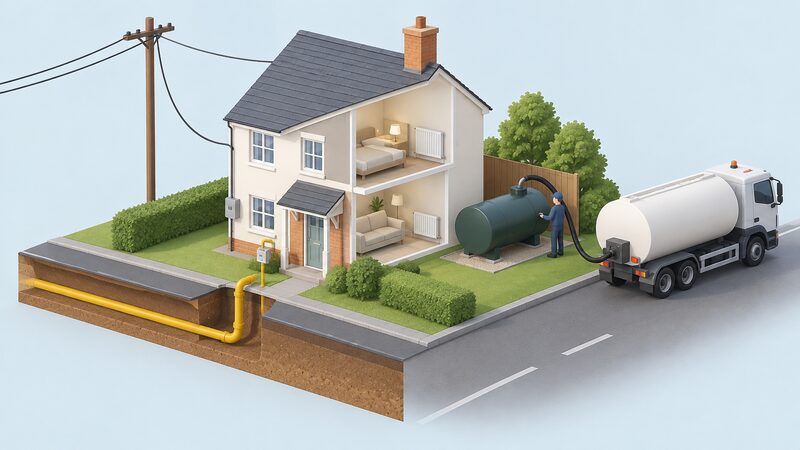
For import dependence, the split matters. Gas is bought on a market where imports make up around 50% of supply3, so a gas heated home carries close to that exposure on the larger part of its energy. Electricity carries a diluted exposure because about 42% of the grid is renewable7. This is the arithmetic that makes electrification of heat the single largest lever on a household's imported fraction, and it is also why the state of the winter gap between generation and demand determines how much of that dilution actually holds in January.
The price context: the price cap set an energy bill for a dual fuel home with typical usage in Great Britain paying by direct debit at around £1,758 for the period 1 January to 31 March 202621.
Off-grid households: how many, and where
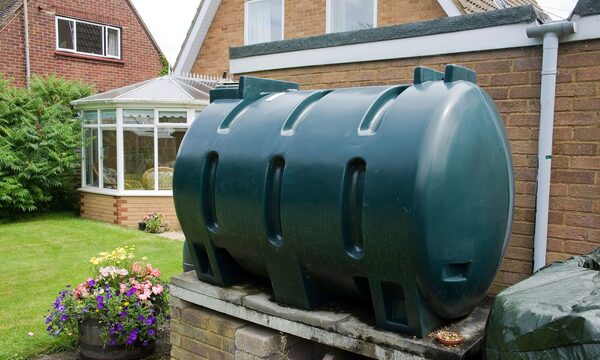
Households with no mains gas connection carry a different kind of dependence, on deliveries rather than a pipe. The counts differ between documents, and the difference is not trivial.
| Source type | Figure | Coverage | Period |
|---|---|---|---|
| Official statistics | 4.8 million households, 16.0% of domestic properties22 | Great Britain | 2024 |
| Parliamentary briefing | Four million UK households (15%)23 | UK | as published |
| Written evidence | Approximately 15% of the 28 million properties in the UK24 | UK | 2026 |
| Independent statistics | More than four million off-gas homes25 | England, Wales, Scotland | 2021 |
| Independent guidance | Some two million properties off-grid26, and some four million properties in a second document from the same body4 | UK | 2026 |
| Independent guidance | More than one million homes not connected to the gas grid27 | UK | 2025 |
The official statistics figure of 4.8 million for Great Britain in 2024 is the most recent and the most clearly defined, and the liquid gas trade body's own pages disagree with each other, giving two million on one page and four million on another26.
Regional variation is wide. Off gas grid households were 19.5% of domestic properties in Wales, 26.6% in Inner London and 14.9% in Outer London in 202422. The London figures reflect flats on electric heating rather than rural isolation, which is a reminder that off grid does not mean remote. In Scotland, over 450,000 homes do not use gas as their primary heating fuel29. Northern Ireland is not covered by the Great Britain statistics, and oil use there is notably high.
What these households have in common is that they buy energy in batches, hold a stock on site, and cannot switch supplier at a month's notice. That is a form of storage independence and a form of contractual dependence at the same time.
Oil boilers: the default off-grid heating fuel
Around 1.5 million UK homes use oil for heating, including many in Northern Ireland30. Heating oil is bought by the tankerload and stored in a tank owned by the household, which distinguishes it from LPG.
Cost sits well above mains gas. The UK average cost of heating a typical three bedroom house is around 50% higher with heating oil than with mains gas23. One official assessment used 7.0p per kWh for oil based on recent local prices18. But the delivered price is volatile in a way a capped gas tariff is not: between the end of February and mid March 2026 the average price of home heating oil in the UK increased by over 100%, from approximately 60 pence per litre to over 120 pence per litre31. A household that fills a tank in the wrong fortnight pays the whole of that swing at once, and there is no price cap over it.
Support has been correspondingly thin. Scottish Government material described UK Government support for oil heated households as equating to only £33 per household using oil heating32.
For independence, an oil boiler gives a genuine buffer: a full tank is weeks of heat that no supplier can interrupt. What it does not give is price security or a route away from imports, because the fuel is a refined petroleum product priced internationally. The plan's premise of a wide annual cost range for oil heated homes is not something the available official figures pin to a single number; the cost comparison that can be stated is the 50% premium over mains gas23.
LPG: delivered by road, and the most expensive of the common fuels
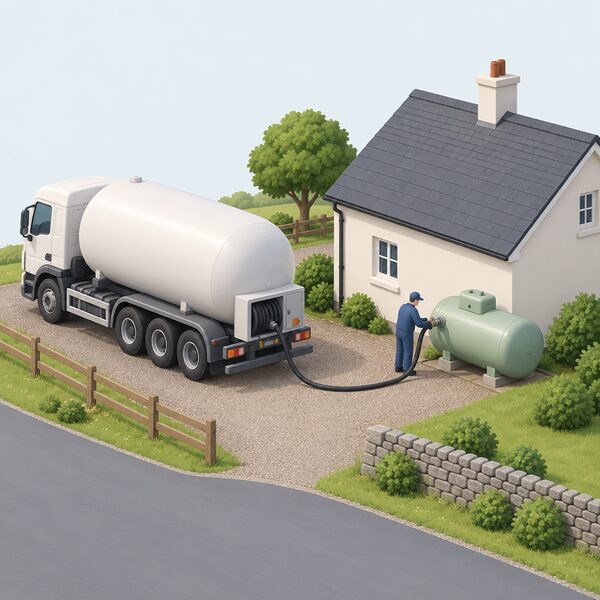
LPG is delivered by road and stored in a tank rather than being piped directly into the home30. Around two hundred thousand UK households use it by one independent count30, and 193,000 homes by the trade body's figure4.
It is the costliest mainstream option. Heating a typical three bedroom house costs around 100% more with LPG than with mains gas23. Standard fuel prices effective from 1 January 2026 give bulk LPG at 9.60p per kWh and bottled LPG at 12.01p per kWh34. Estimated annual heating costs for a three bed semi detached house on bulk propane were £1,800 to £2,200 in March 202622. A litre of LPG converts to 7.1 kWh, and in July 2025 it cost an average 57p per litre according to Sutherland Tables30. An average medium use household needing around 11,500 kWh per year for heating was estimated at around £923 per year on LPG in the same guidance30, which sits below the March 2026 range above; the two figures rest on different usage assumptions and different dates.
On tank ownership, the trade body states plainly:
"unlike liquid fuel tanks, the tank is usually owned by the company that supplies the gas"
Households may need to buy or rent the tank from the supplier, which adds to the cost, and on switching must transfer ownership of the tank to the new supplier or have a new tank installed30. Homeowners are usually tied into long contracts, which limits the options when looking for a better deal35. That is the sharpest loss of independence among the delivered fuels: the fuel, the vessel and the contract come from one company.
On carbon, the trade body's own pages disagree. Liquid Gas UK states LPG emits 35% less CO2 than coal and 12% less than oil4, while its bioLPG page gives 33% less than coal and up to 20% less than oil36. An independent guide states only that LPG has lower carbon emissions than oil37. These are supplier side claims about the fuel in use.
Regulatory treatment reflects the small improvement. In a worked example for replacing an oil fired boiler, an LPG boiler gave 1.23 kWhPE per kWh under the England and Wales primary energy test and 1.075 kWh per kWh heat output under the Scottish delivered energy test, both judged acceptable18. One case study of a pre 1918 rural home, said to represent 227,000 rural properties in Great Britain, found a switch to LPG to be £16,000 cheaper in upfront costs than a heat pump or biomass system36, a trade body figure and an upfront comparison only.
Biomethane: domestic gas inside the existing network
Biomethane is the one route that reduces a gas connected household's import exposure without changing anything in the house. It is injected into the existing network and burned in ordinary appliances. There are 128 biomethane sites connected to the gas grid with the capacity to heat one million homes, and enough biomethane already in the system to heat 20,500 homes in Somerset and 950,000 homes across the gas networks38. An industry body states there is already enough biomethane flowing through the network with capacity to heat up to one million homes39.
The ceiling is what matters for a household. The same industry body notes that 50TWh of biomethane would represent 14% of the UK's current gas demand, and separately refers to volumes equal to the heating demands of over 10 million homes at a larger scale of deployment39. Against around 24.5 million homes on the gas grid16, today's connected capacity of about one million homes is a small fraction, and no household can buy a physically biomethane supply: the gas is blended into a shared network.
By comparison, the Domestic Renewable Heat Incentive's renewable heat output was described by Ofgem as enough to heat almost 770,000 typical UK homes for a year40. Both are scheme scale numbers, not household guarantees.
For independence, biomethane reduces the national imported fraction of gas rather than the household's dependence on the gas grid, a supplier and a meter. It is worth distinguishing from actually disconnecting from the gas grid, which changes the household's position entirely.
Heat pumps: replacing deliveries with one electricity import

A heat pump converts a delivered fuel dependence into an electricity dependence, and does so at a multiple. Official guidance states that for every unit of electricity they use, heat pumps typically produce three to four units of heat41, and an independent guide cites the Energy Saving Trust figure of around 300% efficiency37. An air to water system transfers heat drawn from the surrounding air to water in a wet central heating system42; note that an air to air system is not considered a renewable system in ECO442.
Deployment is still small. Heat pumps are installed in 1% of UK homes43, and domestic heat pump electricity consumption was 169 ktoe in 2024, over four times the level a decade earlier in 201444. The Climate Change Committee's pathway would put approximately 10% of existing homes on heat pumps by 203045, 52% by 2040 against around 1% in 202315, and at least half but likely closer to 80% of homes by 205043.
Suitability is less of a barrier than often assumed. Official material states that 90 per cent of British homes have sufficient insulation and electrical capacity for a heat pump17, and a Public Accounts Committee report records that 80% to 90% of UK homes do not need additional insulation for a heat pump to work effectively46.
The dependence that remains is the electricity network, the supplier and the generation mix. Around 42% of the grid is renewable7, so a heat pump does not eliminate imported energy from the heating bill; it shrinks the quantity of energy bought and moves the residual exposure from a directly imported fuel to a partly domestic one. Sizing that electrical demand alongside any on site generation is covered in sizing generation and storage and whole-home system design.
What each route does to a household's imported fraction
Modelling for 2030 gives the clearest single comparison. A typical household without upgrades would use as much energy as today and rely on over 20MWh of imported energy, an increase of 3MWh (20%), even if new licences increased production. A household at EPC C with an electric heat pump and an electric vehicle would require only 3.4MWh of primary energy imports per year9. Households with a heat pump and an electric vehicle are described as far less dependent on foreign oil and gas imports and as making more use of British electricity1.
| Route | Direct import exposure | What dependence remains |
|---|---|---|
| Mains gas boiler | High: gas is 62% of household energy consumption5 and around 50% of supply is imported3 | Gas grid, supplier, international gas price |
| Heating oil | High: a refined petroleum product, and around 50% dearer than mains gas23 | Deliveries, tank refill timing, price swings of over 100% in weeks31 |
| LPG | High, and around 100% dearer than mains gas23 | Supplier owned tank, long contracts35 |
| Biomethane in the grid | Lower nationally, capped at connected capacity for about one million homes today38 | Gas grid, supplier, blended supply |
| Heat pump on grid electricity | Lower: three to four units of heat per unit of electricity41, grid about 42% renewable7 | Electricity network, supplier, generation mix |

No route removes dependence outright. Gas and oil still account for 78% of household energy costs nationally2, and the UK remains a net energy importer with a high dependence on gas and oil10. Fuel switching changes which market a household is exposed to and how much energy it needs to buy; it does not end the relationship with a network or a supplier. Only on site generation, storage and, at the extreme, going off-grid change that, and each carries its own costs, set out in what energy independence costs. The broader picture is in the household energy independence guide.
Sources47 cited
- Household energy: buying British, Energy and Climate Intelligence Unit, 15 April 2024
- EVs and heat pumps cut UK fossil fuel consumption, Ember, 21 October 2024
- Smart meters and energy security, Smart Energy GB, 8 April 2026
- LPG in the home, Liquid Gas UK, 20 September 2026
- Green energy statistics, Uswitch, 12 November 2024
- What is the energy price cap, Energy Saving Trust, 7 September 2026
- Home energy efficiency key terms explained, Development Bank of Wales, 17 October 2024
- How different households use energy, Nesta, 2023
- Household energy security in 2030, Energy and Climate Intelligence Unit, 2024
- Spring Statement 2022, HM Treasury, March 2022
- Retrofit your home, TrustMark, 20 September 2026
- Domestic RHI annual report, scheme year 11, Ofgem, July 2025
- Domestic RHI annual report 2023-24, Ofgem, July 2024
- DESNZ annual report and accounts 2025 to 2026: performance report, Department for Energy Security and Net Zero, 2025
- Heating our homes: Energy Security and Net Zero Committee report, House of Commons, 2021
- Decarbonisation of heat, Energy Systems Catapult, 27 June 2025
- Domestic hybrid heat pumps, UK Government, November 2016
- Building regulations discussion document and pre-consultation, Department of Finance Northern Ireland, 11 October 2023
- Energy UK explains the April 2025 price cap rise, Energy UK, 20 February 2025
- What's in my energy bill, Energy and Climate Intelligence Unit, 1 September 2021
- Energy price cap explained, Climate Action Wales, 2026
- Households off the gas grid, briefing CBP-9838, House of Commons Library, 2024
- Heating off the gas grid, briefing SN05806, House of Commons Library, 17 September 2026
- Written evidence on off-grid properties, UK Parliament, 2026
- Renewing Britain report, MCS, September 2021
- New to LPG, Liquid Gas UK, 20 September 2026
- The best heating for your home, Which?, 22 September 2025
- Off gas grid households briefing page, House of Commons Library, 2024
- Heat in Buildings Strategy consultation, Scottish Government, 5 February 2021
- LPG central heating, Which?, 22 September 2025
- Home heating oil prices, briefing CBP-10609, House of Commons Library, 2026
- Help for households using heating oil, Scottish Government, 16 March 2026
- Boilers and heating: building regulations, Planning Portal, 2026
- SAP 10 fuel prices from 1 January 2026, BRE Group, 1 January 2026
- Heating options off the grid, OFTEC, 20 September 2026
- BioLPG, Liquid Gas UK, 20 September 2026
- Heating fuel guide, Uswitch, 27 January 2026
- Cheese-making farm could show the whey to net zero, Wales and West Utilities, 3 March 2025
- The role of biomethane in reaching net zero, IGEM, May 2025
- Domestic RHI annual report April 2023 to March 2024, Ofgem, 31 July 2024
- Heat pumps: expert guide for homeowners, Development Bank of Wales, 7 November 2024
- ECO4 new measures and products guidance, Ofgem, 26 March 2026
- Heat pumps POSTnote, Parliamentary Office of Science and Technology, 19 September 2026
- Energy Consumption in the UK 2025, Department for Energy Security and Net Zero, 2025
- UK off track for net zero, say the country's climate advisors, Climate Change Committee, 18 July 2024
- Public Accounts Committee report on decarbonising home heating, House of Commons, 26 May 2024
- Planning permission for air source heat pumps, Planning Portal, 17 September 2026
 Household Energy ConsumptionHow much gas and electricity does a typical UK home use in a year?
 The Full Statistics GuideHow many homes in the UK have solar panels, heat pumps or batteries?
 Data and Energy IndependenceHow many UK homes actually make their own power, and is that number really growing?
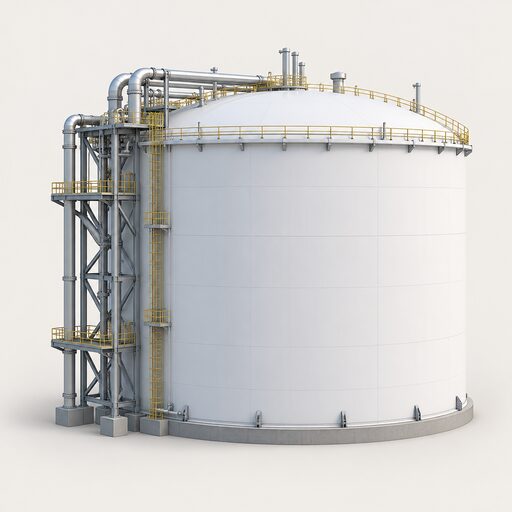 LNG Imports and TerminalsHow much of Britain's gas arrives by ship, where does it come from, and why does a damaged plant in Qatar or a storm of bidding in Asia change what a household pays?
 Cost of Energy IndependenceA heat pump and better insulation are the usual starting point, but what does the whole job really cost, and what help is there with the bill?
 The Full Where Our Energy Comes From GuideWhere does the gas in your boiler and the electricity in your sockets actually come from?