

In this guide
A community energy project stands or falls on whether the group can secure the ground or the roof it wants to generate from. There is no general power to force a private landowner to sell for an energy scheme. What exists instead is a set of request routes against public bodies, a planning system that decides what may be built, and a private law of leases, wayleaves and covenants that decides who may cross whose land.
The strongest statutory route sits in Scotland. Community Asset Transfer is a mechanism through which community organisations have a right to request to take over publicly owned land or buildings that they feel they can make better use of for local people, and the Community Asset Transfer Scheme sets out how groups can buy or lease sites on the national forests and land to benefit their communities1. Those community empowerment rights apply to all land and buildings managed by Forestry and Land Scotland1. In England, neighbourhood planning lets a community grant planning permission directly under certain circumstances, so a group with a made neighbourhood plan may not have to go through the normal planning permission process for building projects that benefit the local community and have community support2.
The limits are as important as the rights. A community cannot compel a private sale, permitted development rights are withdrawn on designated land and around listed buildings, and a group that does not own its site depends on a lease that will eventually end. The sections below set out the routes, the consents, the money and the risks, and what each means for a household's or a village's energy independence.
What the community right to buy means for energy projects
The phrase covers two different things, and confusing them wastes a group's time. The first is a right to request transfer of a publicly owned asset. In Scotland that is Community Asset Transfer, which applies to all land and buildings managed by Forestry and Land Scotland, and the associated Community Asset Transfer Scheme sets out how groups can buy or lease sites on the national forests and land1. The second is the planning route: in England, neighbourhood planning lets a community grant planning permission directly under certain circumstances, and where a project benefits the local community and has community support, a group may not have to go through the normal planning permission process2.
Neither is a right to buy in the ordinary sense. A request can be refused, and the terms of any transfer are negotiated with the body that holds the asset. For an energy project the practical consequence is that the site is the first constraint, not the technology. A group that has identified a rooftop or a field but has no route to control it cannot proceed to generation, whatever the planning position.
There is a further limit that shapes what a community can do with the power once it has the site. Independent guidance notes that there are regulatory and legal challenges that make it difficult for smaller generators to sell power locally without becoming a licensed supplier, the costs of which are huge5. A community that secures land and builds generation may still find that the electricity it produces has to be sold through established routes rather than directly to neighbours. That does not remove the value of the asset, but it changes the business case: the return comes from generation and export, not from a local retail supply business.
For a household, the significance is indirect but real. A community scheme that owns its site outright, or holds a long lease, can offer members a stake in generation that is not tied to their own roof, their own orientation or their own landlord. That is a form of energy independence that does not depend on the property a household happens to occupy. The dependence that remains is on the grid for export and import, on a licensed supplier for settlement, and on the terms of whatever lease or transfer agreement the community signs.
Land and building rights: the options a community group has
A group has four broad ways to control a site, and they carry different levels of security.
- Freehold purchase or asset transfer. The strongest position. In Scotland, Community Asset Transfer covers all land and buildings managed by Forestry and Land Scotland, and the Community Asset Transfer Scheme sets out how groups can buy or lease sites on the national forests and land1.
- Lease. Common for roofs and for land where the owner will not sell. The term, rent review, break clauses and removal rights determine whether the project can recover its costs.
- Licence or wayleave. Suitable for a cable crossing third-party land or a small rooftop array, but weaker than a lease and usually terminable.
- Planning-led control. In England, neighbourhood planning lets a community grant planning permission directly under certain circumstances, which can make a site viable even where ownership sits elsewhere2.
Alongside these sit the permitted development rights that decide whether a structure needs an application at all. Permitted development is a national right for homeowners to make improvements and alterations without planning permission, and it is a form of planning permission granted through legislation rather than a grant from a case officer6. The renewable energy rights are set out in Schedule 2, Part 14 (Renewable energy) of the Town and Country Planning (General Permitted Development) Order 2015, as amended8. Those rights are written around dwellings and their grounds, which is why a village hall or a farm building usually needs a different analysis from a house.
Other permissions can also bite. Official guidance lists ancient monuments, covenants and private rights, wildlife and protected species, the party wall and rights of way among the approvals some building work may require9. A community scheme that crosses a footpath, disturbs a protected species or relies on a right of way needs those consents in addition to planning permission, and they are held by different bodies.

How a community buys land or a building for an energy project
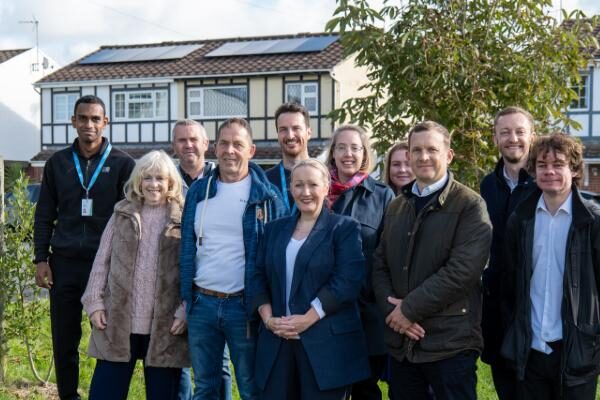
The process is a sequence of gates, and each one can stop the project.
- Identify the asset and the holder. For public land in Scotland, the Community Asset Transfer route applies to all land and buildings managed by Forestry and Land Scotland1. For other public assets, the holder sets its own procedure.
- Establish the planning position. Check whether the proposal falls within permitted development, which is a national right for homeowners to make improvements and alterations without planning permission, or needs an application6. Renewable energy rights sit in Schedule 2, Part 14 of the GPDO 2015 as amended8.
- Check the other consents. Ancient monuments, covenants and private rights, wildlife and protected species, the party wall and rights of way may all require approval9.
- Agree terms. Purchase, lease or licence, with the term and exit provisions that match the project's payback.
- Secure the money. Grant, share offer or community fund, in that order of certainty for most groups.
- Build and operate. The point at which the asset starts producing.
The timetable is not fixed nationally. The nearest published figure is from a grant programme rather than a land transfer: the timeline between initial application and completion of works can take anything from 3 weeks to several months, depending on installers' schedule and capacity10. Land transfers and leases run to their own clocks, set by the body holding the asset.
Where a group is buying rather than requesting, the transaction is ordinary property law with an energy purpose attached. The complications come from the consents that run with the land: a covenant restricting use, a right of way across the access track, or a protected species on the site can each add cost and delay. A group that prices the site without pricing those consents will find the budget short.
Site selection: what makes land or a roof suitable
Suitability has three layers: what the planning system allows, what the building or ground can physically take, and what the grid will accept.
On planning, permitted development rights do not apply to a turbine within the curtilage of a listed building or within a site designated as a scheduled monument, or on designated land other than conservation areas, where designated land includes national parks and the Broads, Areas of Outstanding Natural Beauty, and World Heritage Sites11. The same exclusion applies to building-mounted turbines, and a block of flats must consist wholly of flats and should not also contain commercial premises11. Where permitted development does not apply, a domestic wind turbine needs an application to the local authority13.
On the building itself, the Welsh building regulations require that when a dwelling or a building containing a dwelling is erected, a system for renewable electricity generation must be installed on-site, designed to enable any electricity generated to be available for use of residents and capable of generating a reasonable output, subject to exclusions for relevant buildings and where installation is not possible14. Sizing that system depends on the on-site energy demand, the capacity and nature of the available infrastructure including export limits set by the District Network Operator, the relationship between export limits, the level of generation and on-site energy demand, and other characteristics of the site15. Those factors apply equally to a community array: the export limit is often the binding constraint, not the roof area.
On the ground, the Welsh Government has recommended support for communities to develop smart local energy systems where these could help balance supply and demand or provide a solution where grid capacity is constrained16. That is a policy signal rather than a permission, but it points to the same conclusion: a site with constrained grid capacity may still be viable if the generation is matched to local demand rather than exported.
Planning permission and landowner agreements
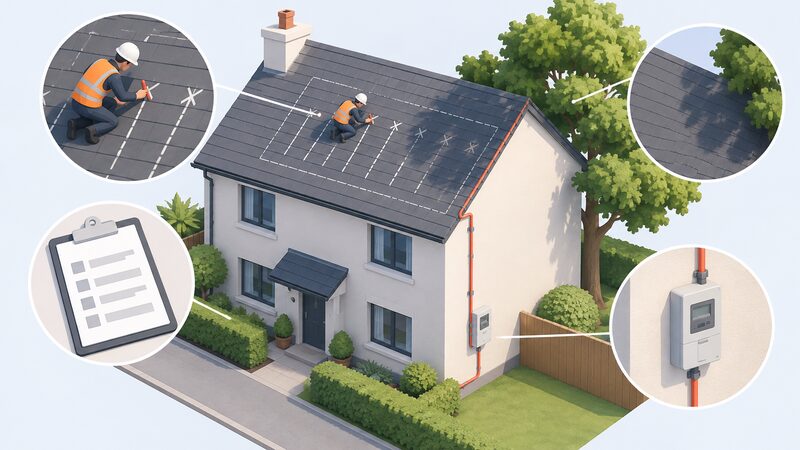
Planning permission and private agreement are separate requirements, and a group needs both. Planning permission includes landscaping considerations, and changes to buildings are likely to require it17. Householder planning consent covers projects such as porches, which shows the scale at which the householder route operates19. For anything larger, the application goes to the local planning authority.
The landowner agreement is the private half. A cable crossing third-party land needs the landowner's consent, normally as a wayleave or easement, and official guidance lists covenants and private rights, the party wall and rights of way among the approvals some building work may require9. Where the building is listed, consent is required for adding solar panels to the building or curtilage, and for extensions20. That consent is separate from planning permission and from building regulations approval.
Who signs the application depends on who holds the interest. An application must be made to, and determined by, the local planning authority21. Where a scheme is delivered through a collective buying model, it is the resident's responsibility to provide any drawings or information required for a submission via the Planning Portal8. A community organisation that owns or leases the site signs as applicant; the authority decides. Where the site is publicly owned and the transfer is still in progress, the applicant's identity needs settling before submission, because the authority will correspond with whoever is named.
Ownership structures: which legal form fits which project

The legal form follows the asset and the money. A group taking on a publicly owned building through Community Asset Transfer needs a body capable of holding a lease or freehold, and the Scottish route applies to all land and buildings managed by Forestry and Land Scotland1. A group running a generation scheme with members needs a form that can issue shares and hold an asset on behalf of those members.
The delivery landscape is broader than community groups alone. Smart Local Energy Systems can be delivered by community energy organisations, social enterprises, public sector bodies, and SMEs developing innovative approaches22. That matters for structure: a project may be delivered by a community benefit society, a community interest company, a local authority or a partnership, and the choice affects who can hold land, who can raise grant, and who carries liability.
Public bodies have their own development rights. Permitted development rights allow local authorities to build dwellings which conform to a local development plan, and local authorities can build dwellings which conform to a local development plan23. A council-led energy scheme therefore sits inside a different planning framework from a community-led one, even on the same site.
For a household, the structure determines what the stake actually is. A share in a community benefit society is a membership interest with the rights the society's rules give it. A lease held by a community interest company is an asset of that company. Neither is the same as owning panels on your own roof, and neither gives a household direct control over the generation. What it gives is a claim on a local asset, and the security of that claim depends on the rules and the lease term, not on the technology.
Raising the money: shares, grants and community funds
Community energy is funded from three main sources, and they carry different conditions.
Grants come first for most groups. The Warm Homes: Social Housing Fund Wave 3 allows lead grant recipients to claim grant funding from 1 April 2025, provided they have signed a Grant Funding Agreement and complied with clause 4 obligations, and phase requests should all be submitted by 30 September 20273. That is a social housing programme rather than a community generation fund, but it shows the shape of public funding: a signed agreement first, claims after, and a hard submission date.
Local authority funds operate on their own cycles. The Warm Homes Local Grant reports that the timeline between initial application and completion of works can take anything from 3 weeks to several months, depending on installers' schedule and capacity10. Energy supplier schemes and grants can cover energy costs, paying off energy debt, and making energy-saving improvements to your home25. Local councils may also offer support with home or business energy bills25.
Shares are the other route, and they are the one that gives households a direct stake. The regulatory limit noted earlier applies here: it is difficult for smaller generators to sell power locally without becoming a licensed supplier, the costs of which are huge5. A share offer therefore usually funds generation that exports or sells through established routes, rather than a local retail supply business.
Working with landowners, councils and developers
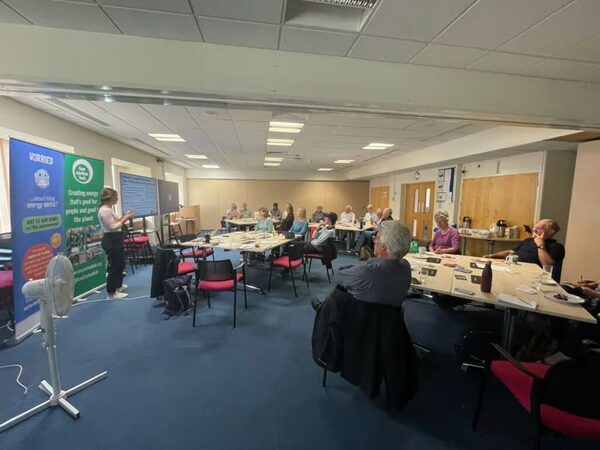
Support exists, and it is concentrated in Scotland. The Community and Renewable Energy Scheme has a network of development officers across Scotland to provide free, expert and impartial advice and support to community groups, charities and other eligible organisations seeking to explore their renewable energy options1. That is advice on options, not a grant or a site.
On the developer side, the Scottish Government has set up a pilot scheme to provide new opportunities for communities to benefit from renewable energy developments, and has identified ten onshore wind sites under 50 megawatts on public land to pilot this approach1. Repowering of existing wind farms is the mechanism: as older sites reach the end of their life, the opportunity to re-equip them can be shared with the community that hosts them.
Councils appear in two roles. As planning authority, the council determines applications, and an application must be made to, and determined by, the local planning authority21. As asset holder, a council may transfer land or buildings through a Community Asset Transfer route, which is a mechanism through which community organisations have a right to request to take over publicly owned land or buildings that they feel they can make better use of for local people1. The two roles are separate, and a group should not assume that a sympathetic asset holder translates into a smooth planning decision.
The Welsh policy position adds a further dimension. The Welsh Government has recommended providing support for communities to develop smart local energy systems where these could help balance supply and demand or provide a solution where grid capacity is constrained16. Where a developer's connection is constrained, a community scheme matched to local demand may be the workable option, and that changes the negotiation: the community is offering a solution to a grid problem, not asking for a share of someone else's project.
Where community projects fall short: limits and risks
The limits are structural, and they do not disappear with a better business plan.
- No power to compel a private sale. The statutory routes are requests against public bodies. Community Asset Transfer is a right to request, and the Scottish scheme covers sites on the national forests and land1.
- Local supply is hard. It is difficult for smaller generators to sell power locally without becoming a licensed supplier, the costs of which are huge5.
- Permitted development is withdrawn in sensitive locations. Rights do not apply within the curtilage of a listed building or scheduled monument, or on designated land other than conservation areas11.
- Consents multiply. Ancient monuments, covenants and private rights, wildlife and protected species, the party wall and rights of way may all require approval9.
- Leases end. The asset reverts unless the agreement says otherwise, and local policy can change what a site may be used for: local authorities would be able to remove permitted development rights and require full planning permission where they can demonstrate that uncontrolled short term lets would undermine sustainable communities26.
- Support material ages. Some official guidance on community groups and energy efficiency activities dates from 2013 and carries an accessibility warning that the file may not be suitable for users of assistive technology27.
The dependence that remains after a successful project is real. The community depends on the grid for export and for settlement, on a licensed supplier or an offtaker for the sale of power, and on the terms of a lease or transfer that it did not write. A household that joins such a scheme gains a stake in local generation but not control over it. That is a different proposition from installing your own solar, where the household holds the asset and the export agreement directly.
Deadlines and funding rounds to watch

Dates matter more than intentions in this field, and several are fixed.
- Warm Homes: Social Housing Fund Wave 3. Lead Grant Recipients can claim grant funding from the 1st April 2025, provided they have signed a Grant Funding Agreement and complied with clause 4 obligations, and Phase Requests should all be submitted by 30th September 20273.
- Permitted development rights to support the provision of new homes. The consultation ran from 3 September 2025 to 27 October 2025, and responses were to be submitted before the closing date of 27 October 202528.
- Changes to various permitted development rights. The consultation on demolition and rebuild, building upwards, electric vehicle charge points and air source heat pumps closed on 9 April 202430.
- Warm Homes: Local Grant. Local authorities had to apply for the funding by 1 December 202422.
The pattern across these dates is that the planning framework is in motion. The consultation on permitted development rights to support the provision of new homes covered potential measures to simplify planning processes and encourage the provision of new homes in rural areas and town and city centres, including options related to domestic air source heat pumps and heat network connections29. A Scottish consultation proposed a condition that the ground surface must be restored to its original condition or appearance following any work connected to a heat network connection29. Groups planning a site should expect the rules around them to change during the project's life.
The wider context is a target rather than a deadline: the community energy target is reported as 8 GW by 20304. That figure sets the scale of ambition, not the terms of any individual scheme. For a household or a village, the practical question remains the one this page opened with: who controls the land, what the planning system allows on it, and what the agreement says when the term ends. The routes described here, from community energy funding to community energy share offers, all rest on that foundation.
Sources30 cited
- Local and small scale renewables, Scottish Government
- When you don't need planning permission, GOV.UK
- Warm Homes: Social Housing Fund Wave 3 scheme guidance addendum, GOV.UK, 2026-06
- Community energy capacity target, UK Parliament
- Community energy delivers affordable power, Energy Saving Trust, 2025-09-22
- Permitted development, London Borough of Redbridge
- Permitted development rights consultation, Scottish Government, 2025-09
- Solar Together domestic planning guidance, Southampton City Council
- Building regulations approval for homeowners, Solihull Council
- Warm Homes Local Grant, Surrey County Council
- Building-mounted wind turbines, Planning Portal
- Stand-alone wind turbines, Planning Portal
- Wind turbines, Planning Portal
- Building Regulations Approved Document L Volume 1, Welsh Government, 2026-04
- Approved Document L frequently asked questions, GOV.UK, 2026-09-08
- Preparing Wales for a renewable energy 2050, Welsh Government, 2023-10
- Difference between building regulations and planning permission, Planning Portal
- Find out if you need planning permission, Buckinghamshire Council
- Householder planning consent, Planning Portal
- When consent is required, Buckinghamshire Council
- Solar photovoltaics and planning in conservation areas, West Suffolk Council
- £129 million to support Welsh communities transition to renewable energy, Welsh Government, 2025-09-17
- Permitted development rights to support provision of new homes consultation, Scottish Government, 2025-09-03
- Permitted development rights to support provision of new homes consultation, Scottish Government, 2025-09-03
- Get help with your energy bills, Ofgem, 2026-09-17
- Permitted development rights, Cornwall Council
- Role of community groups in smart metering-related energy efficiency activities, GOV.UK, 2013-03-25
- Permitted development rights to support provision of new homes: summary of responses, Scottish Government, 2026-03-10
- Permitted development rights to support the provision of new homes, Scottish Government, 2025-09-03
- Changes to various permitted development rights consultation, GOV.UK, 2024-02-13
 Community Energy in the UKWhat community energy means in practice, the legal structures used, and the types of project householders can join or benefit from.
 Community Energy Share OffersHow community energy share offers work in community benefit societies and co-operatives, what returns and risks are stated, how withdrawal works, and how owning shares differs from owning generation on your own roof.
 Community Energy in NICan a community group in Northern Ireland sell power to its neighbours, and is there funding to get a project off the ground?
 Permitted Development RightsDo you need planning permission for solar panels or a heat pump?
 Community Energy in EnglandCommunity energy lets neighbours own their own power together, often through solar panels, and share the money it makes.
 Building-Mounted Wind TurbinesWill a wind turbine on your roof actually make enough electricity to be worth it?