
In this answer
Short answer
Green Wedmore is a village group in Somerset, established in 2006 in response to the climate and nature emergency, that aims to explore, develop and implement initiatives to encourage and facilitate sustainable living in the village and surrounding areas1. Its best-known output is a village-level zero carbon report, funded by local fundraising in 2018 after members heard about the Centre for Alternative Technology's Zero Carbon Britain project, and launched a year later at the local church1.
The scale is small and specific: Wedmore is a community of 3,000 people working towards becoming a zero carbon village1. That is the whole point of the exercise. Where national targets are set in decades and gigawatts, a parish target is set in working groups, cookbooks, festivals and retrofit advice, and it is measured against a parish boundary rather than a national grid.
For a household, the interest is not the target date but the method. Green Wedmore's zero carbon ambition is focused on six areas, energy, food, transport, wellbeing, housing, and carbon and nature, with a working group dedicated to each area1. That structure is what a village-scale independence project looks like in practice, and it is also where its limits show: a parish group can advise, measure and convene, but it does not own the wires, the gas mains or the planning system.
What Green Wedmore is and what it aims to do
Green Wedmore was established in 2006 in response to the climate and nature emergency1. Its stated aim is to explore, develop and implement initiatives to encourage and facilitate sustainable living in the village and surrounding areas1. That wording matters: the group describes itself as exploring and facilitating rather than delivering infrastructure, which places it in the same family as the community energy and climate action groups that work through advice, measurement and local convening rather than through owning generation assets.
The village context is a community of 3,000 people working towards becoming a zero carbon village1. A parish of that size has no direct lever over the electricity grid, the gas network or the price of imported fuel. What it can do is reduce what its households and buildings demand, change what they buy locally, and measure what its land takes up. Green Wedmore's six working groups map onto exactly those levers.
It is worth being clear about what this kind of group is not. It is not a supplier, not a network operator and not a grant scheme. Households looking for funded energy efficiency measures in Wales, for example, deal with Green Homes Wales, a Welsh Government initiative managed by the Development Bank of Wales, which supports eligible homeowners in making energy-efficiency and low carbon heat improvements to their homes3. In England there is no equivalent single national scheme described in the same terms, and support is spread across supplier obligations and local authority programmes. A village group sits alongside all of that, not in place of it.
The independence a parish group can build is therefore partial and social rather than technical. It can raise the take-up of measures, keep money circulating locally through food and trade, and produce a parish-level carbon account that no national statistic will ever publish. It cannot disconnect a household from the grid, and it does not claim to.
Zero Carbon Wedmore: the village target and how the report came about
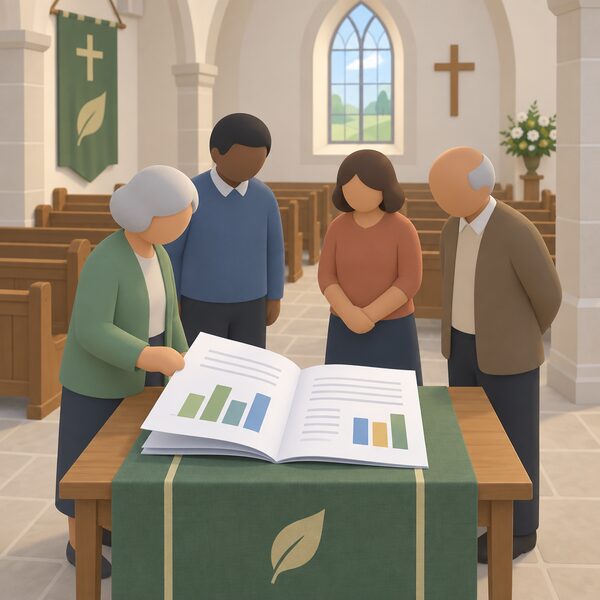
In 2018, after hearing about CAT's Zero Carbon Britain project, members of Green Wedmore fundraised locally to produce a detailed zero carbon report for the village1. The report was launched a year later, in the local church1. The sequence is instructive: a national research project provided the method, local fundraising provided the means, and the output was a document about one parish rather than a national scenario.
The fundraising covered the production of the report itself. It did not buy hardware, and it did not create a delivery body. What it created was a baseline and an argument that the parish could point to in its own decisions.
The target year for the village is not stated in the available material. Wedmore is described as working towards becoming a zero carbon village, with the report setting out how, but no date is attached to that ambition in the published case study1. For scale, the Welsh Government's guidance sets a 2030 public sector decarbonisation goal5, and a 2040 target of an 89% emissions reduction6. Those are different geographies and different scopes, and they are given here only to show the order of magnitude that national and devolved targets use.
The report's value to a household is that it converts an abstract national target into a local question: what does this parish emit, what does its land absorb, and what would have to change. That is the same logic behind community energy projects elsewhere, and behind the wider argument in how a village becomes a zero carbon community.
Focus areas: the six working groups
Green Wedmore's zero carbon ambition is focused on six areas, energy, food, transport, wellbeing, housing, and carbon and nature, with a working group dedicated to each area1. The structure is deliberately broad. A village cannot decarbonise by generation alone, because most of what a parish emits sits in buildings, vehicles and the food and goods its residents buy.
The six-way split also spreads the workload across volunteers, which is the practical constraint on any parish group. Comparable community programmes show the same pattern of small, parallel workstreams. Bristol's community climate action programme, for example, reports that ten groups have completed plans so far7. In west Oxfordshire, the CAPZero programme set a target of improving a further 1,700 homes over five years8. These are different places with different funders, but the shape is the same: several small projects running at once rather than one large scheme.
The breadth has a cost. Six groups means six sets of volunteers, and progress in each depends on who is available. It also means the group's output is advice, events and measurement rather than installed capacity, which is why a household looking for a funded measure will usually end up dealing with a national or devolved scheme instead.
For a household's energy independence, the two groups that matter most are energy and housing. Energy covers what the village generates and buys; housing covers how much the buildings leak. Transport covers the vehicles, and food and wellbeing cover the demand side of consumption that no tariff can fix. Carbon and nature covers the parish's land, which is the one ledger a village can genuinely call its own.
Energy: solar discounts, advice and community buildings
The energy working group is where a village group comes closest to affecting household bills. The published material describes the group's energy activity in terms of solar discounts, advice and community buildings, alongside the wider six-area structure1. The limits are structural: a parish group can negotiate a collective purchase or run an advice session, but it does not control the grid connection, the tariff or the export arrangements.
Households seeking independent advice on solar panels, heat pumps and other energy efficiency measures are directed to the NI Energy Advice service in Northern Ireland, which offers exactly that9. The same service gives free advice on saving energy in the home, on energy efficiency grants and on oil buying clubs, plus referrals to energy grants and other sources of help9. These are the bodies with a remit to advise on measures; a village group's role is to point people towards them and to keep the conversation going locally.
On the money side, the schemes that exist are specific and geographically bounded. Green Homes Wales supports the installation, in domestic properties located in Wales, of certain types of energy efficiency improvement measures and low carbon heating systems10, and offers access to grant funding alongside loans for specific measures, reducing out-of-pocket expenses4. Applicants must be homeowners, the property must be their primary residence, and they will be required to pass credit checks and affordability assessments4. Support also extends to accessing existing funding schemes such as the Boiler Upgrade Scheme and targeted grant funding3.
For a household in England, the position is different again. Energy supplier schemes and grants can cover energy costs, paying off energy debt, and making energy-saving improvements to the home11. The Warm Home Discount is a government scheme aimed at tackling fuel poverty in Great Britain12. None of these is administered by a parish group, and none of them is a village-scale scheme.
Housing, transport and food in practice
Housing is where Green Wedmore offers something direct to residents: advice and support with new builds and refurbishing and retrofitting existing buildings1. That is advice rather than delivery, but retrofit is the single largest lever a parish has over its own emissions, because it reduces demand permanently rather than shifting it between fuels.
The retrofit landscape the group is advising into is uneven. The UK Green Building Council has been bringing together leaders in politics, business and local authorities since 200713, and has responded to changes in retrofit schemes13. Case studies of retrofit at village scale exist: Eynsham has published case studies showing how retrofit is done8. For households in Wales, the Green Homes Wales scheme supports installing a heat pump, upgrading insulation, or modernising a heating system3, and for larger projects, terms may be extended4.
Transport is the hardest of the six areas for a parish to influence, because vehicle choice and charging infrastructure sit with households and network operators. The official statistics give a regional picture rather than a parish one: the West Midlands had 164.0 total public EV chargers per 100,000 population as of 1 July 20262. No equivalent figure for Wedmore or for Somerset is published in the available material, and the West Midlands number cannot be read across to a Somerset parish. The Welsh Government has run a community EV car clubs subsidy scheme with the objective of decarbonising transport under Net Zero Wales14, which is the kind of intervention a village can host.
Food is where the group has a concrete published output. Supported by the parish council, Green Wedmore published the Close to Home Cookbook, promoting local food producers, food shops, pubs and restaurants1. Shortening food supply chains does not reduce a household's electricity imports, but it does reduce the transport emissions embedded in what the parish eats, and it keeps spending local.
Carbon and nature: measuring the parish's sequestration

Green Wedmore's carbon and nature group has two aims: to measure the carbon sequestration amount for the parish and work towards increasing it to help achieve its zero carbon targets, and to restore nature locally1. This is the most distinctive part of the project, because it is the one ledger a parish can genuinely own. A village cannot measure the national grid's carbon intensity, but it can measure what its own hedgerows, woodland and soil take up.
The measurement task is not trivial. At national level, mapping greenhouse gas emissions and removals for the land use, land use change and forestry sector is prepared by the Centre for Ecology and Hydrology15. A parish group attempting the same at village scale is working with a fraction of the data and a fraction of the resource, and the result will be an estimate rather than an inventory.
The scale of land-based action is also worth stating plainly. Wales' Fourth Carbon Budget sets out that land-based actions contribute only 1% of the emissions reduction required by 2033 in Wales, against a 2% share of emissions reduction by 2033 in the UK as a whole16. Nature and sequestration matter, but they are a small part of the arithmetic, and a parish group measuring sequestration is measuring something real without expecting it to carry the whole reduction.
For a household, the practical value of a parish sequestration measure is that it makes the local carbon account honest. It shows what the land can and cannot offset, and it prevents a village from claiming that tree planting alone will reach zero carbon. The restoration aim sits alongside it: increasing sequestration and restoring nature are treated as the same piece of work1.
Past achievements and planned projects
The published record of Green Wedmore's activity is short and specific. It was established in 20061. In 2018 it fundraised locally for a detailed zero carbon report, after hearing about CAT's Zero Carbon Britain project, and launched the report a year later in the local church1. It organised the Wilder Wedmore three-day festival of nature, featuring talks, workshops and stands1. Supported by the parish council, it published the Close to Home Cookbook, promoting local food producers, food shops, pubs and restaurants1. It offers local people advice and support with new builds and refurbishing and retrofitting existing buildings1.
The planned work follows the same six-area structure. The carbon and nature group continues to measure the parish's sequestration and work towards increasing it, and to restore nature locally1. The housing group continues to advise on new builds and retrofit1. The energy group continues with solar discounts, advice and community buildings1.
Set against national and devolved programmes, the scale is modest, and that is the honest reading. A Welsh Government scheme can support installing a heat pump, upgrading insulation, or modernising a heating system across a whole nation3. A parish group can advise a few hundred households and measure a few thousand acres. The two operate at different scales and neither substitutes for the other.
What a village project does contribute to household energy independence is the part that national schemes are worst at: local measurement, local advice, and a reason for neighbours to act at the same time. The dependence that remains is the same as for any household in Somerset: the grid, the supplier, the gas mains where they are still connected, and the imported fuel behind the electricity. A zero carbon village target does not remove any of those. It changes what the parish asks of them.
Sources16 cited
- It takes a village, Centre for Alternative Technology, 2024
- Public electric vehicle charging infrastructure statistics, 1 July 2026, GOV.UK, 2026
- Written statement: Green Homes Wales scheme, Welsh Government
- Green Homes Wales, Development Bank of Wales
- 2023 progress report: reducing emissions in Wales, Climate Change Committee
- Net Zero Strategy: why net zero, GOV.UK
- Bristol Warm Homes Plan, Bristol City Council, 2025
- Eynsham: showing how retrofit is done, case studies now live, Low Carbon Hub, 2024
- Energy saving grants in your area, nidirect, 2026
- Green Homes Wales loan standard terms and conditions, Development Bank of Wales
- Get help with your energy bills, Ofgem, 2026
- Zero carbon and climate change: action for residents, Manchester City Council, 2026
- UKGBC responds to changes to retrofit schemes, UK Green Building Council, 2024
- Community EV car clubs subsidy scheme, Welsh Government, 2024
- UK local authority and regional greenhouse gas emissions statistics, 2005 to 2024, GOV.UK, 2026
- Wales' Fourth Carbon Budget, Climate Change Committee, 2025
 Climate TargetsWales is legally committed to net zero by 2050 under the Environment (Wales) Act 2016, with carbon budgets set in five-year periods.
 Wales Renewable Energy TargetsWales aims for renewable sources to meet the equivalent of 70% of its electricity consumption by 2030 and 100% by 2035, with at least 1.5 GW locally owned by 2035.
 Carbon Budgets and Net ZeroThe UK has promised to cut its emissions to almost nothing by the middle of the century.
 Biomethane and Green GasHow biomethane is made, injected into the gas network and counted towards green gas targets, what a green gas tariff actually buys, and the limits on how much of the grid it can supply.
 Climate TargetsScotland aims to stop adding greenhouse gases by 2045, five years before the rest of the UK.
 Community Energy in EnglandCommunity energy lets neighbours own their own power together, often through solar panels, and share the money it makes.