
In this guide
Low Carbon Hub is a community benefit society working across Oxfordshire, and it is one of the larger community energy organisations in the UK. It states that it has nearly 2,000 investor members who support its work, and that its activity is powered by 50+ renewable projects1. Its stated focus is helping communities in Oxfordshire set up and manage renewable energy projects1.
The organisation's assets are a mix of hydro, battery storage and aggregated solar PV panels, and it took that portfolio into the flexibility market trials run under Project LEO, or Local Energy Oxfordshire2. Its surplus model is the part that matters most to a household weighing up involvement: as a community benefit society, any surplus is reinvested into community energy projects, energy efficiency programmes and local carbon-cutting initiatives, and it states that 100% of its project surplus supports further action on climate change in the Oxfordshire community1.
For a household, the practical question is what this does for energy independence. Community generation adds local capacity and keeps value in the county, but it does not disconnect a home from the grid or from a supplier. The sections below set out what the organisation is, how its money works, what it owns, and where the limits sit.
What Low Carbon Hub is: an Oxfordshire community benefit society
Low Carbon Hub describes itself as a community benefit society, and its geographic focus is Oxfordshire1. That combination sets the boundaries of what it does. It is not a national supplier, not an installer, and not a grant body. It is a locally constituted society that develops and operates renewable generation and uses the income to fund further local work.
Its own description of its role is that it helps communities in Oxfordshire set up and manage renewable projects1. That places it in the enabling layer of community energy rather than the delivery layer: the society convenes, funds and operates, while the projects themselves sit in schools, businesses and community buildings across the county.
The society structure is what distinguishes it from a commercial developer. A community benefit society exists to benefit a community, and Low Carbon Hub states that any surplus is reinvested into community energy projects, energy efficiency programmes and local carbon-cutting initiatives1. The society also states that 100% of its project surplus supports further action on climate change in the Oxfordshire community4.
For a household, this matters in two ways. First, the organisation's purpose is local, so its activity is concentrated in one county rather than spread thinly. Second, its independence is partial: it generates and it funds, but the homes and buildings it serves remain connected to the national grid and to a licensed supplier. Community generation changes who owns some of the capacity and where the revenue goes; it does not change the physical dependence of a home on the network. The wider picture of how local projects fit into household independence is set out in community energy in the UK.
What a community benefit society means for your money

The community benefit society is a specific legal form, and it changes what happens to money put in. Low Carbon Hub states plainly that as a community benefit society, any surplus is reinvested into community energy projects, energy efficiency programmes and local carbon-cutting initiatives1. The society also states that 100% of its project surplus supports further action on climate change in the Oxfordshire community4.
That is the central difference from a conventional company. A surplus is not distributed to shareholders as profit; it is directed back into the society's objects. For an investor member, the return comes in the form of interest on shares rather than equity growth, and the capital is committed to the society's purposes.
The scale of the membership base is the other relevant figure. Low Carbon Hub states that it has nearly 2,000 investor members who support its work1. That is a large body of small investors rather than a small group of large ones, which is characteristic of the community energy model.
For a household considering whether to put money in, the honest position is that this is a community investment, not a savings product. The society's own framing is that surplus goes to local climate action, and the structure is designed to keep value in Oxfordshire rather than to maximise a financial return. The mechanics of share offers across the sector, including the caps and withdrawal terms that typically apply, are covered in community energy share offers. A household weighing a community scheme against installing its own generation can compare the two in community energy scheme vs own solar.
The assets: hydro, battery storage and solar PV
Low Carbon Hub's generation portfolio is described as hydro, battery storage and aggregated solar PV panels, and it was that range of renewable energy assets that the organisation took into the flexibility market trials3. The three types do different jobs.
Hydro provides predictable, steady output tied to river flow, and it generates through the day and night rather than only in daylight. Battery storage shifts output in time, which is what makes a generator useful to a flexibility market rather than simply a source of units. Aggregated solar PV means many smaller rooftop arrays grouped together so that they can be managed and traded as one larger block.
The rooftop solar programme is described as offering fully funded solar panels, meaning no upfront costs and access to cheaper, greener energy for businesses with a large roof space1. That model puts the capital cost on the society and the benefit on the host, which is how a community organisation can install generation on buildings whose owners would not fund it themselves.
The storage side is where the organisation has been most explicit about the limits of the river. It has described exploring how the river can be used as a battery, storing water upstream of Sandford Hydro to maximise generation at times of peak energy need2. That is impoundment rather than a chemical battery: water is held back and released through the turbine when it is most valuable. It is short-term and flow-dependent, and it cannot carry energy across seasons.
For a household, the asset mix is a reminder that community generation is real capacity but not household independence. The output is sold or traded, and the homes nearby remain supplied by the grid. How much of a home's own generation it actually uses is a separate question, covered in self-consumption.
Project LEO and the grid edge: flexibility trials in Oxfordshire
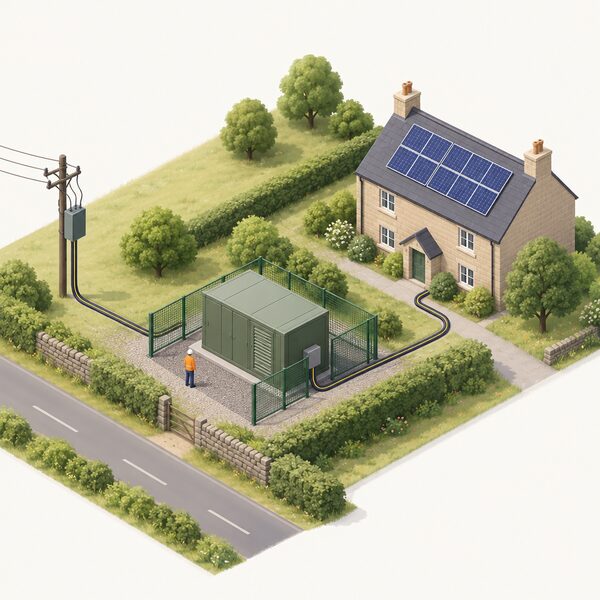
Project LEO, or Local Energy Oxfordshire, was a flexibility market trial run in conjunction with Scottish and Southern Electricity Networks' TRANSITION project3. Its stated purpose was to provide a better understanding of how a smart, locally balanced energy system could bring social, economic and environmental benefits for all4.
Low Carbon Hub took part with its range of renewable energy assets, including a hydro plant, battery storage and aggregated solar PV3. The organisation has also described exploring how it could get involved as part of the flexibility market trials in Project LEO2.
The second trial period opened access to a custom-built trading platform to any business or organisation operating in the project trial areas in Oxfordshire, and it tested flexibility provision over a day, a week or a whole season3. Organisations interested in joining were invited to check whether they were in one of the trial areas and to express interest by completing a simple form3.
The concept underneath the trial is the grid edge, which Low Carbon Hub has explained as the point where the network meets distributed generation, storage and flexible demand4. The idea is that a locally balanced system can reduce the need for reinforcement and shift consumption to when generation is available.
The national policy direction supports that logic. The Clean Flexibility Roadmap sets out government support for flexibility, including a cap and floor revenue support scheme for long duration energy storage technologies such as pumped storage hydro, compressed air energy storage, liquid air energy storage and flow batteries5. The statutory security of supply report identifies 80 transmission projects required to achieve clean power by 20306. Community-scale flexibility sits alongside that national build-out rather than replacing it. The wider context is in microgrids and local energy systems.
"to provide a better understanding of how a smart, locally balanced energy system could bring social, economic, and environmental benefits for all"
How the projects work: 50+ renewable projects and 56 installations
Low Carbon Hub states that its work is powered by 50+ renewable projects1. That figure is the organisation's own count of its portfolio, and it covers the range of hydro, battery and solar assets described above.
The delivery model behind those projects is the fully funded rooftop solar programme, which offers solar panels at no upfront cost with access to cheaper, greener energy for businesses with a large roof space1. The society carries the capital and the host building gets the generation, which is how a community organisation can build a portfolio without asking each site to fund its own installation.
The wider community energy sector operates at a similar scale in aggregate. The Smart Export Guarantee annual report for Year 5 records 25 hydro, 19 micro-combined heat and power, 18 wind and 2 anaerobic digestion installations registered under the scheme7. Those are national totals for accredited generators, and they show how small the hydro and micro-CHP categories remain compared with solar.
The eligible technologies under the Feed-in Tariff scheme, which underpinned much of the early community build, were anaerobic digestion, hydro generating stations, combined heat and power, solar PV and wind8. That list explains the shape of portfolios like Low Carbon Hub's: a mix of technologies rather than a single one.
For a household, the practical point is that 50+ projects is a meaningful local portfolio but a small share of the county's generation. The projects add capacity and keep revenue local. They do not change the fact that a home in Oxfordshire is supplied by the grid and billed by a licensed supplier. What a home can do on its own roof is covered in Oxfordshire County Council's solar guidance and in sizing a self-sufficient home system.
Who owns and funds it: nearly 2,000 investor members and 29 community shareholders
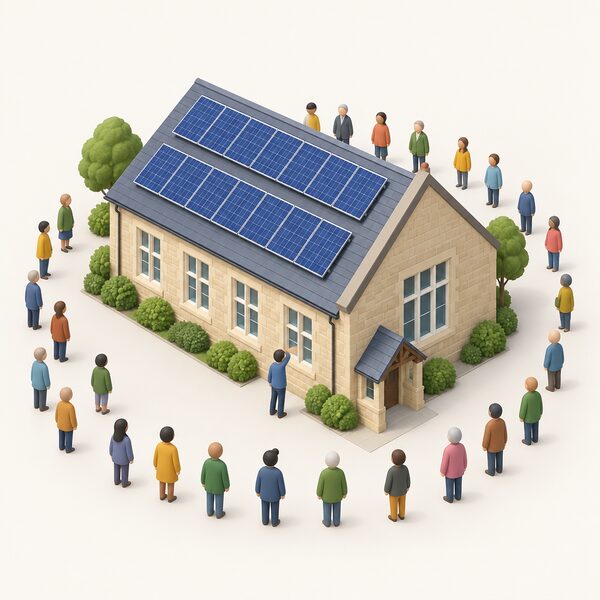
Low Carbon Hub states that it has nearly 2,000 investor members who support its work1. Those members provide the capital that the society deploys into projects, and the community benefit society structure directs any surplus back into local purposes rather than to them as profit1.
The society also states that 100% of its project surplus supports further action on climate change in the Oxfordshire community4. Taken together, the two facts describe a funding model in which members supply capital, projects generate income, and the income is recycled into further local work.
That model is common across the community energy sector, and it is why community schemes are often described as having a social as well as a financial return. The capital is patient and local, and the decision-making sits with the society rather than with an external owner.
For a household, the relevant question is what happens to money if the society's circumstances change. A community benefit society holds assets for community benefit, and its constitution governs what happens on wind-up. The general mechanics of co-operative and society ownership, including member voting and asset locks, are set out in community energy share offers and in community energy funding.
The scale of the membership base is itself the point. Nearly 2,000 members is a broad base of small holders, which spreads both the capital and the governance across the county rather than concentrating it. That is the structural difference between a community society and a commercial generator, and it is the reason the surplus rule can be stated as a flat 100%.
Support for community groups: thermal imaging cameras and data
Low Carbon Hub's stated role includes helping communities in Oxfordshire set up and manage renewable projects1. That support function is the part of its work most directly available to a local group, and it sits alongside the society's own generation portfolio.
The tools a community group typically needs are diagnostic rather than financial: thermal imaging to find heat loss, and consumption data to understand where energy is used. Low Carbon Hub's position as a county-wide society with a portfolio of assets and a data interest makes it a natural point of contact for that kind of support.
The wider policy environment has moved in the same direction. The consultation on support for low carbon heating in residential buildings showed support for widening eligibility to a range of low carbon technologies, and it will inform the design of a support scheme for low carbon heat and energy efficiency in residential buildings9. In Wales, £15 million has been directed at helping keep communities warm and connected, delivered through local authorities10. In Northern Ireland, the Warm Healthy Homes Fund consultation proposes solar photovoltaic systems and electrical energy storage, subject to the Home Assessment9.
For a group in Oxfordshire, the practical route is to approach Low Carbon Hub directly through its website and ask what equipment, data and advice are currently available. The organisation does not publish a general phone number in the material reviewed here, so contact is made through its site. Household retrofit enquiries in the county run through a separate route at retrofit@oxfordshire.gov.uk11.
Contact details and Oxfordshire availability

Low Carbon Hub operates in Oxfordshire, and its stated focus is helping communities in that county set up and manage renewable projects1. Availability of its support is therefore geographic: a group or building inside the county is in scope, and one outside it is not.
Contact is made through the organisation's website. No general phone number for Low Carbon Hub appears in the published material reviewed here, so none can be given. For household retrofit questions in the county, Oxfordshire County Council publishes a separate advice route at retrofit@oxfordshire.gov.uk11.
For national scheme queries that sit outside the county's community energy work, Ofgem runs a contact centre for ECO and the Great British Insulation Scheme on 0808 169 4447, freephone, Monday to Friday excluding bank holidays, from 9.30am to 4.30pm12. The Boiler Upgrade Scheme customer service team can be reached on 0330 053 2289, or by email at bus.enquiry@ofgem.gov.uk13.
The distinction matters because the routes do different things. Low Carbon Hub is a community energy society, not a grant administrator or a national advice line. A household looking for a grant, a retrofit assessment or a heat pump subsidy is in the territory of the national schemes, and the community organisation is the route for local project involvement and community group support.
For a household weighing what community involvement adds to its own energy position, the honest summary is that it adds local generation and local ownership, and it leaves the grid connection, the supplier relationship and the home's own consumption pattern unchanged. The full picture of what independence involves is in the household energy independence guide.
Sources13 cited
- Low Carbon Hub FAQ, Low Carbon Hub, 2025-12-10
- Save, shift, share: three strategies for a more secure energy future, Low Carbon Hub, 2022-04-05
- Project LEO recruiting pioneers for flexibility markets in Oxfordshire, Scottish and Southern Electricity Networks, 2022-06-15
- What is the grid edge?, Low Carbon Hub, 2025-03-10
- Clean Flexibility Roadmap: July 2026 update, Department for Energy Security and Net Zero, 2026
- Statutory Security of Supply Report 2025, Department for Energy Security and Net Zero, 2025
- Smart Export Guarantee Annual Report Year 5, Ofgem, 2025-12
- FIT Guidance for Licensed Electricity Suppliers V17.1, Ofgem, 2024-09-06
- Warm Healthy Homes Fund consultation, Department for Communities (Northern Ireland), 2026-05
- £15 million helping keep communities warm and connected, Welsh Government, 2025-12-22
- How do I retrofit my home: solar panels, Oxfordshire County Council, 2026-09-17
- Retrofit measures, ECO4 and GBIS, UK Parliament, 2025-10-13
- Boiler Upgrade Scheme Quarterly Report Issue 12, Ofgem, 2025-05-30