
In this answer
Short answer
Around one prepayment customer in five has run out of credit in the periods the official survey series covers. Ofgem's Energy Consumer Satisfaction Survey recorded 21% of prepayment customers running out of credit in findings published in September 2023, and 17% in the wave covering July 20241. In its July to August 2025 wave, the share of customers owing money or running out of credit stood at 10%, unchanged since January 20253.
Running out of credit is not the same as being cut off permanently, and it is not the same as self-disconnection. A meter that reaches zero can usually draw on emergency credit, most commonly around £10, which is reclaimed from the next top-up4. Self-disconnection is what happens when that bridge is exhausted or never available: Ofgem defines it as a consumer with a prepayment meter not having enough money to top up, or not realising the credit is running out, so the meter cuts out5.
The scale is contested and the measures differ. Citizens Advice estimated in January 2023 that more than 3 million people had been disconnected because they could not afford to top up, which it put at one person every 10 seconds6. Ofgem's later survey work counts a share of all energy consumers rather than a headcount of prepayment households, which is why the two numbers sit so far apart3.
What running out of credit means on a prepayment meter
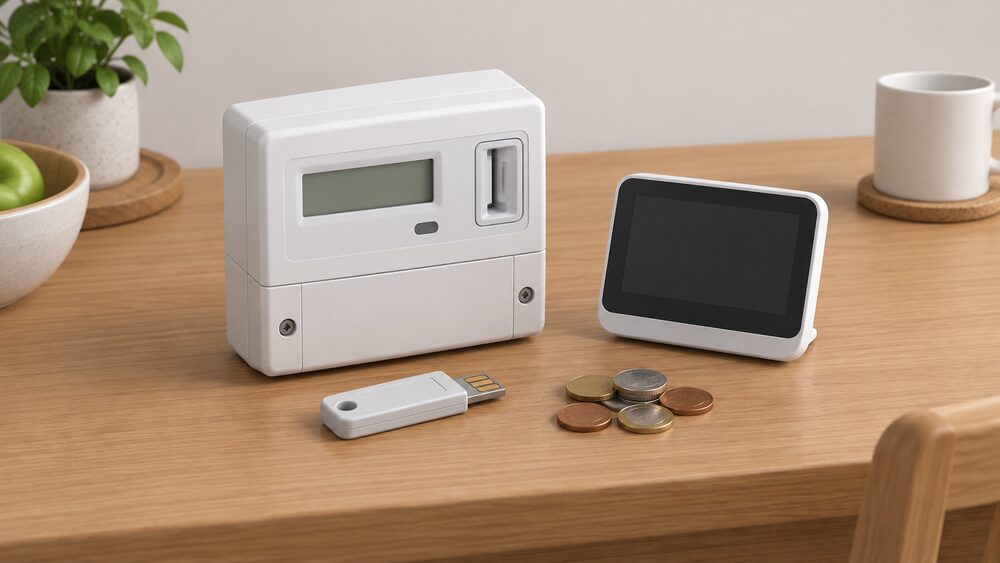
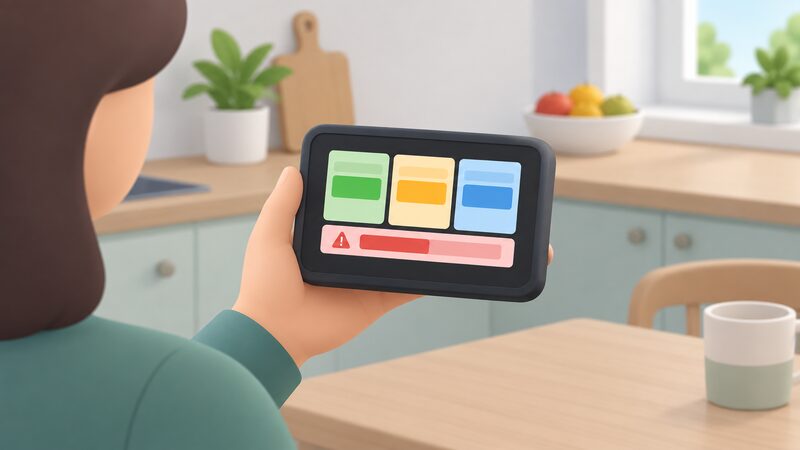
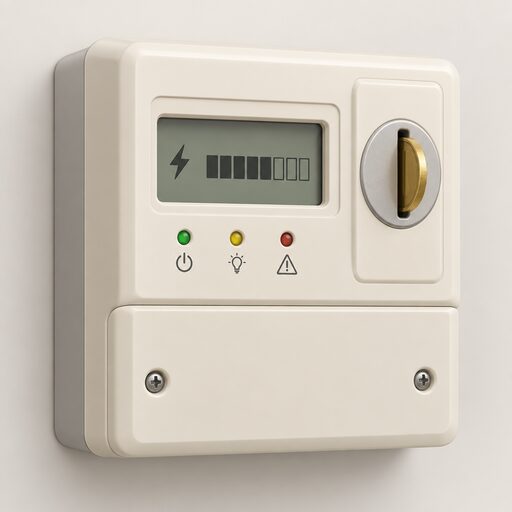
A prepayment meter is paid for in advance, so the household holds a credit balance rather than a bill. On a smart meter in prepay mode, the in-home display shows how much credit is left, how much emergency credit is available, how much debt is being recovered, and whether the balance is low9. The same display warns when credit is nearly gone, and the monitor can show the balance, alert when it is running low, and let the household activate emergency credit10.
Running out of credit is therefore a specific event: the balance reaches zero and the meter stops supplying until credit is added or emergency credit is drawn. It is distinct from being in debt, though the two overlap heavily. Prepayment customers were carrying £1bn of debt on their meters as of September 2023, and more than one million customers were more than £2,200 in debt without a repayment plan in place as of February 202412.
The distinction matters because the meter recovers debt as it goes. Where a customer owes money, the meter takes a little extra alongside the unit rate for the energy used, so each top-up is split between current consumption and arrears14. A household in that position can top up a normal amount and still see the balance fall quickly, which is one route into repeated running out of credit.
How often it happens: one person every 10 seconds
The headline frequency figure comes from Citizens Advice, which estimated in January 2023 that more than 3 million people had been disconnected because they could not afford to top up, equating to one person every 10 seconds6. That is a count of people affected over a period, not a rate per household, and it was published at a point when prepayment top-up demand was at a peak.
The same research found that 1 in 5 (19%) prepayment customers who had been disconnected from their energy supply in the past year said they had disconnected for more than 24 hours at least once6. That is the figure that separates a brief interruption from a sustained loss of supply, and it is the one that bears most directly on a household's energy independence, because a supply off for more than a day is a supply the household cannot restore without money.
Ofgem's survey series gives the share rather than the headcount. In the July 2024 wave, 17% of prepayment customers had run out of credit, against 21% in the earlier comparison2. In the July to August 2025 wave, 10% of customers owed money or were running out of credit, unchanged since January 20253. The two Ofgem measures are not interchangeable: one is prepayment customers running out of credit, the other is all customers owing money or out of credit.
"This equates to more than 3 million people, or 1 person every 10 seconds."
Why prepayment households are more exposed to self-disconnection
Prepayment is a payment method that puts the supply decision in the meter rather than in a billing relationship. Citizens Advice defines self-disconnection as households losing their energy supply as a result of not topping up their meter15. Ofgem's definition adds the involuntary case: a consumer who does not have enough money to top up, or who does not realise the credit is running out5.
The exposure has two forms. The first is involuntary: the money is not there at the moment the meter empties. The second is voluntary, and National Energy Action describes it as unsafe energy rationing, where households try to use as little energy as possible and even self-disconnect deliberately in a bid to spend less16. Both end in the same place, a home without supply, but only the first is captured by a simple affordability measure.
The standing charge and any fuel debt continue to apply even when a household completely runs out of credit and stops topping up17. That is the mechanism that makes self-disconnection a trap rather than a pause: the meter keeps accruing costs while nothing is being used, so the balance on return is worse than the balance on leaving.
The support framework recognises the risk. Ofgem's regulatory expectations require suppliers to offer additional credit to vulnerable prepayment customers who have self-disconnected or are at risk of doing so18. For authorised heat network suppliers, the obligation is to offer a reasonable amount of additional support credit in a timely manner where a prepayment consumer has self-disconnected or self-rationed and any occupant of the household is in a vulnerable situation18.
What happens when the meter goes to emergency credit
Emergency credit is the buffer between running out and being cut off. It is designed to help avoid sudden disconnection, provide temporary energy access and give customers time to top up10. Most pay as you go smart meter systems include it once the balance reaches zero, activated through the meter or the in-home display, and there is usually an emergency credit button for extra time before a top-up10.
The amount varies by supplier and by meter. Most suppliers provide around £104. National Energy Action gives the example of £5 emergency credit on both electricity and gas meters7. Most prepayment meters have an emergency credit budget that works like an overdraft, but it is limited14. Temporary credit may also be added automatically when the meter runs out, depending on the supplier, and is paid back from future prepayment card top-ups19.
| Feature | What it does | Typical figure |
|---|---|---|
| Emergency credit | Maintains supply after regular credit runs out, reclaimed from the next top-up | Around £10 from most suppliers; £5 on both meters in National Energy Action's example4 |
| Temporary credit | May be added automatically when the meter runs out, depending on supplier | Repaid from future prepayment card top-ups19 |
| Additional support credit | Offered to vulnerable prepayment customers who have self-disconnected or are at risk | Required by Ofgem's regulatory expectations18 |
| Standing charge and fuel debt | Continue to apply while supply is off | Recovered alongside the unit rate on each top-up17 |
Where to get help if you cannot top up
Ofgem's consumer guidance is direct: talk to the supplier if a top-up is unaffordable, and the supplier must offer to help, for example by giving extra credit in a vulnerable situation20. That obligation sits alongside the additional support credit requirements for vulnerable prepayment customers who have self-disconnected or are at risk of doing so18.
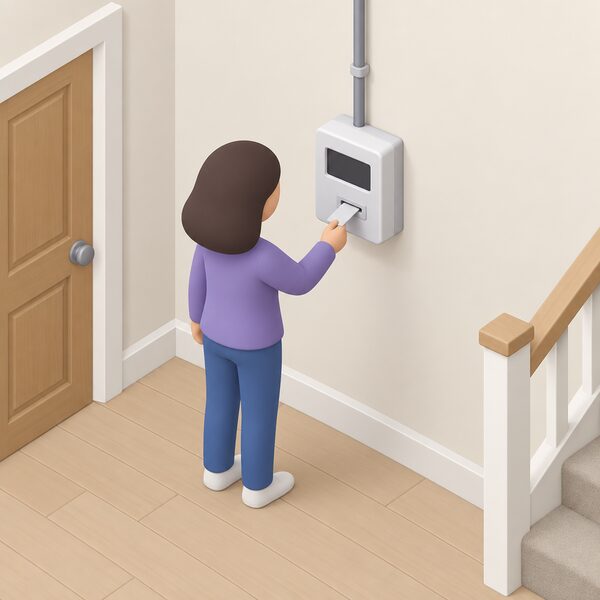
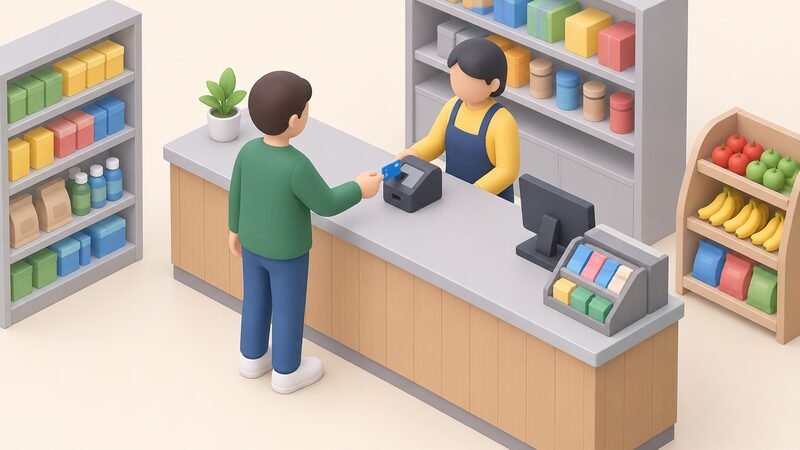
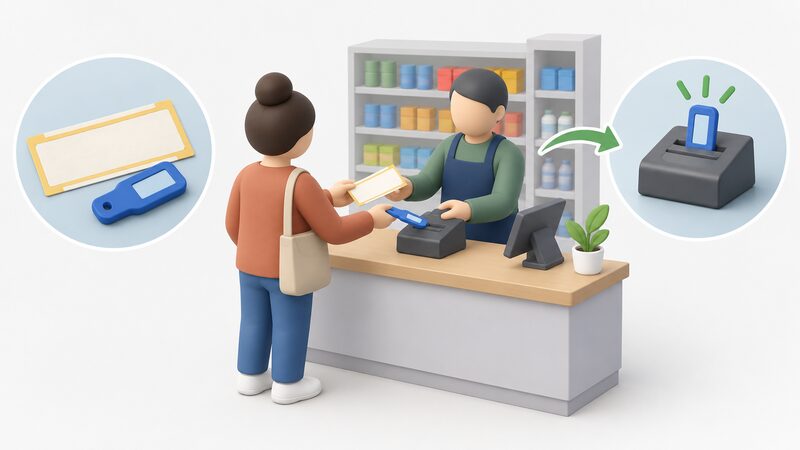
Practical routes exist beyond the supplier. A fuel voucher from the local council can provide some credit for prepayment meter top-ups for households that cannot afford one19. Where a smart meter's in-home display is faulty, the supplier should give other ways to top up, including online, at a local shop or at a post office21. Non-smart prepayment meters are topped up in person at a local shop or Post Office with a Payzone or PayPoint, using a top-up key or card4. Ofgem's guidance sets out the same in-person route at a local PayPoint store or Post Office using the meter's key or card, or a barcode for smart prepayment meters22.
Smart metering changes the mechanics. The DCC network carries over-the-air top-ups, so credit can be added to a meter remotely rather than through a key at a counter23. That reduces one failure mode, the household that cannot physically reach a shop, but it does not change the underlying position: the supply still stops when the credit and the emergency buffer are gone.
The demand on advice services shows how often that happens. Citizens Advice said that by the end of October 2022 it had already helped more people unable to afford to top up their prepayment meter than for the previous five years combined24. By January 2024, the numbers helped with energy issues and people unable to top up their prepayment meter were slightly lower than at the same point in 202325.
Prepayment, satisfaction and switching
The assumption that prepayment customers are worse served does not hold in Ofgem's satisfaction data. Its July 2025 report found that prepayment customers show higher satisfaction than those on direct debit once other variables are controlled for26. Satisfaction with customer service rose from 73% to 80% for prepayment customers and from 73% to 79% for standard credit customers in the same wave3. Prepayment customers were also less likely than standard credit customers to have received an unexpectedly high bill in the previous three months, at 33% against 43%3.
That sits awkwardly beside the running out of credit figures, and the two are measuring different things: how a household rates its supplier, and whether the meter empties. A household can be satisfied with the service and still be exposed to self-disconnection, because the exposure comes from the payment method and the household's cash position rather than from the supplier's conduct.
Switching away from prepayment is possible. Smart DCC states that switching from an existing gas or electricity prepay meter to a smart credit meter is straightforward for customers who meet the conditions23. Some suppliers install a new meter free, but in most cases a credit check or a refundable deposit applies, and private tenants who are the bill payer have the right to change payment method17.
For a household's energy independence, prepayment is a double-edged arrangement. It removes the risk of a large arrears bill building up invisibly, and it gives direct control over spend. It also makes the household the operator of its own supply cut-off, with no buffer beyond the emergency credit, and it leaves the standing charge and any debt running while the supply is off. The dependence that remains is on the supplier for support credit, on the council for a fuel voucher, and on the top-up network for the credit itself.
Sources26 cited
- Energy Consumer Satisfaction Survey Findings Report August to September 2023, Ofgem, 2023-09
- Energy Satisfaction Survey Wave 19 Interim, Ofgem, 2024-07
- Energy Consumer Satisfaction Survey Findings Report July to August 2025, Ofgem, 2025
- Change prepayment meter to credit meter, Confused.com, 2026-04-20
- Self-disconnection definition, House of Commons Library, 2022-12-14
- Kept in the dark: the urgent need for action on prepayment meters, Citizens Advice, 2023-01-11
- How to read your energy bills, National Energy Action, 2026-06-12
- Smart prepayment customers' experience of the demand flexibility service, Nesta, 2024-10-07
- What is a smart meter? Easy read, Smart Energy GB, 2026-03-16
- How to use a smart meter in prepay mode to save money, Smart Energy GB, 2026-08-17
- How to use your smart meter data, Which?, 2026-07-14
- Ofgem price cap change sets sky high energy bills for winter, End Fuel Poverty Coalition, 2023-09-26
- Why the price cap is allowing suppliers to recover recent losses, Energy UK, 2024-02-12
- Prepayment meters guide, Uswitch, 2026-08-26
- Future of prepayment discussion paper, Citizens Advice, 2026-06-25
- What is fuel poverty?, National Energy Action, 2026
- Prepayment meters advice, Centre for Sustainable Energy, 2025-08
- Regulatory Expectations: Additional Support Credit, Ofgem, 2025-08-25
- How to get help with energy bills, Confused.com, 2025-11-10
- Get help with your prepayment meter, Ofgem, 2026
- Fixing problems with your smart meter's in-home display, Citizens Advice, 2026-09-17
- Prepayment meters consumer guidance, Ofgem, 2026
- How to get a smart meter, Smart DCC, 2026
- Citizens Advice response to the BEIS consultation on the design of the ECO scheme 2023-2026, Citizens Advice, 2022
- Energy data, Citizens Advice, 2024-01
- What drives consumer satisfaction with energy suppliers, Ofgem, 2025-07
 Prepayment MetersHow do you top up a prepayment meter for gas or electricity, and what happens when the credit runs out?
 Top Up a Prepayment MeterHow to top up by card, key, app and code, how to enter a vend code by hand and how emergency credit and friendly-hours protection work.
 Prepayment and Pay As You GoHow prepayment and pay as you go energy tariffs work in the UK: meter types, top-ups, emergency credit, debt repayment through the meter, price cap treatment and how households move to a credit meter.
 Prepayment Meter DebtHow debt repayment is set on a prepayment meter, the limits on the share of a top-up that can be taken, and how to have a rate reviewed.
 Energy Debt and ArrearsHow much do households in the UK owe their energy supplier, and how many people are behind on their bills?
 Who to Call for Energy HelpA single reference to the right contact for each situation: gas escapes, power cuts, water leaks, meter faults, billing disputes, scams and free advice.