
In this guide
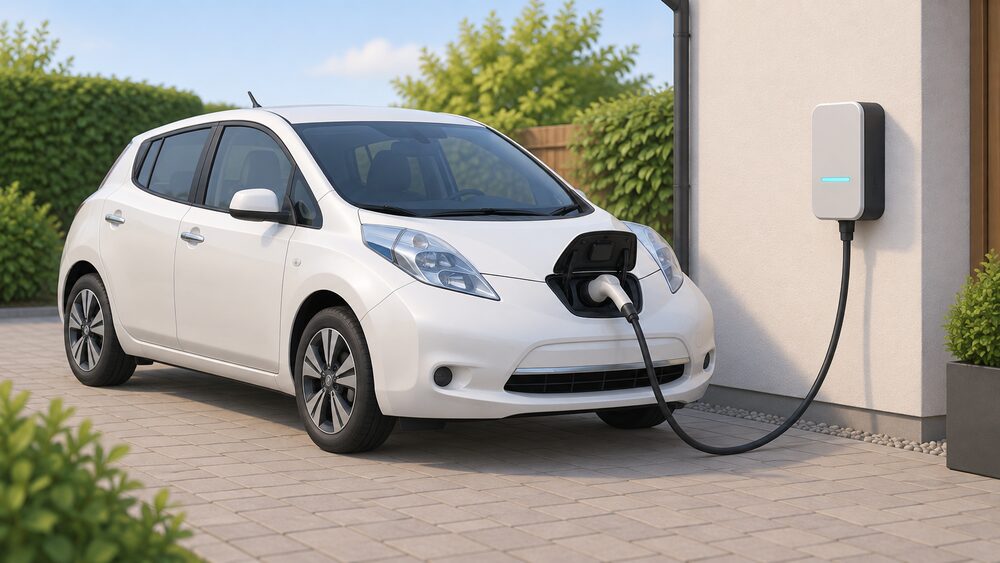
The Nissan LEAF is the car that made vehicle-to-grid real in Britain. It has been able to charge bidirectionally for several years, and independent guidance names it as the pioneer of the technology1. It is also one of the few V2G-ready vehicles commonly available in the UK, alongside the Volkswagen ID Buzz2.
The reason is the connector. Only CHAdeMO currently has a valid protocol for V2G charging that feeds electricity into the public grid, and the LEAF is the car that carried CHAdeMO into the mass market1. That single technical fact explains why so much of Britain's V2G trial history runs through this model, and why a used LEAF is the cheapest route into bidirectional charging for many households.
The trade-off is equally clear. A LEAF keeps a household tied to the grid for anything beyond backup power, to a chargepoint operator or installer for the bidirectional hardware, and to a manufacturer's app and servers for remote features. Battery capacities run from 24 kWh in the first generation through 30 kWh and 40 kWh to 62 kWh in the e+3.
Why the LEAF matters for vehicle-to-grid in the UK
Britain's V2G story starts with a programme that began in April 2018, funded by the Office for Low Emission Vehicles and the Department for Business, Energy and Industrial Strategy in partnership with Innovate UK6. The Vehicle to Grid Britain project set out to unlock an understanding of the key drivers supporting the roll-out of V2G technologies, enabling millions of electric car batteries to become a vital part of the UK energy system8.
Nissan was in the consortium from the start, alongside Energy Systems Catapult, Cenex, Moixa, Western Power Distribution, National Grid ESO and Element Energy7. That is why the LEAF, rather than any other model, sits at the centre of the British evidence base: the trials were built around it.
The prize the programme pointed to is scale. If 50% of the UK's EVs were V2G enabled, they could provide around 16GW of daily flexible capacity to the grid by 20306. The UK and France were identified as the lead markets for V2G, with strong emerging opportunities in Germany, Japan and South Korea9.
For a household, the significance is narrower but real. V2G allows electric vehicles not only to draw power from the grid to charge their batteries but also to send electricity back when needed, generating cash for the owner10. A LEAF is one of the few cars on UK roads that can actually do this today.
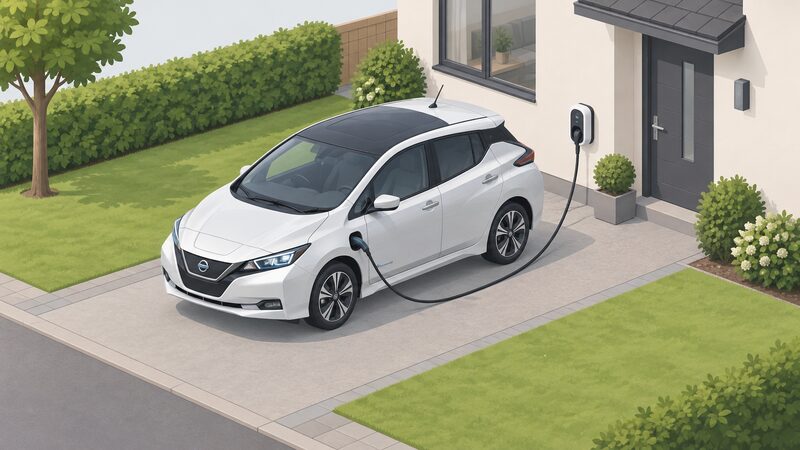
A pioneer of bidirectional charging, and one of the few V2G-capable cars on sale
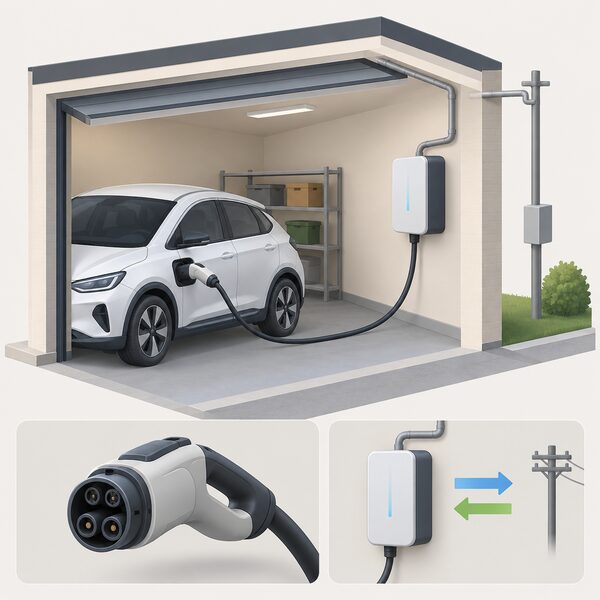
Bidirectional charging allows EVs to power a home or export energy to the grid, and provides backup power during outages11. The LEAF has done this for longer than almost any other production car1.
The equipment side matters as much as the car. Smart V2G chargers such as the Wallbox Quasar 1 and Indra V2G units enable bidirectional energy flow, allowing the EV to both charge and discharge to the grid2. Most V2G systems use CHAdeMO, though some models can also use CCS2. V2G chargepoints provide bi-directional flows of energy and data between a plug-in electric vehicle and the grid, enabling EV batteries to charge, store and discharge electricity when prompted12.
"Only for this connection is there currently a valid protocol for V2G charging in order to feed electricity into the public grid"
That is the constraint in one sentence. A LEAF with a CHAdeMO port is the car that fits the hardware that exists. A newer EV with CCS may be a better car in every other respect and still not be able to export to the grid on the same basis.
The distinction between the two directions is worth holding on to. Vehicle-to-grid exports to the network. Vehicle-to-home uses the energy to power a home rather than delivering it back to the grid10. Both run through the same car and the same charger, but they serve different purposes and are covered separately in vehicle-to-home and vehicle-to-load and bidirectional charging.
What the LEAF can power: backup for the home and export to the grid
Vehicle-to-grid charging allows energy stored in the vehicle's battery to be exported to the grid during periods of high demand13. A V2G system could potentially offer a two-way movement of energy, with energy stored in the car battery used in the home or sold back to the grid at times of peak demand14.
Backup power is the other half of the proposition. V2H can provide backup power from an EV to a home during power outages and support off-grid setups, but it is limited to certain EV models and compatible chargers2. The building itself has to be able to run independently: when a building or home also has the functionality to operate independently from the grid, known as islanding, V2X can enable the vehicle to act as a backup power source in a power cut15.
The scale of what a fleet of LEAFs represents is not trivial. Nissan sold around 28,000 zero emission LEAFs in the UK between 2010 and 2018, equivalent to roughly 825MWh of battery storage capacity1. That figure describes the aggregate, not any single car, but it shows why the network operators took an interest.
For one household, the practical position is that a LEAF can shift when energy is drawn and, with the right charger and building setup, can supply the home for a period during an outage. It does not remove the grid connection, and it does not remove the need for a chargepoint operator or installer in the chain.
Battery sizes and range: 24, 30, 40 and 62 kWh across the generations
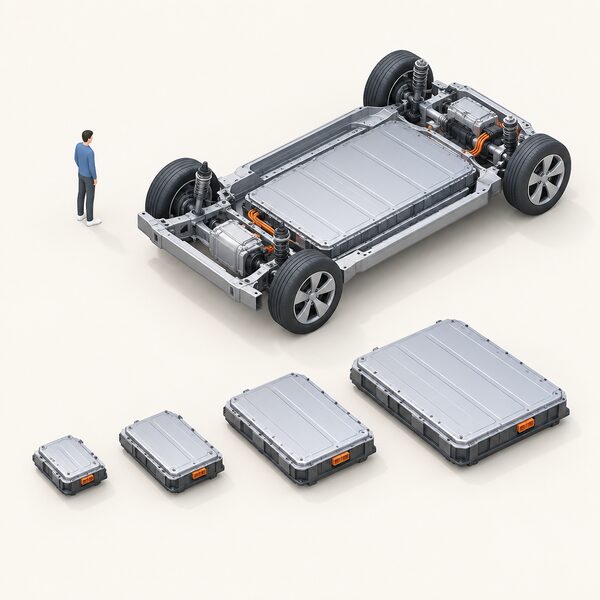
The LEAF's battery grew steadily across its life. The first 24 kWh family hatchback model was followed by a 30 kWh update, then the MkII with a 40 kWh battery, and finally the Leaf e+ with a 62 kWh pack3.
| Generation | Battery | Range | Notes |
|---|---|---|---|
| First generation | 24 kWh | Not stated | Original family hatchback3 |
| First generation update | 30 kWh | Not stated | Mid-life capacity increase3 |
| Leaf MkII | 40 kWh | 160 miles real-world16 | Mainstream second-generation car3 |
| Leaf e+ | 62 kWh | Up to 239 miles3 | Longest range variant3 |
The 40 kWh MkII is quoted with a real-world range of 160 miles16, while the e+ 62 kWh model is quoted at up to 239 miles3. One driver account describes a 30kWh Nissan Leaf in everyday use16, and a home charging calculator lists a LEAF Tekna 30 kWh with a manufacturer battery capacity of 30kWh17.
The gap between the headline range and the real-world figure is the usual one: speed, temperature, heating and load all move it. The 40 kWh car's 160 mile real-world figure against a larger nominal range is the clearest illustration in the sources.
For a household thinking about V2G, battery size sets the ceiling on everything. A 24 kWh car has less to give the grid and less to give the house during an outage than a 62 kWh e+. It also has less to lose from the extra cycling, which is why the V2G, battery degradation and vehicle warranties question matters more on a small pack than a large one.
Charging the LEAF at home: rates, times and what it costs
The LEAF is able to be slow, fast and rapid charged from public points, depending on the network and the type of charge unit3. At home, the car is fitted with a 6.6 kW on-board charger for Type 2 AC charging3. Level 2 AC charging is rated at 7kW1, so a 7kW home charge point will not be fully used: even when connected to a fast charger with a rated output above 6.6 kW, the Leaf will only be able to charge at 6.6 kW3.
Timings follow from that. On a standard 7 kW AC home charger, a session takes approximately seven hours to go from 0% to 100%4. One product page gives 7kW charging to 100% in 7.5 hours3. The two figures differ slightly and the documents do not resolve which applies to which variant.
Cost depends far more on the tariff than on the car. Home charging with an EV tariff or other time-of-use tariff is put at around £8 for a full charge5. On a time-of-use tariff the same charge could cost as little as £2.80 overnight, while daytime charging could exceed £1019. On a fixed tariff, the cost would remain the same regardless of when the vehicle is charged19. Off-peak rates on time-of-use tariffs can be as low as 7p/kWh20.
Several things drive the bill: the electricity tariff and its day and night unit rates, the time of charging, how long the car is charged for, the type of car and battery size, and the charging connection type21. A worked example on a public calculator puts a 30kWh LEAF Tekna at £8.16 for an 80% charge at 34p/kWh, and £10.80 for the same charge at 45p/kWh17.
Rapid charging and connectors: CHAdeMO on older models, CCS on newer ones
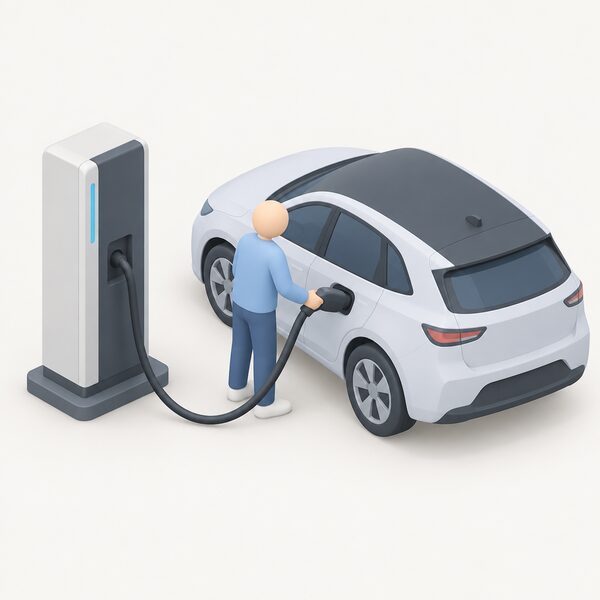
A few older models, such as the Nissan Leaf, still use CHAdeMO for rapid charging, but CCS has largely replaced it23. The CHAdeMO connector is primarily used for Rapid DC charging on older Nissan Leaf models24, and on the LEAF the CHAdeMO connector required is tethered to the charging unit rather than carried in the car3.
It is worth noting that CHAdeMO is less powerful than a CCS connector25. The LEAF's own limits are a maximum DC charging rate of 46kW and a maximum AC rate of 6.6kW4, with rapid 50 kW DC capability quoted for the model3.
On a 50 kW DC charger, the car can take approximately 43 minutes to charge from 20% to 80%, adding approximately 14 to 116 miles of range4. A public charging calculator works a 30kWh LEAF Tekna example at 29 minutes for an 80% charge on a 50kW point27.
Network coverage for the older plug is reasonable but not universal. MFG EV Power, Osprey Charging and InstaVolt all provide charging with tethered devices via both CHAdeMO and CCS connectors28. Tethered units carry their own cable, which suits a CHAdeMO car because the cable is not in the boot28.
The connector question is also the V2G question. Because most V2G systems use CHAdeMO, the older plug is currently an advantage for bidirectional use even as it becomes a disadvantage for rapid charging. The standards position is set out in bidirectional charging standards.
Running costs and second-hand prices: what a used LEAF costs to buy and run
Running costs are where the LEAF's case is strongest. Cheap EV-charging tariffs can allow an electric Nissan Leaf to be driven for less than 2p/mile30. Worked examples on public calculators put a 30kWh LEAF Tekna at 8.7p per mile on a 45p/kWh public charge and 6.6p per mile on a 34p/kWh charge27. A real-world journey cost for a LEAF Acenta 40 kWh over 100 miles is given as £4.2831.
Purchase prices are more complicated. A Nissan Leaf e+ is listed at £35,695 on the road including the Plug-in Car Grant, with a 239 mile WLTP range and a cost per mile figure of £14932. That is a list price for a new car, and the grant position has changed since.
The second-hand case is the one that matters for most buyers. A four year old second-hand Nissan Leaf would, over the remaining 10 years of its life, save its owner over £8,000 in total ownership costs against a Nissan Juke petrol equivalent30. That comparison is against a petrol car of similar size, not against another electric car.
Energy consumption sits behind those numbers. Taking the combined energy consumption of a Nissan Leaf at 265 Wh per mile, one analysis equates that to 6,630 miles per year22. For a household weighing independence, the LEAF's running cost advantage is real but it depends on charging at home on a cheap tariff rather than on the public network.
Sunderland production and the LEAF's place in UK EV ownership
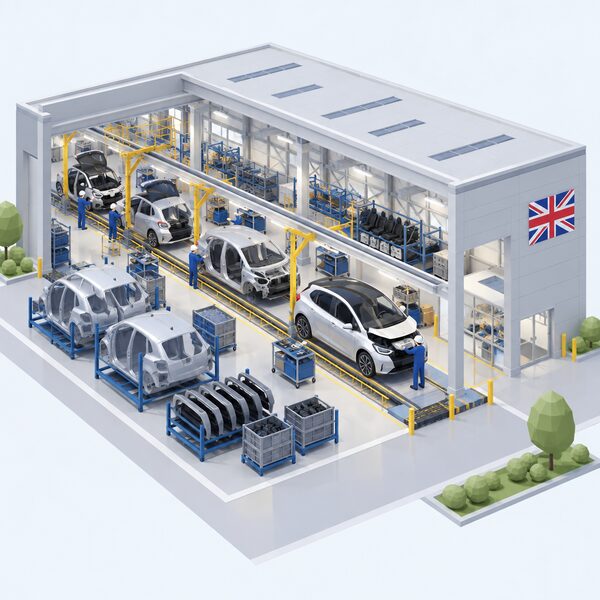
The LEAF is set to be built at Nissan's Sunderland plant33. That matters for the supply chain: a car assembled in the UK keeps parts, service and warranty work closer to home than an imported equivalent, and it ties the model to a British workforce and a British factory.
The model's place in UK EV ownership is already established. Around 28,000 zero emission LEAFs were sold in the UK between 2010 and 20181, which makes it one of the largest single cohorts of early electric cars on British roads. That cohort is now the used market, and it is the pool from which most V2G-capable cars will be drawn for years.
The wider policy backdrop is a phase-out of petrol and diesel cars. The UK Government has announced that by 2030 there will be a ban on producing any internal combustion engine cars34. Polling has found public confusion about that phase-out30, which is one reason the used electric market matters: it is where households meet the technology without a new-car price.
For energy independence, the honest summary is this. A LEAF reduces a household's exposure to petrol and diesel prices and, with a cheap overnight tariff, to peak electricity prices. It does not remove the grid connection, the chargepoint operator, the installer or the manufacturer's app. With a bidirectional charger it can export to the grid or back up the home, which is more than most cars can do. The limits are the CHAdeMO protocol, the availability of compatible chargers, and the fact that the car is one part of a chain that includes the building, the network and the software. The wider picture is at emerging home energy technology.
Sources34 cited
- What is bidirectional charging?, Carwow, 30 May 2025
- Vehicle-to-grid charging, Uswitch, 2 July 2025
- Nissan Leaf model charging, Zapmap, 2026
- How long does it take to charge an electric car?, Zapmap, 15 April 2026
- Electric vehicles: debunking myths, Energy Saving Trust, 22 September 2025
- Case study: UK electric vehicle grid V2G charging, Ofgem
- V2G Britain case study, Cenex, 11 November 2022
- Vehicle to Grid Britain report, Energy Systems Catapult, 24 June 2019
- An introduction to vehicle-to-grid charging for electric vehicles, Cenex, 2019
- LCT strategy, Energy Networks Association, 17 September 2026
- Integrating solar panels with EV charging, Uswitch, 2 July 2025
- Changing perceptions: the importance of V2G, Cenex, 29 June 2021
- Five electric vehicle innovations to watch, Energy Saving Trust, 20 September 2026
- Smart homes, lower carbon footprint, Energy Saving Trust, 21 January 2026
- Well-adapted energy system, Climate Change Committee, 19 September 2026
- Driving an electric car: top tips, Zapmap, 6 December 2024
- Home charging calculator details, Zapmap, 2026
- Smart charging electric vehicles, Energy Saving Trust, 25 March 2025
- Should EV owners get a fixed or time-of-use tariff?, Uswitch, 2 July 2025
- EV charging at supermarkets, Uswitch, 2 July 2025
- How to charge an electric car, Uswitch, 2 February 2022
- Project Sciurus trial insights report, Cenex, May 2021
- Electric car charging guide, Carwow, 16 July 2025
- Connector types, Zapmap, 20 May 2026
- EV glossary, Uswitch, 26 November 2024
- How long does it take to charge an electric car?, Zapmap, 15 April 2026
- Public charging calculator details, Zapmap, 2026
- Tethered vs untethered, Zapmap, 23 February 2026
- Tethered vs untethered, Zapmap, 23 February 2026
- Poll: public confused on petrol car phase out, Energy and Climate Intelligence Unit, 13 July 2023
- Journey cost calculator details, Zapmap, 2026
- Compare cost per mile, Zapmap, 14 May 2024
- Four more EV models qualify for £3,750 discount under Electric Car Grant, GOV.UK, 3 December 2025
- How does storage help us balance the grid?, NESO