
In this answer
Short answer
A Nissan LEAF charges in about 30 to 43 minutes on a rapid charger, roughly 6 to 7.5 hours on a 7kW home wallbox, and up to 11 hours on a 3.7kW supply. The exact figure depends on three things: the power of the charge point, the size of the battery, and how full it already is.
The headline numbers come from independent guidance and from Nissan itself. On a 50kW DC charger the LEAF takes approximately 43 minutes to go from 20% to 80%, adding roughly 14 to 116 miles of range1. Nissan's own press material quotes under 30 minutes for the same window2. On a 7kW home charger, independent guidance gives approximately seven hours from 0% to 100%1, while a product listing gives 7.5 hours3 and Nissan gives 7 hours 30 minutes4.
The LEAF is one of the most common used electric cars in the UK, and its charging behaviour is well documented. What follows sets out the times by charger type, what drives the differences, and what the numbers mean for a household trying to run a car without leaning on public networks.
Charging times at a glance: 30 minutes to 11 hours
The spread is wide because charger power varies by more than an order of magnitude. A three-pin socket delivers around 2.3kW7. A dedicated home wallbox delivers about 7kW5. A rapid charger delivers 43 to 50kW, and the LEAF's own DC ceiling is 46kW1.
Official guidance from the Society of Motor Manufacturers and Traders puts slow charging at 12 to 40 hours or sometimes more for a full charge8. Independent guidance from the Energy Saving Trust splits it more finely: low speed chargepoints below 3.7kW take 12 to 15 hours for a full charge, while standard chargepoints between 3.7kW and 8kW take five and a half to 11 hours9. That second band is where most home wallboxes sit.
| Charger | Power | LEAF charge time | Source |
|---|---|---|---|
| Three-pin socket | around 2.3kW | 30 to 35 hours full | 7 |
| Domestic supply | 3.7kW | 11 hours empty to full | 4 |
| Home wallbox | 7kW | 7 to 7.5 hours to 100% | 1 |
| Home wallbox | 7kW | 80% in around 6 hours | 3 |
| Rapid | 43 to 50kW DC | 20% to 80% in around 43 minutes | 1 |
| Rapid | 50kW DC | 20% to 80% in under 30 minutes | 2 |
The two rapid figures disagree, and the documents do not resolve it. Nissan's under 30 minutes is a maker's headline for a new car under ideal conditions; the 43 minutes is independent guidance for a used example. Both are worth knowing before buying.
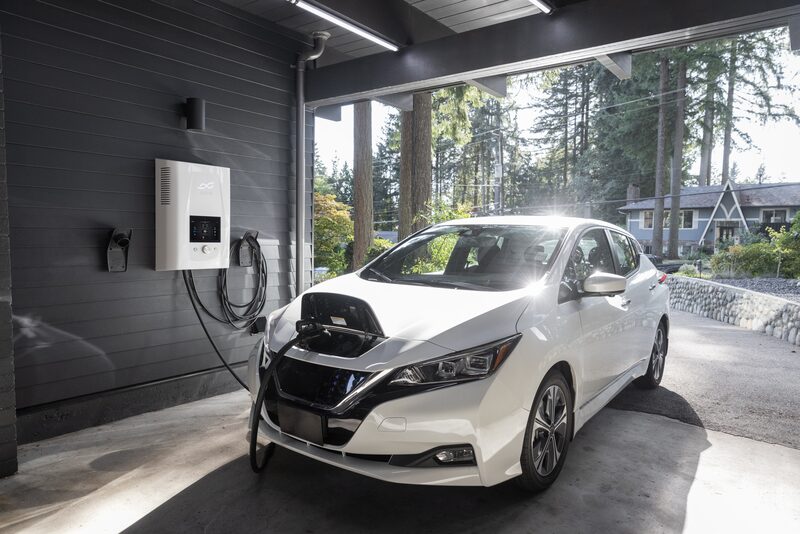
Rapid charging: 20 to 80% in around 30 to 43 minutes
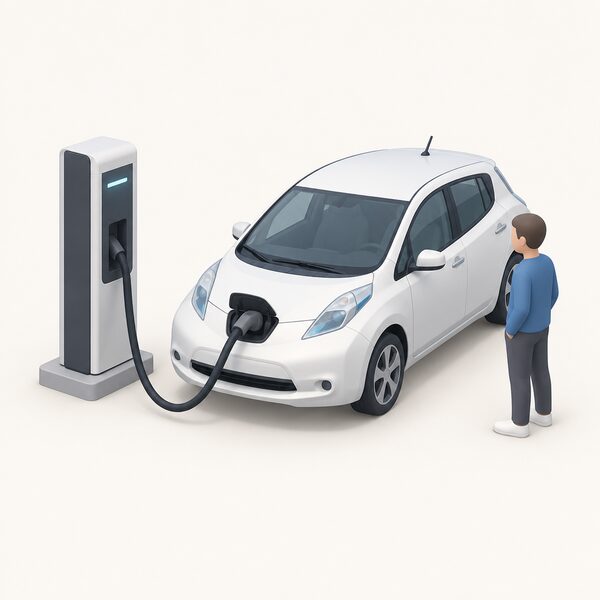
Rapid charging is the LEAF's weakest point relative to newer cars, and the reason is the DC ceiling. The car accepts a maximum of 46kW on DC1, so a 150kW ultra-rapid charger delivers no more than a 50kW unit would. Independent guidance is explicit that even when connected to a fast charger rated above 6.6kW, the LEAF will only charge at 6.6kW on AC3.
For context, ultra-rapid chargepoints of 150kW and over take many newer models from 20% to 80% in 10 minutes to one hour9, and general guidance for rapid and ultra-rapid stations suggests allowing around 40 minutes10. The LEAF sits at the slower end of that band because of its hardware, not because of the charger.
Nissan's own figure for the LEAF is a DC quick charging time of under 30 minutes for 20% to 80%2. Independent guidance gives approximately 43 minutes on a 50kW DC charger, adding roughly 14 to 116 miles of range1. A practical rule of thumb from one charging guide is that a 45-minute rapid charge usually gets a car from about 20% to 80%5.
The 20% to 80% window matters because charging slows sharply above 80% on any lithium-ion battery. Charging to 100% on a rapid charger takes disproportionately longer and is not how the network is designed to be used.
Home charging on a 7kW wallbox: a full charge in about 6 to 7.5 hours
A 7kW wallbox is the standard UK home solution and the one that makes the LEAF practical for most households. Independent guidance gives approximately seven hours from 0% to 100% on a standard 7kW AC home charger1. A product listing for the LEAF gives 7kW charging to 100% in 7.5 hours3. Nissan's own figure is 7 hours 30 minutes on a 7kW charge point4.
For an 80% charge rather than a full one, independent guidance gives around six hours for the 40kWh LEAF on a home charger3. That is the more realistic daily pattern: most owners charge to 80% rather than 100% to reduce time at high state of charge.
The range added per hour is the figure that matters for planning. A 7kW wallbox adds roughly 30 miles of range per hour5. General guidance for Level 2 charging, the North American term for the same 7kW class of equipment, gives about 20 to 40 miles of range per hour11. A 40kWh LEAF MkII has a real-world range of 160 miles12, so a seven-hour overnight charge covers it comfortably.
The wallbox itself is only part of the picture. Installation, electrical capacity and notification to the network operator all bear on what a household can actually run. The EV charging at home guide covers the full process, and electrical requirements for a home EV charge point sets out what the supply needs to support.
Slow charging on a domestic 3.7kW supply: up to 11 hours
A 3.7kW supply is the slowest dedicated circuit a household is likely to have, and it roughly doubles the charge time. Nissan gives 11 hours for a 40kWh LEAF on a 3.7kW charger4. Independent guidance for standard chargepoints in the 3.7kW to 8kW band gives five and a half to 11 hours for a full charge9, which brackets the same figure.
A three-pin domestic socket is slower again. One maker guide states that three-pin sockets deliver around 2.3kW and that charging an average EV battery could take over 24 hours7. Independent guidance is blunter: a three-pin plug can work in a pinch but is very slow, often taking 30 to 35 hours to fully charge depending on the battery5. Another guide puts three-pin charging at 6 to 8 hours, which is inconsistent with the rest and appears to describe a much smaller battery13.
The practical position is that a three-pin socket is a fallback, not a routine. It adds about 4 to 5 miles of range per hour14, so an overnight session of ten hours adds 40 to 50 miles. That covers a short commute but not a full recharge.
What the charging time means in miles of range
Charging time only becomes useful when converted into distance. The simplest rule from independent guidance is that the charging power in kW roughly translates to the number of miles added from 20 minutes of charging9. A 7kW charger therefore adds roughly 7 miles in 20 minutes, and a 50kW rapid adds roughly 50.
That rule is approximate. Measured figures put a 7kW wallbox at roughly 30 miles of range per hour5, and Level 2 charging generally at 20 to 40 miles per hour11. Level 1, the three-pin equivalent, adds about 4 to 5 miles per hour14.
| Charger | Range added per hour | Range added in 30 minutes |
|---|---|---|
| Three-pin, around 2.3kW | 4 to 5 miles | 2 to 3 miles |
| Home wallbox, 7kW | roughly 30 miles | about 15 miles |
| Rapid, 50kW DC | not linear; 20% to 80% adds 14 to 116 miles in 43 minutes | roughly 10 to 80 miles |
The rapid figure is not linear because charging rate tapers as the battery fills. The 14 to 116 miles range for a 20% to 80% session on a 50kW charger1 is wide because it depends on which LEAF battery is fitted and the conditions on the day.
For a household, the arithmetic is straightforward. A 40kWh LEAF with a real-world range of 160 miles12 needs about 30 miles a day for a typical commute, which is one hour on a 7kW wallbox. The rest of the overnight window is spare capacity, and that spare capacity is what makes time-of-use tariffs and solar charging worth considering. The EV charging running costs page works through the cost side.
Does the 40kWh LEAF charge faster than the 75kWh version?
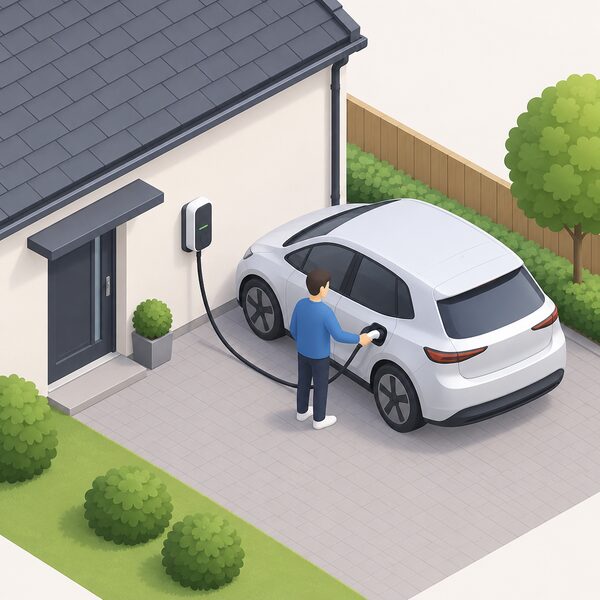
On the same charger, yes, because there is less energy to replace. Nissan gives 11 hours on a 3.7kW charger for the 40kWh battery4, and 6 hours on a 7kW charge point4. A larger pack takes proportionally longer at the same power.
The 75kWh LEAF is the newer, longer-range model, while the 40kWh battery remains the smaller option; a 40kWh LEAF takes 11 hours to charge from empty to full on a 3.7kW charger1, and around 6 hours to reach an 80% charge on a faster home unit2. A bigger battery means more miles per charge but also more hours per full charge on any given charger.
The trade-off is not simply about time. A larger battery accepts a higher peak rapid rate in many designs, so the 20% to 80% window can be quicker in absolute terms even though a full charge takes longer. For the LEAF specifically, the DC ceiling of 46kW applies across the range1, so the rapid advantage of a bigger pack is limited.
For a household choosing between used examples, the question is how much of the battery is used on a typical day. A 40kWh car charged overnight on a 7kW wallbox covers most UK commuting patterns. A 62kWh car reduces the number of rapid charges needed on longer trips, at the cost of a longer full charge at home.
Battery warranty and what it covers
Nissan's published battery warranty covers defects in materials and workmanship for five years or 100,000 kilometres6. That figure comes from a 2013 press release and is stated in kilometres rather than miles. Warranty terms vary by model year and market, so the booklet supplied with a specific car is the document that governs any claim.
The LEAF was also sold with battery leasing contracts at one point, alongside the Renault Zoe15. A used buyer needs to establish whether the battery is owned outright or subject to a lease, because that changes both the running cost and what happens at the end of the term.
Battery condition matters more than warranty paperwork on a used car. State of health testing is the practical check, and the EV batteries and degradation page explains what the figures mean. For charge point warranties rather than car warranties, the EV charge point warranties page covers the equipment side.
Is the Nissan LEAF compatible with vehicle-to-grid charging?
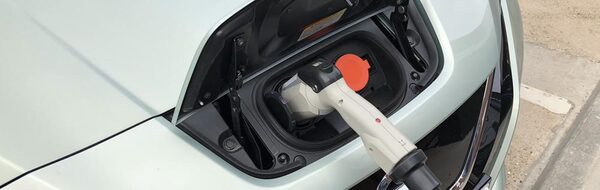
Only on a DC CHAdeMO port with a V2G-capable DC charging station. Nissan's support article states that the LEAF is not compatible for V2G with the PowerPort AC Level 2 charger, and that it can perform V2G charging only on a DC CHAdeMO port with a V2G DC charging station16.
The LEAF uses Type 2 and CHAdeMO inlets3. Type 2 handles AC charging, and CHAdeMO handles DC. Because V2G on this car runs through the DC path, the AC bidirectional hardware sold for other models is not the route.
Vehicle-to-grid charging allows energy stored in the vehicle's battery to be exported to the grid during periods of high demand17. For a household, that is the difference between a car that only consumes electricity and one that can earn from it. The vehicle-to-grid and vehicle-to-home page covers the UK position, and V2G earnings sets out what the schemes pay.
The dependence that remains is worth stating plainly. A LEAF charged at home still draws from the grid, still depends on a supplier and a tariff, and its smart charging features depend on the manufacturer's app and connectivity. V2G adds a route to export, but only through a DC charger that supports it, and only where a network offers the service.
Sources17 cited
- Nissan Leaf model charging guide, Zapmap, 2026
- All-new Nissan LEAF 75kWh priced from £32,249, Nissan UK Newsroom, 2025
- How long does it take to charge an electric car, Zapmap, 2026
- Time to charge, E.ON Next, 2025
- Electric car charging guide, Carwow, 2025
- The new Nissan LEAF in detail, Nissan UK Newsroom, 2013
- How to charge your electric car at home, Power NI, 2025
- EVs: the facts, SMMT, 2025
- Charging electric vehicles, Energy Saving Trust, 2026
- Should I buy an electric car, Which?, 2026
- Electric vehicles: a simple guide to electric car terms, Indra, 2025
- Driving an electric car: top tips, Zapmap, 2024
- Electric vehicle charge points, Flexi-Orb, 2025
- Home EV charger installation, SolarEdge, 2025
- The ultimate guide to buying a secondhand EV, Electroverse, 2024
- Is the Nissan LEAF or the ENV200 V2G compatible with Nuvve's PowerPort AC Level 2 charger, Nuvve, 2026
- Five electric vehicle innovations to watch, Energy Saving Trust, 2022
 EV Charging Speeds and TimesHow long an electric car takes to charge depends on the charger and the car together, so a faster charge point will not always speed things up.
 Cost to Charge an EV at HomeHow home charging cost is worked out from battery size, efficiency, the unit rate paid and the tariff behind it, with full-charge costs of about £8 to £17, cost per mile, annual running costs and what changes for EV owners from April 2028.
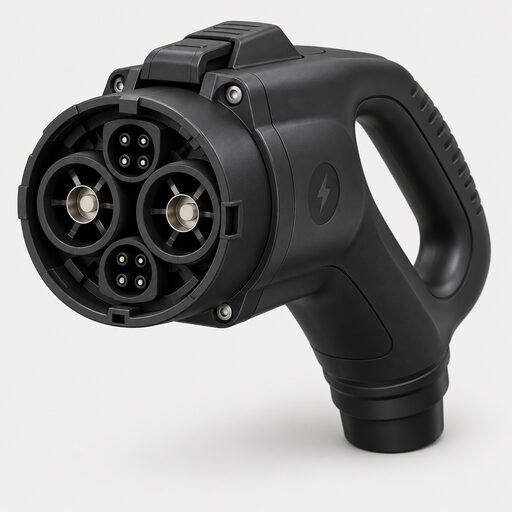 Bidirectional Charging StandardsDoes your electric car and charger actually support sending power back to your home or the grid?
 The Full EV Charging GuideCharging an electric car at home usually means a wallbox, but do you need one, and what will it cost to fit and run?
 EV Charging Bolt-OnsCan you get cheap electricity for your car without changing the tariff for the rest of your home?
 Portable Power Station SizeHow big a portable power station does a home actually need, and how long will it keep things running in a power cut?