In this guide
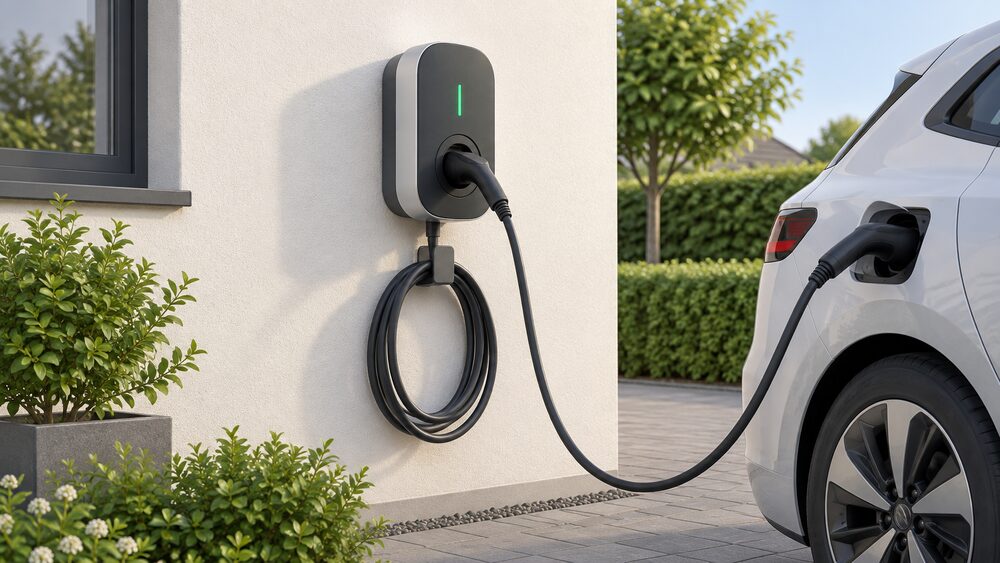
Project EV is a charge point brand sold into UK homes and workplaces, with a product range that runs from 7.3kW AC units up to 1MW DC charge points1. For a household, the relevant part of that range is the 7.3kW AC wallbox, the size that matches a single-phase domestic supply and the output most UK homes can support.
The brand's appeal to householders rests on three things: a free app rather than a subscription, solar charging modes on single gun AC models, and dynamic load balancing across the whole AC range1. Project EV also states that its charge points are OZEV approved, which matters because the government chargepoint grants require approved equipment3.
What follows is what the documents establish about the range, the specifications that decide whether an installation works, the grant position, the app, and the support arrangements, including the limits the maker itself sets.
What Project EV makes: AC and DC charge points from 7.3kW to 1MW
Project EV describes its range as extending from 7.3kW AC up to 1MW DC charge points, and says the technology serves everything from homes and workplaces to public and commercial environments1. That span covers three quite different markets. The 7.3kW AC end is domestic: a wall-mounted unit on a single-phase supply, charging overnight. The middle of the range covers three-phase AC and small DC units for workplaces and fleets. The top end, at 1MW DC, is depot and en-route infrastructure, with nothing in common with a house.
The 7.3kW figure is the one that matters for a home. Project EV lists a 7.3kW range as its domestic AC offering2. That output sits alongside the wider market: 7kW AC is the standard domestic charging level, and 7kW, 11kW and 22kW units are all sold for home and commercial use6. A 7.4kW charger draws 32 amps on a single phase, which is the practical ceiling for most UK domestic supplies without an upgrade8.
The distinction between AC and DC is not a marketing one. AC chargers use the car's own onboard charger to convert current, which is why a 7.3kW AC unit delivers roughly 7.3kW regardless of the car. DC chargers bypass the onboard charger and are physically much larger, which is why the 1MW end of the range belongs to depots rather than driveways.
The APEX range and where home chargers fit in it
Project EV's AC chargers offer four modes of control, including RFID card control on RFID models, the free Project EV App and the Project EV Pro App2. The Pro App is aimed at public charging, managing and controlling multiple chargers and generating revenue from them, so it is not the household tool1.
The current AC model named in the documents is the THOR 07AS-S/P/SE/PE, listed as an AC EV charger9. Older model references still circulate: the Project EV EVA-07S-SE-C is listed as discontinued, so a quote naming that unit is quoting a product no longer sold10.
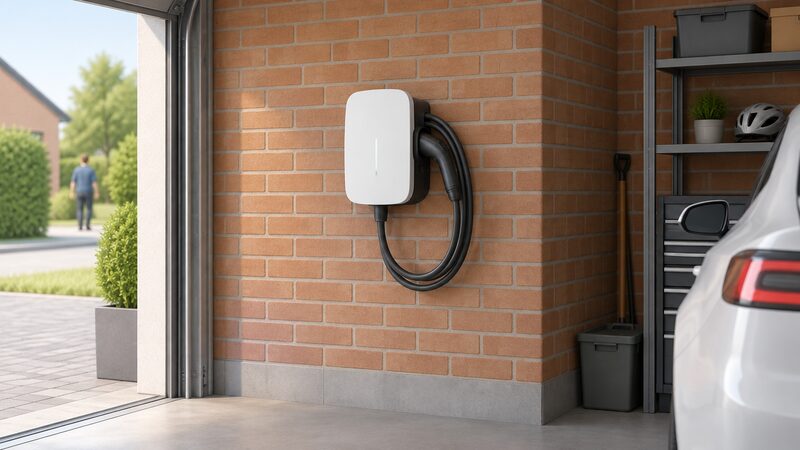
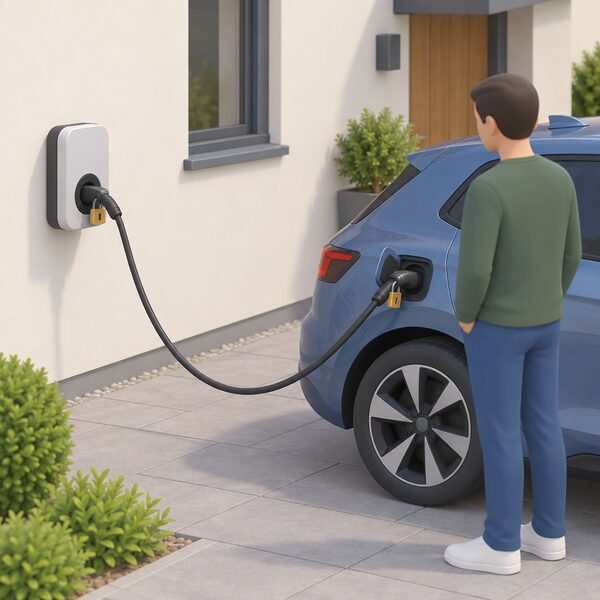
For a household, the practical questions are which current model is being offered, whether it is tethered or untethered, and whether it is single gun or multi gun. Project EV chargers with a dual gun or triple gun outlet can charge multiple vehicles simultaneously, which is a fleet feature rather than a domestic one1. Untethered units in the range carry a cable lock, described as unique to the Project EV range of untethered charge points, which locks an owner's own cable to the charge point and the vehicle3.
Specifications that matter for a household installation
The charger is one part of an installation that has to satisfy building regulations, the wiring standard and the network operator. Building regulations approval is always required when installing an EV home charger, and a competent and reputable installer should be used, with specific processes for notifying the local building control authority11. The work must be done in line with the current edition of BS 7671, the national standard for electrical installations12. Installers need competence in the IET Code of Practice for Electric Vehicle Charging13.
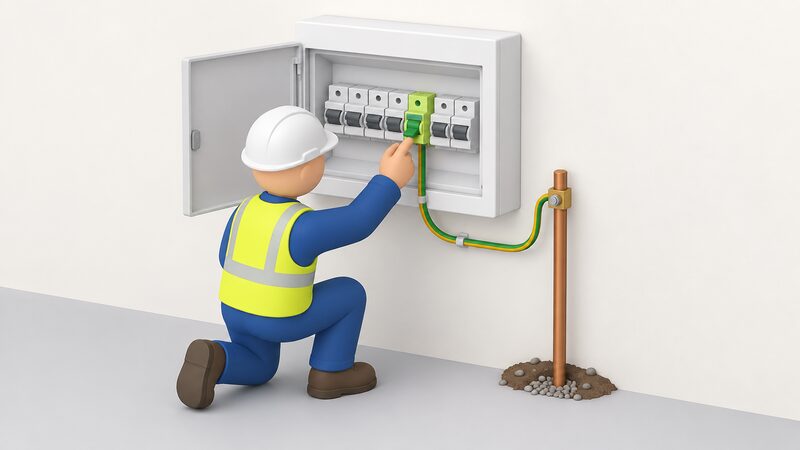
Most local authorities specify that households install a dedicated EV charger with protective earth neutral fault protection, which is why a dedicated unit is preferred to a three-pin socket for regular charging14. In Scotland, policy proposals for new residential buildings require all dwellings with a parking space to have at least one EV charge point socket with a minimum 7kW output rating16.
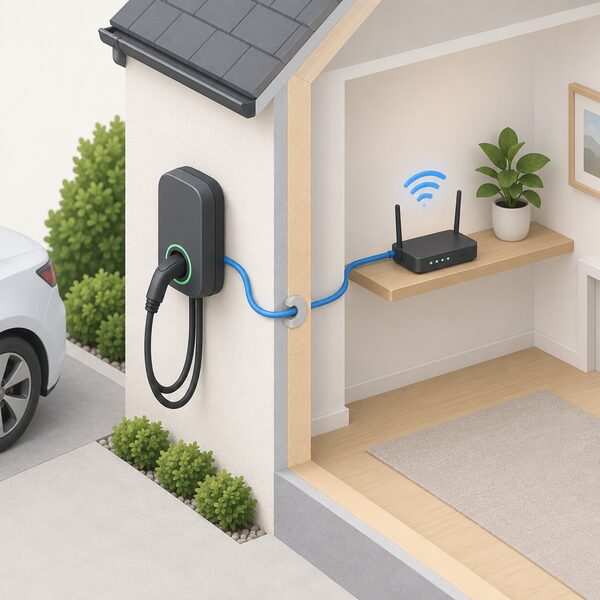
Two Project EV features bear directly on this. All Project EV AC chargers have the ability to dynamically load balance, distributing household power evenly across electrical appliances, which is what allows a charger to be added without exceeding the supply capacity1. Every Project EV charge point is WiFi enabled and comes with an Ethernet LAN port as standard, so a wired connection is available where Wi-Fi is weak3.
| Requirement | What applies | Source |
|---|---|---|
| Building regulations approval | Always required for an EV home charger | 11 |
| Wiring standard | Current edition of BS 7671 | 12 |
| Installer competence | IET Code of Practice for EV Charging | 13 |
| Earth protection | PEN fault protection specified by most local authorities | 14 |
| New build, Scotland | Minimum 7kW socket per dwelling with parking | 16 |
| Load balancing | Supported across the Project EV AC range | 1 |
In Northern Ireland the process differs: a new electricity supply application requires the electrician to complete the load details section, including the make and model of EV chargers, PV panels and heat pumps17. Certification also matters. Testing and certification for charge points covers both home and commercial use, and the BSI Kitemark exists for the product category18.
OZEV approval and grant support
Project EV states that its charge points are OZEV approved3. OZEV, the Office for Zero Emission Vehicles, administers the chargepoint grant schemes, and grant rules turn on approved equipment and eligible applicants rather than on the brand alone.
The grant landscape has narrowed. The Electric Vehicle Chargepoint Grant for residential landlords opened on 1 April 2022, and OZEV notifies successful applicants and their installers19. The Cross-Pavement Charging Grant accepts applications for plug-in hybrids listed as eligible by OZEV, which shows how the eligibility lists work in practice20. Applications for the EV Pavement Channels Grant opened in August 2025, when eligible local authorities were told their allocations and invited to submit proposals21.
For most owner-occupier households, the relevant point is that the grant schemes are aimed at renters, flat owners, landlords and local authorities rather than at every installation. Approval of the equipment is a necessary condition, not a sufficient one, and the householder still carries responsibility for permissions: installing a home charger is classified as development, and it is up to the householder to ensure the correct permissions are in place22.
Solar charging and the free design service
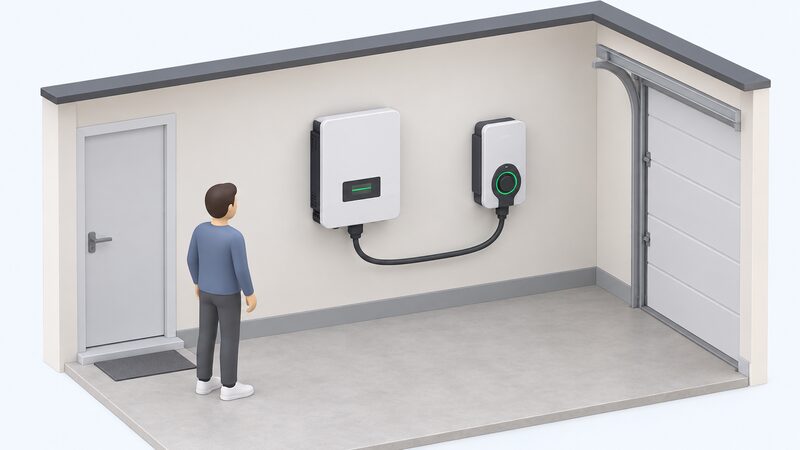
Project EV chargers work in harmony with solar panel technology on single gun AC models, allowing a vehicle to be charged from the green energy a solar system generates1. The maker describes the mechanism in more detail: the charger can charge a vehicle with unused exported power that would normally flow back to the grid, by analysing the exact amount of unused power and charging the vehicle direct from the solar panels3.
That is solar diversion, and it is one of the features independent guidance identifies as desirable in a smart charger, alongside app control and dynamic scheduling, because it prioritises solar power for EV charging and minimises reliance on the grid23. The Project EV App includes a solar charging mode and solar integration for greener charging2.
Project EV also offers a completely free design service to explore the benefits of solar3. For a household, the value of that service depends on whether the property already has panels or is considering them, since the charger's solar mode only has surplus generation to work with if a system is producing it.
The limit is worth stating plainly. Solar diversion reduces the amount of grid electricity a car uses, but it does not remove the grid connection, and in winter a UK array will rarely cover a full charge. The charger is a way of using self-generated power better, not a way of charging without a network supply.
The Project EV app: free to use, but what it controls
The Project EV App is free4. It allows charging rates to be chosen and customised, off-peak charging to be prioritised to maximise savings, a solar charging mode to be used, charging records to be created, and all data to be seen and controlled1. The Pro App is the commercial counterpart, providing public charging capabilities and management and control of multiple chargers1.
The app is the main interface, but it is not the only one. Project EV AC chargers offer four modes of control, including RFID card control on RFID models, the free app and the Pro App2. Multiple charging modes are listed as app, plug-and-go and RFID, and multiple chargers can be managed in one dashboard3.
This is where the dependence sits. Scheduled charging, off-peak prioritisation and solar mode all run through the app, which runs through the home network. Every Project EV charge point is WiFi enabled with an Ethernet LAN port as standard, so a wired connection is an option, but the control layer still belongs to the manufacturer's platform3. Local charging continues without it; the scheduling and monitoring do not.
Support, helpline hours and the installer-first policy
Project EV's support arrangements are documented in its warranty material. The warranty document gives a support phone number, 0800 599 9582, and a technical support email address, enquiries@projectev.co.uk, asking that pictures or videos be sent with the email5. A separate support article lists a different phone number, so the two documents disagree and the current number should be confirmed before relying on it.
The clearest published policy is the call-out limit. Project EV states that it will not call out to solve or fix Wi-Fi or connectivity problems and directs owners to the original installer5. That is consistent with the connectivity specification: because every charge point is WiFi enabled with an Ethernet LAN port as standard, the maker treats the home network as outside its remit3.
The documents do not state Project EV's helpline opening hours. Published hours exist for other organisations, such as National Energy Action's benefits service, which opens Monday to Thursday 10am to 4pm and Friday 10am to 12.30pm, but those are not Project EV's hours and should not be read as such24.
On faults generally, the first step is the installer. Independent guidance on voltage problems is to speak to the installer or electrician first to check there is no problem with the equipment26. SSEN recommends speaking to an electrician or installer first to check whether the wiring can support an EV charger27. For a household, the practical consequence is that the installer relationship matters as much as the brand: the maker supports the product, and the installer supports the connection.
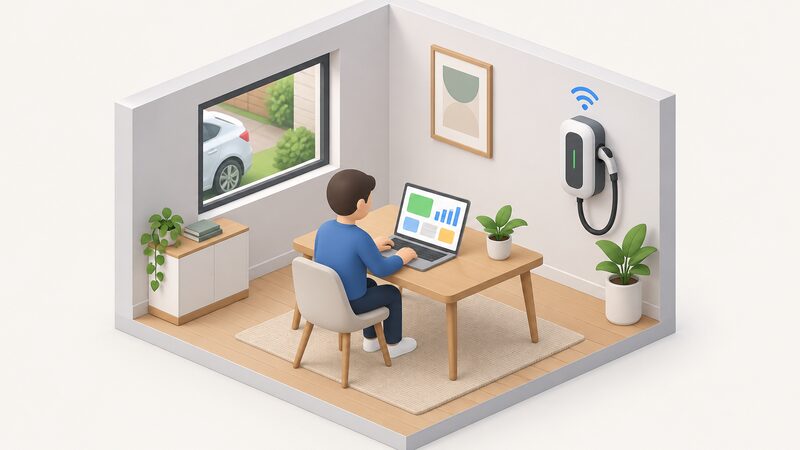
What owning a Project EV charger means for energy independence
A home charger of any brand changes a household's energy position in two directions at once. It adds a large new electrical load, and it moves transport fuel from petrol or diesel to electricity, which can be self-generated. Project EV's contribution to the first is load balancing: all Project EV AC chargers have the ability to dynamically load balance, ensuring household power is distributed evenly across electrical appliances1. That is what allows a charger to be added without a supply upgrade in many homes.
The contribution to the second is solar diversion. Project EV chargers can charge a vehicle with unused exported power that would normally flow back to the grid, by analysing the exact amount of unused power and charging direct from the panels3. A household with panels and a Project EV charger can therefore put its own generation into the car rather than exporting it.
What remains is dependence. The car still charges from the grid when the sun is not shining, so the household stays on a supplier and a network. The scheduling, solar mode and monitoring run through a manufacturer's app and the home network, and the maker does not attend connectivity faults3. The installation itself depends on a competent installer working to BS 7671 and notifying building control11. And chargers can be affected by network conditions: when neighbouring homes all export solar energy simultaneously, local network voltage rises, and some EV chargers respond by shutting down28. A Project EV charger reduces a household's exposure to fuel prices and increases its use of self-generated power, but it does not take the home off the grid.
Sources28 cited
- Project EV, Project EV, 2026-05-07
- 7.3kW Range, Project EV, 2026-04-16
- Project EV charge points, Westech Solar, 2025-07-09
- Project EV AC and DC datasheet, Westech Solar, 2026-09-17
- Warranties, Project EV, 2026-09-17
- EV charging, Uswitch, 2026-09-19
- EV buying guide, Zapmap, 2024-12-06
- Home charging, Polestar, 2026
- THOR 07AS-S/P/SE/PE, Growatt, 2026-09-17
- Project EV EVA-07S-SE-C, Trade Sparky, 2026-09-17
- Building regulations, Planning Portal, 2026-09-17
- EV charger installation and maintenance, NICEIC, 2025-08
- Section 722 EV charging guide, Elec-Mate, 2026-07-02
- Cross-pavement charging solutions, Energy Saving Trust, 2025-07-18
- EV charging smart search, Planning Portal, 2026
- EV charge points for new buildings, Transport Scotland, 2026-09-20
- New electricity supply application, NIE Networks, 2026-09-19
- BSI Kitemark for EV charging, BSI, 2026-09-17
- EV chargepoint grant for residential landlords, GOV.UK, 2026-09-18
- Cross-pavement charging grant, Energy Saving Trust, 2026-09-14
- EV Pavement Channels Grant, Energy Saving Trust, 2025-08
- Planning permission for EV charging, Planning Portal, 2026
- Integrating solar panels with EV charging, Uswitch, 2025-07-02
- Benefits advice and claim support, National Energy Action, 2026-06-29
- Energy advice and support service, National Energy Action, 2026-06-23
- Voltage changes in your home or business, UK Power Networks, 2026-09-17
- Existing electricity supplies, SSEN, 2026-09-19
- Making home energy management work for consumers, Energy Systems Catapult, 2026-02-12