On this page
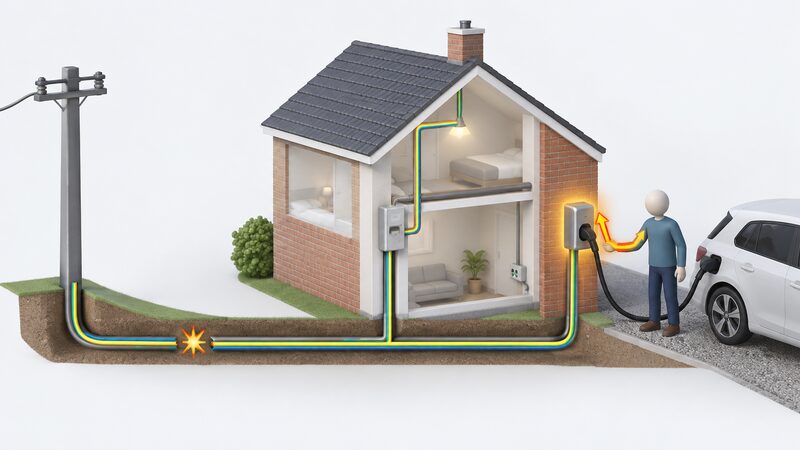
Most UK homes receive electricity on a Protective Multiple Earthing (PME) supply, where the earth and neutral are combined into a single conductor, known as the PEN conductor, for part of the journey from the substation. That arrangement is safe in normal operation, but it creates a specific hazard at an outdoor metal box that a person touches while standing on the ground: if the combined conductor breaks, the "earth" can be pulled up to a dangerous voltage. An EV charger on a driveway is exactly that kind of exposed, touchable equipment, which is why Energy Saving Trust reports that most local authorities specify households install a dedicated EV charger with protective earth neutral (PEN) fault protection1. The government has likewise consulted on building regulation amendments that could require effective load management and PEN fault protection on all EV charge points2.
The protection can be delivered in two ways: a separate earth rod driven at the charge point, or open-PEN detection built into the charger that isolates the vehicle when the fault appears. Rolec, which introduced its TruePEN approach, notes that the detection route is often preferred for its low cost and easy fitment3. This page explains what the fault does, which chargers carry built-in protection, why the UK version of a model matters, and what the Wiring Regulations require.
Why EV chargers need PEN fault protection
A PEN fault is a break or degradation in the combined protective earth and neutral conductor of a PME supply. Under normal conditions the neutral current returns along that conductor and everything connected to it sits near earth potential. If the conductor is broken somewhere between the property and the network's earthing points, current has nowhere to return, and the voltage on the earthed metalwork of the house, and anything connected to it, can rise toward full line voltage. Indoors, the risk is largely managed because PME was designed with that trade-off in mind. Outdoors, the risk profile changes: a charge point is metal, it is fixed at a height and position where a person stands on the ground and grips a plugged-in cable, and the vehicle being charged is itself a large conductive body resting on rubber tyres, insulated from any other earth path.
That is why the 18th Edition of the IET Wiring Regulations (BS 7671:2018) addressed the problem under clause 722.411.4.1 for domestic installations3. The IET's Code of Practice for EV charging equipment installation sets out how the fault is managed in practice, including the role of devices that monitor the voltage between the protective conductor or neutral and a measurement point derived from the phase conductors7. Those open-PEN detection devices are only suitable for use in three-phase installations, though they may be used to protect single-phase charging points within a three-phase installation7.
The charger's own protective features stack on top of this. E.ON Next lists DC leakage protection, temperature monitoring and PEN protection among the safety features a home charger can include8. Electricity North West describes the general behaviour of chargers when supply conditions move outside safe limits: if the voltage goes outside its range, the charger stops working and shows an error, a safety feature protecting the charger and the vehicle9. PEN protection is the specific layer for the specific fault where the earth and neutral conductor itself is lost.
The consequences of getting it wrong are not theoretical. A 2026 product safety report on the Easee One backplate found that incorrect labelling could cause an electrician to connect the PME conductor to the standard PE terminal instead of the dedicated PME terminal, potentially bypassing the charger's built-in PEN fault detection and automatic disconnection function required for UK PME installations4. Where a mislabelled unit is confirmed to be incorrectly wired and without external PEN protection, charging is temporarily paused until remediation is completed4. In other words, the protection only exists if the terminal it depends on is actually used.
Built-in PEN protection: chargers that need no separate earthing rod
The Wiring Regulations accept two routes to safety at a domestic charge point on a PME supply. Rolec summarises them: protection can be achieved by installation of an earth rod at the charge point, or through PEN fault detection and isolation of the vehicle from the home's live, neutral and earth, with the latter often preferred due to low cost and easy fitment3. The earth rod gives the installation its own physical connection to true earth, independent of the network's combined conductor. The detection route instead watches the supply continuously and, if the PEN conductor is lost, disconnects the vehicle from all three conductors so that no dangerous voltage can be transferred to the car body or the cable.
For a household, the practical difference is cost and disruption. An earth rod means driving a rod into the ground near the charge point, which adds work, materials and, on some sites, real difficulty. waEV-charge notes among charging myths that safety features vary between products, such as PEN fault detection which avoids the need for extra earth rods10. Fuse Energy makes the same point from the installation-cost side: the Easee One charger includes integrated open PEN conductor protection, which often removes the need for an earth rod11.
Most current UK chargers take the built-in route. The specifics by maker are covered in the next section, but the pattern is consistent: the detection electronics live inside the charger enclosure, the installer wires to a dedicated terminal, and no separate grounding equipment is needed at the charge point. That does not make the installation simpler in every respect, because the installer still has to verify the supply type and confirm the charger's protection method is valid for it, but it removes the rod itself from the job.
It is worth being clear about what the built-in protection does not do. It does not protect the rest of the house against a PEN fault; it protects the charging circuit and the vehicle. It also depends entirely on the unit being correctly specified and wired, which is why the mislabelled Easee One backplate case mattered so much: the detection function was present in the product but could be bypassed by a wiring error at a terminal that looked, to an electrician, like the right one4.
Which chargers include PEN fault protection
The list below is drawn from what each maker states about its own products. It is not exhaustive, and a maker's claim about its own charger is a maker's claim: the installer's job is to confirm the protection suits the supply at the property.
| Charger | What the maker states | Notes |
|---|---|---|
| Easee One | Integrated open PEN conductor protection, which often removes the need for an earth rod11 | All installations must adhere to safety regulations like BS 767111 |
| evec ESP01 | PEN fault detection, so there is no requirement for an earth rod, reducing installation costs12 | Single socket pedestal model |
| EO Mini Pro 3 | Built-in open PEN conductor protection, no need for earth rods13 | Single-phase only |
| myenergi zappi | Built-in PEN fault technology, eliminating the need to install additional earth rods14 | Maker describes it as the only charger with built-in PEN fault technology |
| Sigen EV AC Charger | Integrated PEN breaker, a design specifically tailored for the UK market15 | Maker states no separate PEN protection is needed16 |
| Tigo GO EV Charger | Integrated protective earthed neutral (PEN) protection17 | EU product page |
| Puredrive Duracharger | Built-in PEN fault protection18 | Listed under protection features |
| Ohme chargers | Include built-in PEN fault protection19 | Maker buying guidance |
| SALUS EV Charger Series | PEN fault protection, no extra grounding required20 | UK version only6 |
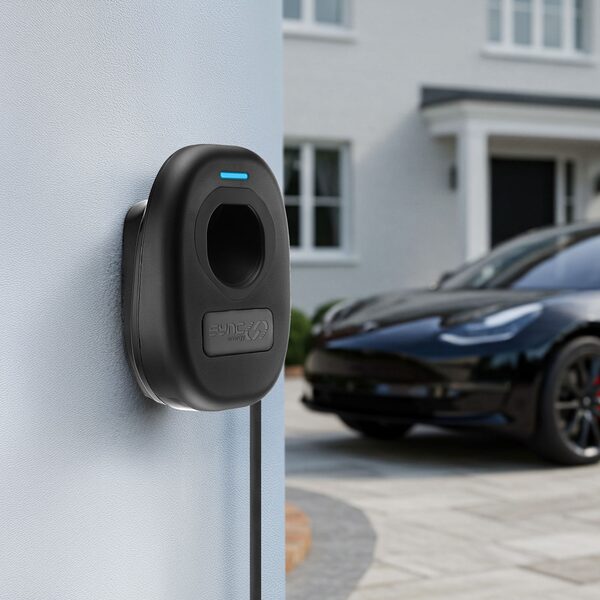
| Sync Energy Pro Charger AC | True PEN fault protection with Class 2 housing21 | Two models listed |
Two things stand out from the table. First, built-in detection is now the norm rather than the exception in the UK market, which reflects the Wiring Regulations position and installer preference for the low-cost route3. Second, the claims are not all identical in kind. "PEN fault detection" and "true PEN fault protection with Class 2 housing" are different engineering approaches, and the Class 2 distinction is worth understanding before you buy; it is covered in its own section below.
The myenergi claim that zappi is "the only electric car charger with built-in PEN fault technology"14 should be read as marketing dated to that product page: several other makers on this list state their chargers also include built-in protection. Where claims differ, the underlying requirement is the same, and it is the requirement, not the badge, that an installer certifies against.
UK versions only: why model choice matters

Several makers sell the same charger in different regional versions, and the PEN protection does not travel with all of them. SALUS lists PEN fault protection as "UK version only" for both its EV Charger Series6 and its EVT Charger Series5. The EVT series carries distinct regional model numbers for the UK, Romania, Germany, the Nordics and the Netherlands, and only the UK version carries the protection5. A household buying the UK version gets the protection; one sold an EU version may not, even though the unit looks and functions the same in every other respect.
This matters because the UK's PME earthing arrangement is not universal. A charger designed for a market where the supply is arranged differently has no reason to carry open-PEN detection, and a charger imported or resold from another market may arrive without it. Sigenergy makes the point explicitly in reverse: it integrated the PEN breaker into the Sigen EV AC Charger as "a design specifically tailored for the UK market"15, and its Belgian product page carries the same statement in Dutch16. The protection is a UK-specific feature added for UK-specific wiring.
The Easee One backplate safety report shows how finely balanced this is. The charger had the built-in detection; the fault was a labelling error that could lead an electrician to wire past it4. The lesson for a household is not to become an electrical engineer but to ask two questions before installation: is this unit the UK version, and does its documentation state PEN fault protection? A charger that cannot answer both is one an installer may have to supplement with an earth rod, or refuse to fit on a PME supply at all.
Class 2 housing and 'true' PEN fault protection
There are two engineering answers to the PEN problem, and they work differently. The first is detection and disconnection: the charger monitors the supply and isolates the vehicle when the PEN conductor is lost. The second removes the hazard at source: if the charger enclosure is Class 2, meaning double insulated with no exposed conductive parts connected to the earth system, there is no metalwork for a PEN fault to raise to a dangerous voltage in the first place.
Sync Energy uses this second approach. Its Pro Charger AC models, the EVPCFSM27LBGRP21 and the EVPCFSM27NBGR22, are both listed with "true PEN fault protection with Class 2 housing". Rolec's TruePEN branding, introduced as "safer by design", takes a similar position: the design removes the dependence rather than merely reacting to the fault3. The maker's explanation of the regulatory background is the same clause 722.411.4.1 route described above3.
For a household, the distinction is mostly one of reassurance rather than a choice to be made. Both approaches satisfy the Wiring Regulations when correctly installed. The Class 2 route has a theoretical elegance: it does not depend on detection electronics responding within a critical window, because the hazardous connection does not exist. The detection route has the advantage of being retrofit-friendly inside a conventional Class 1 enclosure. What matters on the day is that the installer confirms the charger's stated method is valid for the supply, wires to the correct terminals, and records it on the certification.
Compliance: meeting UK wiring regulations without extra grounding equipment
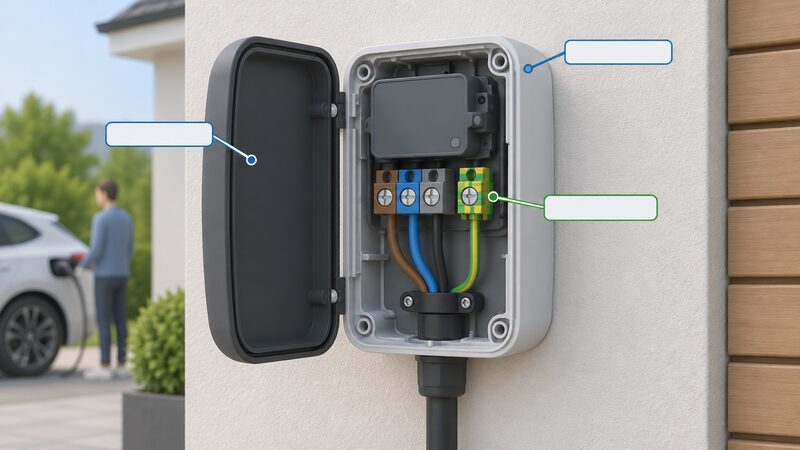
Whatever the charger, the installation must satisfy the Wiring Regulations. NICEIC states it plainly: all EV charging installations must continue to comply with the requirements of BS 7671, the Wiring Regulations23. Flexi-Orb's certification scheme for EV charge points describes the standard installation requirement as circuit protection in keeping with BS 767124. Fuse Energy's installer guidance repeats the same legal basis: all installations must adhere to safety regulations like BS 7671, the IET Wiring Regulations11.
On top of the wiring rules, the equipment itself must conform to product law. The IET notes that EV supply equipment must conform to the Electrical Equipment (Safety) Regulations 2016 and the Electromagnetic Compatibility Regulations 2016 (as amended) for UK sale25. Certification provides the evidence trail: BSI's Kitemark certification for EV chargers covers compliance with regulations such as the UK Smart Charge Regulation and ETSI EN 303 64526. Those instruments are about digital security and smart functionality rather than earthing, but they are part of the same picture of a product being verified against UK requirements rather than assumed to meet them.
The paperwork matters too. The Planning Portal describes the compliance certificate that follows an installation as proving the work complies with building regulations27. In England, the rules around EV charger installation have been tightened, and NICEIC's guidance on what has changed is the reference installers work to23. A household's part is to keep the certificate, confirm the charger is the UK version, and use an installer who will certify the earthing arrangement actually in place.
For a household's energy independence, this is one of the quieter but real dependencies in a home setup. A charger with built-in PEN protection removes the need for extra grounding equipment and the maintenance questions that come with it, but it does not remove the dependence on the network's own earthing arrangement or on the installer having wired the protection correctly. The independence gained is in cost and simplicity at installation; the protection itself is a response to a grid-side fault that no home can prevent.
Related pages: electrical requirements for a charge point, RCD protection, the installation process, charger safety and standards, and the pillar guide to home EV charging.
Sources27 sources
- Cross-pavement charging solutions, Energy Saving Trust, 2025-07-18
- Building regulations amendments relating to EV charging infrastructure, GOV.UK, 2026-10-21
- Introducing TruePEN, safer by design, Rolec, 2026-01-06
- Product safety report: Easee One EV charger backplate BP-AP-1/s01-01, GOV.UK, 2026-05-06
- EVT Charger Series, SALUS, 2026-09-20
- EV Charger Series, SALUS, 2026-09-20
- The IET Code of Practice for EV charging equipment installation, 4th edition, The IET, 2020-05
- EV charger safety tips, E.ON Next, 2026-09-17
- Managing voltage changes in your property, Electricity North West, 2026-09-19
- EV charging myths reviewed, waEV-charge, 2025-08-19
- How much to install an EV charger at home, Fuse Energy, 2026-04-22
- 7.4kW single socket pedestal EV charger, evec, 2026-09-17
- EO Mini Pro 3 support, EO Charging, 2026-09-17
- zappi car charger, myenergi, 2026-09-17
- Sigen EV AC Charger, Sigenergy, 2026-09-17
- Sigen EV AC Charger, Belgium, Sigenergy, 2026-09-20
- GO EV Charger (EU), Tigo Energy, 2026-09-17
- Puredrive home, Puredrive Energy, 2026-09-17
- What to look for when buying a home EV charger, Ohme, 2026-08-18
- SALUS EV chargers, SALUS, 2026-02-23
- Pro Charger AC EVPCFSM27LBGRP, Sync Energy, 2026-09-17
- Pro Charger AC EVPCFSM27NBGR, Sync Energy, 2026-09-17
- EV charger regulations in England: what's changed, NICEIC, 2026-08-19
- Electric vehicle charge points (EVCP), Flexi-Orb, 2025-04-22
- RCDs for electric vehicle supply equipment (EVSE), The IET, 2024-05
- Powering trust in electric vehicle charging with BSI Kitemark certification, BSI, 2026-09-17
- Electric vehicle charging: building regulations, Planning Portal, 2026-09-17