
In this guide
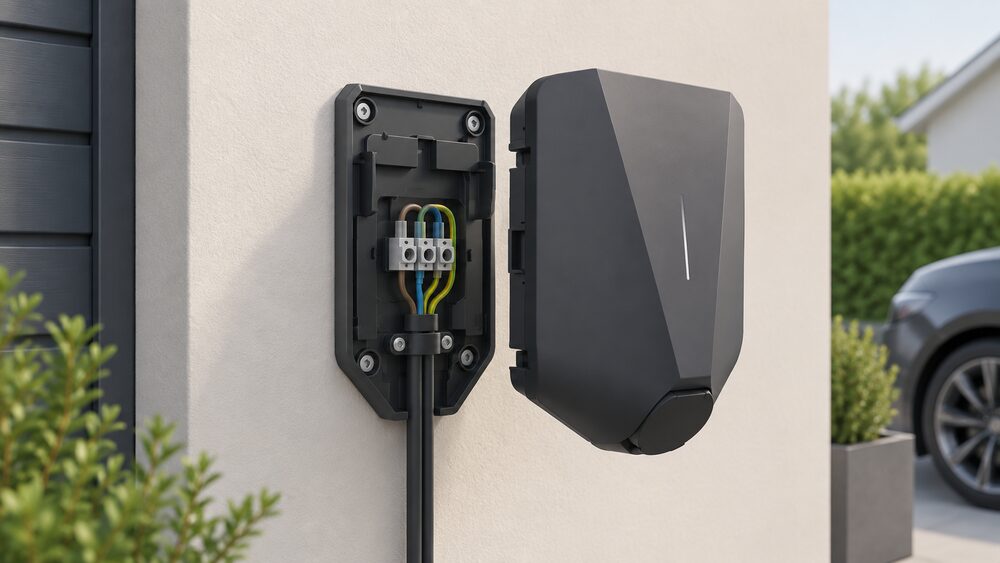
A bp pulse home charger is a rebadged Easee One: a wall-mounted unit that sits on a separate backplate, the wiring base where the supply cables terminate. The backplate carries the model number BP-AP-1/s01-01 and is the subject of a product safety report notified by the Office for Product Safety and Standards on 6 May 2026, covering a small quantity of units fitted with incorrect labelling1. That report is the single most important thing a householder searching this brand by name needs to know, because it determines whether an existing installation can charge at all.
The brand behind the unit is a public charging operator rather than a domestic hardware maker. bp pulse runs 3,581 public charging devices in the UK, of which 1,380 are rapid or ultra-rapid2. Its subscription costs £7.85 per month and gives discounted public charging rates, with subscribers saving once they have used more than 39.25kWh of electricity3. The home charger is the domestic end of that network proposition, not a separate product line.
For a household, the practical position is that a bp pulse home charger does not create energy independence. It adds electrical load to the property and depends on the grid, a licensed supplier and, for remote features, a broadband connection and the manufacturer's servers. What it changes is where the money goes: home charging at 24p per kWh against public rapid charging at 76p per kWh4.
What a bp pulse home charger is: the Easee One unit and its backplate
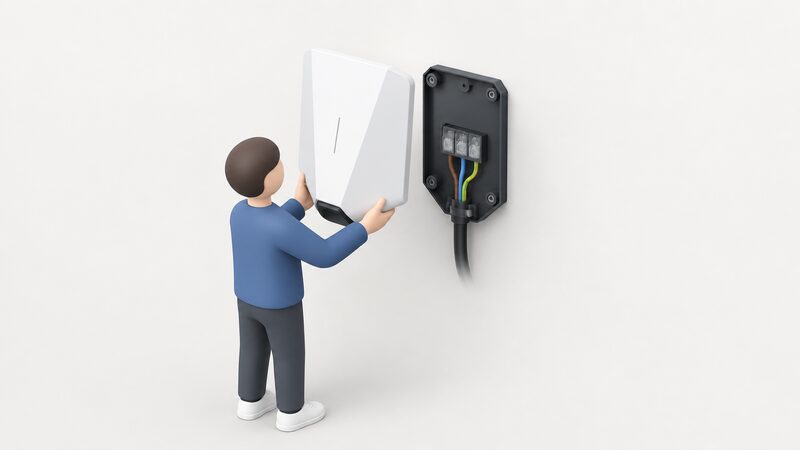
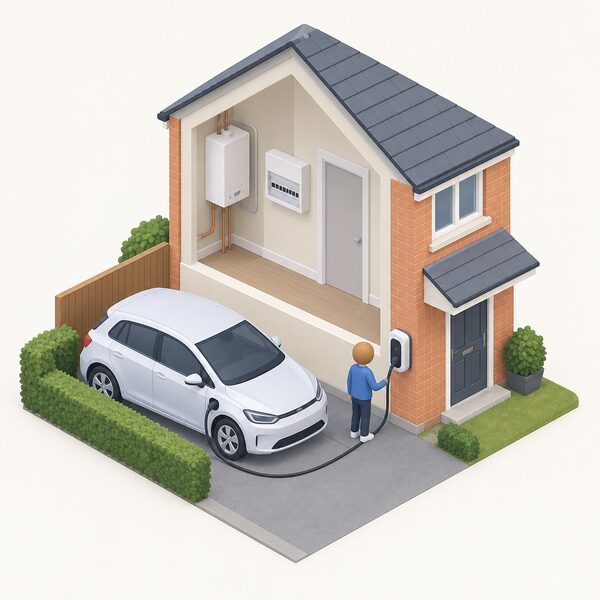
The domestic product is an Easee One supplied under the bp pulse name. The Easee One is a wall-mounted AC charger that separates into two parts: the charger body and the backplate it clips onto. The backplate is the permanent part of the installation, providing the electrical termination interface where the supply cables are connected, and it stays on the wall if the charger body is removed or replaced1.
That two-part design has practical consequences. It means the wiring is fixed and inspected once, and the charger itself can be swapped without disturbing the supply. It also means the backplate carries the identity of the installation: the model number, the country of origin, which for this unit is Norway, and the serial number used for registration and any remediation work1.
The Easee One is also designed to scale. Three Easee units can be installed on a single fuse, allowing three cars to charge from one location at the same time, with the power split between them evenly and access controlled by RFID cards6. That arrangement suits a household with more than one electric vehicle, or a small shared parking area, and it is a load management feature rather than a tariff feature: the total draw stays within the fuse rating, but the energy still comes from the grid.
For a household weighing independence, the split is worth stating plainly. The charger controls when and how fast the car draws power, and it can be paired with a tariff or with on-site generation. It does not generate anything, and it does not reduce the property's reliance on a supplier. The unit is a controlled load, not a source.
The backplate safety report and what it means for owners
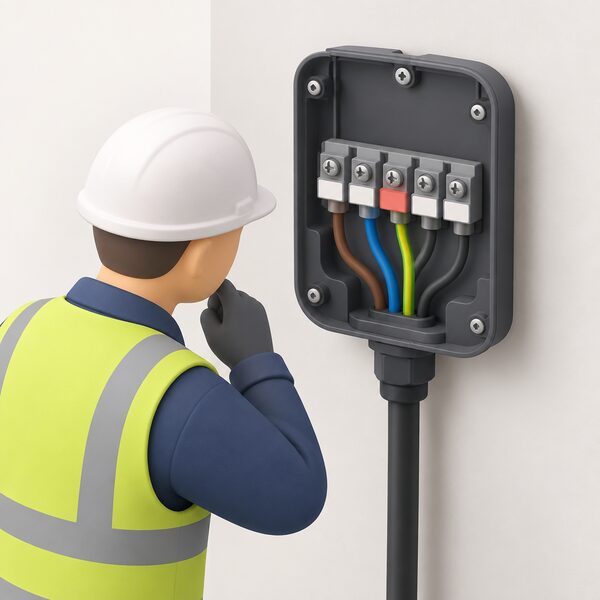
The Office for Product Safety and Standards notified a product safety report for the Easee One EV Charger Backplate BP-AP-1/s01-01, published on 6 May 2026 under notification number 2604-00191. The hazard is labelling, not component failure: a small quantity of backplates were fitted with incorrect labelling1.
The specific error matters. The terminal that should be clearly marked as "PME" (Protective Multiple Earthing) is incorrectly labelled as "L3"1. The report sets out the consequence: this incorrect labelling could cause an electrician to connect the PME conductor to the standard PE terminal instead of the dedicated PME terminal, potentially bypassing the charger's built-in PEN fault detection and automatic disconnection function required for UK PME installations1.
"charging is temporarily paused until remediation is completed"
The corrective action is a modification programme1. Where a mislabelled unit is confirmed to be incorrectly wired and without external PEN protection, charging is temporarily paused until remediation is completed1. That is the operative sentence for an owner: the pause applies to units confirmed as both mislabelled and incorrectly wired, and it is lifted once the modification is done.
The report covers backplates sold between late September 2025 and 3 February 2026. Owners of an Easee One installation should check the model number on the backplate itself rather than on the charger body, since the body can be swapped while the base remains. The wider context of charger safety certification is covered in EV charge point safety, standards and certification, and the earlier regulatory history of this hardware is set out in the Easee charger safety ruling.
Charger specifications and what installation involves
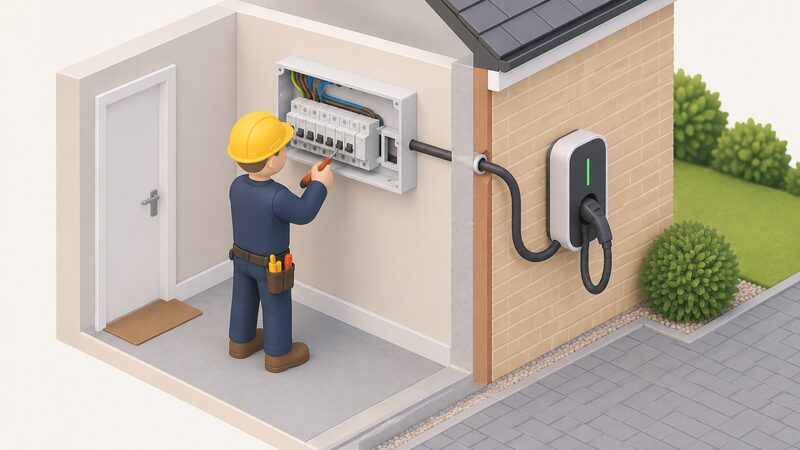
The installation requirements are the same as for any home charge point, and they are where most of the cost and delay sits. Installing a home EV charger typically requires a fuse upgrade to 80 to 100 amps, which often cannot be done on a looped supply without overloading the shared cable7. A looped service is one where the property shares a supply cable with a neighbour, and it is common in older terraced housing.
The unit itself is usually installed on the exterior of the home or garage, and it will either have a charging cable attached or a socket-outlet where a portable cable can be plugged in8. The choice between tethered and untethered is covered in types of home EV charger, and the electrical background in electrical requirements for a home EV charge point.
Two procedural points apply before work starts. Installing a home charger is classified as development, so it is up to the householder to ensure the correct permissions are in place9. Separately, the network operator needs installation details through the connection notification process, which is set out in telling the network operator about a home EV charger. Where a looped supply is involved, the distributor may need to unloop the service before a charger can be fitted at full rating.
| Item | Position |
|---|---|
| Unit type | Easee One, wall-mounted AC, on BP-AP-1/s01-01 backplate1 |
| Mounting | Exterior wall or garage, cable attached or socket-outlet8 |
| Supply | Fuse upgrade to 80 to 100 amps typically required7 |
| Looped supply | Often cannot take the upgrade without overloading the shared cable7 |
| Permissions | Classified as development; householder's responsibility9 |
| Multi-unit | Three units on one fuse, power split evenly, RFID access6 |
The bp pulse network behind the home charger
The domestic unit is sold against a public network that is one of the larger ones in the UK. bp pulse operates 3,581 public charging devices, which is less than half the total of Shell Recharge Ubitricity2. Of the national rapid and ultra-rapid estate, bp pulse accounts for 1,380 devices, nearly 700 more than the third-placed operator2. One independent guide describes the network as having more than 3,500 rapid (50kW+) and ultra-rapid (150kW+) charging points3.
Those figures sit inside a much larger national picture. There are about 76,500 public charge points in the UK, with roughly 6,000 being rapid or ultra-rapid chargers10. More than 14,000 rapid and ultra-rapid chargers are in place nationally11, and 15,082 rapid and ultra-rapid charging devices were included in publicly available charging devices as of March 202512. Scotland alone has 1,030-plus rapid and ultra-rapid charge points13.
The home side of the market is far bigger than the public one. There are more than a million charge points at homes and workplaces14, and nearly 700,000 domestic chargepoints15. The On-Street Residential Chargepoint Scheme has installed 19,001 public charging devices across local authorities, of which 10,833 were in the last 12 months16. A further 1,750 charge points across towns and cities have been funded17.
For a household, the network size matters in one specific way: it determines whether a subscription is worth holding. A driver who rarely uses public rapid charging gets nothing from a bp pulse membership, however large the network. A driver who covers long distances regularly is buying access to a specific estate, and the value depends on whether that estate sits on the routes actually driven. The general comparison of networks and payment is in public EV charging.
Public charging prices and the subscription breakeven
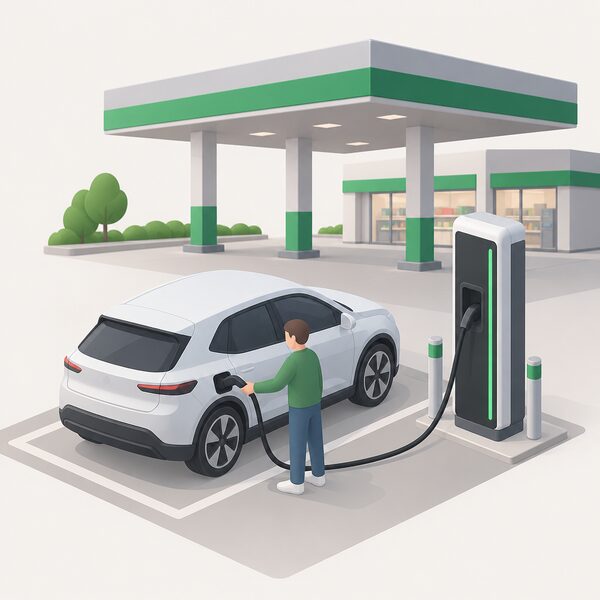
The public tariff structure has three tiers. Pay-as-you-go rapid and ultra-rapid charging is listed at 89p per kWh at a service station when paying directly4. Subscribers pay 69p/kWh for rapid and ultra-rapid charging3. Slower AC charging is priced at 65p/kWh on a pay-as-you-go basis3.
The membership costs £7.85 per month3. The breakeven is stated directly: subscribers will save once they have used more than 39.25kWh of electricity3. Below that monthly volume the subscription costs more than it returns, and above it the discount compounds.
| Tier | Rate | Source |
|---|---|---|
| Pay-as-you-go, service station | 89p per kWh | 4 |
| Subscriber, rapid and ultra-rapid | 69p/kWh | 3 |
| Pay-as-you-go, slower AC | 65p/kWh | 3 |
| Membership | £7.85 per month | 3 |
| Breakeven | more than 39.25kWh | 3 |
Those rates sit at the upper end of the public market. Slower chargers in residential areas typically charge around 53 to 66p per kWh but can sometimes cost more4. Ultra-rapid charge points on the public network are typically priced at 79p/kWh18, and the average for rapid and ultra-rapid chargers is 76p per kWh, approximately 23p per mile5. Slower charging can range anywhere between free-to-use and around 57p/kWh18.
Against home charging the gap is wide. Home charging on a standard rate is 24p per kWh4, and off-peak EV rates can reach 7p per kWh19. A 60kWh electric vehicle costs £27 to £60 to charge publicly, against £16.80 at home on a standard rate19. The Energy Saving Trust puts home charging at £17, public fast charging at £37 and public rapid charging at £53 for the same journey, against £45 for a full tank of petrol20. The comparison is developed in home vs public charging costs.
Payment methods and the overstay fee
Public charge points do not accept cash payments21. Depending on the network, payment runs through an app, a website, a pre-registered contactless charge card, or a credit or debit card21. bp pulse offers pay-as-you-go via app, contactless or RFID card, with a subscription available for discounted rates10. Some networks, such as ubitricity, allow payment on a pay-as-you-go basis by scanning a QR code found on the charge point using a smartphone22.
The overstay fee is the charge that catches drivers out. Overstay charges vary, with some billing per minute and some per hour23. In some cases the fine can be as much as £80 per hour23. The fee applies after charging has finished, so it penalises occupying the bay rather than drawing power, and the rate for a specific site is displayed on the charge point.
For a household, the payment question is mostly about the home unit rather than the public network. A home charger bills through the domestic electricity account, at whatever tariff the property holds, with no app-based payment step. The public payment methods only matter when the same driver charges away from home, and the practical guidance on that is in how to pay at public EV charging.
Investment, grants and what independence actually means
bp pulse announced a £1 billion UK charging infrastructure investment in March 2022, intended to roughly triple its public chargepoint network and roll out 300kW and 150kW ultra-fast chargers. The wider sector is investing £6bn to grow the public network by around 30% a year14. There has been a £300m investment in the UK's public EV charging points17.
Public money runs alongside it. A £200 million programme is intended to accelerate the rollout of chargepoints across the country, on top of a £25 million scheme to make it easier for residents without driveways to install home chargers23. The government is also investing £25m to help local councils install cross-pavement charging solutions10. The cross-pavement route is covered in the cross-pavement charging grant, and the on-street programme in the On-Street Residential Chargepoint Scheme.
None of this changes the household position. A home charger of any brand adds load to the property, depends on the grid and a licensed supplier, and, where smart features are used, depends on a broadband connection and the manufacturer's servers. The proportion of home EV charge points that use an EV tariff is 62%24, which is the lever that actually moves cost: shifting demand to cheaper hours rather than changing hardware. On-site generation and storage are the routes to genuine independence, covered in EV charging and household energy independence and charging an EV from solar panels.
Sources24 cited
- Product safety report: Easee One EV Charger Backplate BP-AP-1/s01-01, GOV.UK, 6 May 2026
- EV charging statistics, Uswitch, July 2025
- Best electric car charging subscriptions, Carwow, 21 November 2025
- How much does it cost to charge an electric car, Which?, 26 August 2026
- Tesla Model 3 charging, Zapmap, 2026
- Best home EV chargers, Carwow, 2026
- Looped services, NIE Networks, 2026
- Electric vehicle charger installation and maintenance, NICEIC, 2025
- Electric vehicle charging: planning permission, Planning Portal, 2026
- Electric car charging guide, Carwow, 16 July 2025
- EVs: the facts, SMMT, 22 September 2025
- Phasing out sales of new petrol and diesel cars from 2030, GOV.UK, 1 March 2025
- Electric cars, Home Energy Scotland, 20 September 2026
- Action on high energy costs needed to keep EV transition on track, ChargeUK, 17 September 2025
- NAPIT welcomes government announcement on discount for new electric cars, NAPIT, 15 July 2025
- Grant schemes for electric vehicle charging infrastructure, GOV.UK, 1 July 2026
- Electric cars and energy bills, Uswitch, 27 April 2026
- Electric car charging costs: all you need to know, Zapmap, 4 September 2026
- What is the cheapest way to charge an EV, Uswitch, 27 April 2026
- Charging electric vehicles, Energy Saving Trust, 23 April 2026
- How to use electric car charging points, Which?, 20 May 2026
- How to pay for public EV charging, Zapmap, 4 September 2025
- En-route charging, Zapmap, 26 February 2026
- Smart meter Guaranteed Standards of Performance draft impact assessment, Ofgem, August 2025