
In this guide
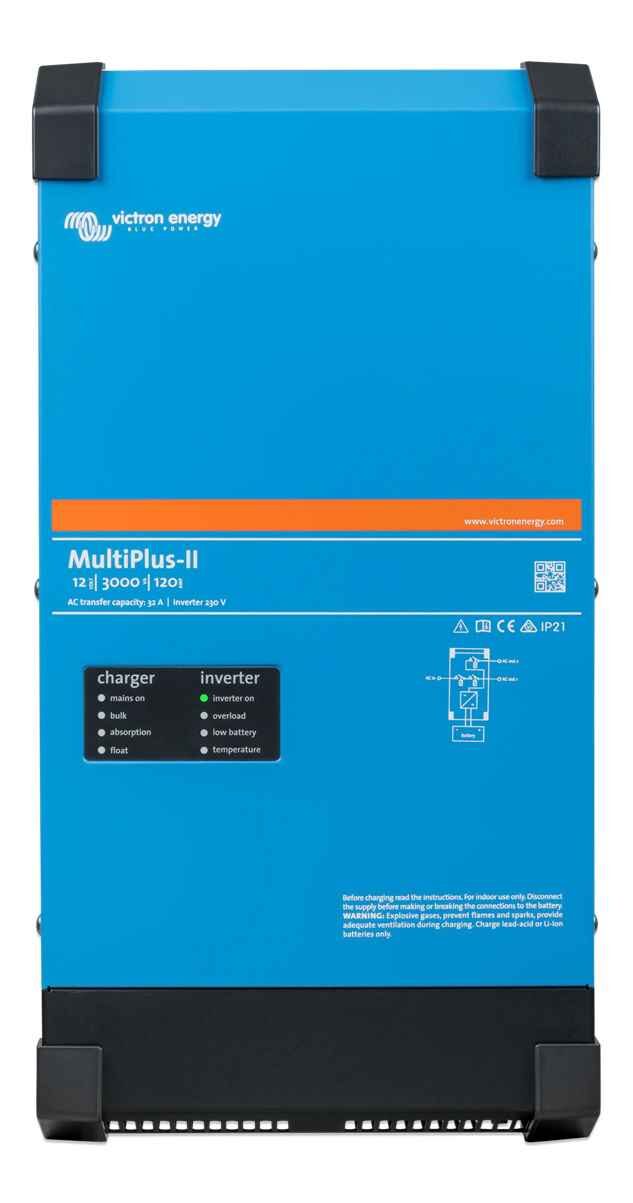
The Victron MultiPlus-II is a multifunctional inverter/charger: a single unit that converts battery DC to 230 V AC mains, charges the battery from the grid or a generator, and switches the supply to connected loads when the grid fails. It is the most-specified Victron line for home backup work, and it is sold in the UK in eight models with power ratings of 2400W, 3000W, 4000W, 6400W, 8000W and 12000W1.
Prices start at £485.60 for the range, with the MultiPlus-II GX versions starting at £552.763. The 48/3000 to 48/10000 models carry G98 and G99 certification for the United Kingdom, which is what allows them to be connected to a UK grid supply under the relevant engineering recommendation3. The standard warranty is 5 years, and Victron states it is upgradable to 10 years by an additional 10% of the initial investment1.
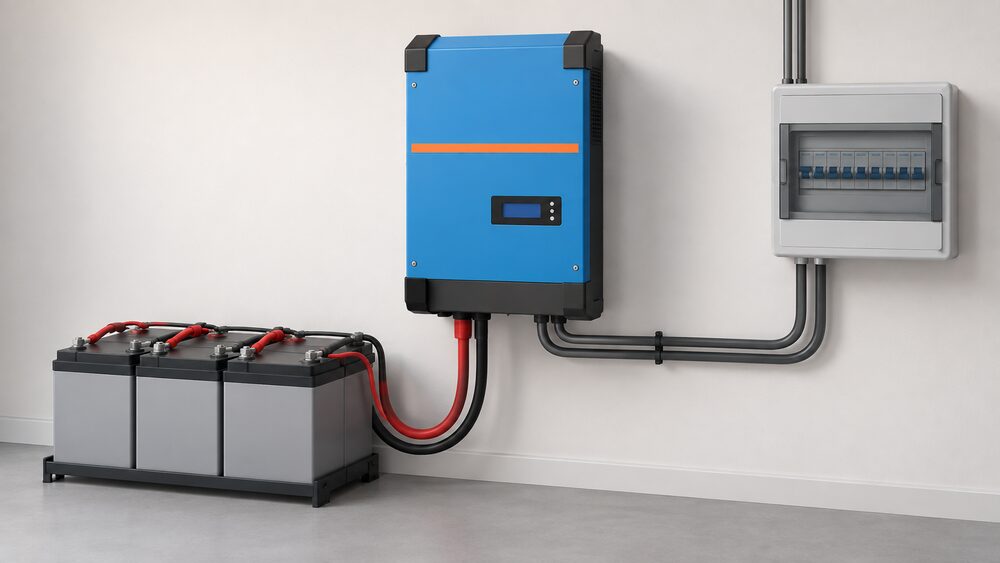
What the unit does for a household is straightforward: it puts a battery between the mains and the circuits wired to its output, so those circuits keep running when the grid goes down. What it does not do is remove dependence. The battery must be charged from somewhere, the unit needs configuring, and the GX versions add a network connection to the manufacturer's monitoring platform. The sections below set out the range, the certification position, the price evidence and the warranty terms.
What the MultiPlus-II is: a multifunctional inverter/charger
Victron describes the MultiPlus-II as "a multifunctional inverter/charger"8. The fuller description in the datasheets is that it carries all the features of the MultiPlus, plus an external current sensor option9. That sensor is the practical difference between the two lines: it allows the unit to measure current at the point where the grid supply enters the property, which is what makes energy storage and self-consumption functions work properly in a grid-connected installation.
The unit is a combined inverter and charger in one package, in the same way as the original MultiPlus5. On the AC side it produces 230 VAC ± 2%, and the output frequency can be adjusted to 60 Hz10. It has two AC outputs, and the second output is the basis of the backup function9. The datasheets also state that the battery charger combines speed with efficiency through a smart adaptive algorithm, and that the design extends battery life1.
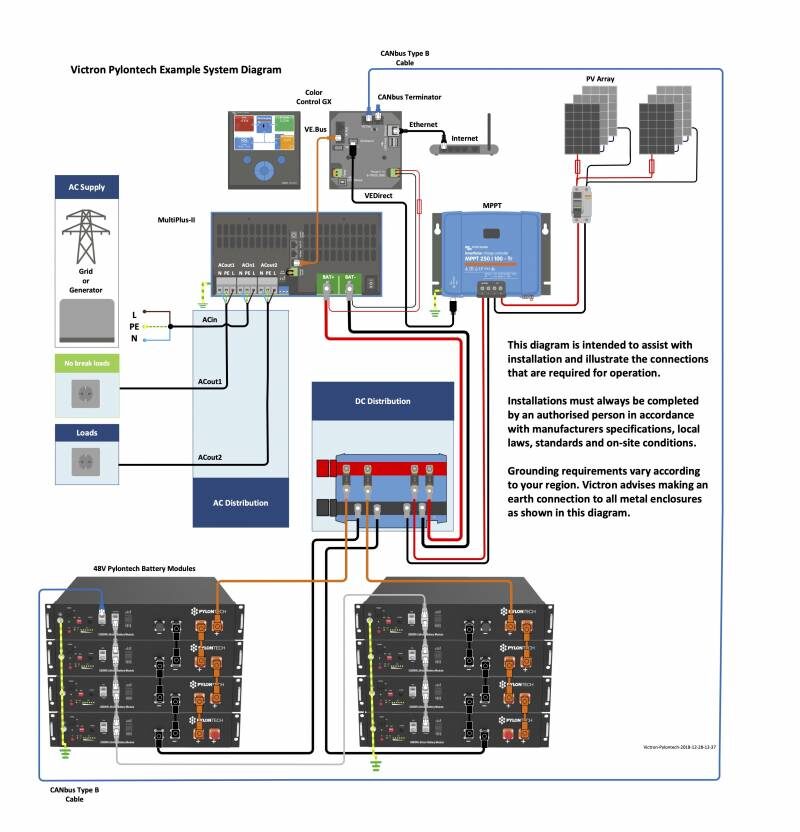
Victron positions the MultiPlus-II as the key component in a Victron Energy Storage System1. In that role it sits between a battery bank, the grid supply and the property's distribution board, handling conversion, charging and changeover. It is a single-phase unit3.
The range: 8 models from 2400W to 12000W
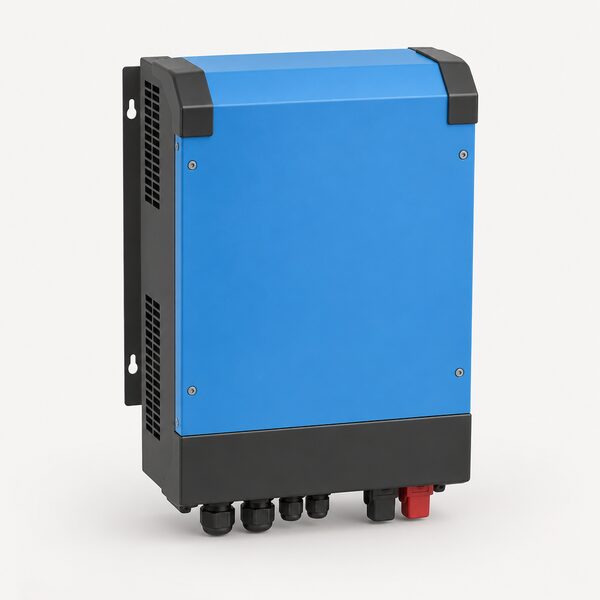
The UK distributor lists eight MultiPlus-II models, with power ratings of 2400W, 3000W, 4000W, 6400W, 8000W and 12000W across the line3. The model count and the power ratings come from the same listing, and the alignment of each rating to each specific model is not stated there, so the figures should be read as the spread of the range rather than a model-by-model table.
Peak power is a separate figure from continuous rating, and it is where the range spreads widest. Victron gives peak power for the 230V range as 5500 W, 9000 W, 15000 W, 18000 W or 27000 W depending on model6. A second Victron document aligns those figures to the 3000VA, 5000VA, 8k, 10k and 15k models respectively11. Peak output is a short-duration capability, not a continuous one, and it is the figure that determines whether a large motor will start.
| Model group | Continuous power | Peak power | Notes |
|---|---|---|---|
| 3000VA | 2400W12 | 5500 W11 | 48/3000/35-32 carries G983 |
| 5000VA | Not stated | 9000 W11 | 48/5000/70-50 carries G993 |
| 8k | Not stated | 15000 W11 | IEC 62477 certificate held13 |
| 10k | Not stated | 18000 W11 | Three units used in one UK installation14 |
| 15k | Not stated | 27000 W11 | IEC 62477 certificate held13 |
The 3000VA model is listed at a 2400W power rating12. Above the MultiPlus-II line, Victron also sells the MultiPlus 48V 20k, which is compatible with both solar charge controllers and grid-tie inverters in the same way15. The MultiPlus-II GX versions are a separate group of three models, listed from £552.764.
Backup capability and built-in anti-islanding
The backup function is the reason most households look at this unit. Victron states that when grid, shore or generator power is disconnected, the inverter within the Multi is automatically activated and takes over the supply to the connected loads1. The changeover is automatic rather than manual, and it applies to whatever is wired to the unit's output.
Anti-islanding is built in. The datasheets state that the MultiPlus-II "also has built-in anti-islanding functionality"8. This matters for safety and for compliance: anti-islanding stops the inverter from energising a circuit that the network operator believes is dead, which protects engineers working on the network during an outage. The same built-in anti-islanding is stated for the MultiPlus-II GX and for the Quattro II16.
The unit is described as suited to professional marine, yachting, vehicle and land-based off-grid systems3. The 230V models carry an IP22 rating, which is protection against vertically falling water rather than against immersion or hose-directed spray3. For a household, that means a dry, ventilated indoor position.
G98 and G99 certification: which UK models qualify
The certification position is the single most important fact for a UK grid-connected installation, and it is narrower than the range itself. The distributor listing states G98 and G99 for the United Kingdom on the 48/3000 to 48/10000 models only3. The MultiPlus-II GX listing repeats the limit: G98 and G99 certification for use in the UK, on 48V models only4.
Victron's own product page gives the certificate references. There is a Certificate ESS G99-1-2024 for the MultiPlus-II 3k, 4k5, 5k and 6k5 (GX) for the UK, and a separate Certificate ESS G99/1 for the MultiPlus-II (GX) 3k, 4k5, 5k and 6k5 for Northern Ireland1. The Northern Ireland certificate is a distinct document, which reflects the different grid code arrangements that apply there.
| Model | Certification stated | Source |
|---|---|---|
| VM-II-48/3000/35-32 | G983 | Distributor listing |
| VM-II-48/5000/70-50 | G993 | Distributor listing |
| VM-II-48/3000/35-32-GX | G984 | Distributor listing |
| VM-II-48/5000/70-50-GX | G994 | Distributor listing |
| MultiPlus-II 3k, 4k5, 5k, 6k5 (GX) | G99-1 2024 UK1 | Maker product page |
| MultiPlus-II (GX) 3k, 4k5, 5k, 6k5 | G99/1 NI1 | Maker product page |
The safety certification sits alongside the grid approvals. The MultiPlus-II 4k5 and 6k5 (GX) hold an IEC 60335-1 and 60335-2 certificate18, the 48V 8kVA, 10kVA and 15kVA models hold an IEC 62477 certificate13, and a separate IEC 62109 certificate covers MultiPlus 230V models19. Victron Energy B.V. is named as the manufacturer on the 4k5 and 6k5 certificate18, as certificate holder on a battery safety certificate20, and as licence holder on a charger certificate21.
Price: from £485.60
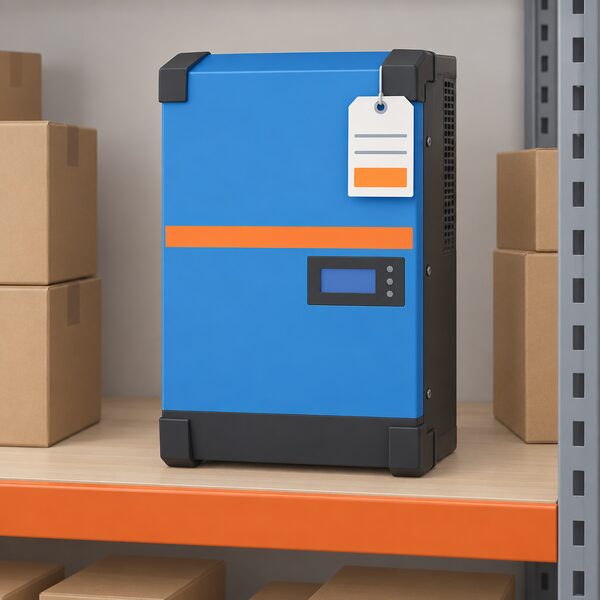
The published starting price for the MultiPlus-II range is £485.60, and the same figure appears on the distributor's inverter collection page3. The MultiPlus-II GX versions start at £552.764. Both figures come from a UK distributor listing and are quoted as starting prices, so they represent the smallest model in each group rather than a typical installed cost.
Other items in the same catalogue give a sense of the surrounding spend. A Victron current transformer for the MultiPlus-II is listed from £20.173. The Quattro-II starts at £925.58, the MultiPlus 500VA to 1600VA range starts at £214.40, and the MultiPlus 3000VA to 5000VA range starts at £680.192.
Because the listings mix VAT-inclusive and VAT-exclusive figures, a household comparing quotes should establish which basis each one uses before treating any of them as comparable. The starting prices above are the only range-level figures, and they are distributor prices for equipment, not installed prices.
Warranty: 5 years, upgradable to 10
The MultiPlus-II carries a 5-year standard warranty, which Victron describes as industry-leading, alongside a global repair service1. The distributor listings confirm 5 years for the MultiPlus-II and for the MultiPlus 3000VA to 5000VA range3. The MultiPlus 2000VA is also listed at 5 years22.
The upgrade path is stated by Victron in its own terms: "Our standard 5 year warranty is upgradable to 10 years by an additional 10% of the initial investment"5. That is a priced extension rather than an automatic entitlement, and the cost scales with what was paid for the equipment. The same 5-year term appears in Victron's energy storage brochure6.
"Our standard 5 year warranty is upgradable to 10 years by an additional 10% of the initial investment."
For a household, the warranty is a manufacturer's term on the equipment. It does not cover the installation work, the battery, or the labour to remove and refit a failed unit, and those costs sit with whoever carried out the installation. The global repair service is the maker's route for a faulty unit.
Communication ports and system integration
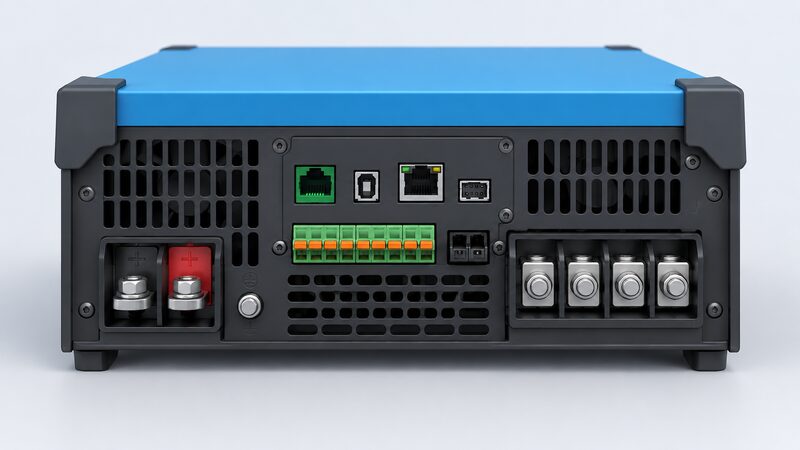
The standard MultiPlus-II 230V models carry a VE.Bus communication port for parallel and three-phase operation, remote monitoring and system integration8. The same datasheet lists two general purpose communication ports and a remote on-off connection9. The 120V variant lists the VE.Bus port and two general purpose communication ports23. The MultiPlus 48V 20k also carries two general purpose communication ports15.
The GX versions add considerably more. The MultiPlus-II GX interfaces are listed as BMS-Can, USB, Ethernet, VE.Direct and Wi-Fi24. The Spanish-language GX datasheet confirms a VE.Direct port24. The GX range also carries a BMS-Can interface that can be used to connect to a compatible CAN-bus managed battery, alongside a USB port, an Ethernet port and a VE.Direct port6.
That BMS-Can interface is the answer to battery integration. Victron states that managed batteries can be integrated through its GX devices in minutes6. The MultiPlus-II GX range is where that integration is built in rather than added.
Solar, AC-PV and off-grid integration
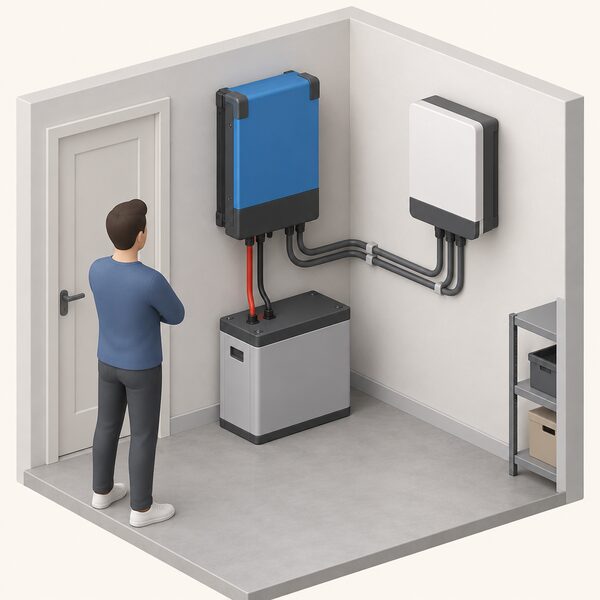
The MultiPlus-II is compatible with both solar charge controllers and grid-tie inverters, a statement repeated across the datasheets for the standard range, the 4k, 4k5, 6k5 and 10k models, the 8k, 10k and 15k models, and the 120V variant8. That means a household can charge the battery either from a DC-coupled array through a solar charge controller, or from an existing AC-coupled PV system through a grid-tie inverter.
Victron states that AC-PV inverters are supported directly after installing a software assistant on its inverters, and notes strong collaboration with Fronius PV inverters6. The software assistant is a configuration step rather than a hardware addition.
There is a worked example of the AC-coupled route in an off-grid setting. An MY-PV AC•THOR can be used with Victron Multiplus and Quattro inverters in off-grid operation, and in one customer's off-grid PV system it worked with a Victron Multiplus inverter system and a standard PV string inverter connected to the inverter's output, using the frequency shift function26. Frequency shifting is how an off-grid inverter signals surplus generation to a device that can absorb it.
A UK installation case study shows the scale the line can reach. One project used three Victron Energy MultiPlus-II 48/10000/140-100 230V inverters, providing stable, high-quality AC power across the property14. That is a three-unit arrangement rather than a single unit, and it sits at the top of the range.
Marine, vehicle and off-grid applications
Victron describes the MultiPlus-II as ideally suited for professional marine, yachting, vehicle and land-based off-grid systems3. The same description appears in the energy storage brochure6. The unit's origin as a combined inverter and charger for mobile and remote installations is why it handles multiple AC sources: grid, shore power and generator are all treated as inputs it can charge from and switch away from.
Configuration is not done from a phone app alone. The datasheet states that VEConfigure software requires a computer or laptop and an MK3-USB interface25. That is a wired configuration route, and it is the step where the unit's behaviour is set up for a particular installation.
The IP22 rating applies to the 230V models3. IP22 is protection against vertically falling water, so the unit is suited to a dry, ventilated position rather than an exposed one. For marine and vehicle use that generally means an enclosed compartment.
Victron Energy: a Dutch family-run maker with over 50 years' experience
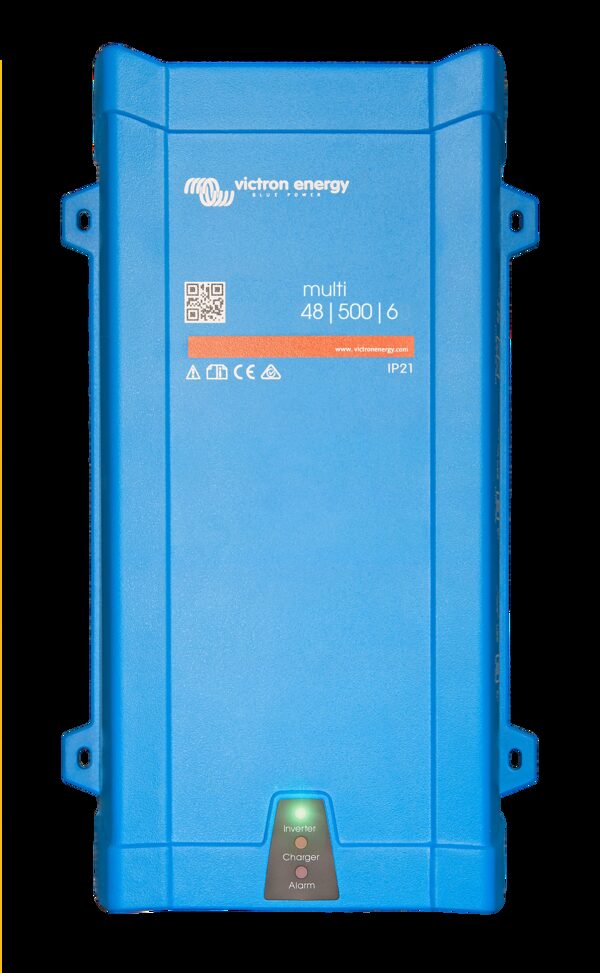
Victron Energy B.V. is the manufacturer named on the MultiPlus-II certificates, with its address given as De Paal 35, 1351 JG Almere, Netherlands21. The company is described as Dutch, and as a family-run business with over 50 years of experience6. A separate Victron page gives over 45 years of experience in building backup and off-grid systems5, so the two figures differ on the exact total.
The company's trading history is described as supplying off-grid and on-grid battery storage systems for automotive, marine, industrial and other uses27. It began focused on the marine industry and now offers products for marine, automotive, telecom, home and industrial applications, both on and off grid7. It is based in the Netherlands with representatives all over the world, and it offers full technical support in the UK27.
For a household, the maker's status matters in two ways. A company with a long trading history and a global repair service is a lower risk on warranty support than a newer entrant. Against that, the equipment is imported, the configuration software is the maker's own, and the GX versions tie monitoring to Victron's platform. The unit reduces dependence on the grid for the circuits wired to it, and it does not reduce dependence on a battery supplier, an installer, or the manufacturer's software and support.
Sources27 cited
- MultiPlus-II inverter/charger product page, Victron Energy, 2026-09-17
- Victron inverters collection, Wind & Sun, 2026-09-20
- Victron MultiPlus-II, Wind & Sun, 2026-09-20
- Victron MultiPlus-II GX, Wind & Sun, 2026-09-20
- Off-grid markets page, Victron Energy, 2026
- Self-Consumption and Energy Storage brochure, Victron Energy, 2026-02
- Victron Energy supplier page, Wind & Sun, 2026-09-20
- MultiPlus-II inverter-charger datasheet, Victron Energy, 2026-09-17
- MultiPlus-II 4k, 4k5, 6k5, 10k datasheet, Victron Energy, 2026-09-17
- MultiPlus-II inverter-charger datasheet (second version), Victron Energy, 2026-09-17
- Off-Grid, Backup and Island Systems brochure, Victron Energy, 2025
- Victron MultiPlus 3000VA to 5000VA, Wind & Sun, 2026-09-20
- IEC 62477 certificate, MultiPlus-II 48V 8kVA, 10kVA and 15kVA, Victron Energy, 2026-04-23
- Fogstar 48V batteries for home backup case study, Fogstar, 2026-03-09
- MultiPlus 48V 20k datasheet, Victron Energy, 2026-09-17
- Victron EasySolar II GX, Wind & Sun, 2026-09-20
- Victron ESS package collection, Wind & Sun, 2026-09-20
- IEC 60335 certificate, MultiPlus-II (GX) 4k5 and 6k5, Victron Energy, 2025-11-12
- IEC 62109 certificate, MultiPlus 20W 230V, Victron Energy, 2026-07-28
- UL 2054 certificate, lithium NG batteries, Victron Energy, 2026-03-05
- IEC 60335 certificate, Blue Smart IP67 charger, Victron Energy, 2026-04-22
- Victron MultiPlus 2000VA, Wind & Sun, 2026-09-20
- MultiPlus-II 120V datasheet, Victron Energy, 2026-09-17
- MultiPlus-II GX inverter-charger datasheet, Victron Energy, 2026-09-17
- MultiPlus-II 8k, 10k, 15k datasheet, Victron Energy, 2026-09-17
- Using excess power for water heating in off-grid systems, Wind & Sun, 2023-12-07
- Victron Energy storage economics, Spirit Energy, 2026
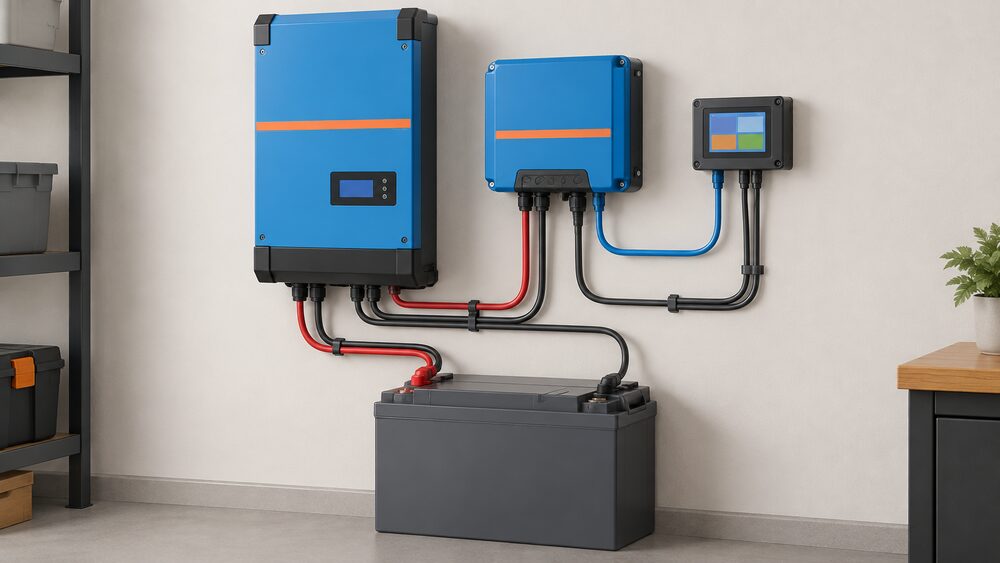 Victron Energy Systems for Off-Grid and Home Battery UseThinking about Victron for a home battery or off-grid setup?
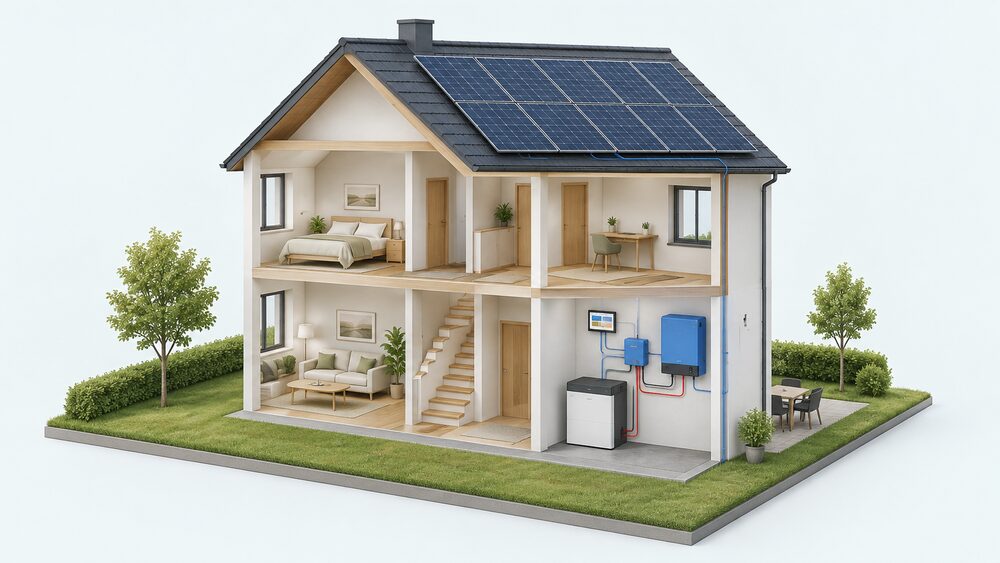 Victron EnergyCan you check your home battery and solar from your phone, and does it work if the internet goes down?
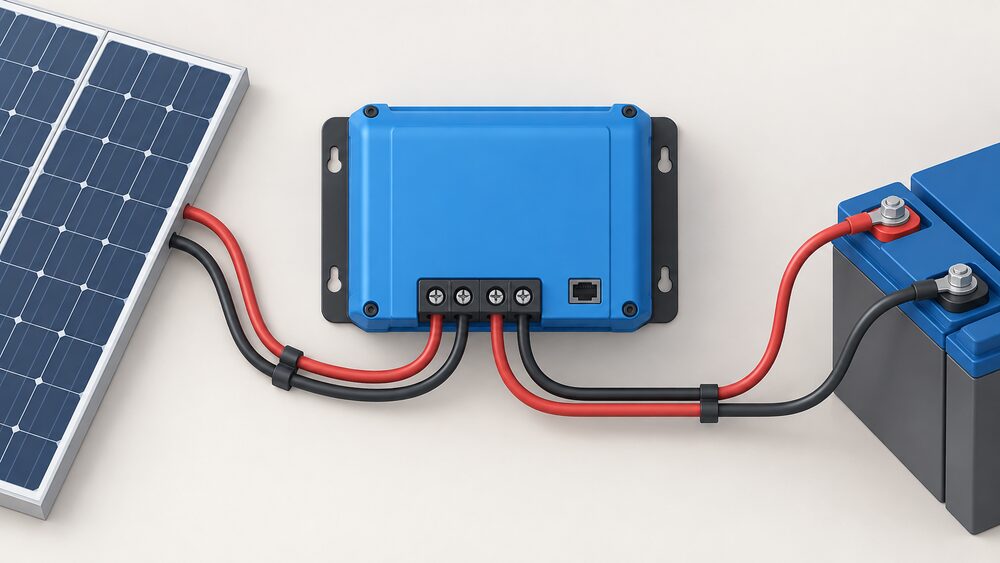 Victron Energy Solar Charge Controllers and Off-Grid EquipmentWhich Victron controller suits your panels and battery when you put solar on a boat, cabin or off-grid home?