
In this answer
Short answer
A power cut that damages a television, a freezer or a computer is one of the most common reasons households go looking for compensation, and it is also the one thing the regulated payment scheme does not cover. The Guaranteed Standards of Performance set minimum service standards for electricity distribution network operators, with automatic payments when they are breached, but the rules explicitly exclude "damage to electrical equipment or appliances"1. UK Power Networks states the position plainly: "We're not liable for any damage to electrical appliances such as TVs, computers etc as a result of a power cut"2.
What the scheme does pay for is the outage itself. For normal weather, homes can receive £100 where fewer than 5,000 properties are affected and the supply is off for more than 12 hours, or where more than 5,000 properties are affected for more than 24 hours; businesses receive £195 on the same triggers3. The maximum payment is £400 where a cut affects 5,000 or more properties1. Amounts are reviewed and updated each year in line with inflation3.
The compensation is paid by the network operator, not the energy supplier. The operator owns the wires, restores the supply and owes the payment; the supplier handles billing and complaints4. For appliance damage, the routes are a discretionary goodwill payment from the operator, a household insurance claim, or a product liability claim under the Consumer Protection Act 1987 where a faulty item caused the damage2.
When a power cut counts as storm or severe weather damage
Severe weather is treated as a separate category of event, with longer thresholds before money is owed. Storms are placed in Category 1 or Category 2, and the outage duration needed before compensation applies is longer than 24 or 48 hours respectively7. That is a deliberate difference from the normal weather rules, where a 12 hour cut affecting fewer than 5,000 homes can trigger £1003.
The reason is that storms create many simultaneous faults. Severe weather "can sometimes be destructive and bring down power lines and cause power cuts", and during storms power cuts can happen across a wide area at once8. Networks publish winter readiness material on that basis, and the industry body for the networks describes storms and bad weather as a standing category of risk9.
There is a further exclusion that matters for anyone thinking about a claim. No compensation is payable for blackouts caused by a national power shortage, for damage to electrical equipment or appliances, or for a low supply after a power cut1. Emergency measures are also outside the scheme: where a network carries out rota load disconnection, compensation is not available under Ofgem rules for an emergency power cut of that nature11. That distinction between a fault and an emergency instruction is worth understanding before any claim is made, and it is covered in more detail on rota power cuts.
For a household, the practical effect is that storm damage to appliances sits outside the regulated scheme entirely. The payment recognises the hours without power, not the cost of what failed when the supply returned.
Guaranteed Standards of Performance: what the operator must pay

The Guaranteed Standards of Performance (GSOP) specify what an electricity distribution network operator must pay a customer or relevant authority if it fails to meet specified standards of performance12. They are not discretionary goodwill: they set minimum service standards, with consumers automatically compensated if they are breached13. The same principle applies on the supplier side, where Guaranteed Standards set minimum performance standards all energy suppliers must meet and, when they do not, automatic payments are issued to affected consumers14.
The payments are funded through the regulated framework and are based on standards set by Ofgem, the industry regulator, under the Electricity Guaranteed Standards15. Consumer bodies describe them as payments to customers should the network fail to meet the standards16.
| Event | Trigger | Payment |
|---|---|---|
| Normal weather, fewer than 5,000 properties | Off supply more than 12 hours | £100 homes, £195 businesses3 |
| Normal weather, more than 5,000 properties | Off supply more than 24 hours | £100 homes, £195 businesses3 |
| Large incident | 5,000 or more properties affected | Up to £400 maximum1 |
| Category 1 storm | Off supply more than 24 hours | £906 |
| Category 2 storm | Off supply more than 48 hours | £904 |
| Planned cut, no notice or wrong day | No 2 days' notice, or cut on a different day | £406 |
Some payments arrive automatically and some must be claimed. Frequent-cut payments are the clearest example of a claim-based route: a household must make a claim with the local network operator, which decides whether the payment is due3. The same applies to severe weather payments, which are not issued without a claim in every case.
Compensation amounts: the £30 per person per day benchmark
The £30 per person per day figure that circulates after major storms is not part of the Guaranteed Standards of Performance. It is a separate welfare payment offered by a network during a specific event. During Storm Gerrit, SSEN offered customers without power for more than 12 hours £30 per person for every day without power, for food and drink17. It sits alongside, not inside, the regulated compensation.
The regulated amounts are the ones set out in the standards. For unplanned cuts affecting more than 5,000 homes, the structure is £100 if power is off for longer than 24 hours, then £45 for every 12 hours after that, up to a maximum of £4006. For planned cuts, £40 is payable where the operator does not give 2 days' notice, or where the cut happens on a different day from the one notified6.
Storm categories carry their own figures. In a Category 2 storm, £90 is payable if the power was off for 48 hours; in a Category 1 storm, £90 is payable if the power was off for 24 hours4. Network guidance for severe weather sets out a Category 2 payment of £85 for power cuts lasting 48 hours from the time of notification, and £40 for each 6 hour period thereafter18. The published figures for the same category differ between documents, and the difference is not resolved here: households should treat the amount as set by the operator's current published schedule.
Storm Gerrit: how the scheme worked in practice
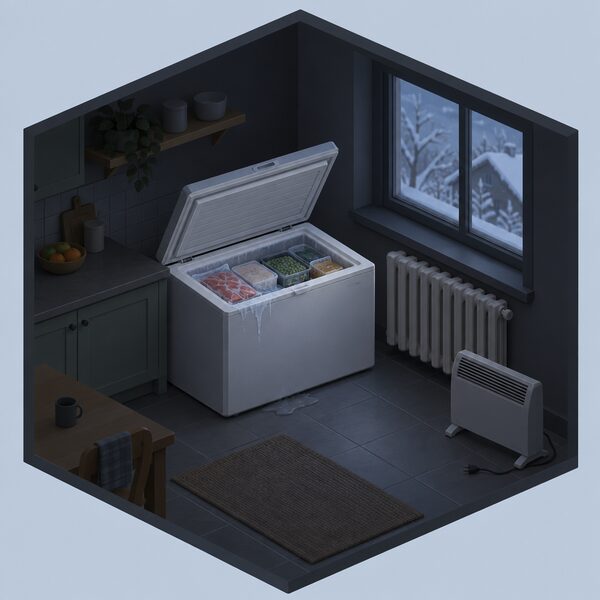
Storm Gerrit, at the end of December 2023, is the clearest recent example of the severe weather scheme operating at scale. SSEN confirmed that any customers impacted for over 48 hours would be entitled to compensation under the regulated Guaranteed Standards of Performance, with a further £40 for every subsequent 6 hour period they were off supply17. The same announcement set out the £30 per person per day welfare payment for customers without power for more than 12 hours17.
The event shows how the two layers interact. The regulated payment is calculated from the duration of the outage and the storm category. The welfare payment is calculated from the number of people in the household and the number of days without power, and is aimed at immediate costs such as food and drink. A household affected for three days could therefore be looking at both, from the same operator, under different rules.
It also shows why the appliance question comes up so often. A long outage in winter means freezers thawing, heating off and, in some cases, equipment failing when the supply returns. None of that is covered by the standards. The network's position is that it is not liable for damage to electrical appliances such as televisions and computers as a result of a power cut, and consumer guidance confirms that the operator does not have to compensate for damage to electronic devices, though it may make a discretionary goodwill payment2.
For a household, the lesson from Storm Gerrit is that the compensation scheme is a payment for time without supply. It is not an insurance scheme for property, and it does not restore what was lost. That is the gap that home insurance, surge protection and backup power are designed to fill, and it is why surge protection devices and protecting appliances during a power cut matter more than the claim itself.
Claiming from the operator: the process and evidence
The first step is to establish who owes the payment. The gas or electricity network operator is responsible for fixing power cuts and paying compensation, not the energy supplier4. The operator is the company named on the local network's fault line, and the 105 number connects callers to it19.
For standard payments, the claim must be made within 1 month of the start of the power cut4. For repeated cuts, the window is different: a household has 3 months to claim after the end of March, and if the claim is accepted the operator should pay within 10 working days4. The eligibility threshold for that route is typically being without power for 12 hours or more, or four power cuts in a year of at least three hours each16. That compensation is not available if a power cut was planned and the household had been told about it, or if compensation was already received for power cuts in the same 12 months4.
A claim needs the facts of the outage: the date and time it began, how long it lasted, the postcode and the operator's incident reference where one was issued. For a damage claim outside the scheme, the evidence is different: photographs of the failed item, receipts or valuations, and the outage record. Where a product itself caused damage, a claim may be possible under the Consumer Protection Act 19875.
If the operator rejects the claim, the supplier should have a formal dispute process that can be requested, and it is often published on the supplier's website20. Complaints can be escalated to the Energy Ombudsman20. Households in payment difficulty can separately ask a supplier to agree a payment plan, a payment break or a reduction, or for access to hardship funds21.
Ofgem's review of severe weather compensation
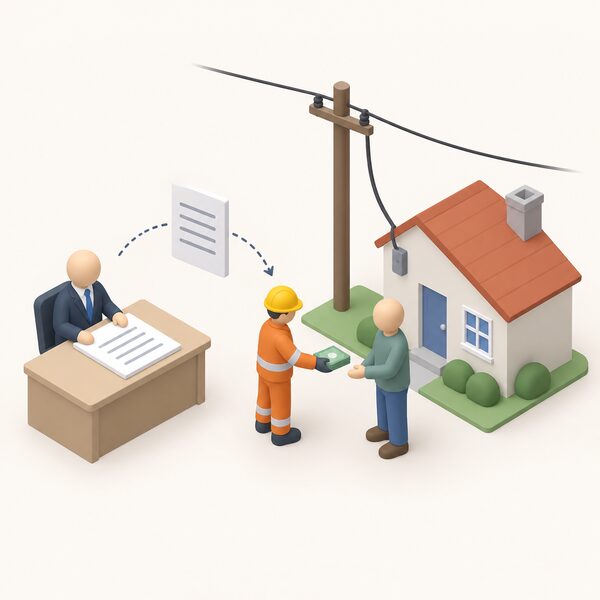
The severe weather arrangements were reviewed after Storm Arwen, and the current scheme dates from that process. Since 2023 electricity network companies in England, Scotland and Wales have had a scheme to pay severe weather compensation funded by electricity customers9. Ofgem reviews and updates the amount paid for a power cut each year based on inflation, with adjustments published for 20264.
The review changed the shape of the scheme rather than the principle. Severe weather events now carry their own thresholds and their own payment levels, separate from the normal weather standards, and the categories determine how long an outage must last before money is owed7. The regulator has continued to consult on the wider consumer protection framework, including proposals on how standards and automatic compensation operate13.
For a household, the practical consequences are three. First, the amount payable depends on the category of event and the duration of the outage, not on what was damaged. Second, the payment is made by the network operator and is funded through electricity bills, so it is a regulated transfer rather than a discretionary gesture. Third, the scheme is not uniform across the United Kingdom: Northern Ireland sits outside the Great Britain severe weather scheme, and its network operator states that compensation is not paid in the same way9. Households there should look at power cut compensation in Northern Ireland instead.
"Your electricity network operator doesn't have to give you compensation for damage to electronic devices after a power cut."
What this means for a household's energy independence
The compensation scheme is a consumer protection, not a resilience measure. It pays for hours lost, at rates set by the regulator and reviewed annually, and it explicitly excludes the appliances that a household actually depends on1. A payment of £100 after a 12 hour cut does not replace a freezer's contents, a failed boiler control board or a computer.
That leaves the household carrying the risk. Insurance covers the property, and a product liability claim under the Consumer Protection Act 1987 covers damage caused by a faulty item, but neither is triggered by the outage itself5. The dependence that remains is on the network to restore supply, on the operator to assess any claim, and on the household's own arrangements to keep essential equipment running and protected in the meantime.
The practical response is preparation rather than claim. Keeping a phone charged, a torch handy, warm clothing and food that needs no heating, and following the network operator for local updates are the standard recommendations10. Beyond that, the choices are the ones covered elsewhere on this site: surge protection for what is plugged in, portable power stations and UPS systems for what must keep running, and the Priority Services Register for households that need advance warning. The compensation scheme answers the question of what is owed after a cut; it does not answer the question of what stays on during one.
Sources22 cited
- Check if you can get payment for a power cut, Ofgem, 2026
- Compensation: a power cut damaged something in my home, UK Power Networks, 2026-09-17
- Plan for a power cut, Ofgem, 2026
- Get compensation if you have a power cut, Citizens Advice, 2026-09-17
- Claim compensation if an item or product causes damage, Citizens Advice, 2026-09-17
- Get compensation if you have a power cut (Wales), Citizens Advice, 2026-09-17
- How to get power cut compensation, Uswitch, 2025-06-23
- Storms and bad weather, Energy Networks Association, 2026-09-17
- Is compensation paid in other parts of the UK, NIE Networks, 2026-09-19
- Get winter ready resources, Energy Networks Association, 2026-09-17
- Emergency power cuts, Electricity North West, 2026-09-19
- Adjustments to Guaranteed Standards of Performance 2026, Ofgem, 2026-03-13
- Energy Consumer Outcomes: proposed implementation, Ofgem, 2026-06-23
- Smart Meter Guaranteed Standard statutory consultation, Ofgem, 2025-08-08
- Compensation for multiple or repeat power cuts, UK Power Networks, 2026-09-17
- Electricity and gas consumer protection, Consumer Council, 2026
- SSEN restores power to communities following Storm Gerrit, SSEN, 2023-12-30
- Standards of Performance, National Grid, 2026-09-17
- Powercut105, Energy Networks Association, 2026-09-17
- Understanding your rights, Energy Ombudsman, 2026-09-20
- Get help with your home or business energy bills, Ofgem, 2026
- Power cuts in Edinburgh, EcoFlow, 2025-11-26
 Network Operators and 105When the lights go out, who do you actually ring?
 Leaving the Electricity GridCan you really cut your home off the grid completely, and what does it cost to have your electricity supply removed for good?
 New Electricity ConnectionWho do you contact for a new or upgraded electricity connection, and what will it cost?
 The Full Backup Power GuideHow long do UK power cuts usually last, and what can keep your fridge, heating or phone going until the power comes back?
 Islanding and Anti-IslandingWhy do solar panels switch off in a power cut, and can you keep the lights on anyway?
 Surge and Lightning ProtectionWill a surge protector stop a lightning strike from wrecking my wiring and appliances?