
In this answer
Short answer
An integrated fridge freezer costs roughly £72 to £78 a year to run, based on Which? figures published in 2026. Which? puts an integrated model at £721 and, in its appliance running cost table, at £78 a year on average2. A maker's own guidance gives around £77 a year3. These sit close together because they describe the same thing: a mid-range integrated appliance running continuously on a typical tariff.
The spread behind that average is much wider than the average suggests. The cheapest integrated model Which? has tested runs at £46 a year and the most expensive at £1432. A maker's guidance puts the range at £44 at the low end to £140 at the high end4. Which? has tested fridge freezers costing as little as £41 annually to run5. The figure a household actually pays depends on the model, its size, its efficiency rating and the unit rate on the tariff.
A fridge freezer is one of the few appliances that runs every hour of the year, so its cost is a permanent part of the household baseline rather than a seasonal spike. That makes it a reasonable first target when working through which appliances use most electricity, and a fixed cost that no behaviour change removes.
Why the published figures range from £44 to £143
The gap between the lowest and highest published figures is not a disagreement about physics. It is four different measurements being reported as if they were one.
The first is the sample. Which?'s £78 is an average across the integrated models it has tested, with a cheapest of £46 and a dearest of £1432. A maker's £44 to £140 range describes the same spread from the manufacturer's side4. A single tested appliance gives a single number: Which? found one Hisense model retailing at around £399 would cost £113.12 a year to run, against an average for freestanding models at that time of £815.
The second is the date and the unit rate. Which? reported the average integrated fridge freezer at £62.19 in October 2021, £139.90 in April 2023, and £73 rising to £136 under a 2022 price cap change7. Those are the same appliance category measured against three different electricity prices. The £139.90 figure reflects the 2023 price spike, not a worse appliance.
The third is the efficiency rating of the model measured. A D-rated fridge freezer costs £53.04 a year and an F-rated one £93.509. A G-rated 265-litre fridge-freezer costs £70 a year in Great Britain, while an F-rated 424-litre model costs £8010. Size and rating move the number independently of each other.
The fourth is what the figure includes. Some running costs exclude the standing charge; a 250kWh/year freezer at 26.11p/kWh costs about £5.44 a month on that basis11.
Integrated, freestanding or American style: which costs less
On average, integrated and freestanding models are almost indistinguishable. Which? puts integrated at £78 a year and freestanding at £792. A maker's guidance gives the same near-parity from the other direction: around £77 for an integrated model against closer to £79 for a freestanding one3. Which? reported a freestanding average of £74 a year in May 20261 and around £75 a year in 20245.
American-style models are the clear outlier. Which? puts the average at £117 a year, with a cheapest of £61 and a dearest of £1722. Its May 2026 guidance gives £110 for the average power-hungry American-style model1, and a 2024 figure put a large American-style fridge freezer at over £108, more than 40% above freestanding5. Welsh Government guidance drawing on Which? material states that American-style fridge freezers add an average of over £125 a year to run12.
| Type | Average | Cheapest tested | Most expensive tested |
|---|---|---|---|
| Integrated | £78 | £46 | £143 |
| Freestanding | £79 | £38 | £147 |
| American style | £117 | £61 | £172 |
Averages and ranges from Which? appliance running cost data2.
The practical point is that the type matters far less than the model. The £97 gap between the cheapest and dearest integrated models is larger than the £39 gap between the integrated and American-style averages. Choosing a well-rated integrated model over a poor one saves more than choosing integrated over freestanding.
What drives a fridge freezer's running cost
Four things set the number, and only one of them is under a household's control at the point of purchase.
The efficiency rating is the largest single factor. An A+++ fridge costs a third of what a B rated fridge costs to run per year13. The current label scale runs from A to G14, and the gap between a D-rated model at £53.04 and an F-rated one at £93.50 shows what a two-band difference is worth9.
Size and compartment volume come next. A 265-litre G-rated fridge-freezer costs £70 a year in Great Britain, while a 424-litre F-rated model costs £8010. The larger appliance is more efficient per litre but consumes more in total.
The unit rate on the tariff converts kWh into pounds. A fridge freezer using 233kWh a year costs £49 in one price cap period and £61 in another, a £12 difference from the rate alone15. A fridge freezer on a standard variable tariff costs £5.39 a month6.
How the appliance is used and maintained matters at the margin. Frost build-up in a freezer compartment increases consumption, and defrosting restores performance3. Siting matters too: an appliance next to an oven or in a hot room works harder.
"You can compare the total energy consumption of appliances by looking for their yearly energy consumption in kWh/annum."
Reading the energy label and finding the rating plate
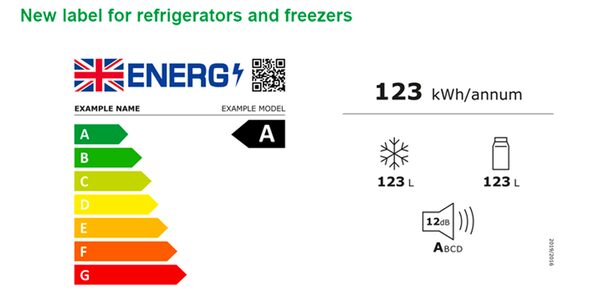
The energy label does not state a running cost in pounds. It shows yearly energy consumption in kWh/annum under the rating scale16, the capacity of the chilled and frozen compartments, and the noise the appliance emits16. The rating itself runs from A to G14.
That kWh figure is the one to compare between models, because it is independent of tariff. Multiplying it by the household's own unit rate gives the running cost. A 233kWh appliance at one cap period's rate costs £49 and at another £6115.
On an integrated model the label is not on the door front, because the door front is a cabinet panel. The label is supplied with the paperwork and is normally fixed inside the appliance or on the cabinet edge. The rating plate carrying the serial number is usually inside the fridge compartment or behind a drawer.
Which? recommends a fridge freezer rated at least D or above, except where an integrated or American-style model is wanted1. That is a recommendation about efficiency, not about running cost in pounds, and it does not account for the tariff the household is on.
How the price cap changes the numbers
Every published running cost figure is a snapshot of an electricity price, and that price moves. The price cap changes every three months18, and the current cap is 70% higher than in 202123.
That is why the same appliance category carries such different figures across the years. Which? reported the average integrated fridge freezer at £62.19 in October 2021, £139.90 in April 2023, and £73 rising to £136 under a 2022 cap change7. The appliance did not change; the rate did.
The cap limits the unit rate charge rather than the total bill, and it is calculated and updated four times a year20. Because it moves quarterly, a running cost calculated at one cap period will not hold for the next. A fridge freezer using 233kWh a year costs £49 in one period and £61 in another15.
For a household, the practical consequence is that any pound figure quoted for a fridge freezer is a figure at a particular rate on a particular date. The kWh/annum figure on the label is stable; the pound figure is not. Where a household wants to compare models, the kWh figure is the one that survives a cap change.
What this means for household energy independence
A fridge freezer is the clearest example of a load a household cannot switch off. It runs continuously, so its cost is a permanent part of the baseline rather than something that can be timed, shifted or avoided. At £5.39 a month on a standard variable tariff6, or about £5.44 a month for a 250kWh/year freezer at 26.11p/kWh excluding standing charge11, it is a fixed draw on the electricity supply every day of the year.
That has two consequences for independence. The first is that the only lever is efficiency at the point of purchase, since behaviour cannot reduce a fridge's consumption. Choosing a model rated D or above, as Which? recommends for non-integrated and non-American models1, locks in a lower baseline for the appliance's life. The second is that the running cost is set by the tariff, not the appliance, so a household on a standard variable tariff pays whatever the cap period dictates.
The dependence that remains is on the grid and on a supplier. A fridge freezer cannot be run from a battery indefinitely without a charging source, and its consumption is invisible to the household unless metered. A smart meter or an energy monitor makes the baseline visible, which is the starting point for working out how much energy your home uses before any spending decision. For a household planning a route to independence, the fridge freezer is the floor of the load: everything else is added on top of it.
Sources23 cited
- Tips to help lower the cost of running your fridge freezer, Which?, 5 May 2026
- How much your appliances cost to run, Which?, 1 October 2026
- Defrost your freezer and reduce energy bills, E.ON Next, 5 November 2025
- What is the best appliance rating, E.ON Next, July 2025
- Beware cheap appliances that cost you twice as much in the long run, Which?, 5 March 2024
- Appliances: how much do yours cost to run, Confused.com, 18 December 2025
- Which? finds household appliance running costs have risen nearly 60 per cent during cost of living crisis, Which?, April 2023
- Which? Money Saving Monday: save on appliance running costs, Which?, 4 September 2022
- How to save energy at home: home appliances, ivie, 20 September 2026
- Top five energy consuming home appliances, Energy Saving Trust, 3 August 2026
- Freezer energy consumption, Bluetti Power UK, 17 September 2026
- Five top tips from Which? to cut your energy bills, Welsh Government, 18 March 2026
- How to save energy and money in your home, Nu-Heat, 6 August 2026
- Buying a more energy efficient appliance, Citizens Advice, 20 September 2026
- The price cap: why every time you turn on this one household appliance will cost you 10p more than your neighbour, Uswitch, April 2026
- Home appliances, Energy Saving Trust, 20 May 2026
- Tax on shopping: energy saving products, GOV.UK, 17 September 2026
- Energy refunds, Uswitch, 29 October 2025
- How to estimate your energy use, Which?, 3 August 2026
- Types of energy tariff, Confused.com, 3 November 2025
- What is a tracker tariff, Uswitch, 26 June 2026
- Current gas and electricity prices, Centre for Sustainable Energy, 27 August 2026
- Improved bill support: the case for a social discount, Energy UK, 23 August 2026
 Heating Controls CostA smart thermostat usually costs between about a hundred and two hundred and fifty pounds, but fitting can push that higher.
 Running CostsA portable air conditioner costs roughly twenty to forty pence for every hour it runs, while a fixed unit uses far less electricity for the same cooling.
 Appliance Running CostsWorking out what your appliances cost to run comes down to two things: how much power they use and what you pay per unit of electricity.
 Air Conditioning CostPublished UK equipment prices and the parts of an installed price for portable, single split, multi-split and whole-house air conditioning.
 Do Smart Controls Save Money?Do smart heating controls really cut your bills, and by how much?
 Changing Habits SavingsWhat the evidence says behavioural change saves: around £90 to £120 a year for one degree off the thermostat, £100 to £110 a year for using a full set of heating controls, and £304 to £351 a year for a bundle of small changes.