
In this answer
Short answer
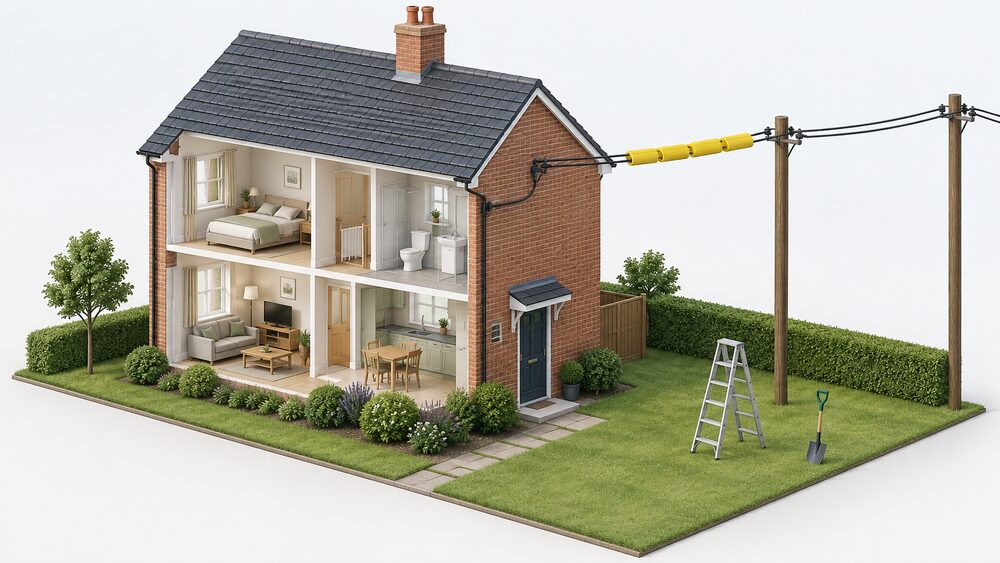
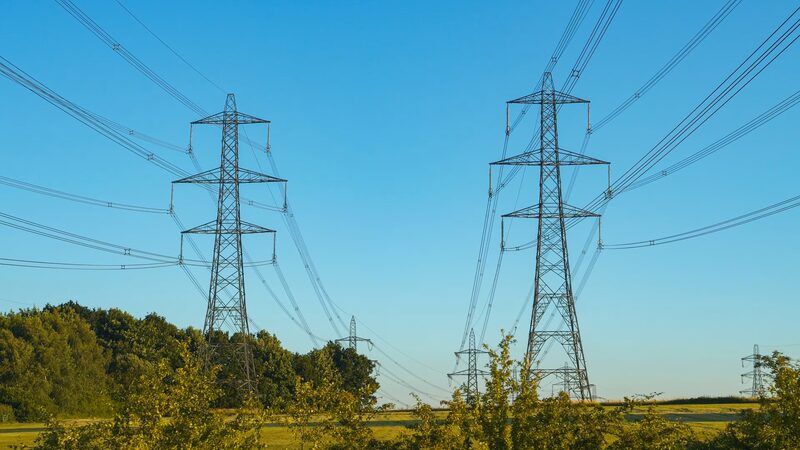
Overhead power lines in the UK carry voltages up to 132kV, and the safety rules around them are built on two phone numbers and one free service. Call 999 if there is an immediate risk to life or someone is in danger1. Call 105 for a power cut or a network fault that is not putting anyone at risk: it is a free call that puts you through to your electricity network operator2. For work near a line, UK Power Networks offers free safety advice and a visit from an expert, and a free shrouding service that covers the line while the work is done3.
The dependence here is straightforward. The lines, poles and towers around a property belong to a regional distribution network operator, not to the household and not to the energy supplier that bills for the electricity. Anything that involves getting close to them, digging under them or building beside them runs through that operator. The household controls the work on its own land; it does not control the network, the clearance distances or the decision on whether a line can be covered.
This page sets out who to call, what the voltages are, how the free advice and site visit work, how to get plans before digging, and which company runs which lines. It is a safety and process page, not electrical advice: where a line is involved, the network operator's own engineers make the call.
Who to call: 105, 999 and your local distributor
The two numbers do different jobs, and mixing them up costs time. The Energy Networks Association, which runs public safety work for the network companies, promotes awareness of the 105 number for use in overhead line emergencies6. Ofgem describes 105 as a free call that puts you through to your electricity network operator for unplanned power cuts2. Citizens Advice gives the same instruction: for an unplanned power cut, call 105, and the free call puts you in touch with your electricity network operator7.
Where a person is at risk, the number changes. Energy Networks Association guidance is that if there is an immediate risk to life or someone is in danger, call 9991. The same wording appears in its storm and bad weather guidance8. UK Power Networks repeats it for power lines: if they are causing significant risk to the public, call 9999. Its emergency line runs 24 hours a day10.
The distinction matters because 105 routes to the distribution network operator, the company that owns the local wires, while 999 routes to the emergency services. A fallen line in a field with nobody near it is a 105 call. A line down across a path, or touching a vehicle or a person, is a 999 call.
Why overhead lines are dangerous: voltages up to 132kV
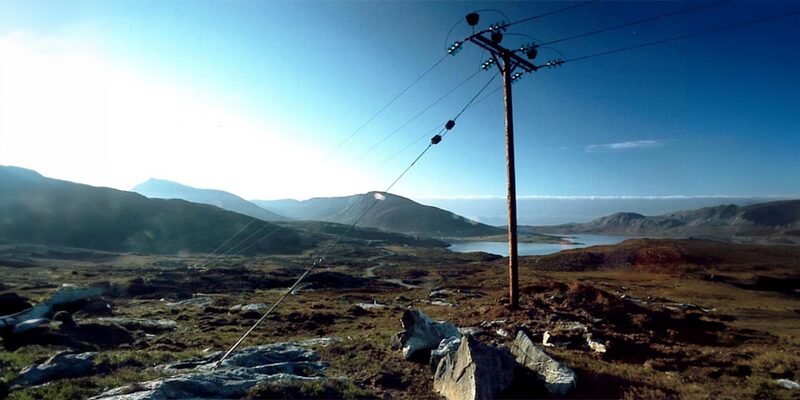
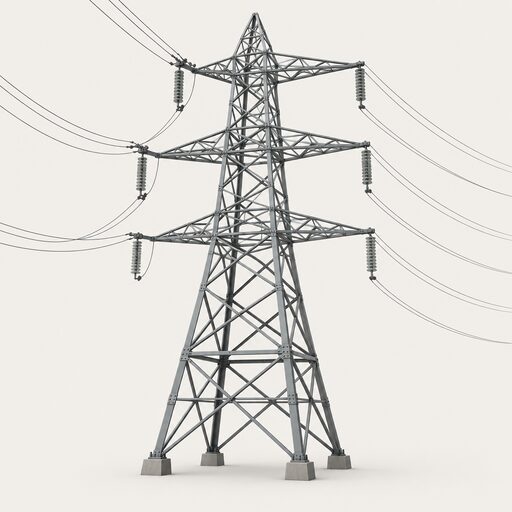
The distribution network carries a range of voltages, and the largest overhead lines in UK Power Networks' area are 132kV5. Those are the lines on steel towers. Lower-voltage lines on wooden poles serve streets and individual properties, and the Energy Networks Association's public safety work groups accidental contact with overhead lines alongside vandalism, trespass, metal theft and damage to underground assets as the incidents that cause death, injury and near misses6.
The physics behind the danger is not complicated. On a three-phase supply the voltage between lines is around 400V, and the probability of a lethal shock is higher at that voltage than at the single-phase voltage a household socket provides3. A distribution overhead line runs at a multiple of that again, and a transmission line higher still. Contact does not require touching the conductor: a long pole, ladder, scaffold tube, crane jib or irrigation pipe can bridge the gap.
Vegetation is part of the picture. Overgrown branches can cause power lines to clash, which can bring them down, threaten lives and in some cases cause fire11. That is why tree work near a line is a network operator job rather than a household one.
For the 132kV lines, UK Power Networks states that electric and magnetic fields return to background levels 30 to 40 metres away from the line5. That is a statement about field strength at distance, not a clearance rule for working near a conductor, and the two should not be confused.
Working near overhead lines: free advice and an expert site visit
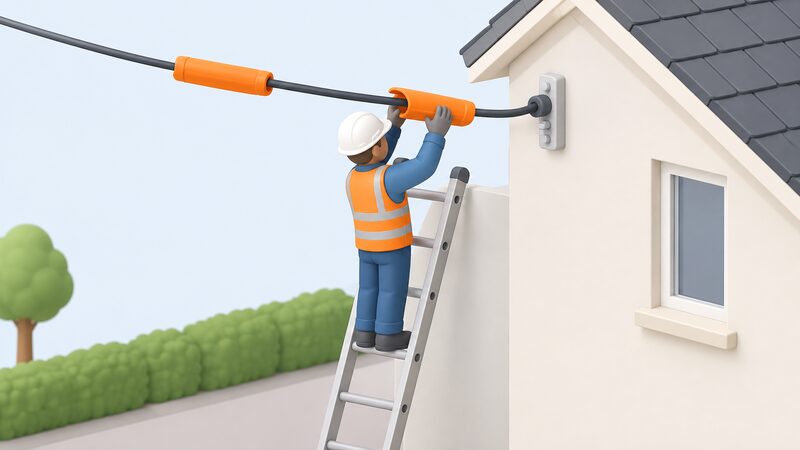
Where work has to happen near a line, the network operator is the first call, and the service is free. UK Power Networks offers free safety advice and a visit from an expert when work is needed near an overhead power line3. Its shrouding service goes further: a free service to arrange for one of its engineers to visit and cover the overhead power line that attaches to a property4. The application route is a free site visit, requested through an online form or by logging into its portal4.
The limit on shrouding is important and is stated by the operator itself.
UK Power Networks offers a free service in its licence areas of Eastern England, London and South Eastern England: an engineer visits to cover, or shroud, the overhead line attached to a property so work can go ahead nearby. The company states that shrouding is a limited protection, not an insulating barrier: covers are installed for incidental contact only. Applications start with a free site visit requested through an online form or the company's portal.4
In other words, the covers are a secondary protection against a brief, accidental brush with the line. They are not a licence to work in contact with it, and normal clearance practice still applies. The same free-visit principle appears elsewhere in the network: UK Power Networks offers a free site visit for replacing a power cable or power line9.
For work that needs the supply made dead, NIE Networks in Northern Ireland describes a safe isolation service in which engineers disconnect the power, remain while the work is completed, and reconnect once it is safe12. That is a different service from shrouding, and it is the one that applies where the work itself requires an isolated supply.
Digging near the network: request plans before you excavate
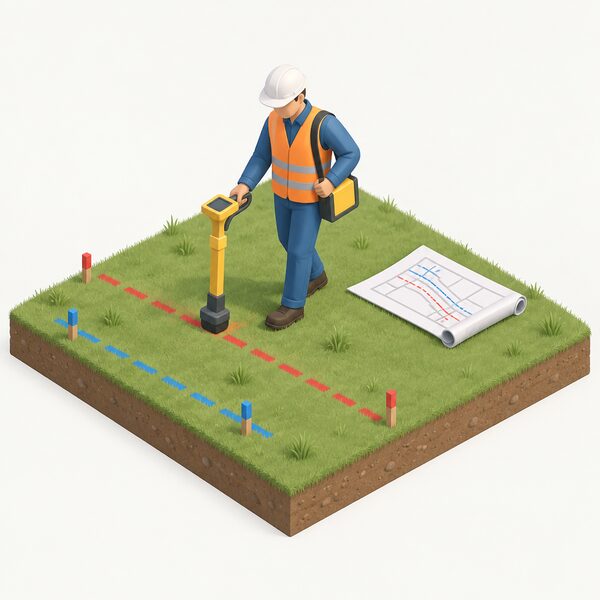
Underground cables cause as many problems as overhead ones, and the rule is to ask before the spade goes in. UK Power Networks encourages anyone carrying out work that involves digging to request plans beforehand to avoid underground electricity cables3. NIE Networks puts it plainly: before digging it is important to find out the location of any underground cables11.
Linesearch Before U Dig is the free service that shows ground utility assets before any digging or excavation work, covering electricity, gas, water and telecommunications networks13. Wales & West Utilities directs users of its Dial Before You Dig service to use cable and pipe locating devices on site to verify positions and to follow safe digging practices14. Plans record what is known; locating devices confirm what is actually there.
Excavation is also how the network itself gets repaired. Electricity North West explains that to repair a faulty cable it has to complete excavation work to access and repair the cable15. On private land, Electricity North West recommends completing excavation work yourself and will provide specifications to do so13.
New connections follow the same pattern. UK Power Networks sets out a step-by-step approach that includes digging before arrival, parking for vans, digging outside the property, pulling the cable into the meter box and reconnecting the supply16. NIE Networks lists trenching, ducting, meter box installation and site haul roads as tasks a customer may need to prepare before it arrives17. For a temporary supply, the trench needs to be dug on your land18.
Who owns and runs the lines around you
The company that owns the lines depends on where the property is. National Grid is the distributor for customers in the Midlands, Southwest England and South Wales19. Across Great Britain, regional companies operate the electricity network in different areas20. National Grid separately owns and operates the electricity transmission network in England and Wales, which is the high-voltage backbone rather than the local distribution network19. Gas transmission is a further exception: it is owned and operated by National Grid Gas22.
That split explains why the answer to "who do I call" is a postcode question. The 105 service exists precisely because the operator changes with the address: it connects the caller to whichever network operator covers the area2. For a household, the practical consequence is that the local lines, the poles, the substation and the underground cables are somebody else's asset, maintained under a public safety commitment that covers accidental contact with overhead lines, wilful interference such as vandalism and metal theft, damage to underground assets, asset failures, fires involving network apparatus on consumers' premises, and communication with the groups most at risk6.
National Grid's public safety pages carry downloadable safety posters and leaflets to display as needed23. UK Power Networks publishes safety advice and resources covering living next to electrical equipment and what an electrical substation is3. Its general enquiry lines are open Monday to Friday, 8.30am to 5.00pm, free to call from a mobile or landline24.
What this means for a household's independence
The safety rules around overhead lines mark the edge of what a household can do for itself. A home can generate its own electricity, store it and manage its own demand, but it cannot touch, move, cover or work close to the network that connects it. Those decisions sit with the regional distribution network operator, and the free advice, the free site visit and the free shrouding service are the routes into that conversation.
The dependence is not only physical. The lines are owned by a company, the emergency routing runs through a national number, and the plans that show what is buried under a garden come from the operator and a shared utility service. A household that wants to dig, build, plant trees or run machinery near a line is working inside somebody else's safety framework, and the framework is designed on the assumption that the household will ask first.
The parts a household does control are the ones inside the property boundary: keeping trees and branches clear of lines, using locating devices before digging, and knowing which of the two numbers applies. Beyond that, the network operator's engineers decide what is safe, and the services they provide to make work possible are free.
Sources24 cited
- Power cut, Energy Networks Association, 2026-09-17
- Plan for a power cut, Ofgem, 2026
- Safety advice and resources, UK Power Networks, 2026-09-17
- Cover my overhead power line (shrouding), UK Power Networks, 2026-09-17
- Living next to electrical equipment, UK Power Networks, 2026-09-17
- Public safety commitment, Energy Networks Association, 2026-09-17
- Get compensation if you have a power cut, Citizens Advice, 2026-09-17
- Storms and bad weather, Energy Networks Association, 2026-09-17
- Replace power cable or power line, UK Power Networks, 2026-09-17
- What is an electrical substation, UK Power Networks, 2026-09-17
- I'm doing DIY at my property, what safety precautions should I take?, NIE Networks, 2026-09-19
- Safe isolation, NIE Networks, 2026-09-19
- Connections FAQs, Electricity North West, 2026-09-19
- Dial Before You Dig, Wales & West Utilities, 2026-09-20
- Restoration following a power cut, Electricity North West, 2026-09-19
- Adding more power, UK Power Networks, 2026-09-17
- Your connections process, NIE Networks, 2026-09-19
- Temporary electricity connection: what's involved, UK Power Networks, 2026-09-17
- What role does National Grid play in your energy bill, National Grid, 2026-09-17
- Power cut 105, Energy Networks Association, 2026-09-17
- Energy networks explained, Energy Networks Association, 2026-09-17
- Energy terms explained, Ofgem, 2026
- Public safety advice, National Grid, 2026-09-17
- Cost and time, UK Power Networks, 2026-09-17
 Who to Call for Energy HelpA single reference to the right contact for each situation: gas escapes, power cuts, water leaks, meter faults, billing disputes, scams and free advice.
 Backup Power Safety RulesWho signs off a battery or backup circuit, and can you legally plug in a power station or a plug-in solar panel in the UK?
 Network Operators and 105When the lights go out, who do you actually ring?
 Prepare a Home for a Power CutA household checklist for before, during and after an outage: what to keep charged and to hand, which appliances to switch off, how long food stays safe and what to do about medical equipment.
 Product RecallsHow recalls and safety notices work for energy equipment in UK homes, who issues them, how to check a product, and what replacement, repair and refund routes exist.
 The Transmission NetworkWondering who owns the pylons near your house, or why the grid needs upgrading before you can run a heat pump or an electric car?