
In this guide
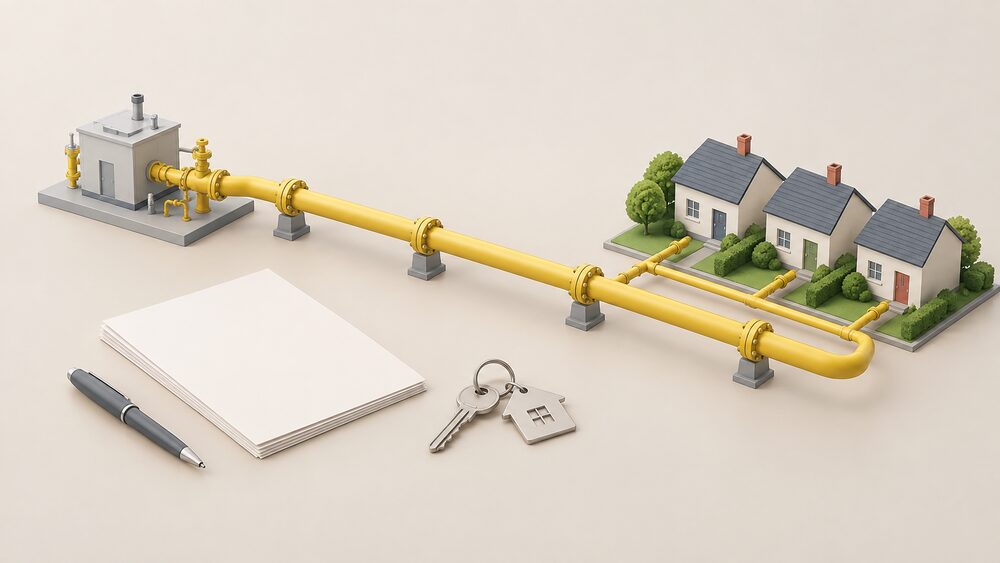
National Gas Transmission owns and operates the National Transmission System, the high-pressure gas pipelines that transport gas from terminals and ports across Great Britain1. It is not a supplier. It does not sell electricity tariffs, and it does not bill households2. Its job is bulk movement: transmission networks carry gas at high pressures and speeds across the country, and the distribution networks then carry it at lower pressures and speeds to individual households3.
The company behind the system is National Gas, owned by a consortium: 80% held by Macquarie Asset Management and British Columbia Investment Management Corporation, with National Grid plc holding 20%4. Independent news analysis published in April 2024 puts National Gas Transmission operating profit at £2,090,000,000 since the energy crisis5. That figure sits alongside other network operators in the same analysis, and it is recovered through regulated charges on bills rather than through selling gas.
For a household, the practical answer is that this is the trunk of the network, not the pipe in the street. Gas reaches a home through one of the four distribution ownership groups, and the transmission system is what keeps gas flowing into them. The sections below set out what the system does, who owns and regulates it, what it costs households, and where policy is taking it.
What National Gas Transmission owns and operates
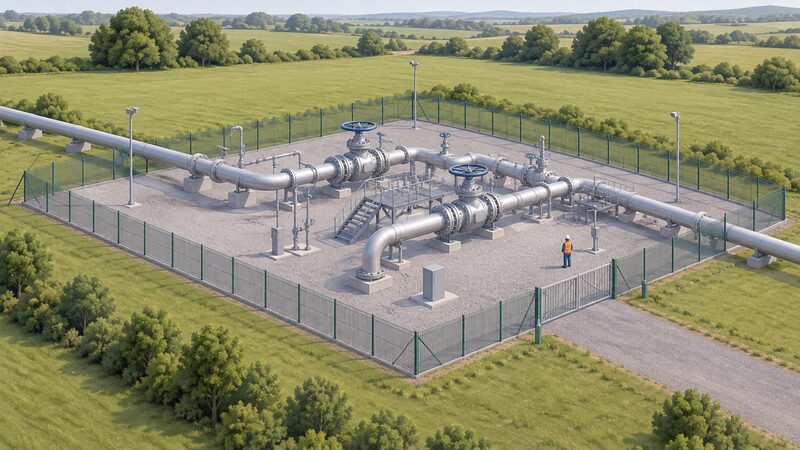
National Gas Transmission owns and operates the National Transmission System, described in an official consultation as a system formed of high-pressure gas pipelines that transport gas from terminals and ports1. That definition matters because it draws the boundary of the company's role. The NTS is the long-distance, high-pressure layer. It does not connect to a domestic meter, and it does not sell anything to a household.
Below it sit the Gas Distribution Networks, which own and operate the networks of medium and low-pressure pipelines that receive gas from the NTS. There are four of them: Cadent, Northern Gas Networks, SGN and Wales and West Utilities1. Ofgem's own explanation of the industry structure puts the count at eight gas distribution network operators, owned by four ownership groups9. The two figures describe the same arrangement at different levels: four parent groups, eight licensed operators.
The transmission system is one part of a network that is designated Critical National Infrastructure, and which serves 67,000 industrial sites and nearly half a million commercial sites across the country10. Domestic supply is the end of that chain rather than its main volume, but it is the part households experience.
| Layer | What it carries | Who runs it |
|---|---|---|
| National Transmission System | Gas at high pressure and speed, from terminals and ports1 | National Gas Transmission1 |
| Gas Distribution Networks | Gas at medium and low pressure, to individual households3 | Cadent, Northern Gas Networks, SGN, Wales and West Utilities1 |
| Domestic supply and billing | The retail contract with the household | A licensed supplier2 |
The National Transmission System: what it does for households
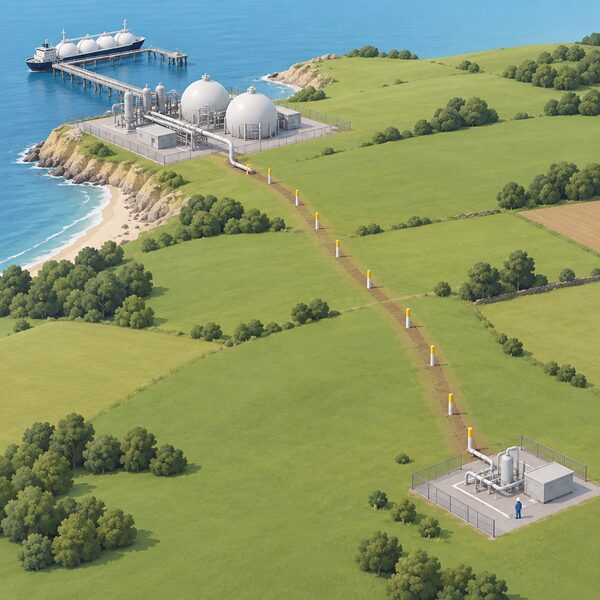
The NTS is the reason gas is available at all in most of Britain. It takes gas from terminals and ports, where imports and domestic production arrive, and moves it at high pressure and speed to the points where distribution networks take over3. A household never sees this layer, but every mains gas home depends on it.
The dependence is direct and one-directional. Around 15% of households are not connected to the gas grid at all, and for them the transmission system is irrelevant to heating7. For the rest, the NTS is the first link in a chain that runs from a terminal or port, through the transmission system, into a distribution network, and finally to a meter.
There is one unusual domestic case worth noting. Where gas piped directly to a customer's home is used partly to fuel a car and partly for domestic purposes, the supply should be apportioned accordingly, and natural gas homefill facilities allow an owner to refill a vehicle fuel tank overnight at home11. That is a niche arrangement, but it shows the transmission and distribution system can serve a household's transport fuel as well as its heating.
The system's reach is national but not uniform. Gas distribution and transmission arrangements differ across the four nations, and Northern Ireland has its own domestic gas framework, including a separate Energy Price Guarantee scheme document for domestic gas consumers there12. Scotland's heat strategy work assumes at least 1 million homes currently using mains gas will need conversion to low or zero-emissions heating by 2030, which is a statement about the future of that connection14.
Ownership and company status
The ownership position has changed, and older descriptions of the network are now out of date. Ofgem's explanation of the industry still states that gas transmission is owned and operated by National Grid Gas9. Independent news coverage dated September 2026 describes the position differently: the network is run by National Gas, owned by a consortium 80% of Macquarie Asset Management, British Columbia Investment Management Corporation, and National Grid plc at 20%4.
What is not in dispute is that National Gas is a private network company, not a public body and not a supplier. It does not sell electricity tariffs, and its services cover commercial and residential gas across the UK, supply connections and disconnections, and site works2. That last category is where a household might encounter the company indirectly, through a connection or disconnection process rather than through a bill.
The distinction between transmission and distribution ownership matters when something goes wrong. A gas escape in the street is a distribution network matter, handled by Cadent, Northern Gas Networks, SGN or Wales & West Utilities depending on the area1. The transmission system is a different layer with different operators and different emergency arrangements.
Profits since the energy crisis: the £4 billion figure
UK gas and electricity network operators earned approximately £4 billion in excess profits between 2021 and 20241. That is the network side of the picture, and it sits alongside the supply side: almost half of the total profits since 2020, £207bn, are generated by firms with extensive involvement in the gas industry2. British Gas, now Centrica, has earned more than £56 billion in profit since privatisation3, and Northern Gas Networks alone reports a Group Operating Profit of £361,829,0004.
The sums flowing out of the country are larger still. Overseas gas producers have received around £50bn from UK customers during the gas crisis to date, based on net imports meeting around half of demand5. Had demand been at historical levels, the UK would have spent in the range of £115-135bn over 2.5 years of the gas crisis, with a likely figure of £120bn5.
For a household, these figures describe where the money goes rather than what can be recovered. Network returns are set through Ofgem price controls, with a figure now projected to reach up to £7bn by 20286. The gas networks themselves carry a decommissioning liability: in October 2023, the National Infrastructure Commission estimated that the cost of decommissioning the gas networks would be £25 billion7.
Independent news analysis published in April 2024 puts National Gas Transmission operating profit at £2,090,000,000 since the energy crisis5. The same analysis lists other network operators, and the figures are not like for like, since the analysis mixes operating profit, net income and pre-tax profit across companies. That should be read as a limitation of the comparison rather than a ranking.
| Company | Figure reported | Basis |
|---|---|---|
| National Gas Transmission | £2,090,000,000 | Operating profit since the energy crisis5 |
| Northern Powergrid | £794,740,000 | Net income or earnings5 |
| Electricity North West | £518,400,000 | Pre-tax profit5 |
| Northern Gas Networks | £361,829,000 | Group operating profit5 |
Where the money comes from is the part that connects to a household bill. Network companies recover their costs through regulated charges, not through selling energy. Ofgem's August 2025 price cap announcement attributed part of the rise to gas network cost adjustments, at 72p a month on an average household bill6. Independent analysis reports gas network running costs per household rose 38% between 2021 and April 20244.
There is a further mechanism that shifts cost between customers. Gas transporters are unable to charge for health and safety disconnections, and according to industry these costs are ultimately passed onto other customers through network charges, leading to higher household bills for those remaining on the network1. That is a structural point about who pays when a customer leaves, and it applies to the distribution networks rather than the transmission system directly.
What the gas backbone means for household energy independence
The transmission system is the clearest example of a dependence a household cannot remove while it remains on mains gas. A home connected to the grid depends on the NTS, on a distribution network, on a licensed supplier, and on the imports and domestic production that feed the terminals and ports. None of those links is within a household's control.
The scale of that dependence is what policy work keeps returning to. The Climate Change Committee has called for clarity on the future of the gas grid and more structured management of interdependencies15. Its wider position is that ending the fossil fuel age is the route to a secure future, and it models that average household energy bills in 2040 would be 15 times less sensitive to a gas price spike like the one following Russia's invasion of Ukraine16. That is a modelled figure for a future in which households are less exposed, not a description of the present.
For a household that wants to reduce reliance, the options that change the fuel are the ones that matter. Renewable technologies reduce reliance on fossil fuels such as gas and oil and therefore reduce fuel bills and carbon emissions17. Behind-the-meter systems do not require a grid connection, though a connection enhances their value by enabling export of surplus electricity18. The trade-off is that leaving gas means taking on a different set of dependencies, typically electricity, and often a manufacturer's equipment and controls.
Where a household stays on gas, the practical lever is efficiency rather than supply. Approved Document L sets minimum efficiency standards for appliances, including 45% for natural gas on an inset live fuel-effect combined fire and back boiler19. Those standards govern what can be installed, not what the transmission system does.
How the NTS fits alongside the electricity grid
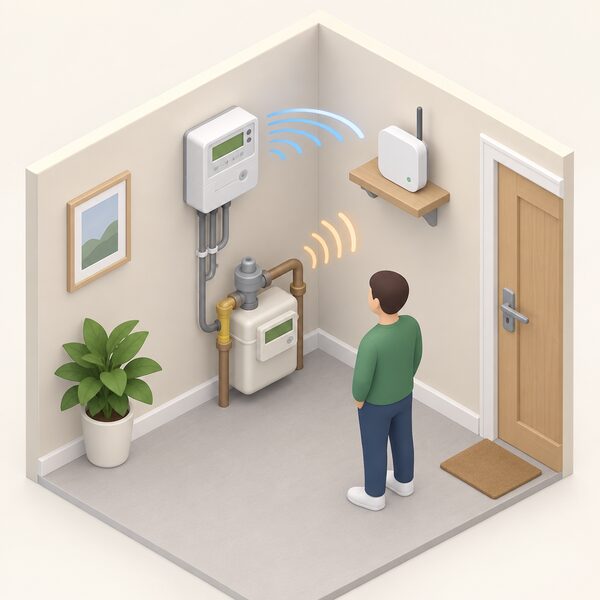
The two networks are separate systems with separate operators, and the distinction is worth holding on to. Gas transmission is owned and operated as described above1. On the electricity side, the National Energy System Operator is responsible for planning and delivering the energy of today and the future UK energy system, and it sets the level of electricity balancing costs6.
The systems meet in two places. The first is generation: gas-fired plant burns gas delivered through the network to produce electricity, which is why gas prices move electricity prices. The second is data. Smart metering transmits consumption and tariff information, and the only data transmitted over the smart energy network is how much gas and electricity a household uses and its chosen tariff21. That is a modest data flow, but it is the point at which a household's gas and electricity use are visible to the system together.
There is also a governance overlap. The government has said it will take forward a series of consultations and policy development on electric vehicle charging infrastructure and planning22, and NESO was expected to consult on its draft RESP methodology by Q4 202523. These are electricity-side processes, but they sit in the same policy space as the gas grid reviews, and the Climate Change Committee's call for clarity on the gas grid's future is explicitly about managing those interdependencies15.
For a household, the practical consequence is that the two networks fail differently. A gas supply emergency is handled through the gas system's own arrangements, while an electricity shortfall runs through the electricity system's notices and margins. The two are covered separately on this site.
Where the system is heading: policy and reviews
No decision has been taken to phase out the gas network, and the work under way is preparation rather than removal. The network is close to fully modernised following an extensive replacement programme over the last 20 to 25 years, the Iron Mains Risk Reduction Programme, and over 80% of the gas distribution network is now made up of PE pipe10. That replacement work is what makes the network compatible with different gases.
The direction of travel is green gases. The network's future role is described as including transporting green gases such as biomethane and hydrogen10. National Gas is delivering the FutureGrid project, described as the first of many steps towards a full-scale conversion of the existing National Transmission System to transport hydrogen, and the LTS Futures project is verifying the compatibility of Great Britain's larger local transmission system pipelines with hydrogen gas24.
The costs of the alternative are large. In October 2023, the National Infrastructure Commission estimated that the cost of decommissioning the gas networks would be £25 billion8. That estimate is a reason the reviews have been cautious rather than a plan.
Two consultations frame the near-term work. The Gas System in Transition: Security of Supply consultation was open until 18 February 202625. A separate call for input on exercising consumer choice, a review of the gas disconnections framework, was published on 13 January 2025 with a response deadline of 7 March 2025, run by the Access and Connections, Gas Systems and Operations Unit1. The disconnections review is the one that touches households most directly, because it concerns the framework under which a home leaves the network.
Sources25 cited
- Call for Input: Exercising Consumer Choice, gas disconnections framework, Ofgem, 13 January 2025
- Which? energy survey results, Which?, 2026
- Gas transmission and distribution networks, House of Commons Library, 2026
- Tariff Watch, End Fuel Poverty Coalition, 20 September 2026
- Energy profits hit £420bn as standing charges rise, End Fuel Poverty Coalition, 1 April 2024
- Energy price cap will rise 2 per cent in October, Ofgem, 27 August 2025
- Energy security and net zero Committee report, House of Commons Energy Security and Net Zero Committee, 9 May 2025
- Government response on the electricity distribution networks study, House of Commons Public Accounts Committee, October 2023
- Energy terms explained, Ofgem, 2026
- Why gas networks remain central to the UK's energy security, Institution of Gas Engineers and Managers, January 2026
- VAT fuel and power manual, HM Revenue and Customs, 17 September 2026
- Energy Price Guarantee for domestic gas consumers in Northern Ireland: direction, HM Government, 19 December 2022
- Energy Price Guarantee scheme documents, HM Government, 31 October 2022
- Heat and buildings strategy strategic environmental assessment, Scottish Government, February 2020
- Well-adapted energy system, Climate Change Committee, 19 September 2026
- End the fossil fuel age for a secure and prosperous future, Climate Change Committee, 26 February 2025
- Renewable energy, Carmarthenshire County Council, 1 July 2025
- Behind-the-meter energy systems guidance, Welsh Government, 29 June 2026
- Approved Document L: conservation of fuel and power, Volume 1, HM Government, 2026
- Energy system research briefing, House of Commons Library, 10 July 2026
- Does a smart meter need Wi-Fi?, Smart DCC, 2026
- Solar on car parks and electric vehicle charging, HM Government, 26 November 2025
- Electricity distribution networks study: government response, HM Government, 7 July 2025
- Ensuring a safe hydrogen gas network, SGN, 2026
- Statutory security of supply report 2025, Department for Energy Security and Net Zero, 17 December 2025
 National Energy ActionStruggling to pay your energy bills?