
In this answer
Short answer
No. A hydro system does not burn anything, so it releases no carbon dioxide at the point of generation. The Energy Saving Trust states plainly that hydroelectricity "doesn't release any carbon dioxide emissions"1, and Home Energy Scotland adds that it "doesn't release harmful carbon dioxide or other pollutants"2. What emissions exist are embodied: the steel, concrete, copper and transport that go into building the scheme, not the running of it.
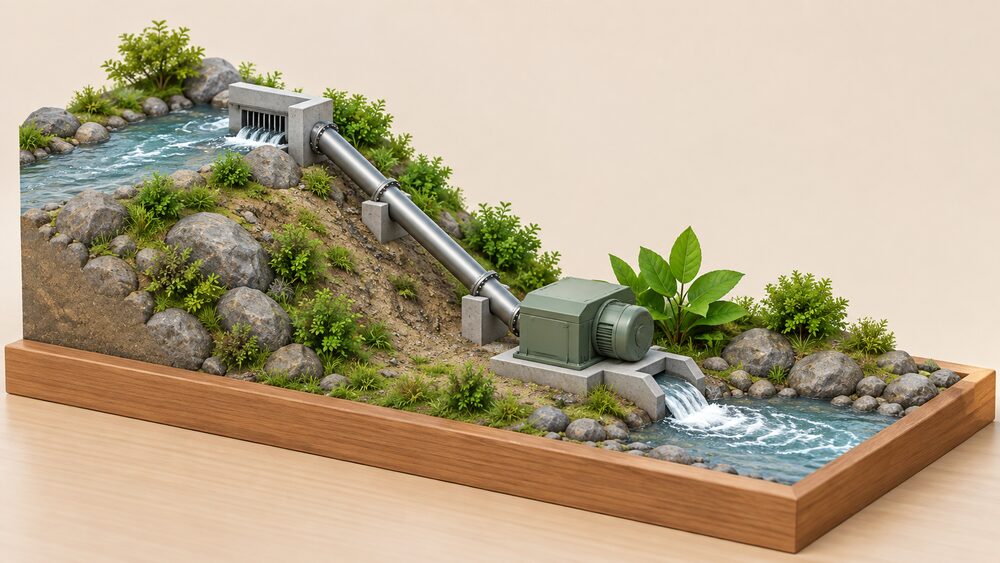
That distinction matters for a household weighing up energy independence. A hydro turbine converts the potential energy of falling water into electricity through a turbine and generator, with no combustion stage at all2. Once running, it produces very low greenhouse gas emissions because it does not burn fossil fuels during operation3. The same cannot be said of any boiler, whether gas, oil or hydrogen.
The practical consequence is a generator that can run continuously. In theory a hydro system can generate 24 hours a day, which could provide all the electricity a property needs and more4. That is a different proposition from solar, which is intermittent by nature, and it is why hydro is often described as ideal for off-grid homes despite high initial costs5.
What hydro power actually emits, and what it does not
The emissions case for hydro rests on a simple physical fact: nothing is burned. Hydropower systems work in a similar way to wind turbines, where flowing water turns a turbine, which is used to generate electricity6. There is no fuel, no flame and no exhaust. The Energy Saving Trust groups hydro with other renewable sources that "tend to have no or low carbon dioxide emissions"6.
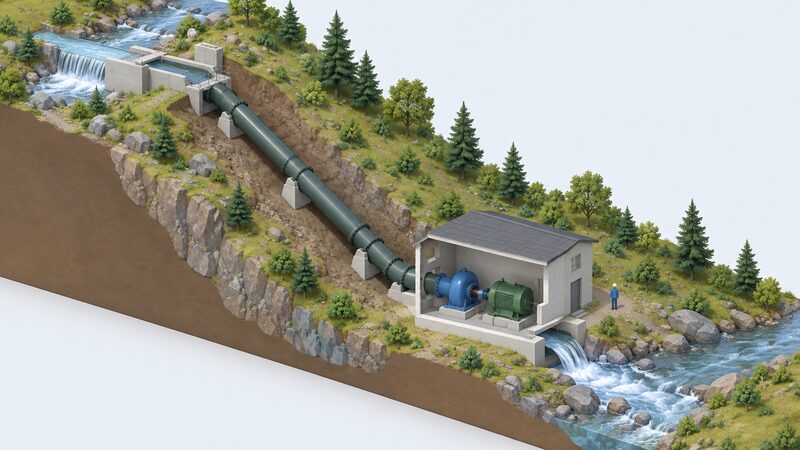
What a hydro scheme does emit is embodied carbon, and the honest answer to the lifetime question is that no generating technology is at absolute zero. Steel penstocks, concrete intakes, turbine housings and the transport of components all carry manufacturing emissions. For a run-of-river micro hydro scheme there is no reservoir and no flooded vegetation to decompose, so the methane and CO2 associated with large storage dams do not arise. The embodied burden is spread across an unusually long operating life: most hydropower systems can last for 40 to 50 years, with low running and maintenance costs1.
Compare that with combustion. Burning any fuel, including hydrogen, can produce NOx7, and hydrogen boilers still produce some of the other pollutants that are a by-product of burning natural gas, such as nitrogen oxides8. A hydro turbine produces none of these because it has no combustion stage. The only moving parts are the turbine and generator, and maintenance costs are usually low because hydro systems are very reliable4.
"Hydroelectricity is green renewable energy and doesn't release harmful carbon dioxide or other pollutants."
Why hydro counts as an independent, low-emission source
Hydro's status as a low-carbon source is written into law, not just marketing. The Building Regulations (Northern Ireland) Order 1979 uses a definition of a low or zero carbon system, describing it as one that relies wholly or mainly on a qualifying energy source or technology9. Water is among the sources named in that framework. That legal recognition matters because it underpins how hydro is treated in building regulations, planning and, historically, support schemes. It also reflects the physical reality: a hydro scheme generates without releasing any harmful CO2 or other pollutants into the atmosphere4.
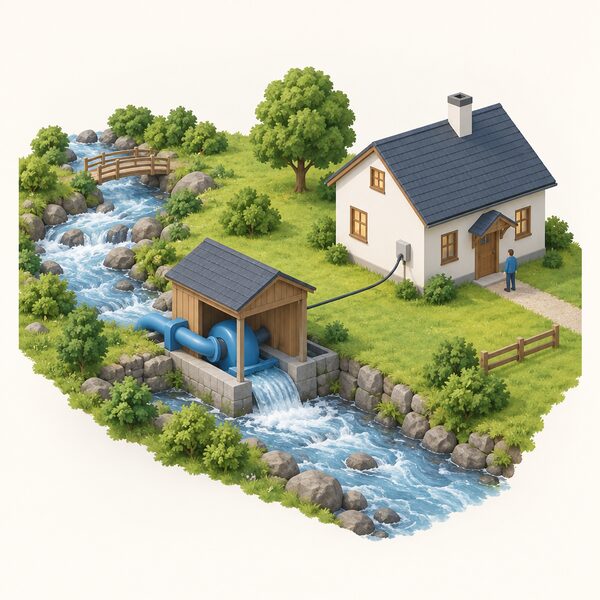
Independence, though, is a separate question from emissions, and the two should not be conflated. A hydro system can reduce dependence on a supplier and on imported gas, but it does not automatically remove dependence on the grid. For houses with no mains connection but with access to a micro hydro site, a good hydro system can generate a steady, more reliable electricity supply than other renewable technologies at a lower cost10. Total system costs can be high but often less than the cost of a grid connection, and with no electricity bills to follow10. That is the strongest independence case: a property that would otherwise pay for a grid connection instead pays for a turbine.
For a grid-connected home, the picture is different. Hydro generates when the water flows, which may not match when the household uses power, so a connection, a meter and often a battery remain part of the system. The emissions are near zero; the independence is partial. Micro-hydro systems generate power from running water and are ideal for off-grid homes, offering long-term savings despite high initial costs5.
Where hydro sits among household renewable options
Hydro is one of several low-carbon options, and it differs from the others in ways that matter for both emissions and practicality. Heat pumps produce much fewer CO2 emissions than other heating systems11, and can save up to 70% of carbon emissions compared to a gas boiler12. Solar thermal produces direct renewable heat without producing any CO2 emission13. Tidal energy does not produce greenhouse gas emissions during operation14. Hydro sits alongside these as an operational near-zero source, but it is the only one of them that generates electricity continuously from a watercourse.
The comparison is not like for like, because these technologies deliver different things. Heat pumps and solar thermal deliver heat. Hydro and solar PV deliver electricity. A household choosing between them is really choosing what to decarbonise first, and the answer depends on the site.
| Technology | Operational CO2 | What it delivers | Key constraint |
|---|---|---|---|
| Micro hydro | None1 | Electricity, potentially 24 hours a day4 | Needs flow and head15 |
| Heat pumps | Up to 70% less than a gas boiler12 | Heat | Building fabric and emitter sizing |
| Solar thermal | None13 | Direct renewable heat | Roof or ground space, daylight |
| Tidal | None during operation14 | Electricity | Coastal site, largely commercial scale |
Hydro's particular advantage is constancy. In theory a hydro system can generate 24 hours a day, which could provide all the electricity you need and more4. A hydroelectricity system can generate electricity 24 hours a day, often generating all or more of your electricity needs2. That load factor is what distinguishes it from solar and wind, and it is why hydro is often paired with off-grid properties.
The trade-off is site specificity. Hydro is not a technology a household can choose freely; it is one the site either supports or does not. Where it does, the emissions case is as strong as any renewable option, and the independence case is stronger than most.
Do micro-hydro systems for homes work in the UK?
Yes, where the site allows. Hydro power accounts for around 2% of the UK's electricity supply4, and micro-hydro systems generate power from running water5. The technology is proven in the UK, but domestic installations are limited by geography rather than by any technical shortfall.
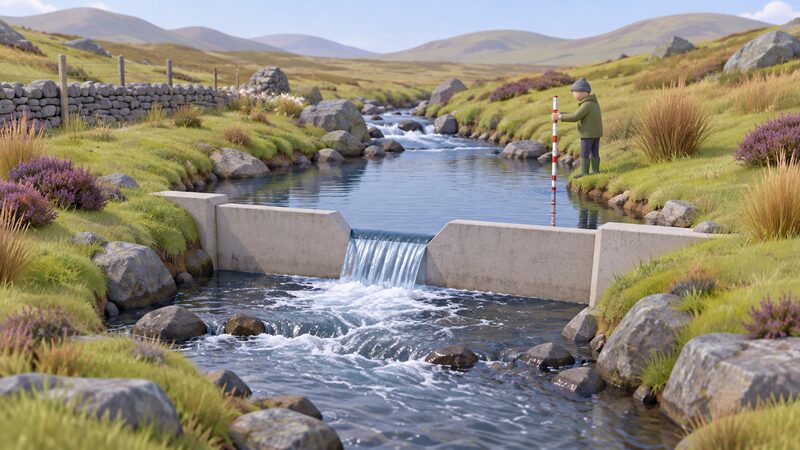
The determining factors are flow and head. The viability of the installation will depend on whether there is enough water flowing per second and the height or head that it falls from15. A suitable site needs a water source with a combination of flow, meaning how much water is flowing through the system, and head, meaning the difference in height between the water at the top of the system and the bottom1. Both must be adequate; a high head with a trickle of water, or a large flow with almost no drop, will not support a viable scheme.
Where those conditions are met, the output can be substantial. Small hydroelectricity systems, also called hydropower systems, can produce enough electricity for all electrical appliances and lighting in your home1. Hydropower can produce more than enough electricity for lighting and household appliances16. That is a genuine whole-home supply, not a supplement.
The UK's hydro resource is concentrated in Scotland, Wales, the Pennines and the South West, where rainfall and gradient combine. Northern Ireland also has a hydro resource, and the nidirect guidance covers hydropower for households there17. Planning and abstraction rules differ between the four nations, and any scheme that diverts water will need consents; the micro hydro power for homes page covers what a scheme involves, and head and flow explains how to assess a site.
Is hydro power truly carbon-free over its whole lifetime?
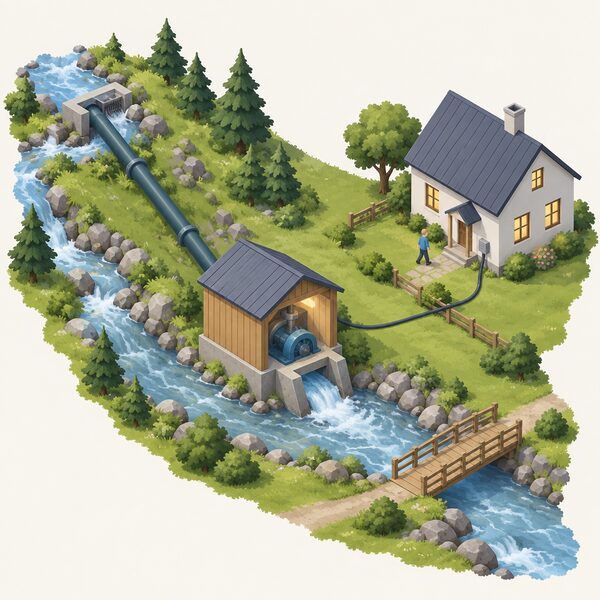
Strictly, no, and it is worth being precise about why. The claim that hydro is carbon-free applies to operation, not to manufacture. Because it does not burn fossil fuels during operation, hydroelectric power produces very low greenhouse gas emissions once the system is running3. The qualifier "once the system is running" is doing real work in that sentence.
The embodied emissions come from materials and construction: concrete, steel, copper winding, electronics and transport. For a micro scheme these are modest, and they are amortised over a long life. Most hydropower systems can last for 40 to 50 years, with low running and maintenance costs1. Over four or five decades, the manufacturing carbon per unit of electricity generated becomes very small.
This is the same accounting logic applied to any renewable. The Energy Saving Trust notes that renewable sources tend to have no or low carbon dioxide emissions6, and the "low" acknowledges embodied carbon. The distinction between operational and embodied emissions is not a technicality; it is the difference between a claim that can be defended and one that cannot.
For a household, the practical implication is that hydro's carbon case is strong but not absolute. A scheme that runs for decades will repay its embodied carbon many times over. A scheme that is poorly sited, underused or abandoned early will not. That is an argument for assessing the resource properly before committing, not an argument against hydro.
Does a hydro system emit any pollutants besides CO2?
No combustion pollutants are produced, because there is no combustion. This is where hydro differs most sharply from the alternatives it is sometimes compared with. Burning any fuel, including hydrogen, can produce NOx7, and hydrogen boilers still produce some of the other pollutants that are a by-product of burning natural gas, such as nitrogen oxides8. A hydro turbine produces none of these.
The pollutants associated with heating appliances are a function of burning something. A direct emission heating system is defined in Scottish Government consultation as a heating system producing harmful gases at the point of use, such as gas, oil and LPG boilers or burners, and bioenergy systems18. Hydro is not a heating system and does not appear in that category. It produces electricity, and it does so without a flame.
That said, hydro schemes have environmental considerations that are not about air emissions at all. Abstraction, fish passage, screening and the ecological impact of diverting a watercourse are real regulatory concerns, and they are covered on the environmental requirements and abstraction licences pages. These are water and habitat issues, not air quality ones.
For a household comparing emissions, the summary is straightforward. Hydro's operational air emissions are zero. Its embodied carbon is low and spread over decades. Its non-carbon environmental obligations are site-specific and regulated. No other generating technology available to a single home combines a zero-combustion generation stage with the ability to run continuously.
Sources18 cited
- Hydroelectricity, Energy Saving Trust, 2025-11-06
- Hydroelectricity, Home Energy Scotland, 2026-09-20
- What is hydropower and how does it work?, Smart Energy GB, 2026-08-19
- Hydro, Electricity North West, 2026-09-19
- Sustainable home energy solutions, Planning Portal, 2024-09-02
- Generating renewable electricity, Energy Saving Trust, 2025-12-11
- Hydrogen boilers: what you need to know, Which?, 2026-09-17
- CCC: progress on low carbon hydrogen must begin now, Carbon Brief, 2018-11-22
- Building Regulations (Northern Ireland) Order 1979, legislation.gov.uk, 1979-12-19
- Hydro electric power, Planning Portal, 2026
- How do heat pumps work?, Smart Energy GB, 2026-03-16
- What does net zero mean?, Smart Energy GB, 2026-03-16
- Hybrid heating, Cadent Gas, 2026-09-20
- Affordable Warmth Scheme, Northern Ireland Housing Executive, 2026-09-17
- Could you generate your own energy, Energy Saving Trust, 2024-04-12
- Heat pumps, Energy Saving Trust, 2026-06-11
- Hydropower, nidirect, 2026-09-17
- Changing the way we heat our homes and buildings, Scottish Government, 2023-11-28
 Green Hydrogen Made and CostGreen hydrogen is made by splitting water using wind or solar power, so it produces no carbon when burned.
 Wind Turbine Output and SizingHow much electricity a home wind turbine makes depends far more on your wind than on its size.
 Condensing BoilersCondensing boilers squeeze extra heat out of the gas they burn by turning the steam in their waste gases back into water.
 Building-Mounted Wind TurbinesWill a wind turbine on your roof actually make enough electricity to be worth it?
 Micro Hydro CostHow much does a micro hydro scheme cost to build and run, and what makes one worth it?
 Using a Heat Pump for CoolingCan a heat pump cool your home in summer as well as heat it in winter?