
In this answer
Short answer
A hydro turbine on a stream, brook or river almost always needs a water abstraction licence before any water is taken. Guidance for hydro projects is blunt about the scale of the paperwork: various consents and licences are required for a hydro project1. For a generating station in England and Wales the expected set is an abstraction licence, an impounding licence, and consent to erect any structure in, over or under a watercourse that forms part of a main river2.
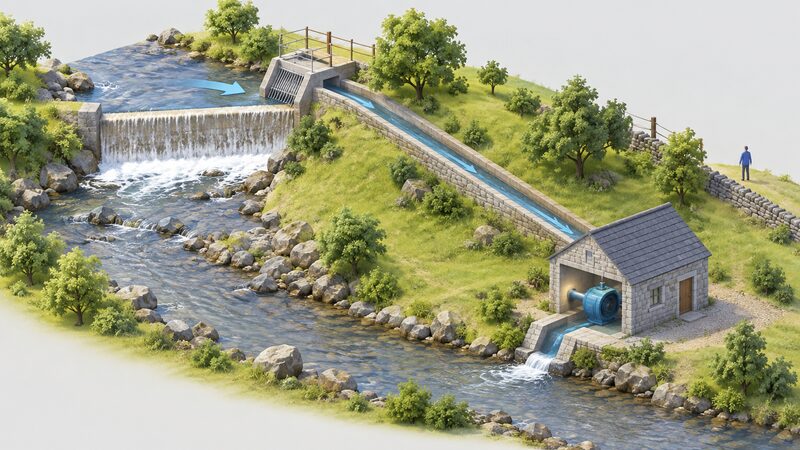
The rule bites hardest where a scheme diverts flow. Diversion of a watercourse will usually require a water abstraction licence, and the impact upon wildlife, especially fish, must be considered and the necessary licences and permissions obtained3. Land ownership changes nothing: the licence attaches to the taking of water, not to the title of the land beneath it.
There is one clear exception in the guidance. A closed loop heat exchanger needs neither groundwater investigation consent nor an abstraction licence4. That distinction, between a system that returns water to its source and one that takes it out, is the single most useful test a householder can apply before ringing a regulator.
What an abstraction licence is, and who issues it
An abstraction licence is the permission to take water from a source, whether surface water such as a river or stream, or groundwater. It sits alongside, and is distinct from, the other consents a hydro scheme attracts. In England the Environment Agency is the body that grants abstraction licences, impounding licences and consents for structures in main rivers, and it is the regulator a householder in England will deal with. Scotland, Wales and Northern Ireland operate their own regimes through their own regulators, so the authority named on the application differs by nation even where the underlying principle is the same.
The licence is not a property right and it is not a formality. It defines how much water may be taken, from where, and under what conditions, and those conditions are where fish protection, minimum flow and seasonal limits usually appear. Because the licence governs the taking rather than the equipment, changing a turbine does not change the licence, but changing the abstraction point or the volume taken does.
For a household, the licence is the point at which a private energy scheme meets public water management. A stream running through a garden feels like a private resource; the water in it is regulated. That is the first real limit on the independence a hydro scheme can deliver, and it is worth understanding before any money is spent on a turbine.
When a licence is normally required for taking water from a watercourse
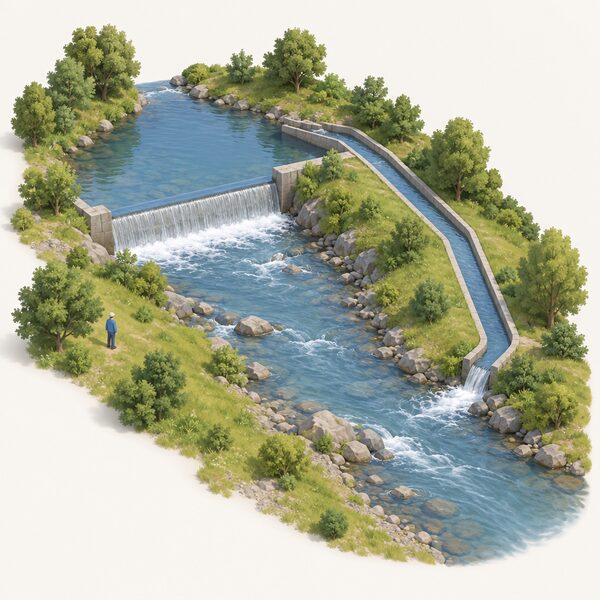
The trigger is abstraction, and diversion is the clearest case. Where a scheme takes water out of a watercourse and returns it downstream, the taking is an abstraction and the guidance states that diversion will usually require a water abstraction licence3. The same guidance makes the environmental test explicit: the impact upon wildlife, especially fish, must be considered and the necessary licences and permissions obtained3.
A hydro generating station in England and Wales is expected to hold a fuller set. The abstraction licence covers the water taken; an impounding licence covers the impoundment of the watercourse, which is what a weir or a headrace creates; and consent to erect any structure in, over or under a watercourse that forms part of a main river covers the physical works2. A scheme can hold one of these and still need the others, which is why the consent set is best treated as a package rather than a single application.
There is a further permission that catches some sites. Permission may also be required from the Coal Authority for use of water from disused mine workings6. That applies where the water source is mine water rather than a natural watercourse, and it is a reminder that the source of the water, not just the fact of taking it, determines which permissions apply.
The practical consequence is that a stream with useful power is not automatically a stream that can be used. Useful power may be produced from even a small stream5, but the licence determines whether that power can lawfully be captured. Head and flow decide the engineering; the licence decides whether the scheme may exist at all.
How the requirement applies to water source heat pumps and hydro installations
Water source heat pumps and hydro turbines both interact with water, but they sit on opposite sides of the abstraction line. A closed loop heat exchanger takes no water out of the source: it circulates a fluid through a sealed loop and returns it, and the guidance is explicit that no groundwater investigation consent and no abstraction licence are needed4. An open loop system, which abstracts water, discharges it and returns it to the source, is a different proposition and falls within the abstraction regime.
For hydro, the position is the reverse. A scheme that diverts flow is taking water, and diversion will usually require a water abstraction licence3. The environmental conditions attached to that licence, particularly around fish, are where most of the design work sits, and they connect directly to the fish passage and screening requirements that shape a scheme's cost and layout.
The two technologies also differ in how they are treated for planning and support. Hydro sits within the microgeneration framework: a hydro generating station in England and Wales is expected to hold the abstraction, impounding and structure consents described above2, and hydro schemes up to 5MW have been eligible for support routes that require accreditation7. A water source heat pump, by contrast, is a heating technology whose consenting questions are about groundwater and discharge rather than about a turbine in a channel.
For a household weighing the two, the consent burden is a genuine part of the comparison. A closed loop heat pump avoids the abstraction licence entirely4. A hydro turbine on a diverted watercourse should assume it will need one3.
Applying to the Environment Agency: the process and what it covers

An application to the Environment Agency for a hydro scheme is really an application for a set of permissions, and it is best prepared as one. The abstraction licence covers the volume and rate of water taken and the conditions attached to the taking. The impounding licence covers the works that hold water back. Consent for structures covers anything erected in, over or under a main river2.
The information a regulator expects follows from that. An authorisation document requires the organisation name as a basic identifier8, and where grant funding is involved the borrower must provide a copy of the quotation provided by the installer, in the form required by the scheme, with all information true, accurate and complete9. For an abstraction application the equivalent core is the abstraction point, the quantity and rate, the head and flow of the scheme, and the measures protecting fish and wildlife, since the impact on wildlife must be considered and the necessary licences and permissions obtained3.
Timing is the part householders most often underestimate. The available guidance does not give a fixed determination period for an abstraction licence, but it does show that consent regimes run to their own clocks: prior approval for a free-standing wind turbine in Scotland expires 28 days after the planning authority receives the application10. A hydro project should be planned around the full consent set and the environmental assessment that supports it, not around a single deadline.
Where a hydro scheme's independence stops
A hydro turbine delivers electricity from a resource on the site, which is as close to genuine energy independence as domestic generation gets. The abstraction licence is the boundary of that independence. The water is not the household's to take at will; it is taken under a permission that specifies how much, from where, and on what conditions, and that permission can be varied or refused.
The dependence does not end with the licence. A grid-connected scheme still relies on a licensed supplier and a connection agreement, and the support framework that once rewarded hydro output has closed to new applicants, with the Feed-in Tariff scheme having operated through licensed suppliers for eligible generators7. A scheme that diverts a watercourse also carries ongoing environmental obligations, because the impact on fish and wildlife is a condition of the permission rather than a one-off hurdle3.
For a household, the honest position is that hydro offers a high degree of independence in operation and a low degree in permission. The stream may run every day of the year, but the right to use it is granted, conditioned and revocable. That is the trade a stream owner is making.
What happens if you take water without a licence
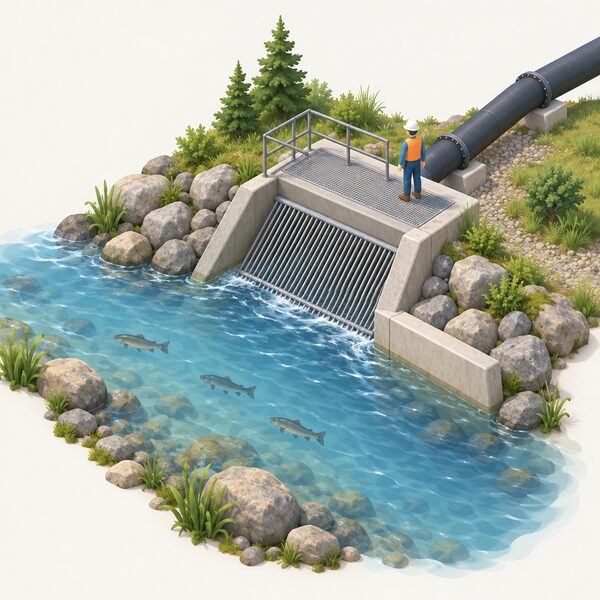
Taking water without the required licence is not a technicality that can be regularised after the turbine is installed. The abstraction licence is the legal basis for the taking, and a scheme that diverts a watercourse without one is operating outside the permission it needs3. The same applies to impoundment and to structures in a main river, which carry their own consents2.
The environmental dimension makes unauthorised abstraction more serious than a paperwork breach. Because the impact on wildlife, especially fish, must be considered and the necessary licences and permissions obtained3, a scheme that abstracts without a licence has also bypassed the assessment that protects the watercourse. Fish screening and passage requirements exist precisely because unscreened intakes harm fish, and those requirements are imposed through the consenting process.
There is also a support consequence. Accreditation routes for hydro have required schemes to meet eligibility conditions, and a scheme that cannot demonstrate its consents is in a weak position when applying for accreditation or for any grant that requires accurate and complete information9. The practical advice is to establish the consent position before committing to equipment, because the licence determines whether the scheme can be built at all.
Sources12 cited
- Hydropower, nidirect, 2026-09-17
- Feed-in Tariff guidance for renewable installations v10.2, Ofgem, 2016-06-20
- Advice on Improving Energy Efficiency, Eryri, 2022
- Open loop heat pump systems: permits, consents and licences, GOV.UK, 2016-02-01
- Hydro electricity, Planning Portal, 2026
- Ground source heat pumps and water source heat pumps (GSHP + WSHP) (2010), Scottish Government, 2010-03
- FIT Guidance for Licensed Electricity Suppliers V17.1, Ofgem, 2024-09-06
- Boiler Upgrade Scheme Letter of authorisation, Ofgem, 2026-09-17
- Green Homes Wales loan standard terms and conditions, Development Bank of Wales, 2026-09-17
- Circular 1/2024: Householder permitted development rights, Scottish Government, 2024-05-28
- The Town and Country Planning (Permitted Development and Miscellaneous Amendments) (Scotland) Regulations 2024, legislation.gov.uk, 2024-05-24
- Guidance for suppliers v14, Ofgem, 2021-08
 Abstraction Licences and PermitsTaking water from a stream to power a turbine needs permission, and where you live decides who grants it.
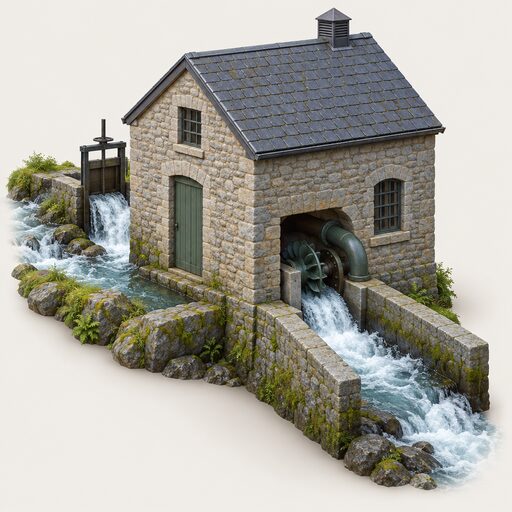 Micro Hydro Power for HomesA stream on your land that flows all year can make steady electricity, day and night, even when there is no sun or wind.
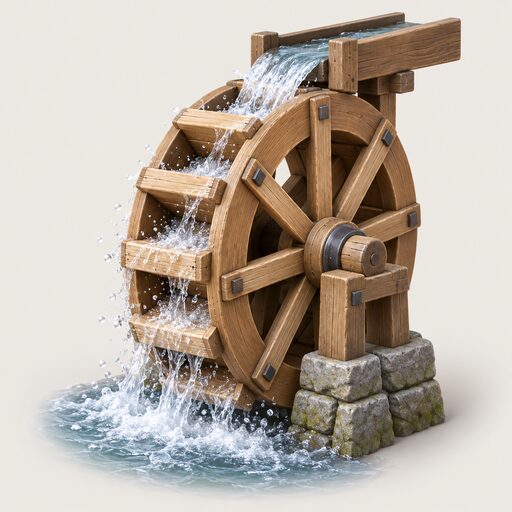 Micro Hydro InstallationHow much water do you need, and how far does it have to fall, for a micro hydro system to be worth it?
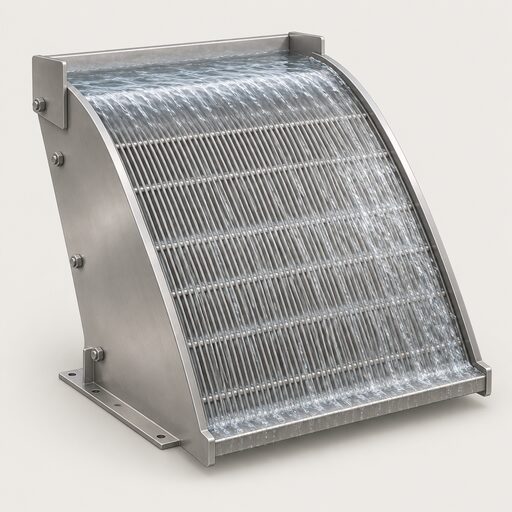 Hydro Environmental RequirementsWhat does a micro hydro scheme need to do about fish, and who decides?
 Wind Turbine Planning in WalesDo you need planning permission for a wind turbine at home in Wales?
 Home Energy Planning Rules in NIDo you need planning permission for solar panels or a heat pump in Northern Ireland?