

In this answer
Short answer
Paying a solar deposit by credit card is the single most effective way to keep a recovery route open if the installation goes wrong or the installer stops trading. The protection comes from Section 75 of the Consumer Credit Act 1974, which makes the card provider jointly liable with the supplier for a breach of contract or misrepresentation. Citizens Advice states that if you pay for work costing between £100.01 and £30,000 by credit card, you may be able to claim against the card company1.
The threshold matters more than the deposit itself. A deposit paid by credit card can bring the whole purchase within Section 75 even where that deposit is less than £100, because the legislation looks at the total cash price of the work, not the amount placed on the card1. That is the key point for a solar contract, where a deposit is typically a fraction of a four-figure or five-figure sum.
The alternative, chargeback, is a card network scheme rather than a statutory right, and it is available on debit as well as credit cards. Neither route is open to a household that pays by cash or bank transfer1. For a purchase of this size, the payment method is not an administrative detail: it determines whether there is any card-based remedy at all.
Why the payment method matters for a solar deposit
A solar installation is a forward payment for work that has not yet been done. The household pays a deposit before scaffolding goes up, before panels are mounted and before the system is commissioned. Between payment and completion there is a gap in which the installer could cease trading, deliver a defective system or fail to complete the work. The payment method determines what happens in that gap.
Card payment creates a second party, the card provider, who shares liability. Citizens Advice is explicit that if you pay by credit or debit card you might be able to get your money back through your card provider if something goes wrong, and that if you paid by cash or bank transfer you cannot claim through the chargeback scheme or Section 751. That is the whole argument in one sentence: the card is the only payment method that leaves a recovery route.
The wider context is that a solar installation is a long-lived asset with a long tail of obligations. The Energy Saving Trust notes that a household buying a house with solar panels should complete a change of ownership form to receive export payments, which shows how far the paperwork extends beyond installation day3. A deposit is the first commitment in a chain that includes commissioning, certification, handover documents and warranty cover. Getting the first payment wrong removes protection from everything that follows.
There is also a practical asymmetry. A bank transfer is instant, irreversible and leaves no chargeback right. A card payment can be disputed. For a household spending several thousand pounds on a system intended to reduce dependence on the grid, the payment method is part of the risk management, not an afterthought.

Section 75 protection: what purchases it covers and up to what amount
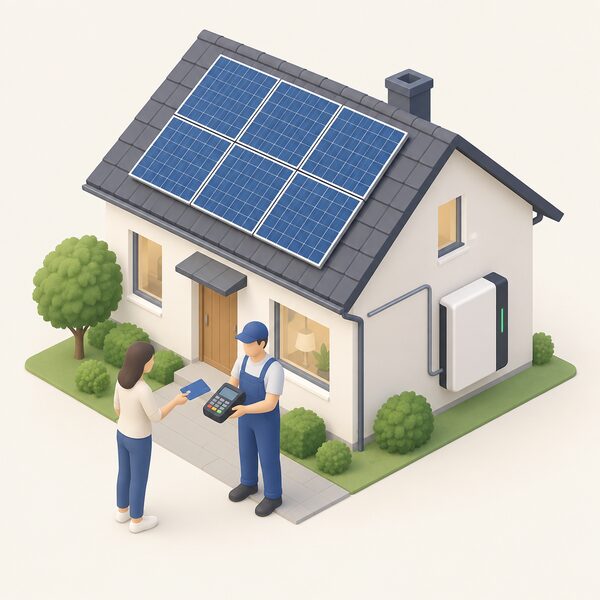
Section 75 of the Consumer Credit Act 1974 makes the credit provider jointly liable with the supplier for misrepresentation or breach of contract on a regulated agreement. In practice, for home improvement work, Citizens Advice describes the scope as work costing between £100.01 and £30,000 paid by credit card1. Both ends of that band matter. Below £100.01 the protection does not attach to the transaction; above £30,000 it falls outside.
The deposit point is the one most householders get wrong. Citizens Advice states that the protection includes paying a deposit by credit card even if that deposit is less than £1001. The test is the total cost of the work, not the amount charged to the card. A household paying a deposit by card on an installation costing between £100.01 and £30,000 is within the band, because the work falls inside that range.
| Element | Position |
|---|---|
| Minimum qualifying cost | £100.011 |
| Maximum qualifying cost | £30,0001 |
| Deposit under £100 by card | Can still bring the purchase within scope1 |
| Cash or bank transfer | Outside Section 75 and chargeback1 |
| Card type | Credit card for Section 75; credit or debit for chargeback1 |
The £30,000 ceiling is a real constraint for larger installations. A domestic solar array with battery storage can approach or exceed that figure, and any part of the price above £30,000 is not covered by Section 75. Where a contract sits near the ceiling, the protection applies to the transaction within the band, and the household should understand that the excess is unprotected.
Section 75 is a statutory right, not a goodwill scheme. That distinguishes it from chargeback, which depends on card network rules and can be refused. The legislation itself sets out the joint liability framework under which a card provider can be pursued4.
Chargebacks: the alternative route when Section 75 does not apply
Chargeback is a scheme operated through card networks that allows a card provider to reverse a transaction. It is not a legal right and it is not the same as Section 75. Citizens Advice describes it as a route where, if you pay by credit or debit card, you might be able to get your money back through your card provider if something goes wrong1. The word "might" carries weight: chargeback depends on the scheme rules and the circumstances.
The practical difference is twofold. First, chargeback is available on debit cards as well as credit cards, whereas Section 75 applies to credit agreements. Second, chargeback has no statutory minimum or maximum transaction value in the way Section 75 does. That makes it useful for smaller payments that fall below the £100.01 Section 75 threshold.
Neither route is available on cash or bank transfer. Citizens Advice states plainly that if you paid by cash or bank transfer, you cannot claim through the chargeback scheme or Section 751. This is the single most important sentence for a householder deciding how to pay a deposit.
"If you paid by cash or bank transfer, you can't claim through the chargeback scheme or section 75."
The two routes can be considered together. A household paying by credit card has Section 75 as the primary route and chargeback as a possible fallback. A household paying by debit card has chargeback only. A household paying by bank transfer has neither.
When a deposit is actually due, and how much is reasonable
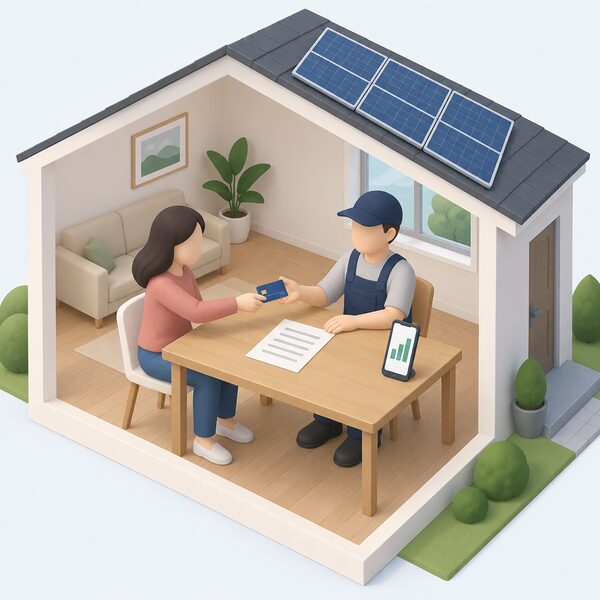
Deposit timing and size vary by contract, and no single industry standard applies. Good Energy states that a 25% deposit is required before installation5. A generation connection process sets a different pattern: if the quote is accepted within 90 days, a deposit must be paid within 90 days for the application to continue, with the final balance required before construction commences6. That is a connection process rather than a domestic solar contract, but it shows a deposit tied to acceptance and a balance tied to commencement.
On the final payment, independent guidance suggests agreeing in writing that the final instalment, for example 10%, will only be made after 48 hours of continuous operation, visible via an app2. That is a condition a household can ask for, and it shifts the last payment to after the system has demonstrated it works.
| Payment stage | Typical condition |
|---|---|
| Deposit | Paid after accepting the quote, within 90 days in the connection example5 |
| Final balance | Required before construction commences in the connection example5 |
| Retention | Final instalment (e.g. 10%) only after 48 hours of continuous operation2 |
The reason deposit size matters is that it sets the exposure. A deposit paid by credit card within the Section 75 band is protected; a deposit paid by bank transfer is not, whatever its size. A household asked for a large deposit should weigh the amount against the protection attached to the payment method.
There is a separate deposit protection regime for consumer codes. HIES, for example, covers Solar PV, Electrical Energy Storage Systems, EV Charge Points and Heat Pumps under its products covered list6. Membership of a consumer code with deposit protection is a different layer from card protection, and the two can sit alongside each other.
Paying by other means: bank transfer, finance and what they lack
Bank transfer is the payment method most commonly requested for large home improvement sums, and it is the one that removes card protection entirely. Citizens Advice advises paying by debit or credit card if possible, bank transfer if not, and not paying in cash1. The order of preference is explicit.
Finance is a separate route. The Energy Saving Trust notes that some installers let households spread the cost of solar panels, with or without battery storage, over a number of years with low or zero interest, and that finance may also be available from local authorities, banks or other financial organisations7. A finance agreement is a credit agreement, but it is not the same as paying the installer by credit card, and the Section 75 analysis turns on the card transaction.
The Green Deal, now closed, used a different mechanism again: repayment through a charge added to the electricity bill8. That model tied the loan to the electricity account rather than to a card, and it is no longer available.
Other payment contexts show the same principle. Energy bills paid by cash can attract a charge from a bank or building society9. Prepayment meters work on a pay-as-you-go basis topped up with a key or token10. In each case the payment method carries its own terms, and for a solar deposit the terms that matter are the ones that create or remove a recovery right.
What to check about an installer before you hand over any money
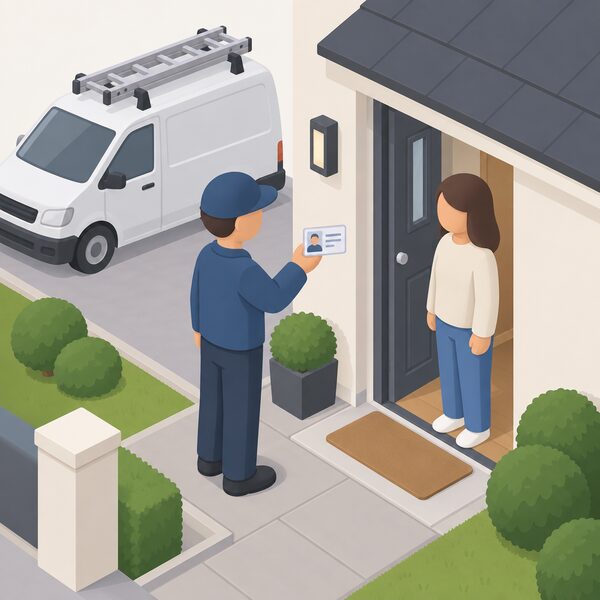
Certification is the first check. The Energy Saving Trust advises getting the system checked by a certified installer11, and East Hertfordshire Council states that it would recommend always using a qualified installer12. Registration with a competent person scheme or a consumer code is the evidence that an installer has been assessed.
A quote should carry substance. Independent guidance states that the installer should provide a quote which includes an estimate of the annual generation and the assumptions behind that estimate, including how much will be used in the house and how much exported2. A quote without a generation estimate and its assumptions is thin on the detail a household needs.
On site, identification and competence checks apply. Smart meter guidance notes that installers should show a photo ID card before they start13. A Welsh scheme specification requires that all site operatives carry valid CSCS cards and that scaffolding is only installed by a suitably qualified subcontractor14. Metering guidance requires a handover pack containing a process to check the meter is operating correctly, maintenance or calibration requirements and reading instructions15.
Group-buying schemes add their own step. Under Solar Together, once an offer is accepted a surveyor visits the property to assess whether the roof is suitable, and to confirm the number of panels, their location and details such as cabling locations and colour16. That survey sits between acceptance and installation, and it is the point at which the specification is fixed.
For a household, the sequence is: check registration, read the quote for a generation estimate and assumptions, confirm who will be on site and what identification they carry, and only then decide how to pay. The payment method is the last decision, and it is the one that determines what happens if the work goes wrong.
Sources16 cited
- Before you get building work done, Citizens Advice, 2026-09-20
- How to choose a good solar installer, Low Carbon Hub, 2025-10-20
- Buying a house with solar panels, Energy Saving Trust, 2026-08-13
- Consumer Credit Act 2006, Part 6, Chapter 4, legislation.gov.uk, 2026-09-17
- Generation connections FAQs, NIE Networks, 2026-09-19
- Insurance backed guarantees, Flexi-Orb, 2026-02-25
- Solar panel installation, Energy Saving Trust, 2026-09-07
- Green Deal energy saving measures, GOV.UK, 2026-09-17
- Paying for energy by cash, Uswitch, 2025-09-05
- Moving house gas and electricity guide, Uswitch, 2026-08-26
- Moving house energy checklist, Energy Saving Trust, 2026-05-01
- Solar panels, East Hertfordshire Council, 2026-09-17
- Getting a smart meter installed, Smart Energy GB, 2026-03-16
- Barcud Solar Panel Installation Scheme Specification, Sell2Wales, 2026-06-15
- Domestic RHI guide to metering, Ofgem, 2026
- Solar Together domestic planning guidance, Southampton City Council, 2026-09-17
 Deposits and Staged PaymentsHow much deposit should you pay for solar panels or a heat pump, and what happens to your money if the installer goes bust?
 Adding Battery StorageCan you add a battery to solar panels you already have, or does the whole system need replacing?
 Section 75 and ChargebackIf an installer takes your deposit and then goes bust, can you get your money back from the card company?
 Solar Mounting SystemsWill your roof take the extra weight of solar panels, and will it still keep the rain out afterwards?
 Cooling with Solar PanelsCan solar panels run an air conditioner, and will they cover the whole bill?
 Surge and Lightning ProtectionWill a surge protector stop a lightning strike from wrecking my wiring and appliances?