

In this comparison
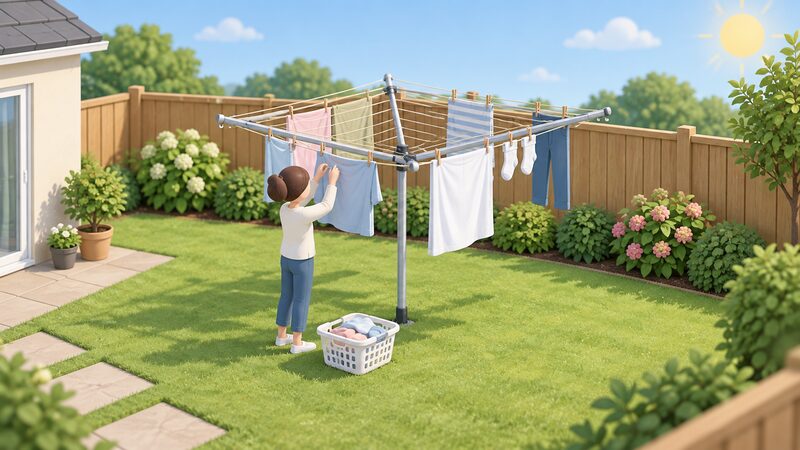
Drying clothes outside or on an indoor rack instead of using a tumble dryer saves £50 a year in Great Britain and £60 a year in Northern Ireland, according to the Energy Saving Trust1. That figure assumes the usual laundry is dried outside for just three months of the year, so it is a conservative estimate rather than a best case1. The same organisation repeats the £50 and £60 figures in its general quick-tips guidance and in its advice for renters2.
The saving is small in cash terms because it is measured against a modest amount of tumble drying. The cost of the machine itself is where the money goes. An average tumble dryer uses about 3 kWh per cycle, which at the July 2026 price cap unit rate works out at 78p every time it runs4. National Energy Action puts a vented or condenser cycle higher, at £1.21 to £1.565. Run three loads a week and the annual bill reaches the £125 to £147 range that independent testing has recorded for condenser and vented machines6.
What air drying offers a UK household
The case for air drying rests on a simple substitution: the laundry still gets dry, but the heat comes from the sun, the wind or the ambient air in the house rather than from a resistive element drawing 1.8 to 5 kWh an hour8. The Energy Saving Trust's £50 and £60 figures are the most widely quoted version of that saving, and they appear in guidance aimed at owner-occupiers, renters and anyone working through a list of low-cost measures1.
Other bodies put the number slightly higher. SP Energy Networks, the distribution network operator, gives around £55 from line drying instead of tumble drying when the weather allows11. Its separate home-energy page gives £30 from line drying instead of using a tumble dryer, a lower figure that reflects a different assumed pattern of use12. Scope, the disability equality charity, gives £60 a year from drying clothes on racks or outside where possible13. The Consumer Council for Northern Ireland gives around £60 from avoiding the tumble dryer in warmer weather14.
The spread from £30 to £60 is not a disagreement about physics. It reflects how many loads a household is assumed to move outdoors, and for how much of the year. The Energy Saving Trust is explicit that its £50 and £60 figures assume outdoor drying for three months only1. A household that line-dries for six months, or that has the outdoor space and the weather to do so, sits above that range; one that air-dries a handful of loads a month sits below it.
What air drying offers for energy independence is real but partial. It removes a load from the electricity supply entirely, and it does so without any purchase, installation or subscription. It does not remove the household from the grid, and it does not work in every home: flats without balconies, terraces with small yards and households in damp or cold weather have less scope than the guidance assumes. Indoor drying also puts moisture into the air, which has to be managed through ventilation.
What the specifications show
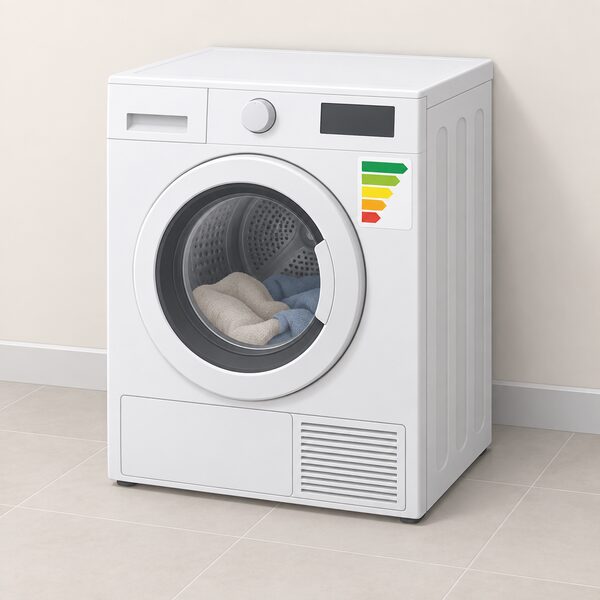
Tumble dryers are labelled on a different scale from most white goods. In Great Britain they use A+++ down to D, not the A to G scale that applies to ovens, fridges and washing machines9. The 2021 rescale to A to G applied only to certain appliances and did not include tumble dryers, which kept the older A+++ to D grades10. In Northern Ireland, new labels use a rescaled A to G rating that removes the old A+++, A++ and A+ grades10.
That difference matters when comparing a machine bought in one part of the UK with one bought in another. A dryer sold in Northern Ireland with an A rating is not directly comparable with a dryer sold in Great Britain with an A+++ rating, because the scales are different constructions10. The higher standards in Northern Ireland also mean some older tumble dryers can no longer be sold there because they are considered too energy inefficient10.
Which? has tested 135 tumble dryers and awarded 34 Best Buys and 3 Don't Buys, with the highest score recorded at 82%15. That testing programme is the main independent source of performance data on individual models sold in the UK.
| Specification | Figure | Applies to |
|---|---|---|
| Energy label scale | A+++ to D | Great Britain10 |
| Energy label scale | A to G, old A+++/A++/A+ removed | Northern Ireland10 |
| Energy use per hour | 1.8 to 5 kWh | Tumble dryers generally8 |
| Energy use per cycle | about 3 kWh | Average tumble dryer4 |
| Maximum Energy Efficiency Index | 85 | New ecodesign rules, Great Britain17 |
| Minimum condensation efficiency | 80% | New ecodesign rules, Great Britain17 |
The recommended cycle setting is auto-dry rather than a timed cycle, which lets the machine stop when the load reaches the chosen dryness rather than running for a fixed period18. Running the dryer on a lower heat setting is also reported to save energy compared with a high-heat setting5.
What the warranty covers
Guarantee terms are set by the maker, not by regulation, and they vary widely across the brands sold in the UK. Hoover tumble dryers carry a one-year guarantee as standard, and the appliance must be registered with Hoover15. Samsung tumble dryers carry a two-year guarantee as standard, with some products eligible for guarantees up to five years; all products must be registered on purchase to qualify19. AEG tumble dryers carry a two-year guarantee as standard, with selected models on a five-year guarantee20. All IKEA tumble dryers come with a five-year guarantee as standard16.
The pattern is that the standard term is short, one to two years for most brands, and the longer terms are either model-specific or conditional on registration. A five-year guarantee on a machine expected to run for a decade or more leaves the household carrying the repair risk for most of the appliance's life. That is a dependence on the manufacturer's service network and on the availability of spare parts, and it is worth reading alongside the running-cost figures, because a cheap machine with a high running cost can cost more over its life than a dearer one with a lower one7.
What it costs to run
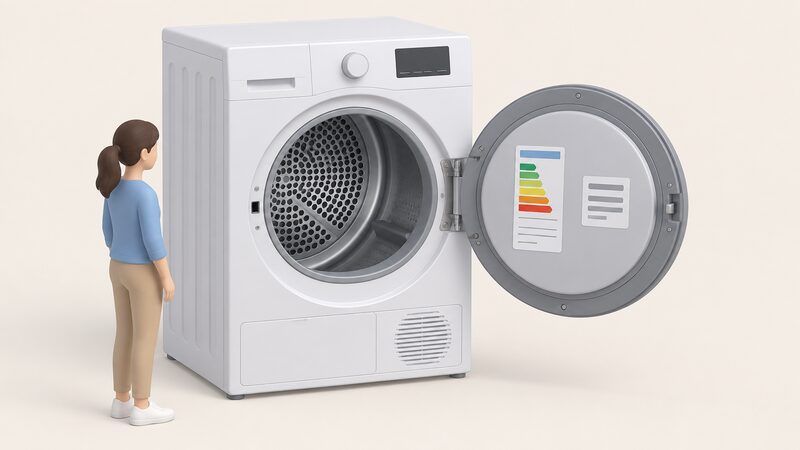
The running cost of a tumble dryer depends on three things: the energy the machine uses per cycle, the number of cycles, and the unit price of electricity. On energy use, the range across the sources is wide. Smart Energy GB gives 1.8 to 5 kWh an hour on average, based on a power rating multiplied by one hour of use at the £0.2635 per kWh energy price cap8. Uswitch gives an average of 3 kWh, which at the July 2026 price cap works out at 78p per cycle4. National Energy Action puts a vented or condenser cycle at £1.21 to £1.565.
Annual figures follow from those per-cycle numbers. Condenser tumble dryers are reported to cost over £125 a year on average, and American-style fridge freezers sit in the same bracket6. A condenser model is reported at about £138 a year based on three full loads a week on cotton and cupboard dry settings at the July energy price cap of 26.11p per kWh7. An earlier independent press release gives £147 a year for vented dryers and £140 for condenser machines21. The Energy Saving Trust frames the same spending as waste: relying exclusively on a tumble dryer for all clothes drying wastes £50 a year in Great Britain and £60 in Northern Ireland22.
The comparison that changes the arithmetic is between dryer types rather than between drying and not drying. A heat pump tumble dryer rated A+++ is reported to add around £54 a year to energy bills, against about £138 for a condenser model7. The Energy Saving Trust puts the lifetime saving of an A+++ machine over a B-rated one at around £700 in Great Britain and £850 in Northern Ireland over a 13-year life9. A separate Energy Saving Trust figure gives £700 over an 11-year lifetime for the same comparison, so the two documents differ on the assumed life even where they agree on the direction5.
| Method | Annual cost or saving | Basis |
|---|---|---|
| Air drying instead of tumble drying | £50 saving in GB, £60 in NI | Three months outdoor drying1 |
| Line drying instead of tumble drying | around £55 saving | When weather permits11 |
| Line drying instead of tumble drying | £30 saving | Separate network operator guidance12 |
| Drying on racks or outside | £60 saving | Charity guidance13 |
| Condenser tumble dryer | over £125 a year | Average running cost6 |
| Condenser tumble dryer | about £138 a year | Three loads a week, July 2026 price cap7 |
| Vented tumble dryer | £147 a year | Independent press release, 202321 |
| Heat pump tumble dryer | around £54 a year | Three loads a week, July 2026 price cap7 |
Prices for the machines themselves are installer- or retailer-quoted and vary by model, capacity and retailer, so no single figure covers the market. The payback question is therefore about running cost, not purchase price: the gap between a heat pump machine and a condenser machine is roughly £84 a year on the figures above, and the gap between drying outside and using a condenser machine is roughly £138 a year7.
The rules are changing
The government consulted on raising product standards for household tumble dryers, opening the consultation at midday on 17 July 2025 and closing it at 11:59pm on 14 August 202523. The response, published on 19 March 2026, set out final policy decisions to proceed with new Ecodesign and Energy Labelling regulations for household tumble dryers in Great Britain23.
The new rules set a maximum Energy Efficiency Index of 85 and a minimum 80% condensation efficiency rate17. Vented tumble dryers are reported to use far too much energy to be remotely close to meeting the new requirements, so a ban on the sale of inefficient condenser and vented tumble dryers in the UK is expected as soon as time allows17. New models will also have to carry an eco-programme, effective moisture collection and little to no power use in standby mode7. The consultation also covers reforming the energy efficiency and condensation efficiency scales and introducing a new acoustic airborne noise emission and repairability index scale23.
Two limits on the scope are worth noting. The new minimum energy performance standards apply only to standalone tumble dryers, not to washer-dryers17. And the rules are being made for Great Britain; Northern Ireland already operates a rescaled A to G label and has already removed some inefficient models from sale10.
What it means for energy independence
A tumble dryer is one of the household appliances with the smallest potential for demand flexibility, grouped by the Citizens Advice policy briefing with refrigerators, freezers, extraction fans and heat recovery ventilation as appliances with larger comfort impacts if their use is shifted24. That matters for independence because it means the load cannot easily be moved to a cheaper or greener time of day. A household that wants to run a dryer on its own solar generation has to run it when the sun is out, which is not when most laundry gets done.
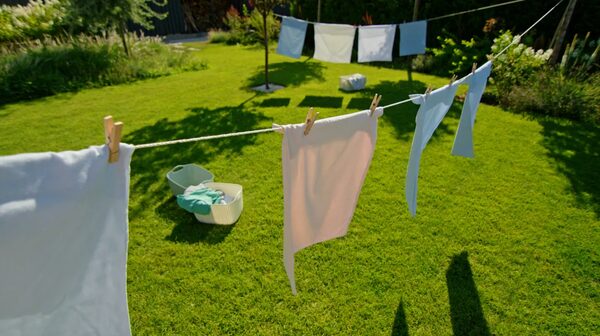
Air drying is the opposite: it uses no metered energy at all, needs no supplier, no app and no cloud connection, and cannot be interrupted by a power cut. That is the strongest form of independence available for this particular task, and it is why the £50 to £60 saving understates the case for households that can do it. The limit is practical rather than financial. Outdoor drying depends on weather and outdoor space; indoor drying depends on ventilation, and official guidance on traditional buildings notes that while draught-stripping is valuable for energy efficiency it reduces the free air within the building, and the practitioner has to demonstrate how the proposals manage this25. Airtightness and indoor drying pull against each other.
Where a dryer is used, the remaining dependence is on the electricity supply, on the unit price at the time of use, and on the manufacturer for parts and service once the guarantee has expired. Room-sealed appliances or those with a directly connected ducted external air supply minimise ventilation energy losses from the room and the risk of cold draughts, which is the installation detail that keeps a vented dryer from undoing other fabric work26. For a household working through a plan, the sequence that matters is set out in the full guide to getting started, and the appliance-level savings sit alongside the measures covered in no-cost and low-cost ways to cut energy use and how much can changing habits save on energy bills.
Sources26 cited
- Top five tips to save energy in the kitchen, Energy Saving Trust, 2026-05-20
- Quick tips to save energy, Energy Saving Trust, 2026-08-21
- How to save energy and money if you rent your home, Energy Saving Trust, 2025-11-14
- Heated clothes airers: energy efficiency, Uswitch, 2026-07
- Avoid using the dryer, Smart Energy GB, 2026-04-22
- Five top tips from Which? to cut your energy bills, Welsh Government Climate Action, 2026-03-18
- Why no one should mourn the condenser dryer, Which?, 2026-06-10
- What appliances use more electricity, Smart Energy GB, 2026-03-16
- Home appliances, Energy Saving Trust, 2026-05-20
- New energy efficiency labels for tumble dryers in Northern Ireland, Energy Saving Trust, 2026-05-20
- Energy tips to help you save, Electricity North West, 2026-09-19
- You and your home, Electricity North West, 2026-09-19
- Energy saving tips, Scope, 2026-09-01
- Save energy and money, Consumer Council for Northern Ireland, 2026-09-20
- Hoover NDEH9A3TCBER80 tumble dryer review, Which?, 2026-09-17
- IKEA Uddarp tumble dryer review, Which?, 2026-09-19
- The tumble dryer ban: what does it mean for you, Which?, 2026-07-09
- Energy efficient laundry, Uswitch, 2026-01-06
- Samsung DV90CGC0A0AE tumble dryer review, Which?, 2026-09-17
- AEG TXH508A4R tumble dryer review, Which?, 2024-11
- Which? warns against buying cheap appliances that rack up huge energy bills, Which?, 2023-11-09
- Energy mistakes to avoid, Energy Saving Trust, 2025-10-15
- Raising product standards for household tumble dryers, GOV.UK, 2026-03-19
- Policy briefing: smart appliances, Citizens Advice, 2015-07-13
- Guide to the conversion of traditional buildings, Scottish Government, 2026-08-10
- Building regulations guidance Part J: heat producing appliances, Welsh Government, 2026-09-17
 Changing Habits SavingsWhat the evidence says behavioural change saves: around £90 to £120 a year for one degree off the thermostat, £100 to £110 a year for using a full set of heating controls, and £304 to £351 a year for a bundle of small changes.
 Do Smart Controls Save Money?Do smart heating controls really cut your bills, and by how much?
 Insulation Savings and PaybackHow much can you really save by adding insulation, and does it depend on your home, your heating and how you use it?
 The Full Home Batteries GuideA home battery stores cheap or solar power for later, but will it really cut your bills enough to be worth it?
 Domestic Wind Turbine CostA home wind turbine usually costs between nine thousand and nineteen thousand pounds, but the real price depends on its size and how it is mounted.
 Solar DivertersYour panels often make more electricity than your home needs.