In this guide
Knauf Insulation is one of the three mineral wool manufacturers named as members of the Mineral Wool Insulation Manufacturers Association, alongside ROCKWOOL and Superglass1. It makes glass mineral wool, the material sold in rolls for lofts, batts and slabs for walls, and loose granulate for blown cavity fill. For a household, the practical question is not the brand name but what the material does: mineral wool is non-combustible, A1 or A2 Euroclass fire rated, and carries zero ozone depletion and global warming potential2.
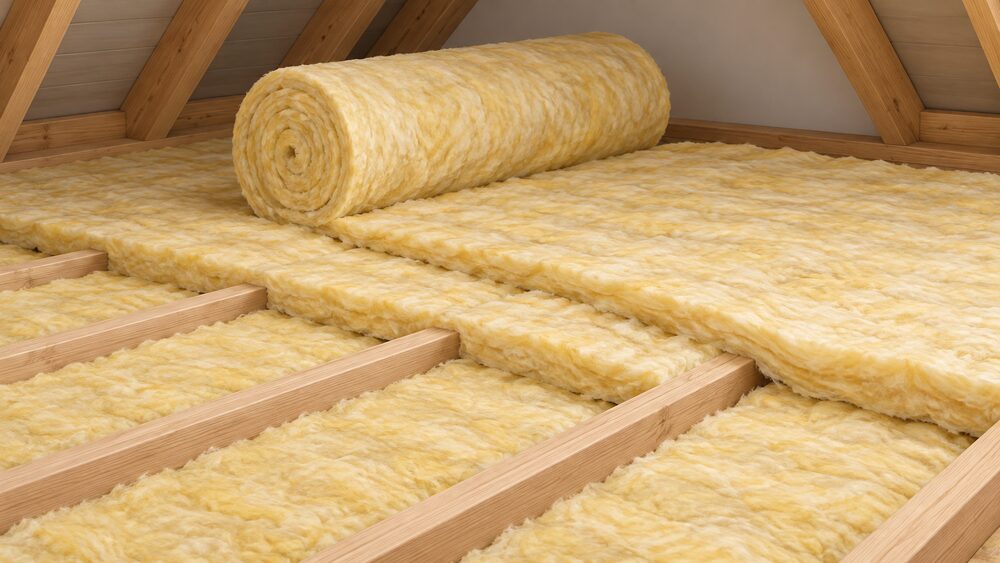
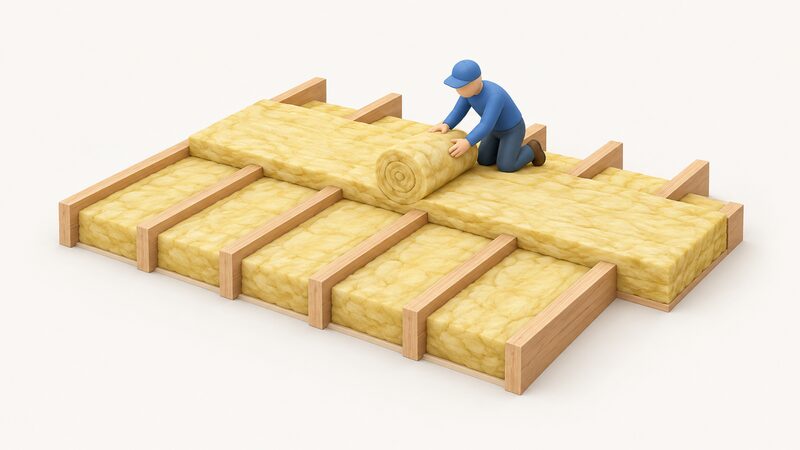
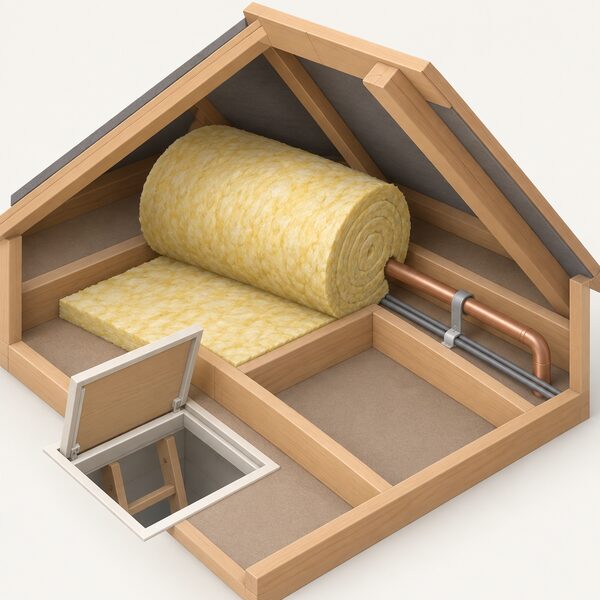
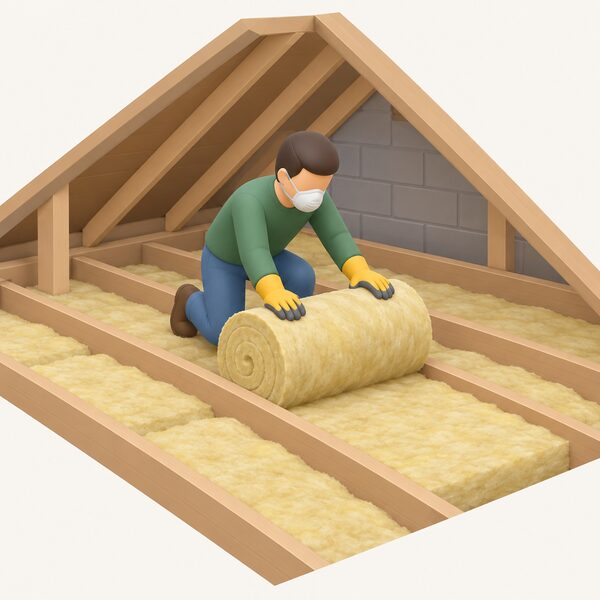
The loft roll is the product most homes meet. Independent guidance describes standard loft insulation as rolls laid in between and over the floor joists, and gives a working example: a 100mm roll between the joists, then a 170mm or 200mm roll laid across the top at right angles to the joists3. The recommended target when topping up is at least 270mm, up from 120mm4.
What glass mineral wool buys a household is a fabric that does not depend on injected gas, does not transmit liquid water to the inner leaf when correctly installed, and does not need replacing on a fuel cycle. What it does not buy is independence from the grid: insulation reduces the heat a home loses, but the heat still comes from a boiler, a heat pump or a network, and the savings only appear if the rest of the building is sound.
Knauf Insulation: who the company is
Knauf Insulation appears in industry guidance as one of the three named members of the Mineral Wool Insulation Manufacturers Association, the trade body that publishes the technical and safety material on mineral wool in the UK1. The other two are ROCKWOOL and Superglass. That membership matters more than it sounds: it means the material Knauf sells is covered by the same published position on fire classification, fibre safety and environmental rating as its competitors, and the trade body's statements can be read across the sector.
The wider mineral wool industry describes itself in broad terms. ROCKWOOL, the stone wool maker, describes itself as the world's leading manufacturer of stone wool insulation9, and its Sound Insulation Slab is recorded as manufactured in the United Kingdom10. Glass mineral wool and stone wool are different products from different raw materials, but they sit in the same category and are governed by the same guidance.
For a householder, the company identity matters in three places. First, the datasheet: the declared thermal conductivity and fire classification for a specific roll come from the manufacturer, not from a merchant's shelf label. Second, the guarantee: insulation guarantees are usually issued by the installer rather than the maker, and the scheme rules in Northern Ireland require a minimum 25-year guarantee for cavity or solid wall work where grant aid is awarded8. Third, the contact route if something goes wrong, which for scheme work in Northern Ireland runs through the scheme manager rather than the manufacturer11.
Glass mineral wool: what the material is and how it works
Mineral wool is made in several forms. Industry guidance lists loose granular material used for blown insulation of cavity walls, slabs for walls, rolls for loft insulation, and pre-formed and faced pipe sections, ceiling tiles and acoustic panels6. The same material therefore covers a cavity fill, a loft floor, a flat roof deck and a pipe run, which is why it appears in so many parts of a building.
Its properties are consistent across those applications. Mineral wool uses recycled material and has zero ozone depletion potential and zero global warming potential, with a BRE Green Guide rating of A+ to B12. It does not rely on injected gas that can leak and cause thermal performance to deteriorate over time6, which is the main structural difference between it and the gas-blown foam boards it competes with. It absorbs sound well, which is why it appears in separating walls and acoustic applications as well as thermal ones13.
"It does not rely on injected gas that can leak and result in a deterioration in thermal performance."
The material's fire behaviour is the other defining characteristic. Mineral wool is non-combustible and A1 or A2 Euroclass fire rated, which helps compliance with Part B of the Building Regulations2. That is why industry guidance states that mineral wool insulation can be used in the external walls of all buildings across the UK nations1. For a household in a flat or a terraced house, that non-combustibility is the reason the material appears in party wall and separating wall constructions, where it absorbs sound and provides thermal separation between adjoining properties2.
Loft rolls and related products in the range
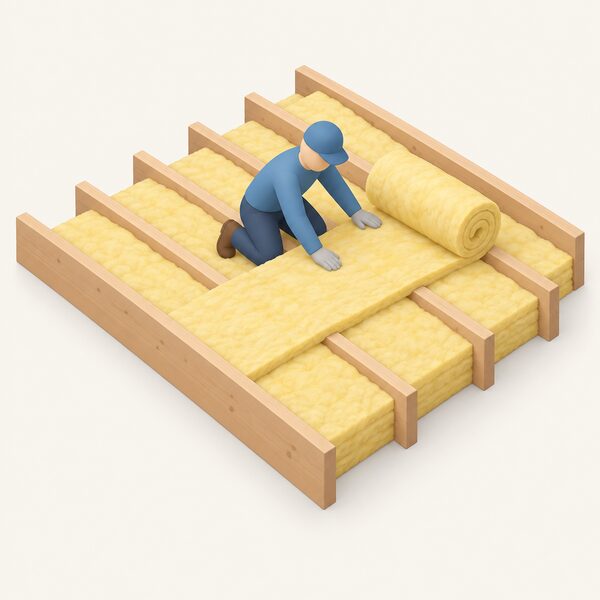
The loft roll is the entry point for most households, but the mineral wool family extends well beyond it. Industry guidance describes the material as available in roll or batt form to suit specific requirements12, and as easy to fit with a simple installation process13. The same source notes that mineral wool covers large areas quickly, which is the practical advantage of a roll over a board in an open loft14.
Beyond lofts, the material appears in cavity walls, solid walls, flat roofs, separating walls and ceilings. In flat roof construction, mineral wool improves the acoustic performance of timber or metal decks as well as insulating them14. In steel frame separating walls it absorbs sound and improves acoustic performance while providing thermal separation between adjoining properties2. In ceilings, makers sell acoustic suspended ceiling systems, ceiling insulation slabs and rolls, and soffit solutions15.
| Application | Form | Key property |
|---|---|---|
| Loft floor | Roll | Laid between and over joists3 |
| Cavity wall | Loose granulate, blown | Liquid water not transmitted to inner leaf12 |
| Solid wall | Slab or batt | Non-combustible, A1/A22 |
| Flat roof | Slab | Acoustic improvement to decks14 |
| Separating wall | Batt | Sound absorption, thermal separation2 |
| Ceiling | Roll or slab | Acoustic and thermal15 |
The breadth matters because it means a single material can be specified across a whole house, which simplifies detailing at junctions where different materials meet. It also means the same handling and safety guidance applies throughout. For a fuller comparison of how mineral wool sits against foam boards and natural fibres, see insulation materials compared.
Thermal performance: what the R-values and thicknesses deliver
Thermal performance in mineral wool is expressed as thermal conductivity, the lambda value, in watts per metre kelvin. A lower figure is better. ROCKWOOL's Sound Insulation Slab is listed at a maximum thermal conductivity of 0.038 W/m·K10, and wool insulation generally is given as 0.038 to 0.054 W/m·K16. That range is the honest picture: mineral wool products vary by density and application, and the figure for a specific roll is the one on its datasheet.
The regulatory backdrop sets a benchmark rather than a product figure. Approved Document L Volume 1 states that pipework insulation thicknesses apply for insulation with a thermal conductivity of 0.035 W/m·K or better, and that other circumstances require reference to BS 542217. Welsh guidance on other insulation requires insulating pipes, ducts and vessels to standards that are not worse than those set out in the Domestic Heating Compliance Guide18. Neither sets a lambda value for loft rolls, because the requirement is expressed as a U-value for the finished element, not as a material property.
What that means in practice is that the thickness of the roll and the conductivity of the material combine to produce the U-value of the loft floor, and the U-value is what the Building Regulations assess. A roll with a better lambda can be thinner for the same performance; a roll with a poorer lambda needs more depth. For the relationship between the two, see U-values and R-values explained.
Where glass mineral wool fits, and where it does not
Glass mineral wool fits most of the places a household needs insulation. It is non-combustible and A1 or A2 rated, so it can be used in the external walls of all buildings across the UK nations1. It does not transmit liquid water to the inner leaf when the appropriate glass wool product is used with correct installation12. It is not classified as a carcinogen in the EU, and the requirement about fibre diameter and length is generally not relevant to mineral wool because the manufactured fibre diameter and fibre length are greater than 3 microns and 200 microns respectively19.
"Mineral wool meets or exceeds these requirements so is not classified as a carcinogen in EU"
Where it does not fit is where space is tight or where a thinner build-up is needed. Independent guidance on blanket and roll insulation lists the disadvantages plainly: rolls can be too bulky to fit in small spaces or around obstructions, some materials irritate the skin so proper protection must be worn, and sustainable options are often more expensive3. The same guidance notes that for lofts with difficult access, those with small hatches and very little space, standard loft insulation rolls may not be suitable and blown-in insulation fitted by a professional is the alternative20.
Cost comparisons put mineral wool at the cheaper end. Cork insulation is described as not widely produced in the UK, which makes it more expensive, up to ten times the price of equivalent mineral wool products16. Independent guidance on spray foam notes that mineral wool insulation may be cheaper and better at insulating21. For a direct comparison of the two loft options, see spray foam vs mineral wool loft insulation.
Installation basics for loft rolls
The standard method is straightforward. Independent guidance describes rolls of insulation laid in between and over the floor joists20, and gives a worked example: a 100mm thick roll in between the joists, then a 170mm or 200mm roll across the top at right angles to the joists3. The cross-layering matters because it covers the joist timbers themselves, which would otherwise act as a thermal bridge through the insulation.
Cold loft insulation places the material over and between the wooden joists, above the ceiling of the top floor22. Warm loft insulation is different: it is installed directly under the roof slope, between and across the timber rafters3. The two approaches insulate different boundaries, and the choice depends on whether the loft space is to be kept warm or cold. Warm loft work is described as not as easy as laying rolls of insulation, with a recommendation to hire a professional installer, though it can still be done as a DIY job with the right skills22.
For a household planning the work, the sequence is: establish the current depth, decide the target, check whether the joists can carry the load and whether the loft is to be cold or warm, and confirm the Building Regulations position before starting. More detail on thickness targets is at how thick should loft insulation be, and on adding to what is already there at can you top up existing loft insulation.
Fire, safety and environmental credentials
The fire position is the strongest part of the case for mineral wool. It is non-combustible and A1 or A2 Euroclass fire rated, which helps compliance with Part B2. External wall insulation systems are described as fully conforming to all UK fire regulations7. That combination is why the material is permitted in external walls across all four UK nations1.
The safety position on fibres is set out by the trade body. Mineral wool is not classified as a carcinogen in the EU, and the requirement regarding fibre diameter and length is generally not relevant to mineral wool because the manufactured fibre diameter and fibre length are greater than 3 microns and 200 microns respectively19. Handling irritation is a separate matter from classification, and independent guidance notes that some materials irritate the skin so proper protection must be worn3.
On environmental performance, mineral wool uses recycled material and has zero ozone depletion potential and zero global warming potential, with a BRE Green Guide rating of A+ to B12. It does not rely on injected gas that can leak and cause thermal performance to deteriorate6. For the wider picture on fire and handling, see insulation safety: fire, cladding and handling.
Cost and what owning it means for household energy independence
There is no published list price for a Knauf loft roll in the material available here, and prices for insulation are quoted by merchants and installers rather than set by the maker. What can be said is comparative: cork insulation is up to ten times the price of equivalent mineral wool products16, and mineral wool may be cheaper and better at insulating than spray foam21. Beyond that, the cost of a loft job depends on the area, the depth, the access and whether the work is done by the householder or an installer.
The savings figures that exist are for floor insulation rather than lofts, and they differ by nation. For detached homes, independent guidance gives annual savings of £85 in Great Britain and £120 in Northern Ireland4. That is a reminder that the four nations do not always share the same numbers, and that savings depend on the starting point and the fuel being displaced.
On independence, the position is clear. Insulation reduces the rate at which a home loses heat, which reduces the amount of fuel that must be bought and burned to hold a given temperature. It does not remove the need for a heat source, a fuel supply or a grid connection. A well-insulated loft makes a heat pump more viable and a boiler less heavily worked, but the household remains connected to whatever supplies the heat. The material's contribution is to lower the demand side of the equation permanently, without a fuel cycle, a gas fill or a moving part. For how that fits into a wider strategy, see insulation, glazing and energy independence and what insulation a heat pump needs.
Sources25 cited
- Mineral wool FAQs, Mineral Wool Insulation Manufacturers Association, 2026-09-20
- Separating wall insulation, Mineral Wool Insulation Manufacturers Association, 2026-09-20
- Installing blanket insulation, Which?, 2026-05-26
- Tips to improve the EPC rating of your home, Energy Saving Trust, 2026-08-03
- Current Decent Homes Standard summary table, Department for Communities, 2025-08-05
- About mineral wool, Mineral Wool Insulation Manufacturers Association, 2026-09-20
- INCA: 18 benefits of EWI, SWIGA, 2026-09-20
- Affordable Warmth Scheme, Northern Ireland Housing Executive, 2026-09-17
- ROCKWOOL brand page, Quiet Mark, 2026-09-17
- ROCKWOOL Sound Insulation Slab, Quiet Mark, 2026-09-17
- NISEP List of Schemes 2026-27, Utility Regulator Northern Ireland, 2026-04
- Masonry cavity wall insulation, Mineral Wool Insulation Manufacturers Association, 2026-09-20
- Masonry solid wall insulation, Mineral Wool Insulation Manufacturers Association, 2026-09-20
- Flat roof insulation, Mineral Wool Insulation Manufacturers Association, 2026-09-20
- Ceiling insulation, ROCKWOOL, 2026-09-20
- Cellulose vs hemp vs cork insulation, Uswitch, 2025-11-21
- Building Regulations Approved Document L Volume 1 2026, Welsh Government, 2026-04
- Building Regulations insulation: other insulation, Welsh Government, 2026-09-17
- Mineral wool health and safety, Mineral Wool Insulation Manufacturers Association, 2026-09-20
- Loft insulation advice, Centre for Sustainable Energy, 2025-10
- Make sure your home is energy efficient, Citizens Advice, 2026-09-19
- Roof insulation, Which?, 2026-05-05
- Building Regulations energy efficiency requirements for extensions, Planning Portal, 2026
- Building Regulations work to an existing roof, Planning Portal, 2026-09-17
- Fire safety roof insulation: fire testing summary and recommendations, UK Government, 2025-12-22