
In this comparison
For most lofts, mineral wool laid between and over the ceiling joists is the cheaper, easier and better-understood choice. Citizens Advice puts it directly: mineral wool "may be cheaper and better at insulating" than spray foam1. The Energy Saving Trust goes further, describing standard mineral wool loft insulation as "the cheapest, easiest and most efficient option for most people"2.
Spray foam is a different product doing a different job. It is sprayed onto the inside of roofs, walls and floors, and in lofts it is most often applied to the underside of a sloping roof rather than laid across the loft floor1. That places it in the roof structure itself, where moisture, ventilation and future access all become harder to manage. The Centre for Sustainable Energy reviewed its own guidance in November 2025 and concluded that in almost all cases spray foam carries considerable risks and that other forms of insulation should be considered first3.
The practical comparison comes down to three things: how much thickness each material needs to hit a target, what each costs to install and later remove, and what each does to the roof above your head. On the last point the official research is unambiguous. Spray foam applied directly onto the roof covering produced high moisture and timber degradation risk under all modelled scenarios, and the highest risk assessed was exactly that configuration4.
Spray foam or mineral wool: the short answer
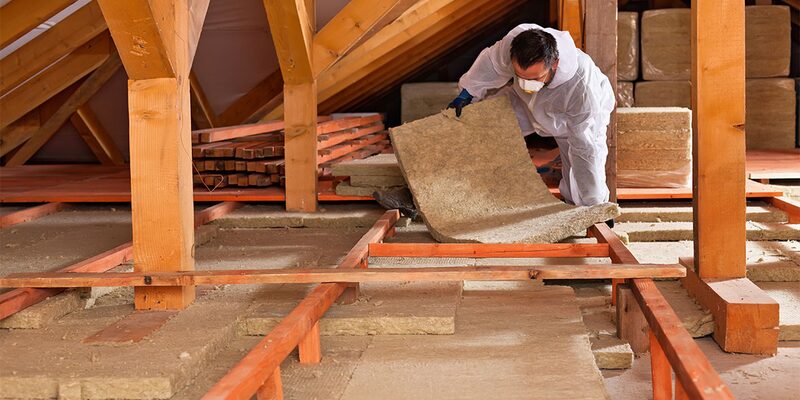
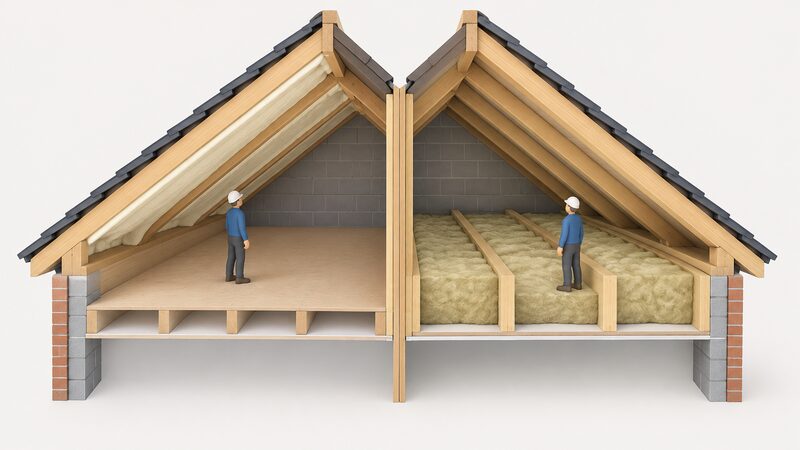
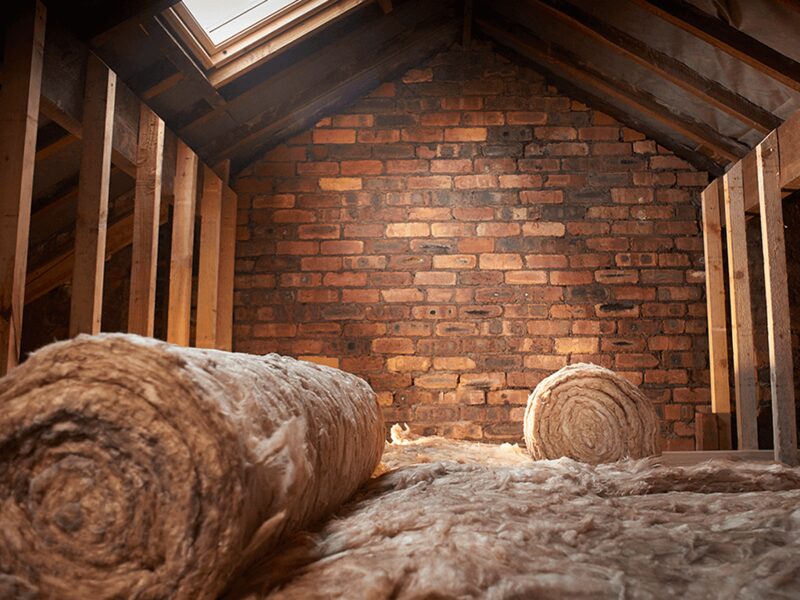
Mineral wool is a fibrous blanket supplied in rolls, batts and slabs. It is laid between the ceiling joists and then across the top of them, so the timber is covered and the insulation is continuous. It is described as easy to fit, covering large areas quickly, and it is the cheapest of the common materials, with boards and foams costing more5. For an accessible loft with regular joists, the method is a layer between the beams and a second layer over them12.
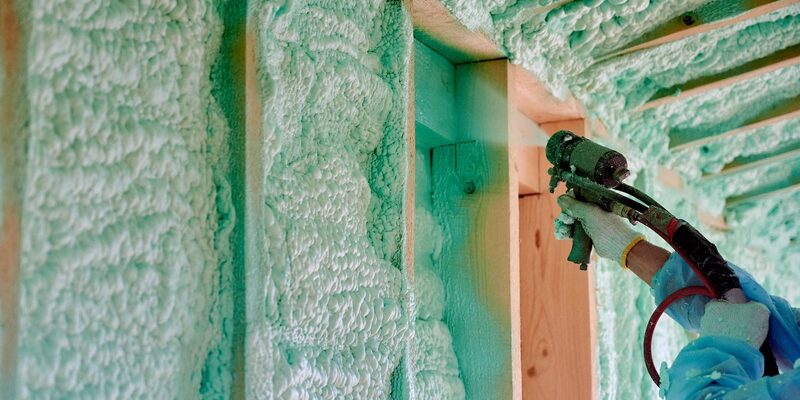
Spray foam is applied wet and sets in place. It can be sprayed on the inside of roofs, in walls and floors, and it is also used under suspended floors1. In a pitched roof with an uninsulated loft, foam is sometimes sprayed onto the underside of the sloping roof as an alternative to mineral wool at joist level2. That is the configuration that generates most of the difficulty discussed below.
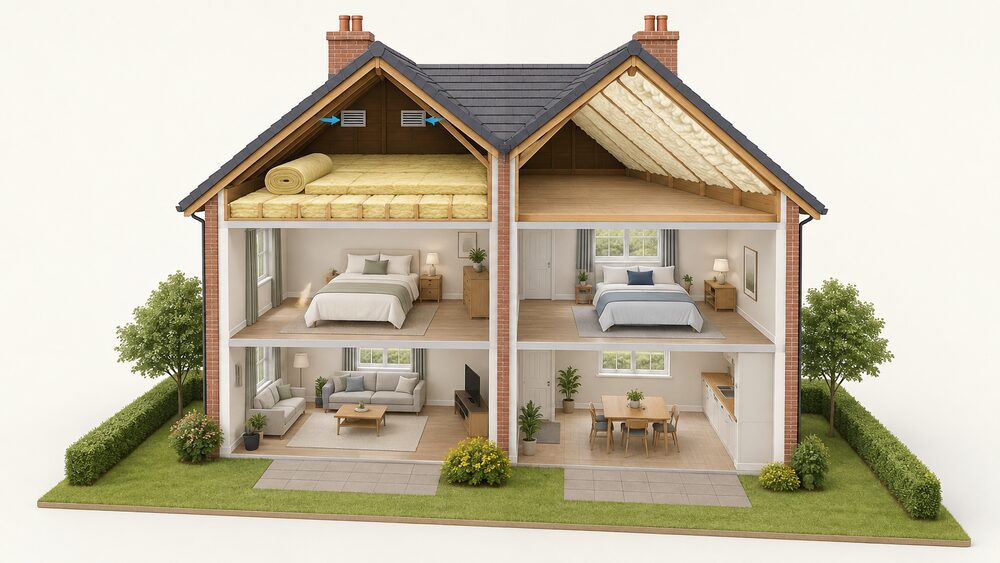
The two are not interchangeable in the same position. Mineral wool at joist level insulates the ceiling plane and leaves the roof void cold and ventilated. Spray foam on the underside of the roof insulates the roof plane and brings the roof timbers inside the insulated envelope. Each approach has consequences for ventilation, for access to the roof structure, and for what a surveyor sees when the property is sold.
Thermal performance: how much thickness each needs
Mineral wool is not a high-performance material per millimetre, so it is installed deep. Just 300mm meets current Building Regulations at joist level5. The recommended depth for blanket style loft insulation is a minimum of 270mm, and 270mm is the figure given for most situations13. The Centre for Sustainable Energy gives the same recommended depth of 270mm, about one foot, for mineral wool, described as the most common material6.
The equivalence figure that circulates for spray foam comes from the National Insulation Association, reported by Which?: 100mm of spray foam is equivalent to around 170mm of mineral wool loft insulation7. Read carefully, that is a statement about relative thermal performance per millimetre, not a recommendation to install 100mm of anything. Mineral wool at 270mm to 300mm is the mainstream specification; the equivalence simply explains why a thinner foam layer can reach a similar thermal result.
Mineral wool's thermal resistance is given as 2.5 to 3.0 m²K/W per 100mm15. That is the number behind the depth figures: to reach a target resistance, wool has to be laid considerably thicker than a foam would be. The trade-off is cost and simplicity against thickness. Wool is bulky and cheap; foam is thin and expensive.
Two practical points follow. First, mineral wool must not be compressed. Where boards are fitted on top of it, the guidance is not to squash the wool, because doing so reduces its insulating properties16. Second, where loft storage is wanted, the options are to insulate between the joists with mineral wool and lay rigid boards and floor boarding on top, or to raise the floor level so enough mineral wool fits beneath the new floor16. Spray foam does not solve the storage problem, because it is not applied at floor level in a loft.
Cost: spray foam versus mineral wool laid on the loft floor
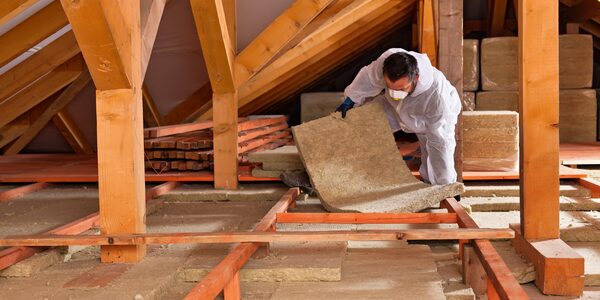
The cost gap is the single clearest difference between the two. Spray foam is much more expensive to install than standard mineral wool loft insulation laid on the loft floor3. Mineral wool is usually the cheapest material, with boards and foams costing more11. Installing mineral wool between and on top of the joists is described as one of the cheapest ways to insulate a loft5.
For spray foam, the National Insulation Association told Which? that typical costs for professionally installed spray foam loft insulation are around £2,500 on a three-bedroom semi-detached property7. Closed-cell spray foam is generally pricier than open-cell7. The National Insulation Association also strongly warns against DIY spray foam installation because of safety issues7.
Removal is where the cost picture becomes serious. Removal of spray foam can be very expensive, in the £1,000s for most properties3. The parliamentary library figure is £40 per square metre8. Those two figures describe the same problem at different scales: a per-metre rate that becomes a four-figure sum across a typical roof.
| Mineral wool at joist level | Spray foam on the roof underside | |
|---|---|---|
| Relative material cost | Usually the cheapest; boards and foams cost more11 | Much more expensive than wool on the loft floor3 |
| Typical installed cost | Not published as a single figure | Around £2,500, three-bedroom semi-detached7 |
| Removal | Not normally required | £40 per m2; £1,000s for most properties8 |
| Depth for Building Regulations | 300mm5 | Not specified in the same terms |
Prices for mineral wool loft insulation are installer-quoted and vary with access, joist spacing and the depth specified. The one published cost adjustment in the figures is £1.50 per m2 of roof plan area for mineral wool at joist level, given in a Northern Ireland regulatory impact assessment for a 0.12 W/m2K target9.
Moisture and ventilation risk in a sprayed roof
This is the section that decides the comparison for most households. The Building Safety Regulator published research on 28 March 2024 into moisture and timber degradation risk when a sprayed foam insulant is applied to typical domestic timber roofs, applying to England4. The exchange of letters on that research was published on 8 May 202417.
The findings are specific. The highest risk assessed is when spray foam insulation is applied directly onto the roof covering, and that configuration leads to high risks under all modelled scenarios4. Higher levels of risk were identified in some scenarios where sprayed foam is applied to a high resistance underlay4. High levels of risk were also identified in Newcastle4. Risk reduced to low where a closed cell insulant and/or an air and vapour control layer was used, in London4.
The Energy Saving Trust explains the mechanism in plain terms: spraying foam directly to the underside of the roof partially seals the timber, so if rainwater from a leak collects there it can cause rot, and condensation can cause similar problems, with lower risk from open-cell foam2. Spraying vapour-impermeable foam directly to the underside of an old and poorly maintained roof is described as one of the highest risk insulation options there is2.
Mineral wool behaves differently because it is vapour-open and is not bonded to the timber. The risk of condensation is described as negligible with the correct product and installation, and liquid water is not transmitted to the inner leaf when the appropriate glass wool product is used18. That is a statement about the material's behaviour, not a licence to insulate over an existing damp problem: where a loft has damp issues, those should be sorted out by a professional before insulation is fitted12.
The mis-selling problem and what regulators have said
Spray foam has a consumer protection problem that mineral wool does not. Citizens Advice published a report on 17 June 2025 titled A Foamidable Challenge: Tackling the impact of the mis-selling of spray foam insulation19. In Parliament on 17 June 2026, it was recorded that many households who had spray foam installed have found they encountered problems when selling their home20.
The sales tactics are documented. Rogue traders are known to use aggressive sales tactics to pressurise homeowners into installing spray foam insulation3. Some installers have used misinformation that existing mineral wool loft insulation no longer complies with regulations to try to increase sales2. There are reports of some traders incorrectly installing spray foam insulation and then charging for its removal1. The pattern described is a claim that current insulation is illegal or dangerous, pressure for a quick decision, and a later demand for thousands of pounds for removal3.
The scale of the cold-calling problem is measurable. Spray foam insulation was the second most common topic of nuisance calls in 2023, according to call blocking device providers21.
"Some installers have used this misinformation to try and increase sales."
There is a counterweight in the evidence. The Energy Saving Trust notes that mortgage issues were possibly true for a while, but that industry progress in determining whether a house is at risk means there should be less of an issue where spray foam was installed correctly2. That is a statement about correctly installed foam, and it does not undo the official moisture findings for foam applied directly to the roof covering.
Why lenders and surveyors treat spray foam as a problem
The risks listed for spray foam are a high cost compared to other forms of insulation, reduced ventilation causing condensation and dampness, covering up roof problems, difficulty of removal, lowering property value, and mortgage difficulty with some lenders1. Mortgage lenders are wary of spray foam insulation and often refuse to lend to buyers if the property has it installed14.
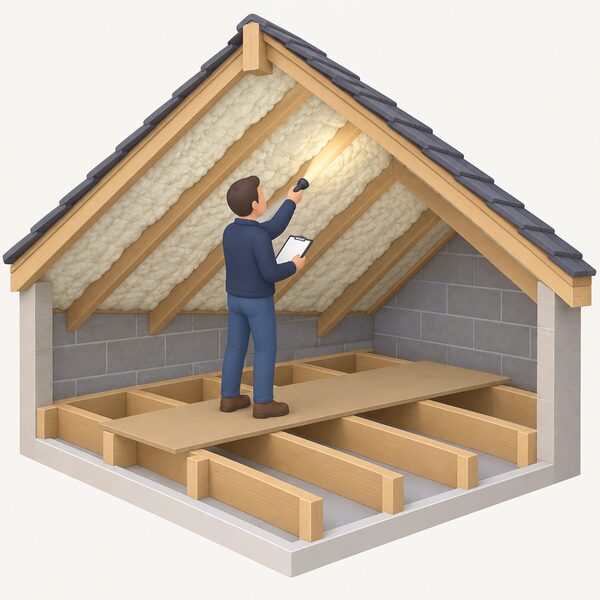
The surveyor's role is the practical pinch point. Where a surveyor encounters spray foam during an inspection, they may reduce the value of the property or request an independent specialist report, and it may render a property un-mortgageable in the eyes of a lender7. The presence of spray foam can make homes harder to sell, particularly if a survey finds the insulation has been poorly installed3.
Open-cell foam does not escape scrutiny. It does not provide the same level of insulation as closed-cell foam because it is not as dense8. That matters because open-cell foam is often presented as the lower-risk option on timber roofs; it is lower risk on moisture, but it is also a weaker insulant per millimetre.
For a household, the consequence is that spray foam is not only an insulation decision but a future transaction risk. Mineral wool at joist level carries none of these lender or surveyor concerns, because it is removable, vapour-open and does not bond to the roof structure.
Mineral wool options: stone wool and sheep's wool
Mineral wool covers both glass wool and stone wool, and it is used far beyond lofts. It is installed in the void between timber floor beams without increasing floor depth, and in concrete beam and block floors either above the concrete or within a ceiling void below22. In separating walls and floors it absorbs sound and improves acoustic performance while providing thermal separation between adjoining properties24. It is also widely used for closing the external wall cavity at the junction between separating walls and external walls, to minimise flanking sound transmission and fire spread24.
Its environmental credentials are documented. Mineral wool uses recycled material and carries a BRE Green Guide rating of A+ to B10. It is found to have lower embodied energy than most non-mineral wool products, especially where low density products are used27. On health and safety, the requirement regarding fibre diameter and length is generally not relevant to mineral wool, because the manufactured fibre diameter and fibre length are greater than 3 microns and 200 microns respectively18.
Sheep's wool is the natural-fibre alternative. A Welsh case study recorded 200mm of sheep's wool insulation fitted between the rafters of a pitched roof28. It occupies the same positions as mineral wool and is a niche product in the UK market; the published cost comparisons in the figures centre on mineral wool, boards and foams rather than natural fibres.
Where spray foam still makes sense
Spray foam is not without legitimate applications. It is most often used in lofts where the foam is sprayed onto the underside of sloping roofs, and it is also used to insulate under suspended floors3. It can be used to insulate the roof, walls and floors, and it is sometimes sprayed into empty cavity walls where standard cavity wall insulation is not considered suitable2. It has been in use for more than 30 years and has become increasingly popular because it offers insulation7.
The case for it is strongest where access is genuinely difficult, where a roof space is too shallow for deep mineral wool, or where a floor void needs insulating from below. In those situations the alternative may be no insulation at all, and a thinner material that can be applied in place has value.
The case is weakest where foam would be applied directly to the roof covering of a timber sloped roof. That is the configuration the Building Safety Regulator identified as the highest risk assessed, with high risk under all modelled scenarios4. Where foam is used on a timber roof, the evidence points to closed cell insulant and/or an air and vapour control layer as the combination that reduced risk to low in the modelled London scenario4.
Removing or topping up: what each choice commits you to
Mineral wool is a reversible choice. It can be topped up, replaced, moved to run services, or removed if a roof needs repair. Where internal wall insulation is installed, a stud wall is built and filled with mineral wool in roll or slab form before a vapour check plasterboard finish is applied, and the same principle of accessible, replaceable material applies29. Party wall cavities are required to be fully filled with mineral wool without voids and in full contact with both surfaces of the construction board30.
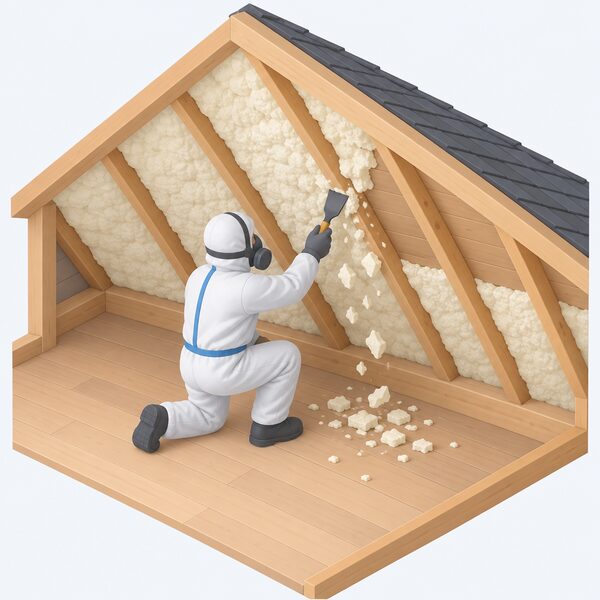
Spray foam is not reversible in the same way. It is considered a permanent installation, and removing it later might require replacing the structure it was applied to2. Any timbers coated in foam are more difficult to replace, as are tiles or slates where there is no roofing felt or other layer between the foam and the tiles2. Removal costs run to £40 per square metre and into the £1,000s for most properties8.
That asymmetry is the heart of the comparison. Mineral wool commits a household to a depth and a specification that can be revised. Spray foam commits a household to a roof structure that is bonded, harder to inspect, harder to repair and, on the evidence of lenders and surveyors, harder to sell. For a household pursuing energy independence, mineral wool at joist level is a low-risk fabric measure that reduces heat demand without creating a future liability in the roof. Spray foam reduces heat loss through the roof plane but leaves the household dependent on the quality of the original installation and on the willingness of a future lender to accept it.
Before either is installed, the independent advice route is the same: a buildings surveyor, or at least three quotes from different traders1. Before paying for removal, Citizens Advice advises checking with a building surveyor, or using a specialist spray foam assessor from the Property Care Association1.
Sources30 cited
- Make sure your home is energy efficient, Citizens Advice, 2026-09-19
- Spray foam insulation, Energy Saving Trust, 2024-12-05
- Spray foam insulation advice, Centre for Sustainable Energy, 2025-11
- Moisture risk of spray foam insulation applied to timber sloped roofs, Building Safety Regulator, 2024-03-28
- Loft insulation at joist level, MIMA, 2026-09-20
- Loft insulation advice, Centre for Sustainable Energy, 2025-10
- Spray foam insulation, Which?, 2026-05-26
- Spray foam insulation and mortgages, House of Commons Library, 2026-09-20
- Draft Regulatory Impact Assessment, Part F, Northern Ireland Department of Finance, 2021-10
- Roof insulation applications, MIMA, 2026-09-20
- Wrap your home in insulation, Low Carbon Hub, 2025-11-27
- Insulation and energy saving, Smart Energy GB, 2026-03-16
- Easter DIY jobs to lower your energy bills, CIPHE, 2022-04-10
- House insulation: the ultimate guide, Federation of Master Builders, 2026-09-20
- Insulation guide, Uswitch, 2026-09-16
- Loft insulation costs and savings, Which?, 2026-05-05
- Exchange of letters on spray foam insulation, GOV.UK, 2024-05-08
- Mineral wool health and safety, MIMA, 2026-09-20
- A Foamidable Challenge: tackling the mis-selling of spray foam insulation, Citizens Advice, 2025-06-17
- Energy Market Consumer Protection, Hansard, 2026-06-17
- Sustainable heating installer policy report, Which?, 2023
- Floor insulation applications, MIMA, 2026-09-20
- Internal floor insulation, MIMA, 2026-09-20
- Separating wall insulation, MIMA, 2026-09-20
- Separating floor insulation, MIMA, 2026-09-20
- Partition wall insulation, MIMA, 2026-09-20
- Mineral wool sustainability, MIMA, 2026-09-20
- Advice on improving energy efficiency, Eryri National Park Authority, 2022
- Masonry solid wall insulation, MIMA, 2026-09-20
- Party wall bypass guide, MIMA, 2010-11
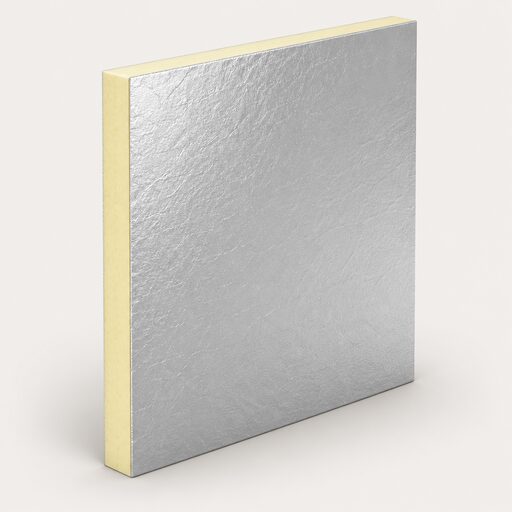 Insulation Materials ComparedMineral wool, PIR boards, polystyrene and natural fibres all keep heat in, but they suit different jobs and budgets.
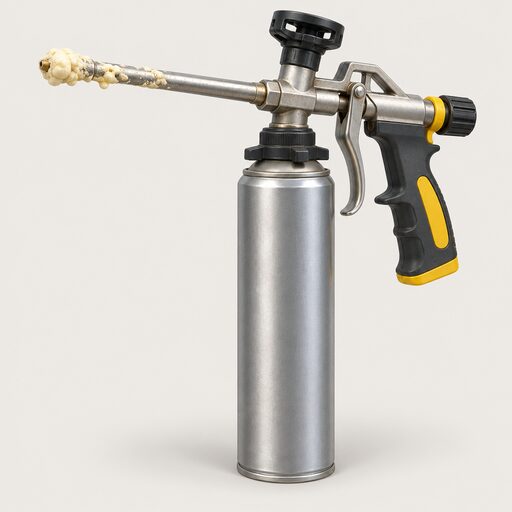 Spray Foam InsulationOpen and closed cell spray foam on roof slopes and under floors: what it costs, the moisture and timber decay risks identified in official modelling, why lenders and surveyors ask questions, what paperwork exists and what removal involves.
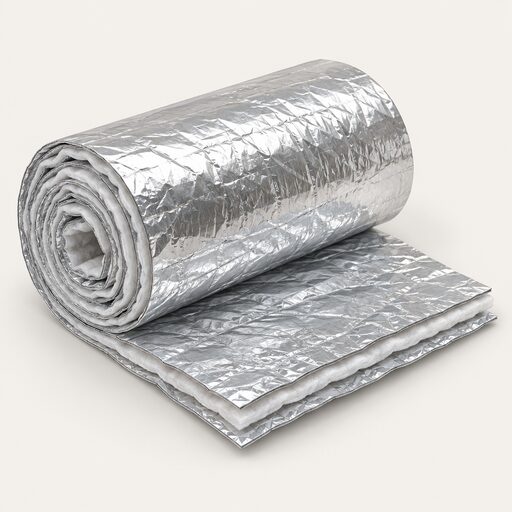 Multifoil InsulationDoes thin foil insulation really keep a home warm, and how does it compare with thick rolls of wool or rigid boards?
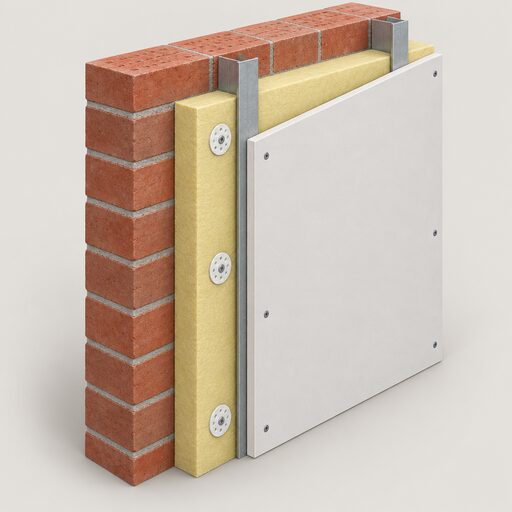 Solid Wall InsulationSolid walls lose far more heat than cavity walls, so what can actually be done about it?
 Retrofitting Pre-1919 BuildingsOlder homes with solid walls need different insulation from modern houses, and getting it wrong can trap damp inside.
 Roof-Integrated SolarSolar tiles replace your roof covering instead of sitting on top of it, so the finished roof looks like a roof.