
In this answer
Short answer
Cavity wall insulation in the UK is installed using one of three main materials: mineral wool (glass or rock wool), EPS bead (polystyrene bead) and PU foam (polyurethane foam)1. The material is blown into the cavity from the outside, a process that takes a couple of hours for a typical three-bedroom house and causes minimal disruption to the householder2.
Which material suits a particular wall is not a free choice. Building Regulations require that the insulation material used is suitable for the wall construction concerned3, and each cavity wall insulation system must pass stringent technical requirements laid down by the British Board of Agrement or an alternative independent approvals body4. The cavity itself must be at least 50mm wide, and the walls need to be in good condition, for the property to be suitable5.
The three materials: mineral wool, EPS bead and polyurethane foam
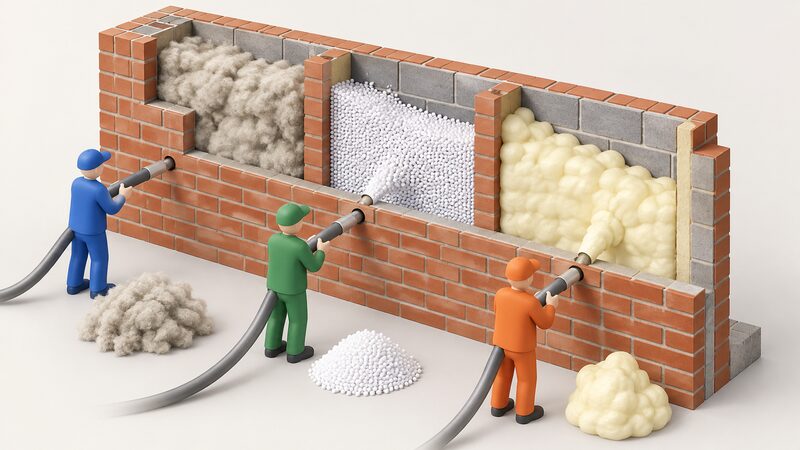
The three materials named in official guidance are mineral wool, made from glass or rock wool; EPS bead, made from polystyrene; and PU foam, made from polyurethane1. Each is a distinct product with its own manufacturing route, its own installation behaviour and its own conditions of use.
Mineral wool is described as a cotton wool like material produced from either rock wool or glass wool, and is used in the majority of installations4. It is common, affordable and often used in lofts and cavity walls8. Mineral wool uses recycled material in its manufacture9, and properly installed cavity wall insulation of this kind should perform effectively for at least 40 years7.
EPS bead is the material most often encountered in retrofit work. Polystyrene beads are the most common material used in cavity wall insulation, more popular than mineral fibre and expanding foam6. A typical specification for a terraced house describes injected polystyrene beads to a wall with a 100mm cavity, with all holes made good on completion10.
Polyurethane foam is the third material and the one with the most conditions attached. It is usually made from polyurethane and filled with bubbles of gas or air, in open-cell and closed-cell types11. In cavity walls it is subject to a specific building regulations check, described below.
The choice between them is driven by the wall, not by preference. The cavity can be fully filled with insulation or partially filled, and in the partially filled case the manufacturer's guidance must be consulted before proceeding12. That instruction sits with the householder's installer, but it explains why the same house can receive different materials from different contractors.
How the material gets in: blown into the cavity
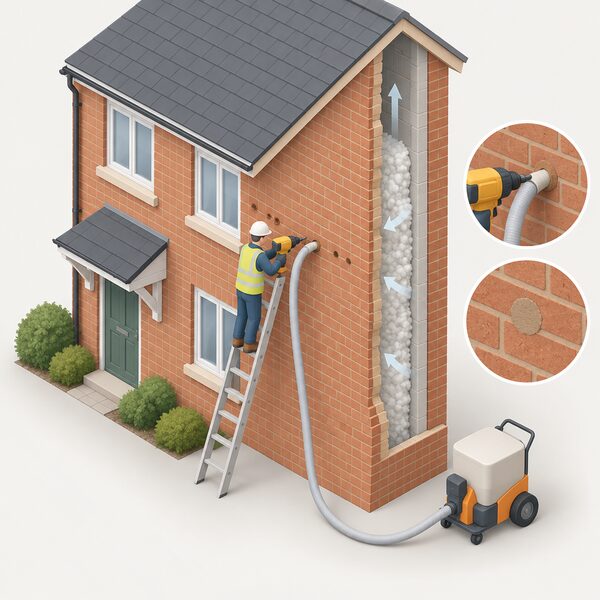
All three materials reach the cavity the same way. The insulation is blown into the cavity from the outside, and disruption to the householder is minimal2. Installers drill a series of holes through the outer leaf of the wall, inject the material under pressure, and then seal the holes.
Making good is part of the specification, not an extra. All the holes through which the insulation is injected are filled with mortar to match the existing colour and texture as closely as possible; on pebbledash finishes, pebbles are added to the surface13. A householder should expect the finished wall to look as it did before, with the injection points visible only on close inspection.
The blown-in method suits both new-build and existing cavities14. In new-build work the cavity can be fully filled as the wall goes up; in retrofit the same material is injected into a cavity that already exists behind a finished external leaf. The method is the same; the timing and the access differ.
The inner skin of a typical modern cavity wall is generally of blockwork15, and the wall ties within the cavity should be made from stainless steel and resistant to corrosion16. Those ties matter to material choice: a fill that holds moisture against a tie, or that cannot be removed if the wall later needs work, is a different proposition from one that drains and can be extracted.
Mineral wool: glass wool or rock wool, and how to tell them apart
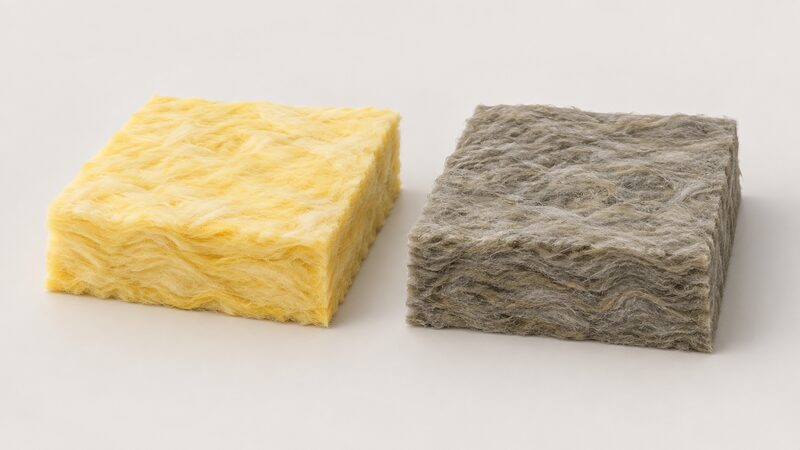
Mineral wool is a single family with two members. It is a cotton wool like material produced from either rock wool or glass wool4, and the two are distinguished by their raw material and their colour. Glass wool is yellow or white in colour; rock wool is grey or brown18. Mineral wool more broadly is made from glass or stone fibres19.
The colour difference is the practical test. If material is visible during installation, or if a wall is opened later, yellow or white points to glass wool and grey or brown to rock wool. Both are used in the majority of installations4, and both are common, affordable and often used in lofts and cavity walls8.
ROCKWOOL, which describes itself as the world's leading manufacturer of stone wool insulation20, offers two main types of wall cavity insulation: cavity slab and granulate21. The maker states the product is water repellent and prevents rainwater coming through the construction21. That water repellence is a maker's claim about its own product, and it addresses the main technical worry with any cavity fill, which is how the material behaves when driving rain reaches the outer leaf.
Mineral wool has a second role beyond thermal insulation. It is widely used for closing the external wall cavity at the junction between separating walls and external walls, to minimise flanking sound transmission and fire spread22. In partition walls, the key requirement for insulation in the cavity is sound absorption, which improves the sound insulation of the wall23. A householder in a terraced or semi-detached house is therefore likely to have mineral wool in more than one place in the wall build-up.
EPS bead: bonded polystyrene beads
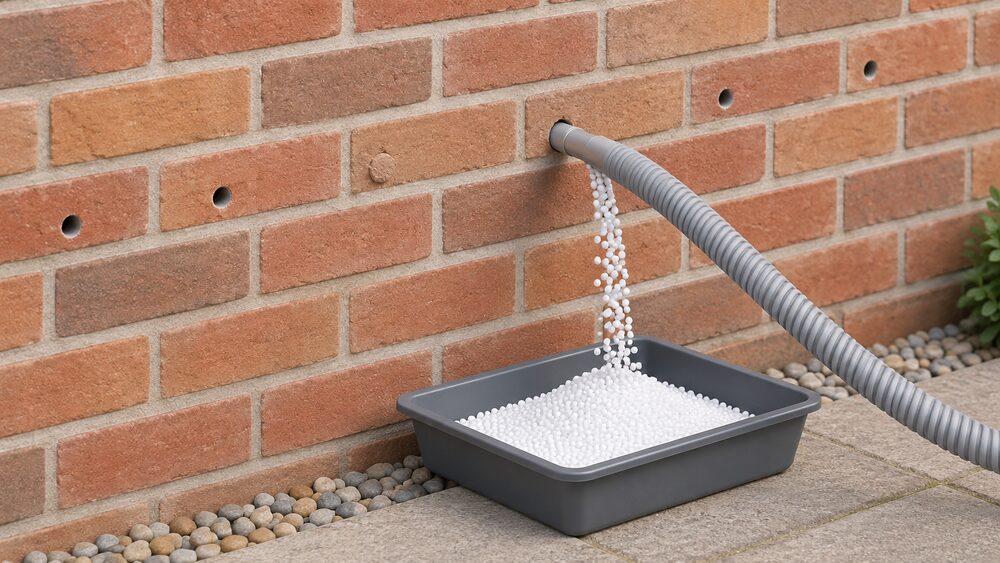
Bonded bead is the material most householders will be offered for a retrofit cavity. It consists of white polystyrene beads18 that are blown into the cavity and then bonded together, so that the fill forms a stable mass rather than a loose aggregate that could settle over time.
The specification is precise. A typical terraced house cavity wall insulation job is described as injected polystyrene beads to wall, cavity width 100mm, with making good of all holes on completion10. The 100mm figure is the cavity width in that specification, not a universal requirement; the general suitability threshold is a cavity at least 50mm wide, with walls in good condition5.
Bead is not confined to cavity walls. Expanded polystyrene boards are among the most common materials for external wall insulation24, so the same base polymer appears in two different retrofit routes: injected as loose bead into a cavity, or fixed as boards to the outside of a solid wall. A householder weighing up the two approaches can compare them directly on the internal vs external solid wall insulation page.
Bead's practical advantage in retrofit is that it flows. It can be injected through relatively small holes and will travel around obstructions within the cavity, which suits the irregular cavities found in older but still cavity-walled housing. Its practical limitation is that it depends on the bonding agent and on the cavity being clean and clear; debris, mortar snots or partial fill already in place can all affect how evenly the beads distribute.
Polyurethane foam: where it fits
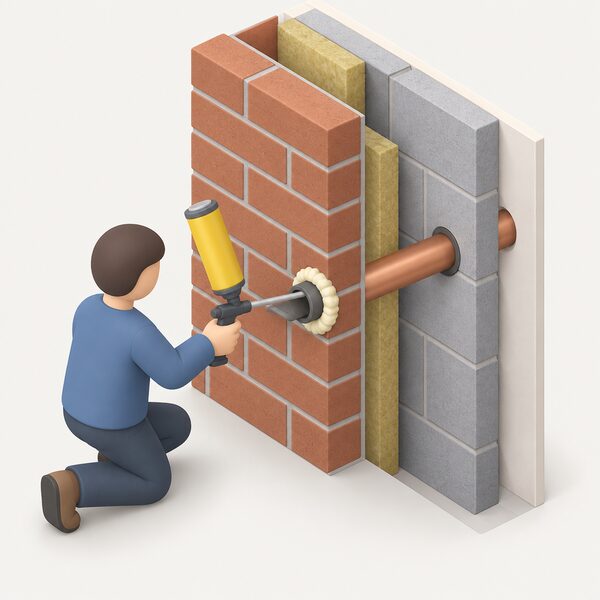
Polyurethane foam is a legitimate cavity wall insulation material, but it is the one that attracts the most regulatory attention. Building regulations state that where some foam cavity wall insulating materials are used, an assessment of the risk of the emission of formaldehyde gas will need to be carried out16. That is a condition on the material, not a prohibition on it.
Spray foam insulation, which is usually made from polyurethane and filled with bubbles of gas or air, comes in open-cell and closed-cell types11. It can be sprayed on the inside of roofs, in walls and floors25, and can be used to insulate the roof, walls and floors26. In cavity walls, foam is a less common choice than mineral wool or bead.
Foam also has a role in smaller-scale work. Larger gaps might require expanding polyurethane foam27, typically around pipework penetrations rather than as a whole-cavity fill. That is a different application from cavity injection and carries different risks.
The wider caution around spray foam in UK housing relates to roofs rather than cavities, and it is significant enough to note here because householders often conflate the two. Spray foam applied to the underside of a roof can affect mortgageability and is difficult to remove, which is why it has its own dedicated guidance. Anyone considering foam anywhere in the fabric should read the spray foam insulation page before committing.
British standards: what any material should meet
The regulatory position on cavity wall insulation materials is consistent across the UK's building regulations, even where the devolved documents differ in detail. If insulation is inserted into a cavity wall, the appropriate requirements will be applied to ensure the insulation material is suitable28. The Building Regulations require that the insulation material used is suitable for the wall construction concerned3.
Suitability is assessed through approved systems rather than material samples. Cavity wall insulation systems must each pass stringent technical requirements laid down by the British Board of Agrement or an alternative independent approvals body4. A householder can therefore ask which approval a proposed system holds, and expect a specific answer.
Where public money is involved, a further standard applies. Under the Great British Insulation Scheme, all measures must be delivered in accordance with PAS 2035, including cavity and loft insulation in all scenarios and heating controls29. The scheme covers cavity wall including party wall, loft, solid wall, pitched roof, flat roof, under-floor, solid floor, park home and room-in-roof measures, for both the general and low-income groups30.
The devolved picture adds its own requirements. In Wales, a wall may be suitable to receive external wall insulation if it is of solid construction or has fully filled and insulated cavities31. In Northern Ireland, a higher specification of insulation is required for dwellings with electric storage heaters, LPG or programmable solid fuel central heating, combining cavity wall insulation where cavity walls can be insulated effectively with loft insulation meeting current NI Building Regulations standards32. A Northern Ireland consultation proposes making loft insulation, cavity wall insulation, draught proofing and ventilation mandatory for all properties unless existing insulation and ventilation meet acceptable standards33.
For a household, the standards matter because they determine what can be installed, what warranty applies and what a future buyer's surveyor will look for. The material is only as good as the system it belongs to, and the system is what the approvals cover.
Sources33 cited
- ECO4 New Measures and Products Guidance v3.0, Ofgem, 2026
- Cavity wall insulation, Energy Saving Trust, 2026
- Building regulations: cavity wall, Planning Portal, 2026
- CWI systems, CIGA, 2026
- Solid wall insulation costs and savings, Which?, 2026
- Cavity wall insulation advice, Centre for Sustainable Energy, 2025
- House insulation: the ultimate guide, FMB, 2026
- Wrap your home in insulation, Low Carbon Hub, 2025
- Roofs, MIMA, 2026
- Insulation costs for different types of home, Which?, 2026
- Spray foam insulation, Which?, 2026
- Thermal resistance, Welsh Government, 2026
- CWI FAQs, CIGA, 2026
- Masonry cavity wall insulation, MIMA, 2026
- Building regulations: external walls, Welsh Government, 2026
- Building regulations: cavity wall, Welsh Government, 2026
- Edinburgh LHEES, City of Edinburgh Council, 2023
- Cavity wall insulation FAQs, National Insulation Association, 2021
- Insulation, nidirect, 2026
- ROCKWOOL brand page, Quiet Mark, 2026
- ROCKWOOL cavity wall insulation, ROCKWOOL, 2026
- Separating wall insulation, MIMA, 2026
- Partition wall insulation, MIMA, 2026
- Park homes advice, Centre for Sustainable Energy, 2026
- Make sure your home is energy efficient, Citizens Advice, 2026
- Spray foam insulation, Energy Saving Trust, 2024
- Draught-proofing, Which?, 2026
- Building regulations: external walls, Planning Portal, 2026
- GBIS government consultation response, NIA, 2023
- Great British Insulation Scheme: homeowners and tenants, Ofgem, 2026
- Approved Document L Volume 1 consultation, Welsh Government, 2025
- Decent Homes Standard summary table, Department for Communities NI, 2025
- Warm Healthy Homes Fund consultation, Department for Communities NI, 2026
 Insulation Materials ComparedMineral wool, PIR boards, polystyrene and natural fibres all keep heat in, but they suit different jobs and budgets.
 Solid Wall InsulationSolid walls lose far more heat than cavity walls, so what can actually be done about it?
 Cavity Wall InsulationCavity wall insulation could cut your heating bill, but is your home suitable?
 Retrofitting Pre-1919 BuildingsOlder homes with solid walls need different insulation from modern houses, and getting it wrong can trap damp inside.
 Multifoil InsulationDoes thin foil insulation really keep a home warm, and how does it compare with thick rolls of wool or rigid boards?
 Cavity Wall Insulation ProblemsDamp patches after cavity wall insulation, and whether the guarantee actually pays out, are the two things people most want answered.