
In this answer
Short answer
The short answer is that there is no published density figure for mineral wool in a party wall cavity. What the official guidance fixes is a performance figure, not a density: insulation of a party cavity wall carries an in-use factor of 15%1. That number, not a kilogram per cubic metre value, is what governs how the measure is treated in the Energy Company Obligation, and it is written into the 2017 legislation that defines phase 3 party cavity wall insulation2.
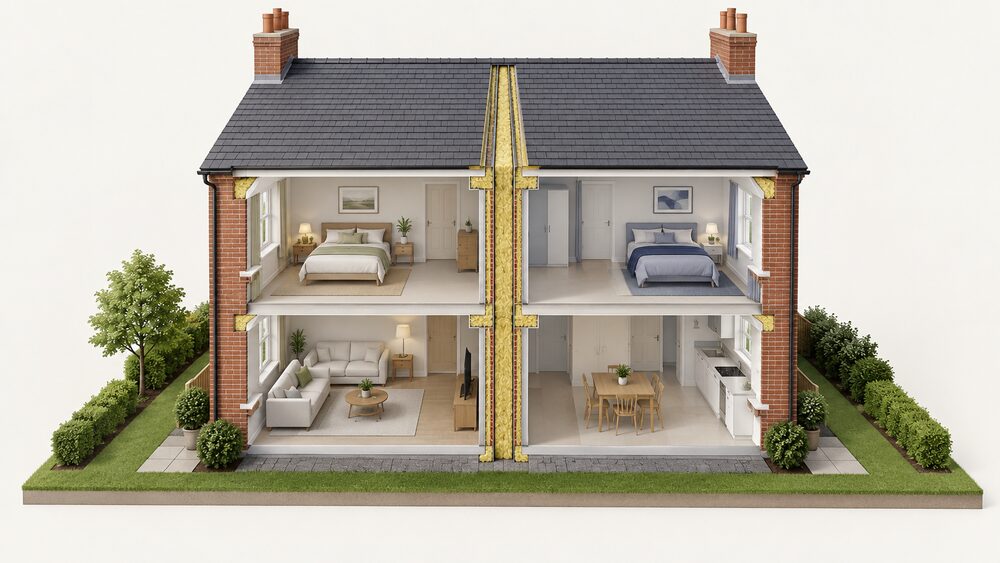
Mineral wool is one of the three main materials used for cavity wall insulation, alongside EPS bead and PU foam3. In a separating wall its job is different from its job in an external wall: the key requirement for insulation in partitions is sound absorption in the cavity, which improves the sound insulation of the wall4. Mineral wool is also widely used for closing the external wall cavity at the junction between separating walls and external walls, to minimise flanking sound transmission and fire spread5.
So the specification question resolves into three parts: the in-use factor that schemes apply, the U-values that Approved Document L sets for party walls, and the material and installation conditions that make mineral wool suitable. The density of the wool itself is not set by the guidance; the thickness and fit are.
Party wall cavity insulation: what the official guidance covers
The official guidance does not describe party cavity wall insulation as a density specification at all. It describes it as a measure with a defined in-use factor. Ofgem's Energy Company Obligation guidance lists "Insulation of a party cavity wall" at 15%1, and the same 15% appears in the 2017 legislation for phase 3 party cavity wall insulation2. The in-use factor is the share of a theoretical saving that a scheme counts as delivered, so a calculated saving is credited at 15% of its face value.
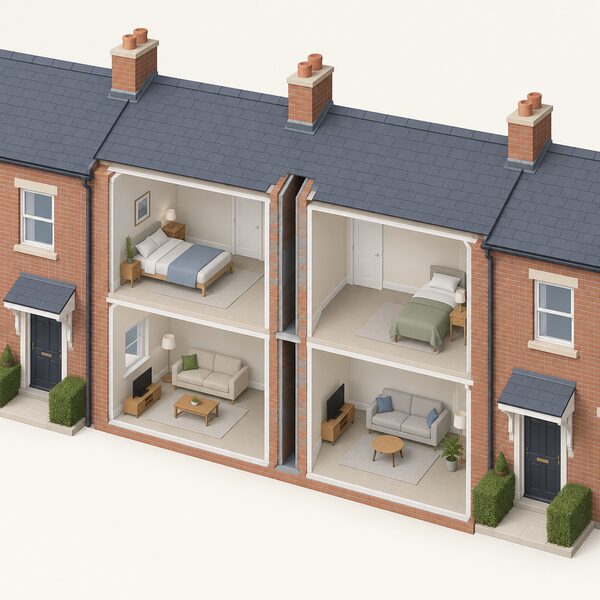
The definition in legislation is precise about what the measure is. Phase 3 party cavity wall insulation means insulation of a cavity wall where installation is completed on or after 1 April 2017 and the wall divides premises from other premises under different occupation2. That is the legal boundary: a party cavity wall separates dwellings under different occupation, which is what distinguishes it from an external cavity wall.
The measure also appears in the ECO4 innovation route. Innovation Measure 006 is Party Cavity Wall Insulation (PWI)8. Under the ECO4 flat in-fill rules, a flat can qualify where solid wall insulation or cavity wall insulation is installed in a block of flats, linked with one other measure of the same kind promoted by the same participant at separate premises in the same block9.
For households in Northern Ireland, the Decent Homes Standard consultation sets out an insulation package. A dwelling with gas or oil programmable heating needs cavity wall insulation if there are cavity walls that can be insulated effectively, or loft insulation meeting current NI Building Regulations standards if there is loft space10. A dwelling with electric storage heaters, LPG or programmable solid fuel central heating requires a higher specification of insulation10.
The 15% figure and what it means in the specification
The 15% in-use factor is the single most important number in this subject, and it is widely misread. It is not a density, not a thickness and not a percentage of heat saved. It is the proportion of a modelled saving that a scheme recognises when the measure is a party cavity wall1.
The reason the figure is low is that a party cavity wall behaves differently from an external wall. In a mid-terraced dwelling, heat lost through an untreated separating or party cavity wall is greater than that lost through all of the other external walls combined, according to a Leeds Metropolitan University study cited in mineral wool industry guidance11. That is the case for treating the wall at all. But the saving is harder to capture reliably than in an external wall, because the cavity is shared between two dwellings and edge sealing determines whether the cavity performs as intended.
For comparison, the same Scottish Government analysis gives cavity wall insulation a 27% saving of heat demand as a communal measure, and internal wall insulation 36%12. Those are different measures with different baselines, and they are not directly comparable with the 15% in-use factor, which is a scheme accounting rule rather than a physical saving.
The practical consequence for a household is that party cavity wall insulation is unlikely to be funded on its own. It is treated as a lower-yield measure, and it tends to appear alongside other work: in the ECO4 flat in-fill rules it must be linked with one other measure of the same kind in the same block9, and in Northern Ireland it sits inside a package with loft insulation10.
How a party wall cavity differs from an external cavity wall
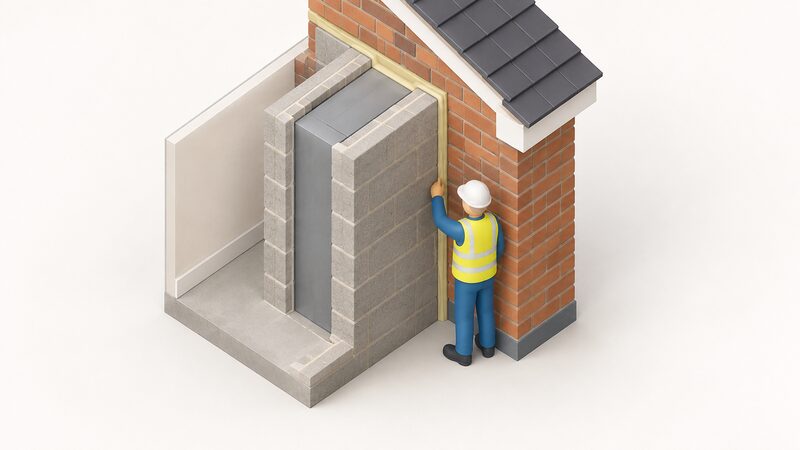
An external cavity wall and a party cavity wall look similar in section and behave very differently. A typical external cavity in a home built after the 1920s is around 50mm wide, formed by two skins with a gap between them7. Homes built after 1920 are likely to have cavity walls, and insulation can usually be installed in cavities no less than 50mm wide13.
The difference is what happens at the edges. Approved Document L gives a party wall an unfilled cavity with effective sealing around all exposed edges and in line with insulation layers in abutting elements a U-value of 0.2 W/(m2·K)6. The same unfilled cavity with no effective edge sealing is given 0.5 W/(m2·K)6. A fully filled cavity with effective sealing at all exposed edges is given 0.0 W/(m2·K)6.
That spread, from 0.5 down to 0.0, is the whole argument. The party wall bypass, the route by which heat escapes around the edges of a separating wall rather than through it, is what the edge sealing controls. The Home Energy Model in Approved Document L Volume 1 sets out the conditions: solid party walls are treated as no heat loss; an unfilled cavity with no effective edge sealing is heat loss; an unfilled cavity with effective sealing is heat loss, except for concrete frame construction in a building containing flats; and a fully filled cavity with effective sealing is no heat loss14.
For an existing dwelling, the threshold U-value for wall cavity insulation is 0.70 W/(m2·K)6. A Welsh consultation version of Approved Document L gives a retained cavity-insulated wall a maximum of 0.5516.
Where mineral wool fits in a party cavity wall
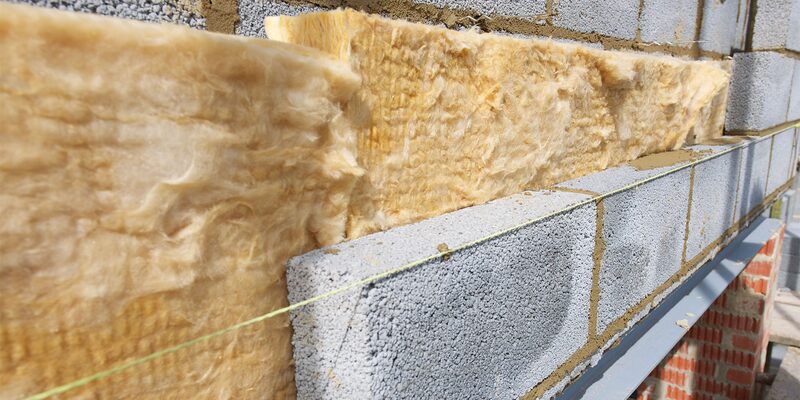
Mineral wool is one of the three main materials used for cavity wall insulation, with EPS bead and PU foam3. In a party wall its function is acoustic as much as thermal. The key requirement for insulation in partitions is sound absorption in the cavity, which improves the sound insulation of the wall4. Mineral wool is also widely used for closing the external wall cavity at the junction between separating walls and external walls, to minimise flanking sound transmission and fire spread5.
The material has practical advantages for this application. Mineral wool has a simple installation process4 and carries a BRE Green Guide rating of A+ to B4. Mineral wool, rigid boards and properly installed cavity wall insulation should perform effectively for at least 40 years17. For loft applications the recommended depth for mineral wool is 270mm18, though that figure belongs to loft insulation, not to a party cavity.
The installation conditions matter more than the material density. In timber frame party walls, the cavity width is to be measured when erecting the party wall and confirmed as within the design tolerance; if it deviates, an alternative mineral wool product of appropriate thickness is to be used11. That is the closest the guidance comes to a specification rule: the wool must fit the cavity as built, and the cavity must be measured rather than assumed.
Building Regulations and certification for party wall insulation

Cavity wall insulation is specifically defined as notifiable building work in the Building Regulations19. For all buildings which are not exempted from the Regulations, it is necessary to submit a building notice to a building control body stating that cavity wall insulation work will be carried out19. The Building Regulations require that the insulation material used is suitable for the wall construction concerned19, and where insulation is inserted into a cavity wall the appropriate requirements will be applied to ensure the material is suitable21.
Certification is layered rather than single. Cavity wall insulation installers are assessed under the Kiwa Cavity Wall Insulation Installer Scheme, which focuses on condensation risk and requires a detailed checklist to be completed22. Full fill suitability for masonry cavity wall constructions is cross-checked against BR262 'Thermal Insulation: Avoiding Risks', NHBC Standards and Zurich Building Guarantees Technical Manual23. Accredited construction details for masonry internal wall insulation limit the overall board-insulation thickness to 75mm because of the practicality of fixing insulated dry lining to blockwork23.
The insulation should go at least 150mm below the DPC level24. That is a general cavity wall rule, and it applies to the external cavity rather than the party cavity, but it illustrates the level of detail building control expects.
Does filling a party wall cavity affect sound insulation between homes?
It can, and the risk runs in both directions. Independent guidance notes that filling the cavity could compromise the acoustic insulation afforded by the original arrangement25. That is the caution: an empty cavity is itself an acoustic break, and filling it changes how the wall performs.
Against that, mineral wool is chosen for partitions precisely because it absorbs sound in the cavity and improves the sound insulation of the wall4. It is also widely used to close the external wall cavity at the junction between separating walls and external walls to minimise flanking sound transmission5. So the material can improve acoustic performance where it is specified and installed for that purpose, and can degrade it where a cavity that was providing a break is filled without regard to the acoustic design.
The practical position is that acoustic performance is a design question for the specific wall, not a property of the material alone. The party wall bypass guidance treats the junction between separating and external walls as the critical detail, and that is where mineral wool is most often used as a cavity barrier5.
Does party wall cavity insulation create a condensation risk?
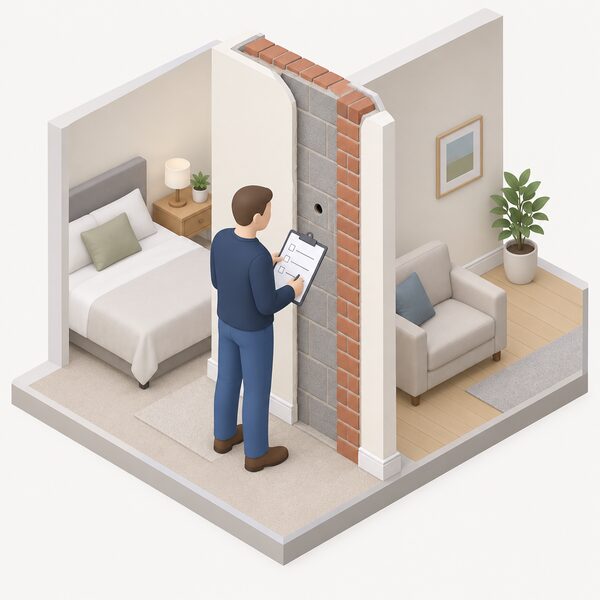
Condensation risk is the focus of installer assessment under the Kiwa Cavity Wall Insulation Installer Scheme, and a detailed checklist is completed as part of the survey22. That is the formal control: the risk is assessed before work, not after.
Independent guidance is broadly reassuring. Cavity wall insulation is much more likely to solve problems of damp caused by condensation because it makes the walls warmer, though for a few houses right on the coast or facing persistent driving rain the empty cavity can provide some protection from damp26. That is the exception rather than the rule, and it is a coastal and driving-rain exposure question.
The Home Energy Model treats a fully filled cavity with effective sealing at all exposed edges and in line with insulation layers as no heat loss14. The condition attached to that, effective sealing at all exposed edges, is also the condition that controls moisture movement around the edges of the wall. Where sealing is incomplete, the model treats the wall as losing heat14, and the same incompleteness is where moisture and air movement problems arise.
"filling the cavity could also compromise the acoustic insulation afforded by the original arrangement"
Does the official guidance apply to existing homes as well as new builds?
Both. For new dwellings the limiting U-value for a party wall is 0.20 W/(m2·K)6. For existing dwellings the threshold for wall cavity insulation is 0.70 W/(m2·K)6. A Welsh consultation version gives a retained cavity-insulated wall a maximum of 0.5516. The Home Energy Model in Approved Document L Volume 1 sets out party wall conditions for the existing stock as well as new build14.
The retrofit schemes add their own conditions. The Domestic Renewable Heat Incentive requires that if an EPC recommends loft or cavity wall insulation, these must be installed and a new EPC obtained, unless an exemption applies27. The Boiler Upgrade Scheme clarifies that if there are no recommendations for loft or cavity wall insulation listed on the EPC, the property fulfils the insulation requirements28.
In Scotland, the Heat in Buildings Standard consultation proposes a simple list of measures to demonstrate compliance: 270mm loft insulation, cavity wall insulation, draught-proofing, heating controls, 80mm hot water cylinder insulation and suspended floor insulation29. Scottish House Condition Survey 2024 data shows 20% of cavity wall dwellings across all tenures have uninsulated standard walls, and internal or external insulation of cavity walls stands at 15% of cavity wall dwellings in the social sector against 5% of private dwellings30.
That is the scale of the installed base, and it is why the party cavity wall matters: it is the remaining uninsulated cavity in a large share of those homes.
Can I insulate a party wall cavity myself?
No. Cavity wall insulation is defined as notifiable building work, so a building notice must be submitted to a building control body stating that the work will be carried out, for all buildings not exempted from the Regulations19. That is a legal precondition, not a recommendation.
There are practical reasons as well. A party cavity wall is a shared structure between dwellings under different occupation2, and the work involves injecting or blowing material into a sealed cavity with edge sealing that has to be verified against the design. The party wall bypass guidance requires the cavity width to be measured when erecting the party wall and confirmed as within the design tolerance, with an alternative mineral wool product of appropriate thickness used if it deviates11. That is a specification decision made on site by the installer.
The installer assessment under the Kiwa scheme covers condensation risk and requires a detailed checklist22. Where a household is considering the work, the route is through a competent installer working to the accredited details, with building control notified before work starts.
Where can I read the official document on party cavity wall insulation?
The definition and the in-use factor sit in the Energy Company Obligation legislation and in Ofgem's ECO guidance, where party cavity wall insulation is listed at 15%1. The U-values sit in Approved Document L, in the 2021 edition incorporating 2023 amendments and in the current Volume 16, with a Welsh consultation version giving a retained cavity-insulated wall a maximum of 0.5516. The Home Energy Model tables in Approved Document L Volume 1 give the party wall conditions14.
For the material and installation side, the party wall bypass guidance from the Mineral Wool Insulation Manufacturers Association covers the junction detail and the cavity width tolerance11. Full fill suitability is cross-checked against BR262 'Thermal Insulation: Avoiding Risks', NHBC Standards and Zurich Building Guarantees Technical Manual23. Accredited construction details for masonry internal wall insulation give the 75mm board-insulation limit23.
Cost data for cavity wall insulation draws on the Royal Institution of Chartered Surveyors Building Cost Information Service database31. Prices for party cavity wall insulation are installer-quoted, and no published range is given here.
Sources31 cited
- ECO3 Guidance Part I: Final Guidance, Ofgem, 2017-02-10
- The Electricity and Gas (Energy Company Obligation) Order 2017, legislation.gov.uk, 2017-03-28
- ECO4 New Measures and Products Guidance v3.0, Ofgem, 2026-03-26
- Partition Wall Insulation, Mineral Wool Insulation Manufacturers Association, 2026-09-20
- Separating Wall Insulation, Mineral Wool Insulation Manufacturers Association, 2026-09-20
- Approved Document L Volume 1: Dwellings, 2021 edition incorporating 2023 amendments, HM Government, 2023
- Cavity Wall Insulation, Centre for Sustainable Energy, 2025-12
- ECO4 Innovation: Approved Innovation Measures v1.17, Ofgem, 2026-01
- The Electricity and Gas (Energy Company Obligation) Order 2023, legislation.gov.uk, 2023-07-24
- Current Decent Homes Standard: Summary Table, Northern Ireland Department for Communities, 2025-08-05
- MIMA Party Wall Bypass Guide, Mineral Wool Insulation Manufacturers Association, 2010-11
- Heat in Buildings: Multiple Ownership and Mixed Use Buildings, Scottish Government, 2023-11-28
- How to Make Your Home More Energy Efficient, Which?, 2026-05-05
- Building Regulations Approved Document L Volume 1 2026, Welsh Government, 2026-04
- Approved Document L Volume 1: Dwellings, HM Government, 2026
- Approved Document L Volume 1: consultation version, Welsh Government, 2025-08
- House Insulation: The Ultimate Guide, Federation of Master Builders, 2026-09-20
- Loft Insulation, Centre for Sustainable Energy, 2025-10
- Building Regulations: Cavity Wall, Planning Portal, 2026
- Building Regulations: Insulation, Cavity Wall, Welsh Government, 2026-09-17
- Building Regulations: External Walls, Welsh Government, 2026-09-17
- Cavity Wall Insulation Installer Scheme, Kiwa, 2026-09-17
- Accredited Construction Details, Planning Portal, 2026
- Thermal Resistance, Planning Portal, 2026
- Party Wall Bypass and Part E, Mineral Wool Insulation Manufacturers Association, 2026-09-20
- Energy Saving Myths, Centre for Sustainable Energy, 2026-07
- Domestic Renewable Heat Incentive: Applicants, Ofgem, 2026
- Summary of Updates to Boiler Upgrade Scheme Guidance for Property Owners v2.4, Ofgem, 2023-12
- Scottish Government Consultation on Delivering Net Zero for Scotland's Buildings, Consumer Scotland, 2024-03-08
- Scottish House Condition Survey 2024: Key Findings, Scottish Government, 2024
- Cavity Wall Insulation: Costs and Savings, Which?, 2026-05-05
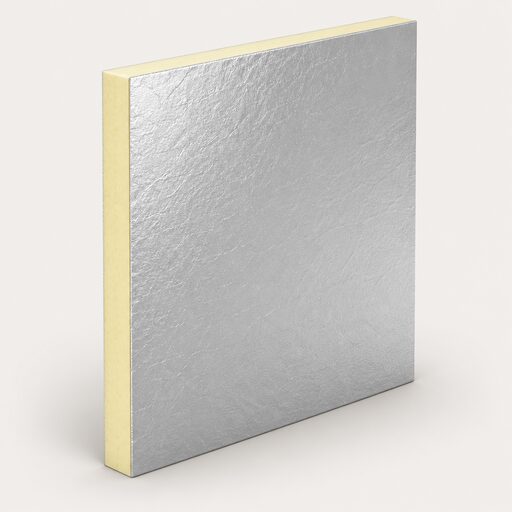 Insulation Materials ComparedMineral wool, PIR boards, polystyrene and natural fibres all keep heat in, but they suit different jobs and budgets.
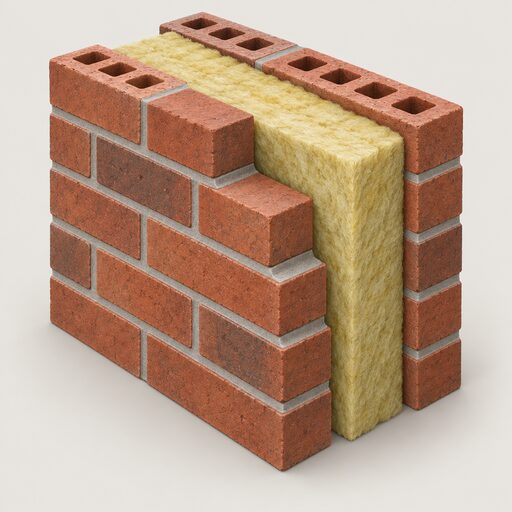 Cavity Wall InsulationCavity wall insulation could cut your heating bill, but is your home suitable?
 Multifoil InsulationDoes thin foil insulation really keep a home warm, and how does it compare with thick rolls of wool or rigid boards?
 Solid Wall InsulationSolid walls lose far more heat than cavity walls, so what can actually be done about it?
 Loft InsulationHow much loft insulation do you need, and is your current depth enough?
 Cavity Wall Insulation ProblemsDamp patches after cavity wall insulation, and whether the guarantee actually pays out, are the two things people most want answered.