

In this guide
Insulation mis-selling in the UK follows a small number of recognisable patterns, and they all depend on the same thing: a household that cannot easily tell a funded scheme from a sales operation. The warning signs are documented. Citizens Advice describes cold calls trying to sell insulation you do not want or need, claims that insulation must be replaced urgently, and claims of compensation for badly installed insulation1. It also states the counter-fact that matters most: "Most insulation works properly and you don't need to replace it."1
The financial damage is concentrated in spray foam. Independent guidance lists a high cost compared to other forms of insulation, reduced ventilation causing condensation and dampness, covering up roof problems, difficulty of removal, lower property value and mortgage difficulty with some lenders1. Removal is quoted at around £40 per square metre2. There are also reports of traders incorrectly installing spray foam insulation and then charging for it to be removed1.
The protection that exists is procedural rather than automatic. Installers delivering measures under the Great British Insulation Scheme had to be TrustMark-registered businesses3, and the scheme's own guidance states that Ofgem does not administer appropriate guarantees or financial protection for measures installed under it3. That single sentence explains why the paperwork matters more than the sales pitch.
How insulation grant scams work
The mechanism is a cold approach followed by a claim that creates urgency, then a signature. Citizens Advice sets out the three recurring forms: cold calls trying to sell insulation you do not want or need, claims that insulation must be replaced urgently, and claims of compensation for badly installed insulation1. Each works on a different fear. The first sells an upgrade nobody asked for. The second tells a household that existing, functioning insulation is a hazard. The third offers money back for work that was done badly, which is a particularly effective hook because it sounds like redress rather than a sale.
The "illegal insulation" line is the sharpest version of the second. It is false as a general proposition. Most insulation works properly and does not need replacing, and where there is a genuine problem it is usually obvious, for example severe damp1. A household told that its loft or cavity insulation is illegal, banned or non-compliant should treat that as a claim to be verified independently, not acted on.
Pressure to sign is the constant. The funded-scheme landscape gives the pressure a plausible frame, because real schemes have existed with real deadlines. The Great British Insulation Scheme ran from April 2023 and installations had to be complete by 31 March 2026, when the scheme ended6. A deadline is therefore not itself a red flag; a deadline attached to an unsolicited call, with no verifiable scheme name, administrator or registration number, is.
The independence question is the one to hold on to. A household that takes a cold call has no way to compare the offer, no survey of its own, and no relationship with the installer beyond the call. The scheme rules that governed legitimate delivery were specific about who could install and to what standard, and those rules are checkable after the fact even now that the scheme has closed.

The red flags that mark a mis-selling operation

Red flags cluster around three things: how the contact began, what is claimed about existing insulation, and what paperwork is offered before work starts.
- Unsolicited contact selling insulation. Cold calls trying to sell insulation you do not want or need are named directly as a warning sign1.
- An urgency claim about existing insulation. Claims that insulation must be replaced urgently, when most insulation works properly and does not need replacing1.
- A compensation offer. Claims of compensation for badly installed insulation, which invert the direction of a genuine complaint1.
- No verifiable registration. Installers under the Great British Insulation Scheme had to be TrustMark-accredited and to hold a registration number6.
- No pre-work survey or product certificate. Independent guidance expects a pre-work survey report and a product certificate showing what type of spray foam was used1.
- No guarantee from both trader and manufacturer. Both are listed among the documents a household should hold1.
The quality problem is not hypothetical. Poor quality workmanship by companies installing solid wall insulation was identified as an issue under the Great British Insulation Scheme7, and routine checks carried out by TrustMark, the independent body which oversees tradespeople working in homes, uncovered substandard solid wall insulation8. Ofgem wrote to 65,000 households potentially affected by poor-quality solid wall insulation fitted under ECO and GBIS since 20228. As of November 2025, 22 installers had been fully reinstated after meeting requirements on TrustMark's "robust six-point plan", including full remediation of the problems identified9.
Spray foam: the insulation most often mis-sold
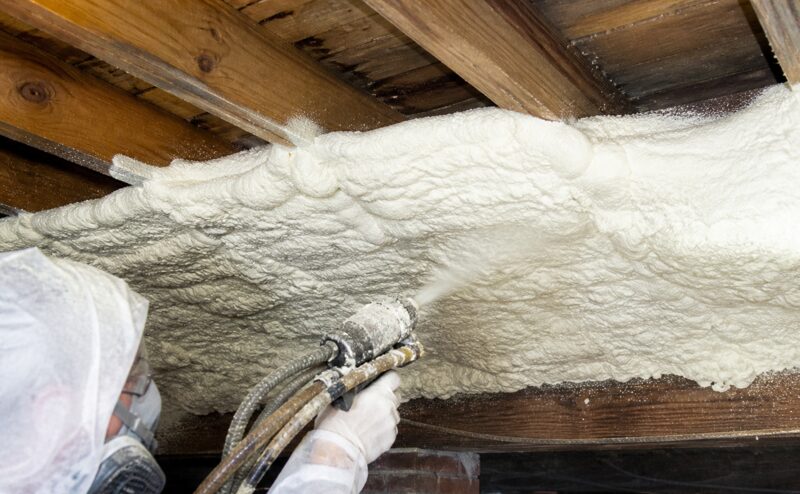
Spray foam insulation is a type of insulation which can be sprayed on the inside of roofs, in walls and floors1. It comes in two forms, open cell and closed cell2. It was one of the measures covered by the government's Green Homes Grant scheme2. None of that makes it illegal, and the question of legality is a distraction from the real issue, which is reversibility.
The risks listed by independent guidance are cumulative rather than theoretical: a high cost compared to other forms of insulation, reduced ventilation causing condensation and dampness, covering up roof problems, difficulty of removal, lower property value, and mortgage difficulty with some lenders1. Each of these interacts with the others. Foam that covers roof timbers hides defects until they are advanced. Reduced ventilation raises moisture levels in a roof space that was previously breathing. Removal to investigate or repair is expensive, and the cost lands on the household.
Official modelling has examined the moisture question directly. For sprayed foam applied to high resistance underlay, the modelling identified higher levels of risk in some scenarios10. That is a conditional finding, not a blanket prohibition, and it points to the installation detail rather than the product category as the deciding factor.
The mis-selling pattern specific to spray foam is the removal charge. There are reports of some traders incorrectly installing spray foam insulation, then charging for it to be removed1. In that sequence the household pays twice: once for work that should not have been done, and again to undo it. The paperwork that would have exposed the problem before installation is a pre-work survey report, a product certificate showing what type of spray foam was used, a guarantee from the trader and a guarantee from the manufacturer1.
What a genuine grant scheme looked like
The Great British Insulation Scheme, formerly known as ECO+, was a government energy-efficiency scheme administered by Ofgem and covering Great Britain11. It was designed to deliver improvements to the least energy-efficient homes in Great Britain to help tackle fuel poverty and reduce carbon emissions11, and it was expected to cost £1 billion, targeting around 300,000 households4. It worked by placing an obligation on medium and large energy companies to deliver measures that result in reduced energy usage11.
The delivery rules are the useful part for anyone assessing a current offer, because they show what a real scheme required. All installers had to be a TrustMark-registered business3, and all measures available under the scheme had to be delivered according to PAS2030/2035 standards3. The scheme delivered the rapid installation of value-for-money insulation measures and, in some cases, heating controls3, with one insulation measure per home6. Cavity wall insulation, including party wall, was funded for both eligible groups, and certain heating controls such as room thermostats were allowed as a secondary measure for eligible insulation measures installed in owner-occupied premises in the low-income group3. Higher-cost measures such as solid wall insulation were more likely to require a contribution from the household3.
Eligibility ran through two routes. The general group covered households with properties rated EPC D to G within Council Tax bands A to D in England and A to E in Scotland and Wales6. The low-income group covered homeowners or tenants receiving at least one of a listed set of benefits including Child Benefit, Pension Guarantee Credit, Income-related Employment and Support Allowance, Income-based Jobseeker's Allowance, Income Support, Universal Credit, Housing Benefit and Pension Credit Savings Credit6. The scheme applied to England, Scotland and Wales12.
| Item | Detail |
|---|---|
| Scheme name | Great British Insulation Scheme, formerly ECO+11 |
| Administrator | Ofgem11 |
| Operating period | April 2023 to March 20264 |
| Installer requirement | TrustMark-registered business with a registration number3 |
| Delivery standard | PAS2030/20353 |
| Measures installed | 126,000 up to the end of December 20254 |
| Measure mix | 38% cavity wall, 28% loft, 25% heating controls, 4% solid wall4 |
| Cost to bills | £5 to a typical annual dual fuel bill in 2023/24 and £17 in each of the following two years4 |
The scheme has closed. The service to check eligibility for free or cheaper home insulation has closed5, and applications for the Great British Insulation Scheme have closed13. Installations had to be complete by 31 March 2026, when the scheme ended6. Any approach now that presents itself as a live Great British Insulation Scheme offer is describing a scheme that has finished.
TrustMark registration: the check that separates legitimate work
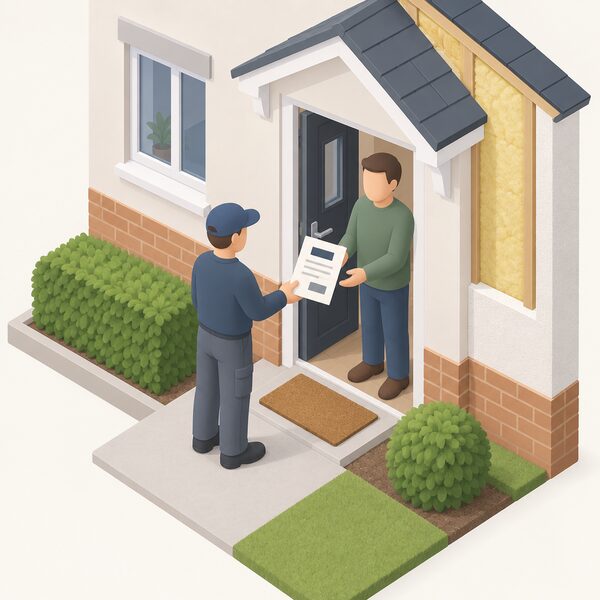
TrustMark is the government-endorsed competent person register for finding an installer that will assess your circumstances and property to identify suitable measures14. Under the Great British Insulation Scheme, all installers had to be TrustMark-accredited and to have a registration number6. The requirement was not advisory. The scheme's supply chain guidance states that all installers must be a TrustMark-registered business3.
The register has a second function beyond vetting at the point of hire. TrustMark carried out routine checks that uncovered substandard solid wall insulation8, and installers were reinstated only after meeting requirements on TrustMark's "robust six-point plan", including full remediation of the problems identified, with 22 fully reinstated as of November 20259. That is a body with enforcement teeth, not just a directory.
The register's own record-keeping has been criticised. Neither TrustMark nor DESNZ have been able to provide minutes of meetings which took place between 2022 and 20249. That is a governance finding about oversight, and it sits alongside the fact that the checks themselves found real defects.
Registration also appears in legislation beyond the insulation schemes. The Warm Home Discount (England and Wales) Regulations 2026 require that the boiler or central heating system is installed by, or under the responsibility of, a person who is registered with TrustMark, with a certificate of lodgement issued by the operator of TrustMark15. The same pattern appears in delivery guidance, which states that measures should be installed by or under the responsibility of a TrustMark registered installer and have a relevant certificate of lodgement16.
For a household, the practical check is narrow: a registration number that can be verified, and a certificate of lodgement after the work. A trader who cannot produce either is not operating to the standard the funded schemes required.
Guarantees, warranties and what protection covers
The guarantee position under the Great British Insulation Scheme is stated without ambiguity: Ofgem does not administer appropriate guarantees or financial protection for measures installed on the scheme3. The current list of appropriate guarantees can be found on the TrustMark website3. That means the household's protection is a contract with an installer and a manufacturer, not a scheme backstop.
Where scheme rules did specify a guarantee, they specified a long one. Under the Northern Ireland Affordable Warmth Scheme, if a household is awarded grant aid for cavity wall or solid wall insulation, the installer employed must be able to provide a minimum 25-year guarantee for the work17. That is a scheme-specific requirement and it shows the order of magnitude a household should expect for wall insulation.
For spray foam, the documents to hold are a pre-work survey report, a product certificate showing what type of spray foam was used, a guarantee from the trader and a guarantee from the manufacturer1. Two guarantees, from two parties, is the standard. A single trader guarantee leaves the household exposed if the business ceases trading.
"where spray foam insulation has been installed in line with the relevant standards, it should not require removal or prevent homeowners obtaining a mortgage"
The distinction between a guarantee and a warranty matters here. A guarantee is a promise from a party, enforceable against that party. A warranty is a term of a contract. Neither is insurance, and neither survives the failure of the company that gave it. The scheme's own evidence forms, the Great British Insulation Scheme and ECO4 forms, are used to collect and provide evidence of measure eligibility3, which is why retaining them matters if a problem emerges later.
If the work is already done: surveys, removal and selling
Removal of spray foam is quoted at around £40 per square metre2. Independent guidance advises checking with a building surveyor before paying to have spray foam insulation removed, or using a specialist spray foam assessor from the Property Care Association1. The reasons removal becomes necessary are listed as damp and condensation, damage to the property, or needing to make a repair such as a roof repair1.
The mortgage question has an official answer that is more permissive than the market sometimes suggests. Where spray foam insulation has been installed in line with the relevant standards, it should not require removal or prevent homeowners obtaining a mortgage2. The qualification is doing the work in that sentence: installation to standard, evidenced, is the position the government describes. Independent guidance nonetheless lists mortgage difficulty with some lenders and lower property value among the risks1, so the practical position depends on the lender and on what the installation looks like.
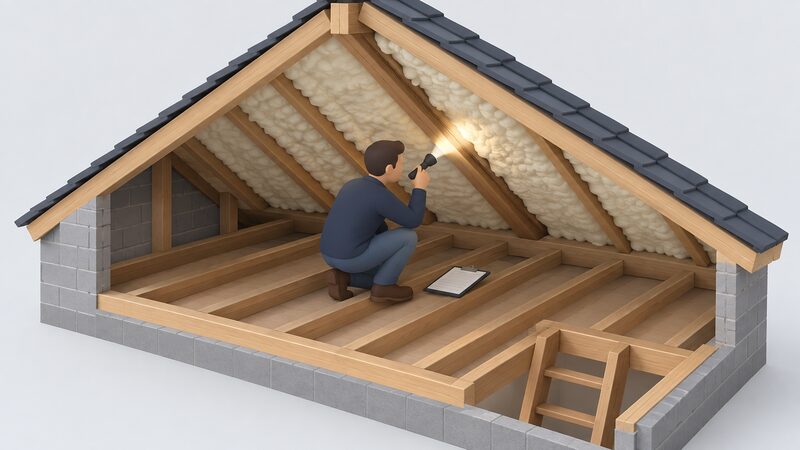
For a household selling a home with spray foam, the useful preparation is documentary. A pre-work survey report, a product certificate showing the type of spray foam used, and guarantees from both trader and manufacturer1 answer the questions a lender's valuer is likely to raise. Where those documents do not exist, a specialist assessor's report is the alternative route.
The cost asymmetry is the point to hold. Removal at around £40 per square metre2 is a bill that arrives after the original installation cost, and it is the reason the pre-installation advice is to get independent advice from a buildings surveyor before installation, or at least three quotes from different home improvement traders if surveyor advice costs too much1.
Where to report a scam or complain

Reporting routes differ by what went wrong and under which scheme the work was funded.
- Suspected fraud under the Great British Insulation Scheme: Ofgem's counter fraud section, which also covers Ofgem's role in preventing fraud18.
- Complaints about an installer: Ofgem or the energy provider13.
- Insulation installed under the scheme and faulty: the Ofgem energy company obligation complaints guidance5.
- General consumer problems with an insulation sale: Citizens Advice1.
- Scheme helpline (while it ran): 0800 098 795013.
- Contact details for obligated suppliers: published on Ofgem's linked page18.
The distinction between fraud and a complaint is worth keeping. Fraud reporting goes to Ofgem's counter fraud function18. A dispute about workmanship goes through the energy company obligation complaints guidance5 or to the installer and the energy provider13. A household that has been cold-called but has not signed anything has a consumer problem rather than a scheme complaint, and Citizens Advice is the route for that1.
For anyone assessing a current approach, the checkable facts are the scheme name and its status, the installer's TrustMark registration number, and the paperwork offered before work begins. The Great British Insulation Scheme has closed13, its eligibility checker has closed5, and installations had to be complete by 31 March 20266. An offer that cannot be matched to a live scheme, a verifiable registration and a documented guarantee is an offer with nothing behind it.
Sources18 cited
- Make sure your home is energy efficient, Citizens Advice, 2026-09-19
- Spray foam insulation and mortgages, House of Commons Library, 2026-09-20
- Great British Insulation Scheme supply chain, Ofgem, 2026-09-17
- Great British Insulation Scheme: research briefing, House of Commons Library, 2026-09-17
- Apply for the Great British Insulation Scheme, GOV.UK, 2026-09-17
- Great British Insulation Scheme: homeowners and tenants, Ofgem, 2026-09-17
- Written statement: Housing Cabinet Secretary responds to UK government action on GBIS and ECO4, Welsh Government, 2025-01-23
- Action taken to protect households with poor quality insulation, GOV.UK, 2025-01-23
- Public Accounts Committee report on insulation schemes, UK Parliament, 2026-01-23
- Moisture risk of spray foam insulation applied to timber sloped roofs, GOV.UK, 2024-03-28
- Great British Insulation Scheme, Ofgem, 2026-09-17
- Great British Insulation Scheme release, November 2025, GOV.UK, 2025-11-20
- ECO4 scheme, West Lindsey District Council, 2025-07
- Energy Company Obligation (ECO) scheme, Leeds City Council, 2026-09-20
- Warm Home Discount (England and Wales) Regulations 2026, legislation.gov.uk, 2026-03-27
- ECO4 delivery guidance version 4.0, Ofgem, 2026-03-26
- Affordable Warmth Scheme, Northern Ireland Housing Executive, 2026-09-17
- Great British Insulation Scheme: contacts, guidance and resources, Ofgem, 2026-09-17
 Grant ScamsGrant schemes attract cold callers, doorstep sellers and fake approval letters using real scheme names.
 Spot and Report an Energy ScamThe common approaches used in rebate texts, grant cold calls, doorstep sales and fake supplier emails, and the checks that confirm whether contact is genuine.
 Scams and Mis-SellingHow energy supplier scams present, what the doorstep and phone selling rules require, the redress available when a contract was mis-sold, and how the Energy Ombudsman handles a dispute.
 Mis-Selling and Doorstep SalesCovers the practices that amount to misleading and aggressive selling of solar, insulation, boilers and batteries, and the rules that prohibit them.
 Finding an Insulation InstallerHow to find, verify and check an insulation, glazing or ventilation installer in the UK: the registration schemes, trade bodies and guarantee arrangements that cover the work, how to compare quotes, what a written specification should state, and how complaints and disputes are handled.
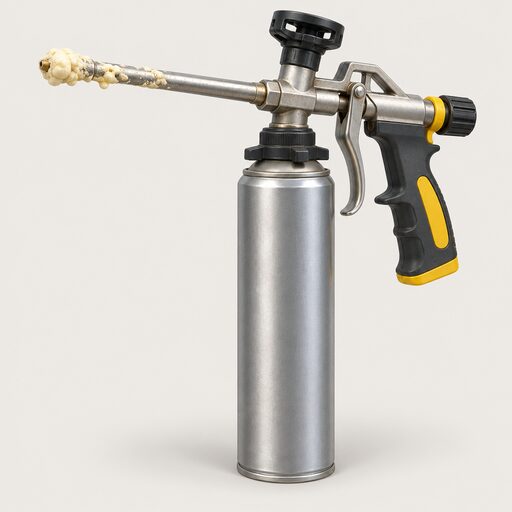 Spray Foam InsulationOpen and closed cell spray foam on roof slopes and under floors: what it costs, the moisture and timber decay risks identified in official modelling, why lenders and surveyors ask questions, what paperwork exists and what removal involves.