
In this answer
Short answer
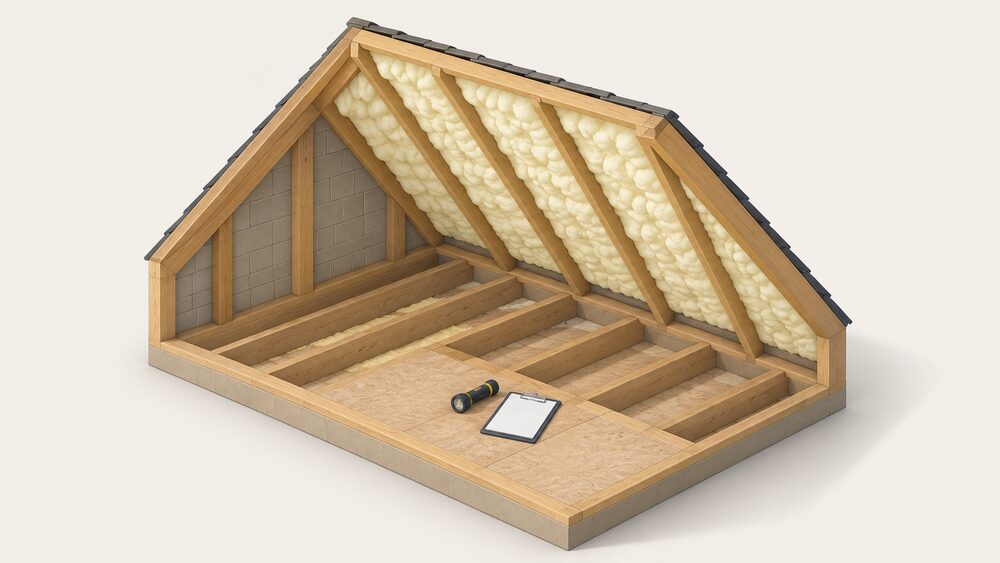
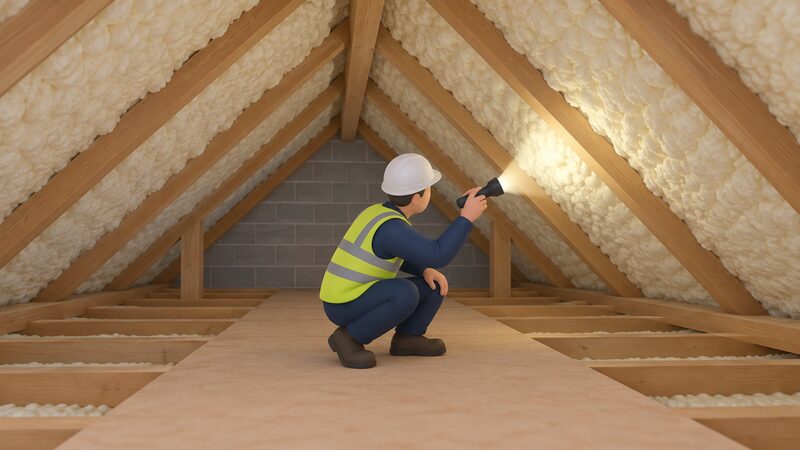
Spray foam insulation is identified by sight: a bumpy cream, yellow or blue foam between the rafters, rather than the flat mineral wool rolls most lofts contain1. It is sprayed onto the inside of roofs, walls and floors, and most often onto the underside of sloping roofs in a loft2. If the foam is there, the next questions are which type it is, whether it was installed to standard, and what paperwork exists to prove it.
The distinction that matters most is open-cell against closed-cell. Closed-cell foam is a better insulator but is generally pricier, and it acts as a vapour barrier that can reduce ventilation; open-cell foam is less dense, more vapour permeable and needs a thicker layer for the same effect3. Government guidance is clear that where spray foam has been installed in line with the relevant standards, it should not require removal or prevent homeowners obtaining a mortgage4.
What follows is how to confirm what is in a roof, how the two foam types differ in practice, and what the evidence says about removal, cost and lender caution. The wider context sits in spray foam insulation and in roof insulation.
What spray foam is and where it is installed
Spray foam insulation is a type of insulation which can be sprayed on the inside of roofs, in walls and floors1. In practice it is most often used in lofts, where the foam is sprayed onto the underside of sloping roofs, and it is also used to insulate under suspended floors2. Both open-cell and closed-cell types are usually made from polyurethane and filled with bubbles of gas or air5.
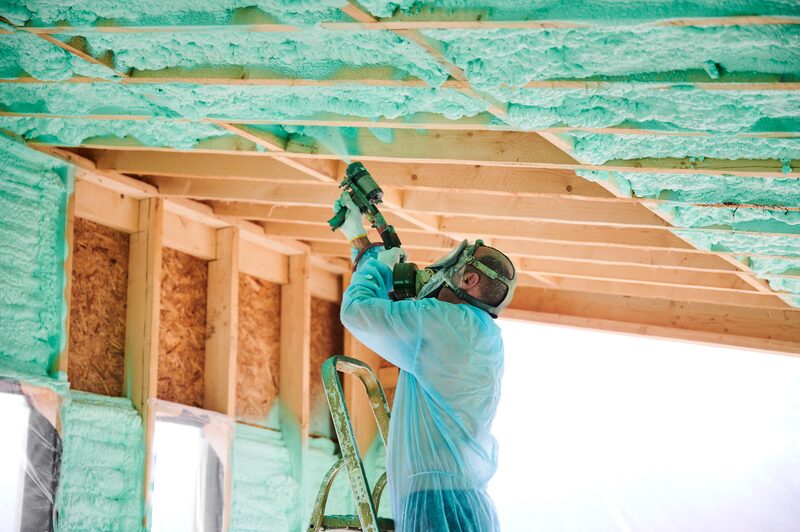
Installation is mainly professional, though DIY kits exist6. The National Insulation Association strongly warns against DIY spray foam installation, and installers must be trained and assessed by the BBA, with the product carrying a BBA certificate or equivalent5. One maker states that spray foam can only be installed by a professional, who mixes the product on site at the home7.
There is a newer route for floors. A small remote-controlled robot can be sent into the void under the floor to install spray foam onto the underside of the boards, a method used in underfloor insulation work8. A separate project installed a 12.5cm thick layer of Elastospray foam insulation under floors by this method9.
Two conditions attach to roofs specifically. No insulation system should be applied to a leaking roof, and the roof must be fixed first10. In listed properties, listed building consent must be obtained before installing spray foam anywhere, and this is unlikely to be granted2.
For a household, the significance is that spray foam is a fabric measure applied to the building itself, with no supplier, fuel or app in the loop once it has set. The dependence it creates is different: on the installer's competence, on the paperwork that proves it, and on the timber and ventilation of the roof it covers.
Signs to look for in the loft
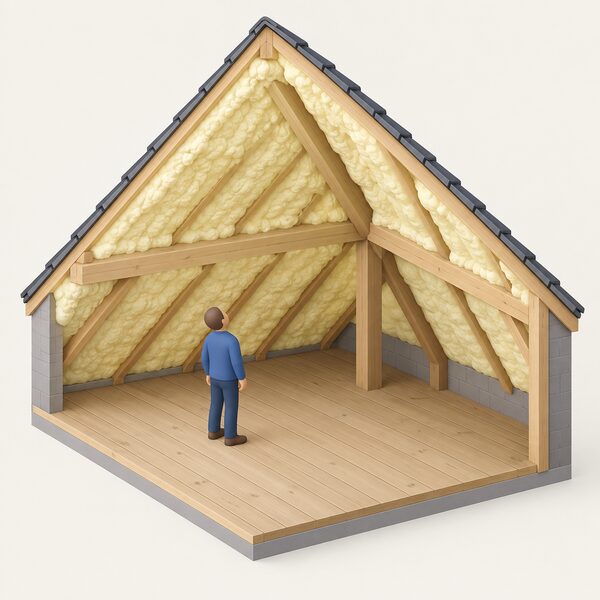
The visual signature is consistent across the guidance: a bumpy cream, yellow or blue foam between the rafters1. It is not laid flat like a quilt and it is not loose. It is bonded to whatever it was sprayed onto, which is why it is found coating timbers, and why any timbers coated in foam are more difficult to replace, as are tiles or slates if there is no roofing felt or other layer between foam and tiles10.
A household checking a loft should also look at what the foam has covered. Spray foam can cover up roof problems, and it reduces ventilation, which can cause condensation and dampness2. Closed-cell foam in particular is a barrier to moisture, so a room or loft needs to be well ventilated to avoid the build-up of condensation5. Building regulations require adequate ventilation when installing loft insulation, and local building control can confirm what applies11.
The paperwork is part of the identification. A household should hold a report from a survey done before any work started, a product certificate showing what type of spray foam was used, a guarantee from the trader who carried out the work, and a guarantee from the manufacturer of the insulation1. Where a scheme installation is monitored, the monitoring agent must confirm that a correctly signed declaration is present in the loft and that any pre-existing loft insulation is not more than 100mm deep12. Under ECO4 delivery guidance, the installer, operative or assessor, and either the occupier or landlord, must sign the pre-existing loft declaration regarding the presence of loft insulation13.
If none of that paperwork exists, the foam can still be identified by a surveyor, but its provenance and compliance cannot be established from documents. That is the practical difference between foam that a lender will accept and foam that raises questions.
Open-cell or closed-cell: why the type matters
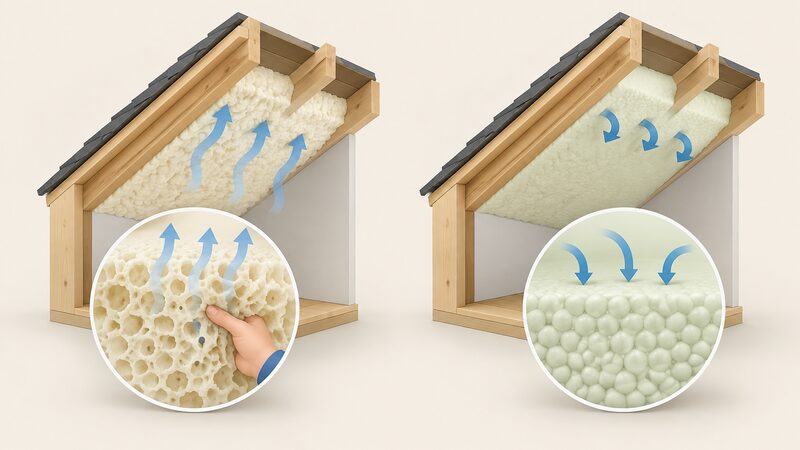
Spray foam insulation comes in two forms, and the difference is not cosmetic4. Closed-cell foam is a better insulator than open-cell, but it is also a vapour barrier that can reduce ventilation4. Open-cell foam does not provide the same level of insulation because it is not as dense4.
The physical test is simple. Open-cell foam is less dense once set and can be compressed with a hand, so a thicker layer is needed for the same effect; it allows moisture through, so there is less chance of condensation building up5. Closed-cell foam is denser and generally pricier5. Open-cell foam is more vapour permeable, more flexible and better for sound insulation, but more fragile than closed-cell, and less effective as an insulator so a thicker layer is needed2. The Energy Saving Trust describes open-cell as a less effective insulator requiring a thicker layer than closed-cell for the same effect10. Open-cell spray foam is often used as sound insulation because it blocks and reduces airflow5.
| Property | Open-cell | Closed-cell |
|---|---|---|
| Insulation performance | Less effective, thicker layer needed4 | Better insulator4 |
| Density once set | Less dense, compressible by hand5 | Denser5 |
| Moisture behaviour | Allows moisture through, less condensation risk5 | Vapour barrier, can reduce ventilation4 |
| Typical price | Lower5 | Generally pricier5 |
| Common non-thermal use | Sound insulation5 | Moisture barrier5 |
For comparison with the alternative, 100mm of spray foam insulation is equivalent to around 170mm of mineral wool loft insulation, according to the National Insulation Association5. Spray foam is also much more expensive to install than standard mineral wool laid on the loft floor2. The comparison is set out further in spray foam vs mineral wool loft.
The type also bears on moisture risk in timber roofs. Government research into spray foam applied to timber sloped roofs in dwellings identified high levels of risk in Newcastle14. The related question of whether open-cell foam is lower risk on timber roofs is covered in open cell spray foam timber roofs.
Why lenders and surveyors raise concerns
The mortgage question is the one that follows identification. Mortgage lenders are wary of spray foam insulation, often refusing to lend to buyers if the property has it installed15. Surveyors who encounter spray foam during an inspection may reduce the value of the property or request an independent specialist report, and it may render a property un-mortgageable in the eyes of a lender5. The presence of spray foam can make homes harder to sell, particularly if a survey finds the insulation has been poorly installed2.
Parliament has recorded the practical effect. Many households who had spray foam installed have found they have encountered problems when selling their home16. The recorded risks include high cost compared to other forms of insulation, reduced ventilation causing condensation and dampness, covering up roof problems, difficulty of removal, lowering property value, and mortgage difficulty with some lenders2. Independent guidance notes there are controversies around spray foam and that if installed badly it can be very damaging for a home6.
The counterweight is the government position: where spray foam insulation has been installed in line with the relevant standards, it should not require removal or prevent homeowners obtaining a mortgage4. The Insulation Manufacturers Association published a code of practice for the installation of spray foam insulation in roofs in May 20234. That code, and the BBA certification behind it, is what separates compliant installations from the cases that generate lender caution.
There is also a fire dimension under investigation. Government work has examined retrospectively applied spray foam roof insulation to investigate the implications for compliance with Regulation B4(2)11. The broader safety picture is covered in insulation safety and fire.
What to do if you find spray foam
The first step is confirmation, not removal. Independent guidance advises checking with a building surveyor before paying to have spray foam insulation removed, or using a specialist spray foam assessor from the Property Care Association1. The same guidance advises getting independent advice from a buildings surveyor before installation, or at least three quotes from different home improvement traders if surveyor advice costs too much1.
Removal costs are quoted rather than published. Official guidance puts removal at £40 per square metre4. Government statistics give a range of £2,000 to £3,200 for removal of spray foam and cavity wall insulation in a three bedroom semi-detached property17. Independent guidance describes removal as very expensive, in the £1,000s for most properties2. For comparison, the National Insulation Association told Which? that typical costs for professionally installed spray foam loft insulation are around £2,500 for a three bedroom semi-detached property5. All of these are installer-quoted figures rather than fixed prices.
Removal is undertaken for specific reasons: damp and condensation, damage to the property, or needing to make a repair such as a roof repair1. Spray foam is difficult to remove from floor joists, wires and pipework, so it can present a problem when maintenance work is needed in that area in future18. Timbers coated in foam are more difficult to replace, as are tiles or slates where there is no roofing felt between foam and tiles10.
On safety, harmful fumes are produced during installation and in the days it takes the material to set, and if poorly installed, dangerous chemicals can continue to leach out for a long time afterwards2. That is a reason the National Insulation Association warns against DIY work5.
A household that finds foam should assemble the documentation first: the pre-work survey report, the product certificate, the trader's guarantee and the manufacturer's guarantee1. Where the foam was installed to the relevant standards, the government position is that removal should not be required and a mortgage should not be prevented4. Where it was not, the surveyor's report is the document that determines what happens next.
Sources18 cited
- Make sure your home is energy efficient, Citizens Advice, 2026-09-17
- Spray foam insulation, Centre for Sustainable Energy, 2025-11
- Spray foam insulation, House of Commons Library, 2026-09-20
- Spray foam insulation, Which?, 2026-05-26
- Roof insulation, Which?, 2026-05-05
- The ultimate guide to loft insulation, OVO Energy, 2021-11-07
- Floor insulation, Which?, 2026-05-26
- Q-Bot application of underfloor insulation, National Energy Action, 2018-04-25
- Spray foam insulation, Energy Saving Trust, 2024-12-05
- Fire safety: roof insulation fire testing summary and recommendations, GOV.UK, 2025-12-22
- Building regulations and ventilation, nidirect, 2026-09-02
- ECO4 delivery guidance version 4.0, Ofgem, 2026-03-26
- ECO3 guidance part I, Ofgem, 2017-02-10
- Moisture risk of spray foam insulation applied to timber sloped roofs, GOV.UK, 2024-03-28
- House insulation: the ultimate guide, Federation of Master Builders, 2026-09-20
- Energy market consumer protection, Hansard, 2026-06-17
- Energy innovation needs assessment: heat and buildings, GOV.UK, 2025-06
- Park homes advice, Centre for Sustainable Energy, 2026-07
 Spray Foam InsulationOpen and closed cell spray foam on roof slopes and under floors: what it costs, the moisture and timber decay risks identified in official modelling, why lenders and surveyors ask questions, what paperwork exists and what removal involves.
 Multifoil InsulationDoes thin foil insulation really keep a home warm, and how does it compare with thick rolls of wool or rigid boards?
 Selling a Home With Energy KitCovers the paperwork a sale requires when a home has solar panels, a heat pump, insulation or a leased roof, and how warranties, export payments and guarantees transfer.
 Insulation Scams and Cold CallsHow funded insulation mis-selling works, from the cold call and the fake 'illegal insulation' claim to spray foam removal bills, plus the TrustMark check, the guarantee position, and where to report a scam.
 Building RegulationsExplains the building control position for a solar installation across the four nations, the structural assessment of the roof, and the fire performance requirements for roof-mounted and integrated arrays.
 Solar Mounting SystemsWill your roof take the extra weight of solar panels, and will it still keep the rain out afterwards?