
In this answer
Short answer
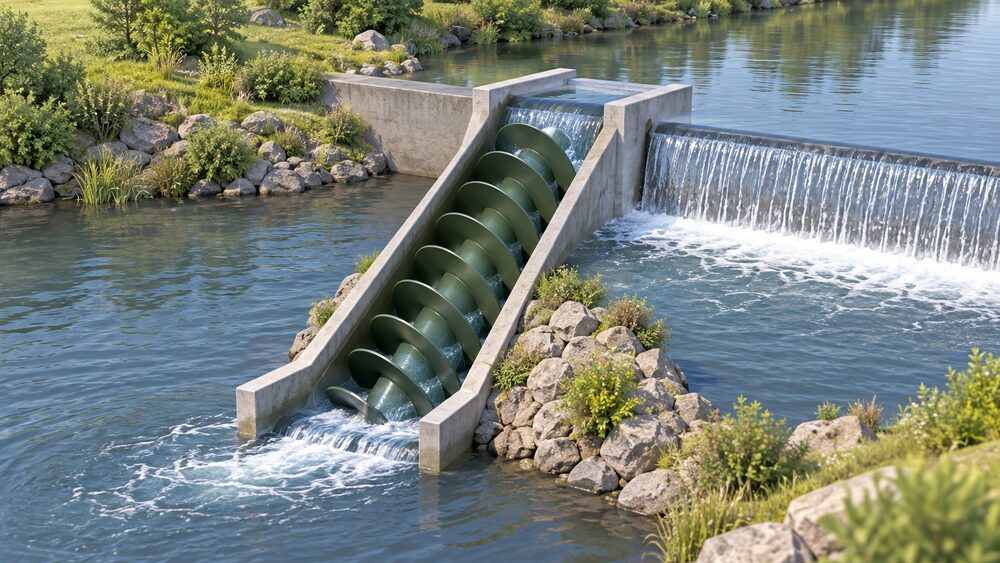
An Archimedes screw turbine is a low-head machine. It is designed for sites where the drop of water is small, and independent guidance from the Centre for Alternative Technology notes that a higher head turbine usually needs a drop of over 10 metres to be viable1. That places the screw in the band below 10 metres, and in practice on drops from around half a metre upward, depending on the site and the maker's specification.
Head is only half the picture. The Energy Saving Trust defines head as the difference in height between the water at the top of the system and the water at the bottom, and says a suitable site needs a water source with a combination of flow and head2. The two figures together set the power available. The Centre for Alternative Technology gives a working estimate: multiply the flow rate in litres per second by the head in metres, multiply by 10, then halve the result for losses to get watts1.
What that means for a household is that a low head is not a barrier in itself. A community-owned 50kW Archimedes screw on the River Esk at Ruswarp, near Whitby in North Yorkshire, shows the scale a good low-head site can reach3. The rest of this page sets out the head range, why the screw suits low-head sites, how flow and head combine, what a site assessment involves, and what owning one means for a household's energy independence.
Low head is the point: typical operating ranges
The Archimedes screw occupies a specific band of the head spectrum. Independent guidance states that a higher head turbine usually needs a drop of over 10 metres to be viable1. Below that figure, the machines that work well change. Pelton and Turgo turbines, which are high head designs, are described as comparatively cheap, easy to install and good in fluctuating flow, but they need the head to suit them1.
The screw sits in the low-head band, and the practical range runs from around half a metre up to about 10 metres. The exact minimum depends on the maker and the site, and no single figure applies to every installation. What matters is that the screw is chosen when the drop is too small for a high head machine but large enough to turn a helical rotor in a trough.
Scale is a separate question from head. Systems with a capacity of less than 100 kilowatts are sometimes referred to as micro-hydro, and very small systems under five kilowatts are also known as pico-hydro4. A screw can fall into either category depending on the site. The Whitby Esk Valley scheme, a community-owned 50kW Archimedes screw on the River Esk at Ruswarp, sits within the micro-hydro band3.
For a household, the head figure is the first filter. A site with a drop of a metre or two and a reliable flow is a candidate for a screw. A site with a drop of 20 metres is not, because a Pelton or Turgo will make better use of that head. The screw's value is that it opens up sites the high head machines cannot serve.
Why the screw suits low-head sites where other turbines do not
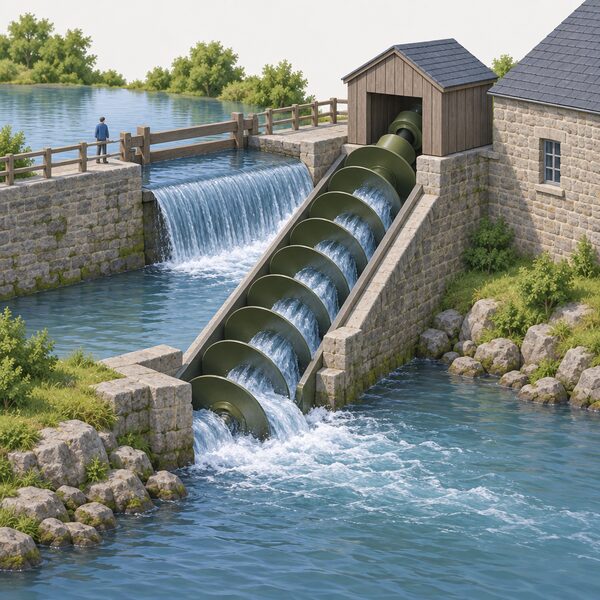
The reason the screw works at low head comes down to how it extracts energy. A high head turbine relies on pressure built up by a long column of water, which is why Pelton and Turgo designs need a drop of over 10 metres to be viable1. The screw does not need that pressure. It uses the weight of water falling through the helical flights to turn the rotor, so a small drop still does useful work.
That makes the screw a fit for the many UK sites where a river has a modest fall, often at an old mill weir or a natural step in the bed. The civil works around the screw, including any weir or impoundment that creates or controls the fall, are part of the scheme, and abstraction and impoundment are licensed separately. The consent position therefore matters as much as the hardware.
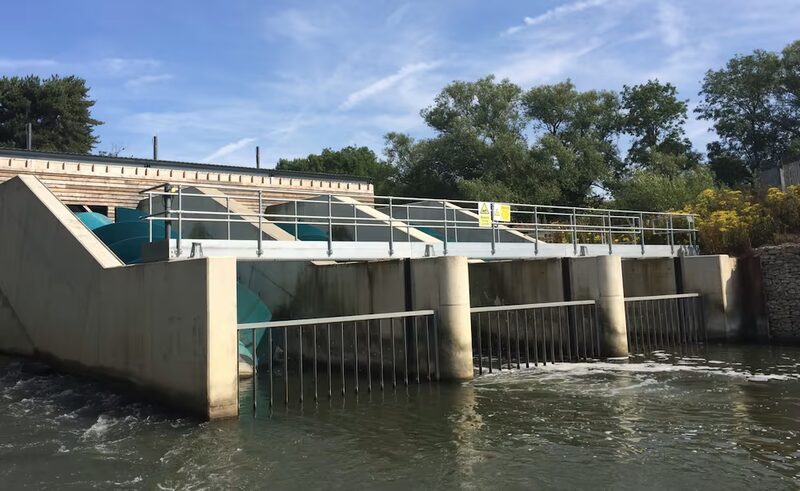
The screw also has a practical advantage on fish passage, which is why fish screening requirements are treated separately for this turbine type. The slow rotation and the gaps between the flights allow fish to pass through the machine rather than being screened out, which is one reason it is favoured on low-head sites where environmental consent is a live issue.
For a household, the point is that the screw is not a compromise forced on a bad site. It is the correct machine for a low-head site, and the alternative is usually no scheme at all rather than a different turbine. The trade-off is that low head means lower power density, so a screw needs a good flow to produce a worthwhile output.
Flow rate and head together: how the two set the power output
Head alone does not determine output. The Centre for Alternative Technology gives the working estimate: multiply the flow rate in litres per second by the head in metres, multiply by 10, then halve the result for losses to get watts1. That formula shows why a low-head site with a strong flow can outperform a higher head site with a weak one.
| Site type | Head | Flow | Estimated output |
|---|---|---|---|
| Low head, strong flow | 1 metre | 500 litres per second | apply the formula below |
| Low head, modest flow | 2 metres | 100 litres per second | apply the formula below |
| Higher head, weak flow | 8 metres | 20 litres per second | apply the formula below |
For each of these sites the estimate comes from the same arithmetic: multiply the flow rate in litres per second by the head in metres, multiply by 10, then halve the result to allow for losses, and the answer is in watts1. The pairing matters more than either figure alone, because a large flow over a small drop and a small flow down a steep drop can reach similar outputs.
The figures in the table are worked through the Centre for Alternative Technology's estimate, which halves the raw product for losses1. They are illustrative of the arithmetic, not predictions for any specific site. The point they make is that flow and head trade off against each other, so a householder with a small drop should not dismiss the site before measuring the flow.
The Whitby Esk Valley scheme shows what the arithmetic can deliver at scale: a community-owned 50kW Archimedes screw on the River Esk at Ruswarp, near Whitby, North Yorkshire3. That output comes from the combination of the head available at the weir and the flow of the river, not from either figure alone.
For a household, the practical question is the flow available for most of the year, not the peak. A river in spate will pass far more water than the turbine can use, and a river in summer low flow may pass too little. The estimate formula uses the flow the scheme can actually take, so the design flow is the figure that matters.
Site assessment: measuring your head and flow before committing
A micro hydro scheme starts with measurement, not hardware. The Energy Saving Trust sets out the two site requirements: a water source with a combination of flow, meaning how much water is flowing through the system, and head, meaning the difference in height between the water at the top of the system and the bottom2. Both figures need to be established before any commitment.
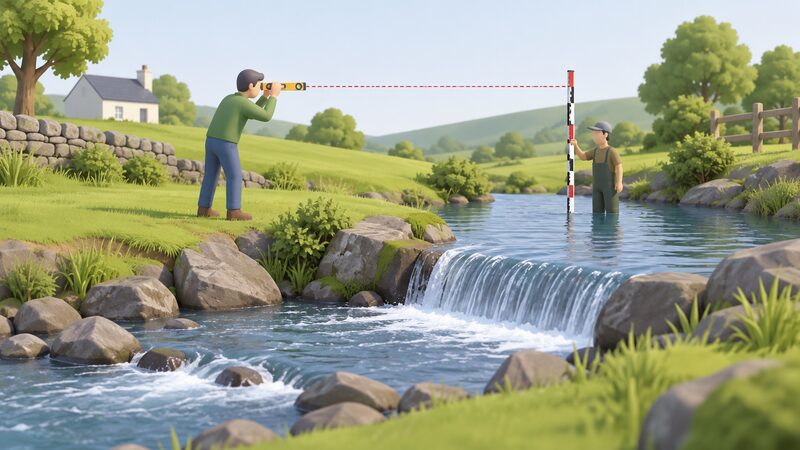
Head is measured as a vertical distance between the upstream water level and the level where the water leaves the turbine. It is not the length of the channel or the pipe. Flow is measured over time, because a single reading on one day says little about what the river does across a year. The Centre for Alternative Technology's estimate then converts the two figures into a power figure, halved for losses1.
The scale of the scheme affects the connection process. For installations of 50kW or greater, it is worth checking the thermal Centralised Network View map to understand constraints in the area5. That threshold matters because the Whitby scheme at 50kW sits exactly at it3.
The assessment stage is where a scheme is made or lost. A site with a measured head and a measured flow that the estimate turns into a worthwhile output is a candidate. A site where the flow is unmeasured, or where the head is assumed rather than surveyed, is not yet a project.
Grid connection, licensing and what owning a screw means for energy independence
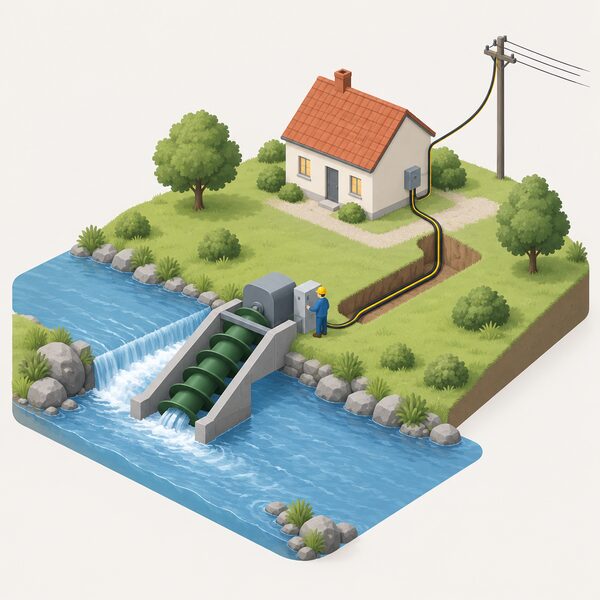
A screw scheme changes a household's relationship with its energy supply, but it does not remove dependence. The turbine generates whenever the river flows, which for a run-of-river scheme means most of the year but not at a constant rate. Output falls in dry periods and rises in wet ones, so the household still draws on the grid or a battery to cover the gaps.
Where the scheme is grid-connected, any unused or excess electricity can be exported to the grid and sold to the local electricity supply company7. That export route is what turns a generating scheme into an income stream as well as a supply. The connection itself is governed by the distribution network operator's process, and for installations of 50kW or greater it is worth checking the thermal Centralised Network View map for constraints5.
For a house with no mains connection but with access to a micro hydro site, a good hydro system can generate a steady, more reliable electricity supply than other renewable technologies at a lower cost8. That is the strongest case for the screw: on an off-grid site with a reliable flow, it provides baseload rather than intermittent output.
The dependence that remains is real. The household depends on the river, on the abstraction and impoundment licences that allow the water to be taken, on the environmental consents that govern fish passage and screening, and on the grid or a battery to balance the output. A screw is a long-lived asset, but it is not a severance from the wider system.
"For houses with no mains connection but with access to a micro hydro site, a good hydro system can generate a steady, more reliable electricity supply than other renewable technologies at a lower cost"
The licensing position is the part householders most often underestimate. Abstraction and impoundment are regulated separately from the turbine itself, and the environmental requirements around fish passage and screening apply to the scheme as a whole. A screw that passes fish well still needs the consents in place before it can run.
For a household weighing a screw against other microgeneration, the comparison is with micro hydro power generally and with micro hydro vs micro wind for a rural site. The head and flow figures on this page are the starting point for that comparison, and the head and flow sizing guide takes the measurement process further.
Sources8 cited
- Micro Hydro, Centre for Alternative Technology, 2025-07-01
- Hydroelectricity, Energy Saving Trust, 2025-11-06
- Seeing is Believing North East and Yorkshire, Community Energy England, 2026-09-20
- Consumer Code, RECC, 2026-07-01
- Generation Connections, SSEN, 2026-09-19
- Building Regulations and Electrical Works, Richmond Council, 2026-06-02
- Wind, nidirect, 2026-05-18
- Hydro Electricity, Planning Portal, 2026
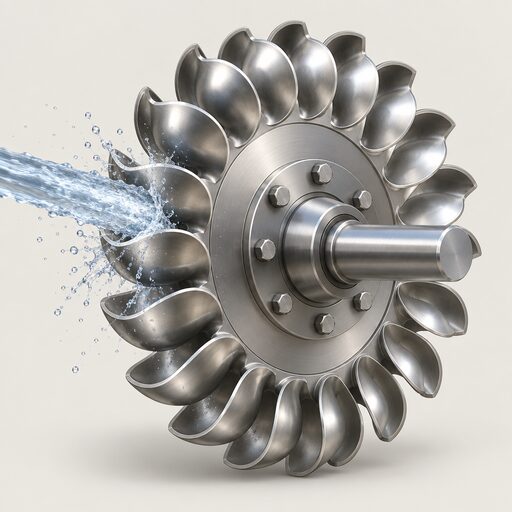 Hydro Turbine TypesWhich hydro turbine suits your site comes down to how far the water falls and how much flows past each second.
 Turbine Siting and Wind SpeedIs my garden windy enough for a home wind turbine?
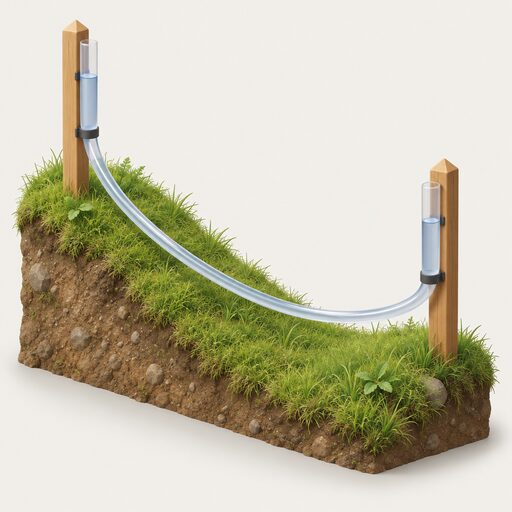 Micro Hydro Head and FlowHead is the drop from the top of your water supply to the bottom, and flow is how much water comes down.
 Domestic Wind TurbinesCan a wind turbine really power a home, and is your site windy enough?
 Abstraction Licences and PermitsTaking water from a stream to power a turbine needs permission, and where you live decides who grants it.
 Building-Mounted Wind TurbinesWill a wind turbine on your roof actually make enough electricity to be worth it?