
In this answer
Short answer
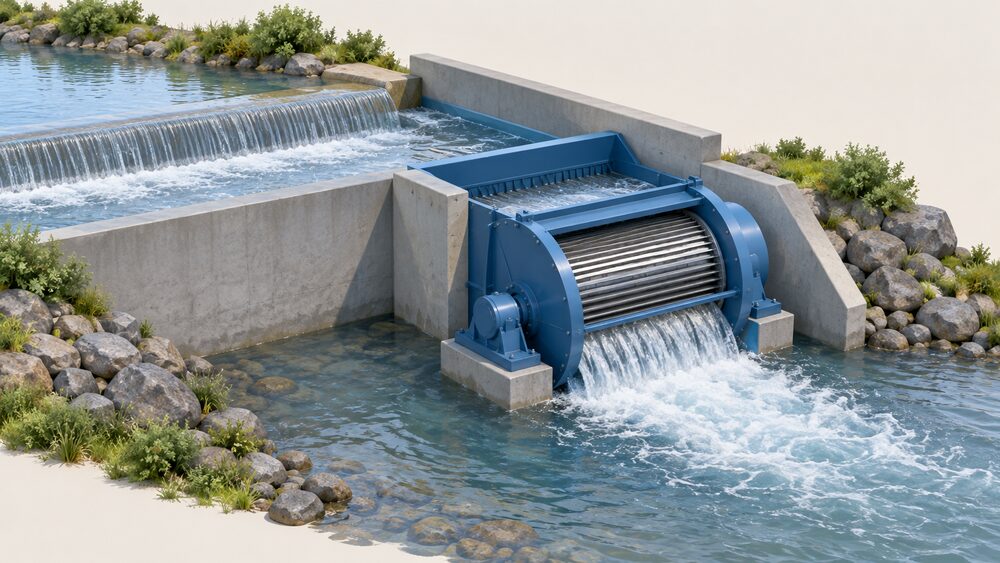
A crossflow turbine is a low head machine. Independent guidance groups it with Archimedes screw turbines as the options for low head sites, and notes that these types tend to be much bigger for the same power output than high head machines1. The same guidance puts the dividing line in plain terms: a higher head turbine usually needs a drop of over 10 metres to be viable1. Crossflow sits below that line, which is where its niche begins.
Flow is the other half of the specification. A hydro site needs a water source with a combination of flow, meaning how much water is moving through the system, and head, meaning the difference in height between the water at the top of the system and at the bottom2. Neither figure alone tells a household anything useful: a crossflow on a low head needs a large volume of water to compensate, and the guidance is explicit that low head machines are physically larger for the same output1.
For scale, the Centre for Alternative Technology's own micro hydro turbine runs on a flow of up to 20 litres per second, dropping about 30 metres from the reservoir to the turbine location1. That is a high head site, and it is the kind of installation where a Pelton or Turgo machine is the natural fit. A crossflow on a two metre drop would need far more water than 20 litres per second to match it.
Head range: where crossflow turbines sit
The head range for a crossflow turbine is defined by exclusion as much as by any published figure. Independent guidance splits hydro turbines into two broad families. On one side are the high head types, such as Pelton and Turgo, which are described as comparatively cheap, easy to install and well suited to fluctuating flow. On the other are the low head options, crossflow and Archimedes screw, which tend to be much bigger for the same power output1.
That size penalty is the practical consequence of low head. A machine working across a small vertical drop must pass a much larger volume of water to extract the same energy, so the runner, the casing and the civil works all grow. The guidance does not publish a minimum head figure for crossflow, and no maximum is given either. What it does give is the threshold above which the high head family becomes the usual choice: a drop of over 10 metres1.
For a household, that means the crossflow question is really a question about the site. If the stream on the property falls two or three metres over a workable distance, and there is enough water, crossflow is one of the two low head options named in the guidance. If the fall is 15 or 30 metres, the same guidance points towards Pelton or Turgo, and a crossflow would be an unusual specification.
The distinction matters for energy independence as much as for engineering. A low head crossflow scheme is a bigger civil project for the same kilowatts, which usually means more cost, more planning exposure and more maintenance surface. What it buys is generation from a resource that a high head turbine cannot use at all. A site with a shallow fall and a strong flow has no other route to hydro power.
Flow range and the low-flow niche

Flow is the variable that decides whether a crossflow scheme is worth pursuing at all. Independent guidance names flow and head as the two requirements of a hydro site, and describes flow simply as how much water is flowing through the system2. There is no published minimum flow for a crossflow turbine in the material available, and no maximum either.
The nearest reference point is the Centre for Alternative Technology's own installation, where the turbine uses a flow of up to 20 litres per second1. That figure belongs to a high head site with about 30 metres of drop, so it is a scale marker rather than a crossflow specification. A low head crossflow would need substantially more water to reach the same output, because the energy available per litre falls with the head.
The low-flow niche for crossflow is therefore not about small streams. It is about sites where the fall is shallow but the volume is there: a weir on a river, a mill leat with a steady throughflow, a channel where the water is wide and slow rather than narrow and fast. The guidance's point that low head machines are much bigger for the same power output1 is the same point seen from the water's side: the machine is large because the flow is large.
Seasonal variation is the harder question. The guidance notes that Pelton and Turgo machines work well in fluctuating flow1, which is a point in their favour on streams that rise and fall. It does not make the same claim for crossflow. A run-of-river scheme of any type produces less in a dry summer, and the material here gives no figure for how far a crossflow can be turned down before it stops being useful.
Efficiency across part-flow: why the flat curve matters
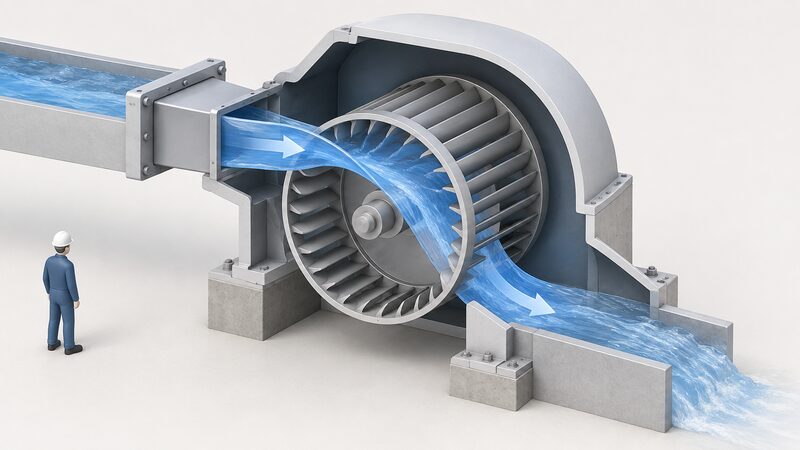
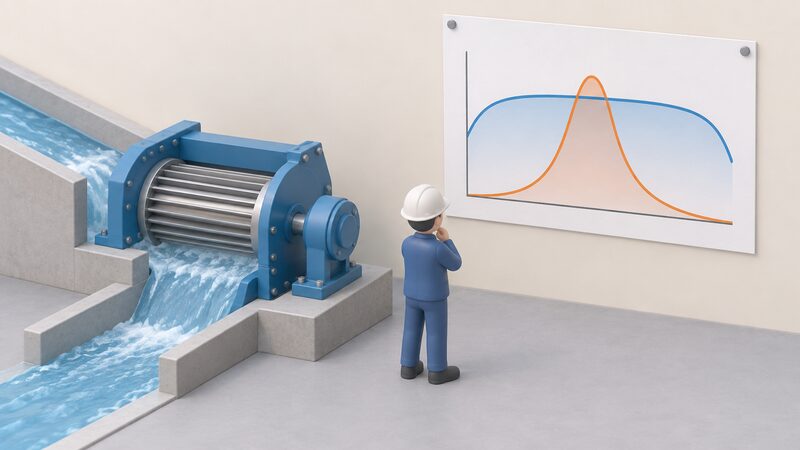
The crossflow turbine's reputation rests on its behaviour away from its design point. A crossflow runner passes water through the drum twice, and that double pass is what produces a relatively flat efficiency curve across a wide band of flows. The material available here does not give a crossflow efficiency percentage, so no figure can be quoted for it. What the material does show is how much part-load behaviour matters in adjacent technologies, which is a useful parallel.
In heat pumps, the same principle is well documented. A buffer vessel allows the heat pump to operate at lower, more consistent flow temperatures, which is where heat pumps achieve their best coefficient of performance4. System efficiency guidance lists low flow temperatures, stable part-load modulation, optimised auxiliary components and clear system design and commissioning as the measures that improve performance5. The pattern is consistent: machines that hold their efficiency across a range of operating conditions deliver more over a year than machines that peak narrowly.
For a hydro turbine, part-flow performance decides how much of the year the scheme earns. A run-of-river site spends most of its time below its maximum flow, so a machine that keeps working efficiently at half flow will out-produce one that only performs at its design point. That is the argument for crossflow on a variable low head site, and it is why the flat curve is the machine's defining characteristic.
The limit is that part-flow efficiency does not create energy. If the flow falls far enough, output falls with it, whatever the curve looks like. The material here gives no minimum flow figure for crossflow, and no efficiency percentage, so a household cannot calculate a cut-off from these documents. The turbine maker's performance curve, supplied for the specific machine, is what answers that question.
Choosing between crossflow, Pelton and Turgo at a given head
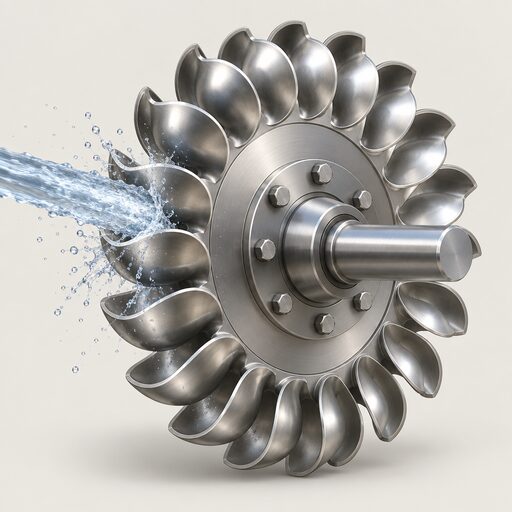
The choice between the three turbine types follows the head, and the guidance is unusually clear about it. Pelton and Turgo are the high head family: comparatively cheap, easy to install and well suited to fluctuating flow1. Crossflow is in the low head family with Archimedes screw, and low head machines are much bigger for the same power output1. The threshold the guidance gives is a drop of over 10 metres for a higher head turbine to be viable1.
| Turbine type | Head band | Character | Best fit |
|---|---|---|---|
| Crossflow | Low head, below the high head threshold1 | Much bigger for the same power output1 | Shallow fall with a large, steady flow |
| Archimedes screw | Low head, grouped with crossflow1 | Much bigger for the same power output1 | Very low fall, high volume, fish-friendly sites |
| Pelton | High head, over 10 metres1 | Comparatively cheap, easy to install, works well in fluctuating flow1 | Steep fall, smaller flow |
| Turgo | High head, over 10 metres1 | Comparatively cheap, easy to install, works well in fluctuating flow1 | Steep fall, medium flow |
The table is a starting point, not a specification. Two sites with the same head can need different machines because the flow differs, and the guidance's size warning for low head types is really a warning about cost and civil works. A crossflow on a shallow fall needs a large channel, a large runner and a large generator for its kilowatts, and that is the trade a household accepts in exchange for using a resource no high head machine can touch.
There is a further consideration that the guidance raises indirectly. Pelton and Turgo machines are described as working well in fluctuating flow1, which matters on a stream that varies through the year. Crossflow's advantage is its part-flow curve, not its tolerance of a dry channel. On a site where the flow drops to a trickle for three months, neither family solves the problem; the scheme simply produces less.
For a household weighing independence, the honest position is that hydro is the most site-specific of the microgeneration technologies. The turbine type is dictated by the fall and the water, not by preference. Where the head is shallow and the flow is strong, crossflow is one of two named options. Where the head is steep, it is not the machine the guidance points to.
Site assessment: measuring head and flow before specifying
Every crossflow specification starts with two measurements. Independent guidance defines a suitable hydro site as one with a water source combining flow, how much water is flowing through the system, and head, the difference in height between the water at the top of the system and at the bottom2. Both are physical facts about the site, and both need to be established before any turbine is chosen.
Head is measured as a vertical difference, and the guidance's threshold of over 10 metres for a higher head turbine1 is the figure that decides which family a site falls into. Flow is measured as a volume per second, and the reference point in the material is CAT's turbine at up to 20 litres per second1. Flow measurement instruments are quoted at an accuracy of plus or minus 3 per cent3, which sets the precision a survey can reasonably claim.
For larger schemes, the connection process adds its own step. Guidance on generation connections advises that for installations of 50kW or greater it is worth checking the thermal Centralised Network View map for constraints in the area6. That threshold is well above a domestic crossflow scheme, but it marks the point at which the grid, rather than the water, becomes the binding constraint.
The assessment stage is also where the scheme's independence is defined. A hydro turbine generates whenever the water flows, without a fuel supply and without a delivery contract, which is a stronger form of independence than a technology that depends on a supplier. What remains is the grid connection for export and backup, the abstraction licence regime, and the manufacturer's ongoing support for the machine itself. Those are the dependencies a household carries even on a good site.

Sources6 cited
- Micro hydro, Centre for Alternative Technology, 2025-07-01
- Hydroelectricity, Energy Saving Trust, 2025-11-06
- Copper vs stainless research report, McDonald Water Storage, 2026-09-17
- Buffer vessel guidance, Newark Cylinders, 2026-07-15
- System efficiency, IDM Energie, 2026-07-06
- Generation connections, SSEN, 2026-09-19
 Hydro Turbine TypesWhich hydro turbine suits your site comes down to how far the water falls and how much flows past each second.
 Micro Hydro Head and FlowHead is the drop from the top of your water supply to the bottom, and flow is how much water comes down.
 Micro Hydro Power for HomesA stream on your land that flows all year can make steady electricity, day and night, even when there is no sun or wind.
 Building-Mounted Wind TurbinesWill a wind turbine on your roof actually make enough electricity to be worth it?
 Microgeneration by Home TypeA stream running through your land, a windy exposed spot, or a gas boiler that runs almost all day: each points to a different technology.
 Domestic Wind TurbinesCan a wind turbine really power a home, and is your site windy enough?