
In this comparison
A Pelton and a crossflow turbine are not competing answers to the same question. They are two different machines for two different sites, and the deciding variable is head, the vertical drop the water falls through. Independent guidance is direct on this: a drop of over 10 metres is usually needed for a higher head turbine such as a Pelton to be viable, while low head sites are served by crossflow and Archimedes screw machines, which tend to be much bigger for the same power output1.
That single split explains most of the practical differences. A Pelton is comparatively cheap, easy to install and works well in fluctuating flow, which suits a steep hillside stream where the flow rises and falls through the year1. A crossflow needs a wide, steady, low fall of water and more civil works to pass it through the runner. Neither is better in the abstract; one is better for the site in front of you.
The prize is real. A water turbine run at about 70% capacity produces roughly seven times the output per kilowatt of a solar PV array of the same rating1. That is why a stream, where one exists, is often the strongest single renewable resource a rural property has. What follows sets out how each machine works, where each fits, and what remains outside the household's control.
Pelton or crossflow: the short answer
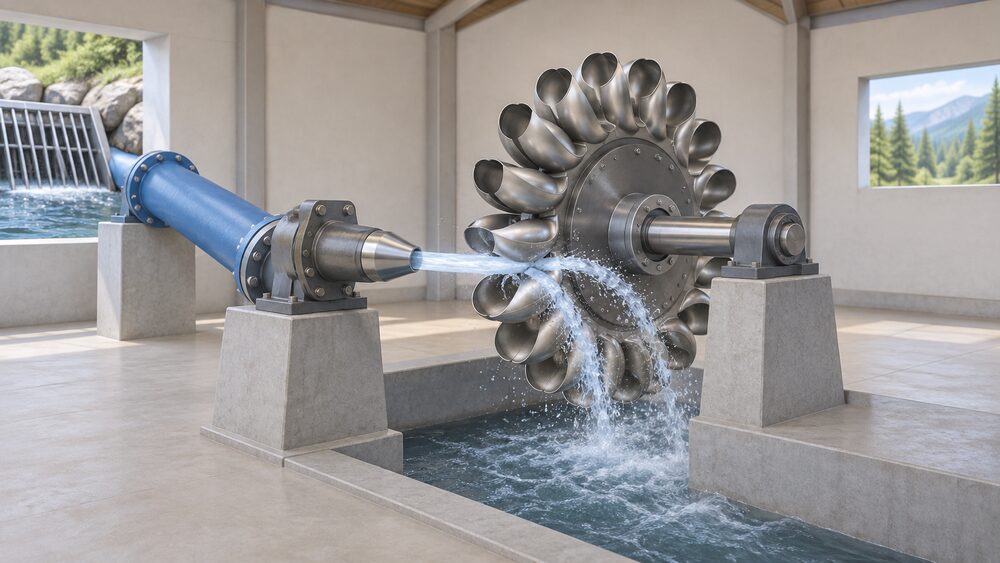
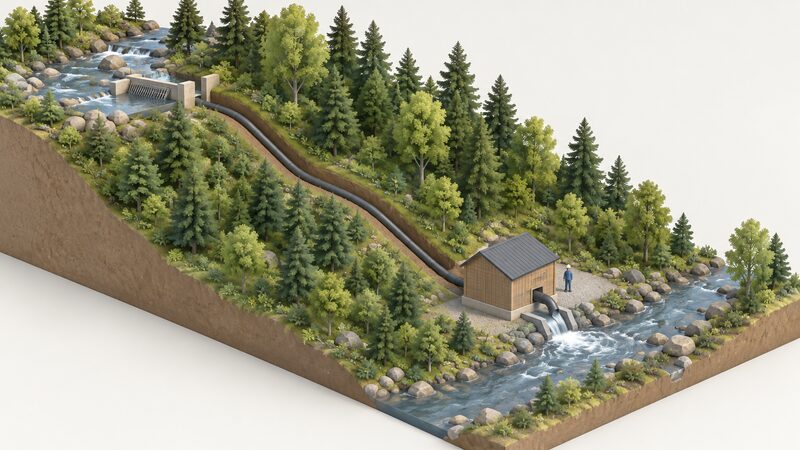
Match the turbine to the head, then to the flow. A Pelton is a high head machine. Water is piped down a steep fall, accelerated through one or more nozzles, and fired at a runner of buckets. The energy comes from velocity, so the drop does the work and the volume of water matters less. A crossflow is a low head machine. Water passes through a wide drum-shaped runner twice, entering at the top and leaving at the bottom, and the energy comes from the weight and volume of water moving through a modest fall.
The consequence is size. For the same electrical output, a crossflow machine is physically much larger than a Pelton, because it is handling far more water at far less pressure1. That means a bigger intake, a bigger channel or penstock, and more civil engineering. On a site with a genuine steep drop, the Pelton's small pipe and compact turbine house are a considerable advantage.
There is a second split, in how each behaves when the stream is not at its best. A Pelton works well in fluctuating flow, which is the normal condition of a hill stream through a British year1. A crossflow is more sensitive to flow variation, because its efficiency depends on the water depth across the runner. Neither machine is a fit-and-forget answer to a dry summer.
For a household, the practical question is not which turbine is better but which one the site can support. A drop of over 10 metres points to a Pelton or Turgo; a shallow fall with good volume points to a crossflow or screw1. The head and flow sizing guide sets out how to measure both before choosing.
How a Pelton turbine works
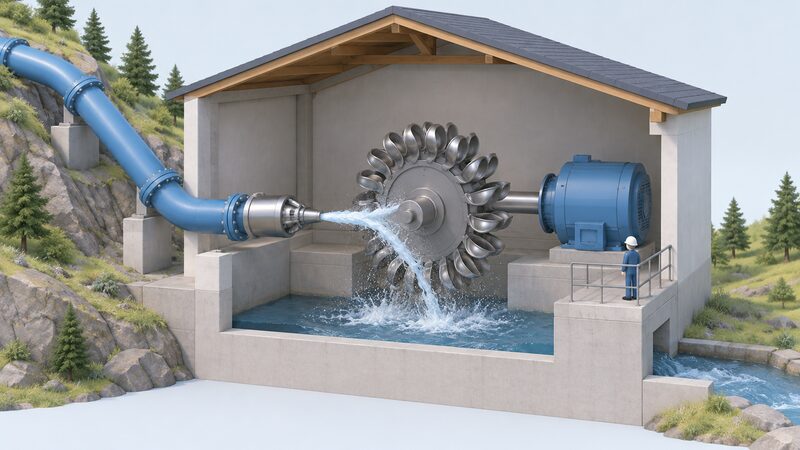
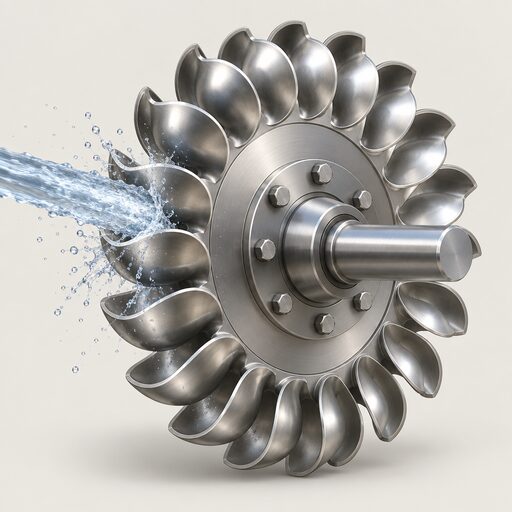
A Pelton runner is a wheel of double-cupped buckets. Water arrives through a penstock, a pipe running down the fall, and leaves through a nozzle that converts the pressure built up by the drop into a high-velocity jet. The jet strikes the split in each bucket, is divided into two streams, and is turned back on itself, transferring its momentum to the wheel. The runner turns, the shaft turns, and a generator produces electricity.
The design has three consequences worth knowing. First, the jet is aimed at the buckets in open air, so the runner sits above the tailwater and the machine is not submerged. Second, the nozzle can be adjusted, which is how output is regulated as flow changes; a needle moves in and out of the jet. Third, because the energy is carried in a narrow high-speed jet, the water must be clean. Grit, gravel and leaf matter will erode a nozzle and pit the buckets.
That last point is the maintenance burden. Screening the intake minimises the risk of damage caused by debris carried downstream during floods, and on a Pelton the screen is not optional4. A screened, piped, high head supply is the classic small hydro arrangement, and it is the one that needs the least water and the least ground disturbance for a given output.
How a crossflow turbine works
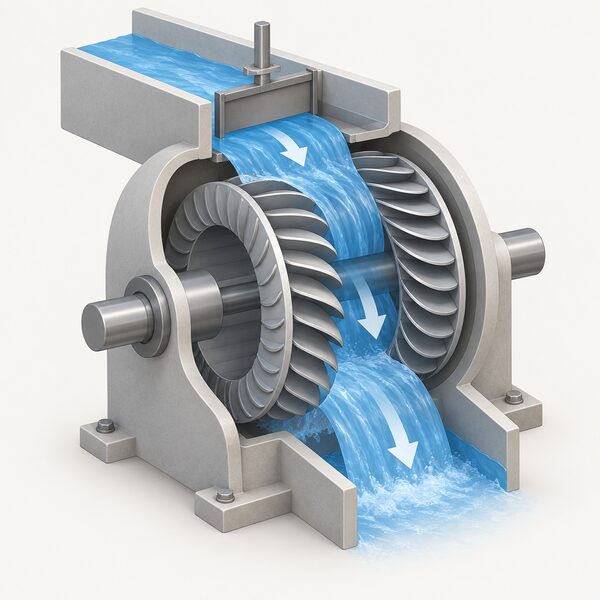
A crossflow turbine, sometimes called a Banki or Mitchell turbine, is a drum-shaped runner made of curved blades arranged around a central shaft. Water enters at the top through a rectangular guide vane, passes through the runner once, crosses the open centre, and passes through the blades a second time before leaving at the bottom. Because the water acts on the runner twice, the machine extracts energy from a large volume of slow-moving water rather than a small volume of fast water.
The geometry is what makes it a low head machine. There is no nozzle and no pressurised jet; the water simply falls through the runner under a shallow head. The runner is wide, the passages are large, and the whole assembly is bulkier than a Pelton of the same rating1. That bulk is the price of working with a low fall.
The large passages give the crossflow one clear advantage: tolerance of debris. Material that would block a nozzle or erode a bucket can often pass through a crossflow runner without damage. That does not remove the need for screening, but it makes the machine more forgiving of a stream that carries silt and leaf litter. A crossflow is also simpler to manufacture, which is part of why it appears so often in low head micro hydro schemes.
The trade-off is part-load behaviour. A crossflow's efficiency falls away as the flow drops, because the water depth across the runner changes and the blades are no longer optimally loaded. On a stream with a strong seasonal swing, that means a long tail of low output through the drier months.
Head and flow: which turbine suits which site
The two measurements that decide the turbine are head, the vertical fall, and flow, the volume of water passing per second. Head sets the type; flow sets the size.
| Site condition | Suited turbine | Why |
|---|---|---|
| Drop over 10 metres | Pelton or Turgo | Higher head turbine viable; compact for the output1 |
| Shallow fall, good volume | Crossflow or Archimedes screw | Low head options; much bigger for the same output1 |
| Fluctuating flow | Pelton | Works well in fluctuating flow1 |
| Debris-laden water | Crossflow | Wider passages tolerate material that would damage a nozzle4 |
The 10 metre figure is the practical dividing line. Below it, a Pelton is not viable and the choice moves to a crossflow or a screw1. Above it, the Pelton's small pipe and compact runner become attractive, and the higher the head the less water is needed for a given output.
Flow is the second constraint, and it is usually the harder one to establish. A stream's flow varies through the year, and a scheme is normally designed around a figure that is exceeded for most of the year rather than the winter peak. The Centre for Alternative Technology's own turbine uses a flow of up to 20 litres per second, which gives a sense of the scale of a small scheme1. A crossflow handling a shallow fall will need considerably more than that for a useful output, because it is working with far less pressure.
There is no substitute for measuring both on site over a full season. The micro hydro power overview covers what a scheme needs, and the turbine types comparison places Pelton, Turgo, crossflow, propeller and Archimedes screw side by side.
Efficiency across varying flow
Efficiency is where the two designs diverge most sharply in everyday use, and the divergence is about part load rather than peak performance. A Pelton holds its efficiency well across a wide range of flows, because the nozzle can be adjusted to keep the jet matched to the available water. As flow falls, the needle closes and the jet stays fast. That is what makes it suitable for a stream whose flow fluctuates1.
A crossflow is less flexible. Its efficiency depends on the depth and angle of the water sheet crossing the runner, and as flow drops the machine moves away from its design point. The result is a flatter, lower output through the low-flow months, even though the turbine is still turning.
The wider context is that micro hydro is a high-value resource per kilowatt. A water turbine run at about 70% capacity produces roughly seven times the output per kilowatt of a PV array1. That figure is about the resource, not the turbine type, but it explains why the part-load behaviour matters so much: a scheme that holds its output through more of the year captures far more of that value.
For comparison, the seasonal performance measures used for heat pumps, the Seasonal Coefficient of Performance and Seasonal Performance Factor, average efficiency across a whole year rather than reporting a peak5. That is the right way to think about a hydro turbine too. A machine's headline efficiency at design flow tells a household very little about what it will produce in February and what it will produce in August.

Part-flow performance and seasonal output
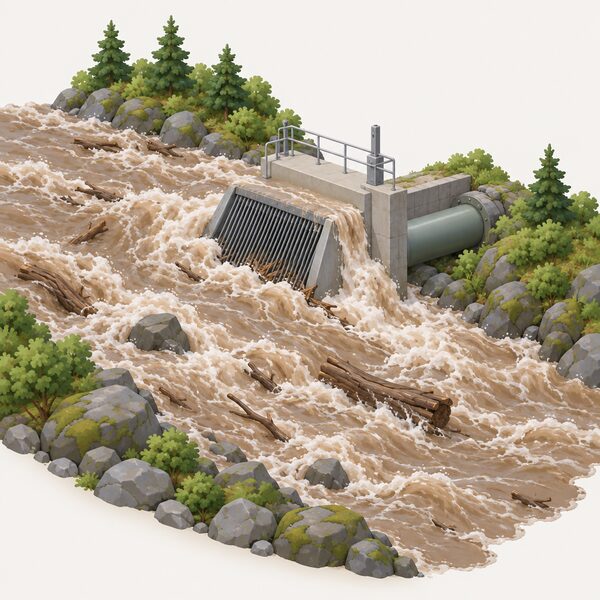
A British stream has a pronounced annual rhythm: high flow in winter, low flow in late summer, and flood events that can arrive within hours. A hydro scheme's annual output is decided less by its peak rating than by how it behaves across that cycle.
A Pelton copes with the swing in two ways. The adjustable nozzle lets output track the available flow, and the machine works well in fluctuating flow by design1. The limit is the opposite end: in a flood, the intake must be screened and the scheme may have to shut down or spill water to protect the runner from debris4. A well-designed intake passes the excess rather than forcing it through the turbine.
A crossflow has a different seasonal profile. It is chosen for low head sites where the flow is the resource, and it is much bigger for the same power output1. In a wet winter it can run near its design point for weeks. In a dry summer the water sheet across the runner thins and output falls away. The scheme still runs, but at a fraction of its winter figure.
Neither machine removes the seasonality of the resource. What a household gains is a predictable pattern rather than a guarantee: high output when the stream is high, low output when it is low, and a scheme that needs to be sized around the reliable flow rather than the peak. The run-of-river load factor explains how much of the year a scheme can expect to run at full power.
Cost, maintenance and typical lifespan
No published installed cost exists for either turbine type, so prices are installer-quoted and no range is offered here. What can be said is that a Pelton is comparatively cheap and easy to install, while a crossflow's larger civil works add to the build1. The micro hydro cost guide covers what drives the total.
Maintenance is the recurring cost. No hydro-specific service interval is published, but comparable guidance for small wind turbines puts maintenance checks at every few years, typically costing between £100 and £200 a year depending on system size2. A hydro turbine has moving parts in water, so intake screening and bearing inspection are likely to be more frequent than that. The maker's schedule governs.
On lifespan, the closest published figure is for generating units generally: most parts of a generating unit, such as a wind farm, hydro station or solar site, have a life span of 20 to 40 years, after which they may need refurbishment or replacement3. A well-built turbine house and penstock can outlast the runner and generator inside it.
Siting, intake design and civil works
The turbine is often the smaller part of a hydro project. The intake, the channel or penstock, the turbine house and the outfall are the civil works, and they decide whether the scheme works reliably for decades.
The intake is the first and most important element. It must take water from the stream without taking debris, and it must pass flood flows without washing out. Screening the water intake minimises the risk of damage caused by debris carried downstream during floods4. For a Pelton, the screen protects a nozzle with a small opening; for a crossflow, it protects the runner passages. In both cases the screen needs cleaning, and in autumn that can mean frequently.
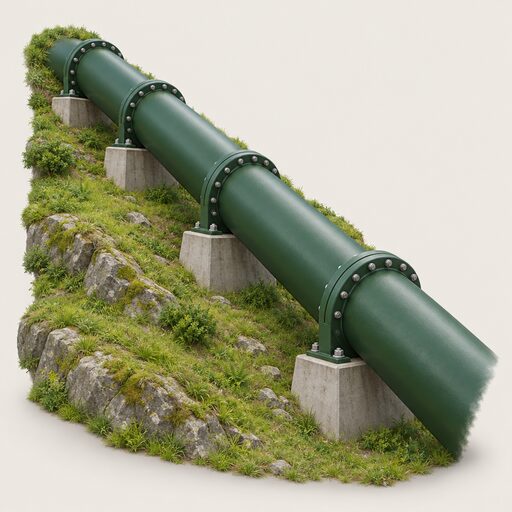
The water conveyance follows from the head. A Pelton on a steep fall uses a pressurised penstock, often a buried pipe, which is compact and can be routed down a slope with relatively little ground disturbance. A crossflow on a shallow fall needs a larger channel or a much wider pipe to carry the same volume at low pressure, and that means more excavation and a bigger footprint.
The turbine house and outfall complete the scheme. The house shelters the machine and the generator, and it is where noise is contained. The outfall returns water to the stream, and its design affects both fish passage and the scheme's environmental acceptability. Abstraction and environmental permissions are a separate matter, covered in the abstraction licences and permits guide and the environmental requirements guide.
For a household, the civil works are where the independence argument is strongest and weakest at once. A completed scheme turns a stream into a generating asset that runs without fuel and without a supplier, and the resource is roughly seven times more productive per kilowatt than solar PV at 70% capacity1. But the scheme still depends on the weather, on a screened intake that must be maintained, on a generator and its electronics, and on a connection arrangement with the network operator if it is grid-tied. The micro hydro installation and maintenance guide sets out what ongoing ownership involves.
Sources6 cited
- Micro hydro, Centre for Alternative Technology, 2025
- Wind turbines, Home Energy Scotland, 2026
- Renewable energy in the UK, ECIU, 2025
- Hydroelectricity, Home Energy Scotland, 2026
- In-depth guide to heat pumps, Energy Saving Trust, 2026
- Small wind turbines, MCS Certified, 2026
 Hydro Turbine TypesWhich hydro turbine suits your site comes down to how far the water falls and how much flows past each second.
 Micro-CHP TypesWhich type of micro-CHP actually gets fitted in UK homes, and how much electricity does one make while it heats your house?
 Microgeneration by Home TypeA stream running through your land, a windy exposed spot, or a gas boiler that runs almost all day: each points to a different technology.
 Domestic Wind TurbinesCan a wind turbine really power a home, and is your site windy enough?
 The Full Wind, Hydro and Micro-CHP GuideCould a small wind turbine or water wheel work at your home, and what about boilers that make their own electricity?
 Micro Hydro CostHow much does a micro hydro scheme cost to build and run, and what makes one worth it?