
In this guide
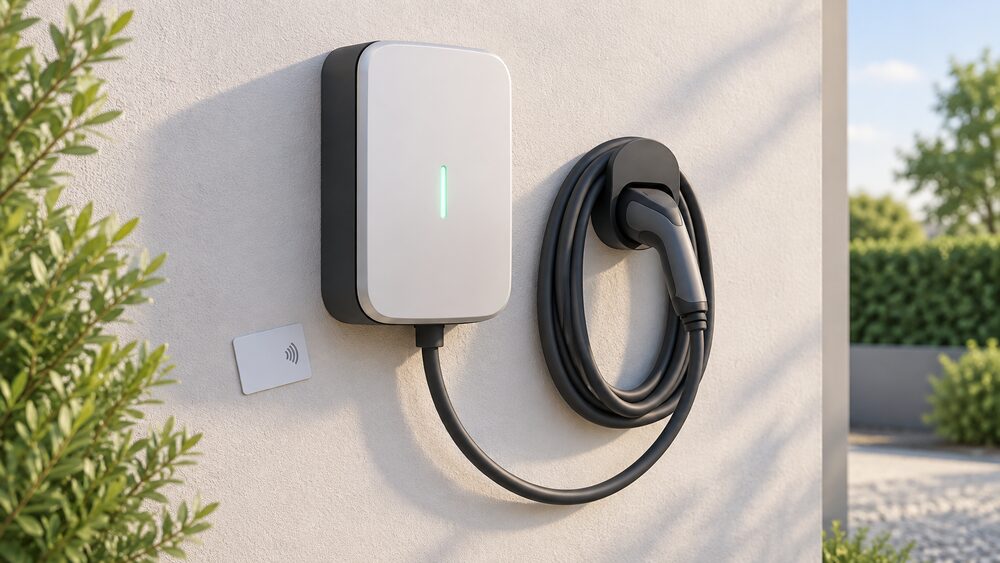
Anker's entry into home charging is the SOLIX V1 Smart EV Charger, a wallbox sold in single and three-phase forms at 7.4kW, 11kW and 22kW, and in two body types: a cable version with an integrated 5m lead, and a socket version without one1. The cable version is rated at 7.4kW maximum output on a 230V, 32A single-phase supply, and Anker states single-phase charging is supported up to 7.4kW (32A)2.
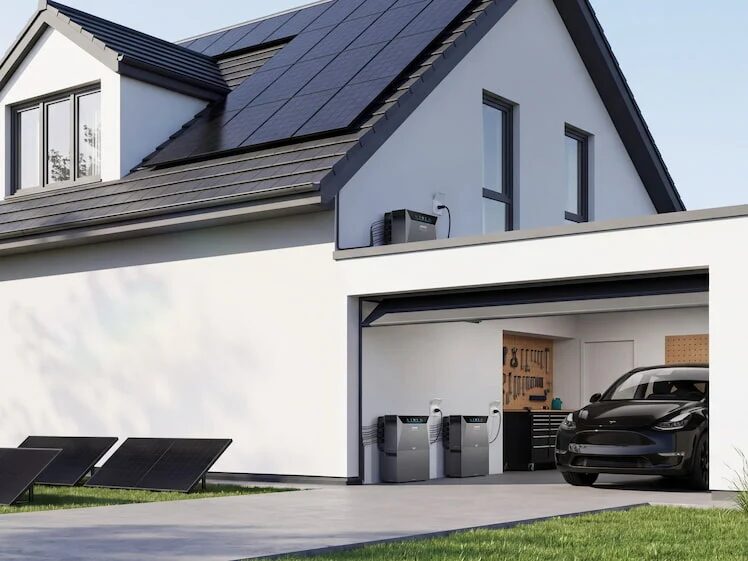
What separates the V1 from a standalone wallbox is the ecosystem behind it. Anker states the charger supports electric vehicle charging with 100% solar power, or hybrid charging using solar power, battery storage and the grid, and that it integrates with named Anker storage systems, each of which supports a maximum of one V1 unit2. That is the whole proposition: a charger bought as one part of a home energy system rather than on its own.
The dependence is equally clear. Solar charging needs an Anker SOLIX Smart Meter or a Shelly smart meter, and the smart features require pairing with a compatible smart meter or integration with a supported Anker storage system1. Remote control runs through the cloud, with Bluetooth as the fallback when the internet is out1. A household without Anker storage, or without one of those meters, gets a compliant 7.4kW smart charger and not much of the ecosystem.
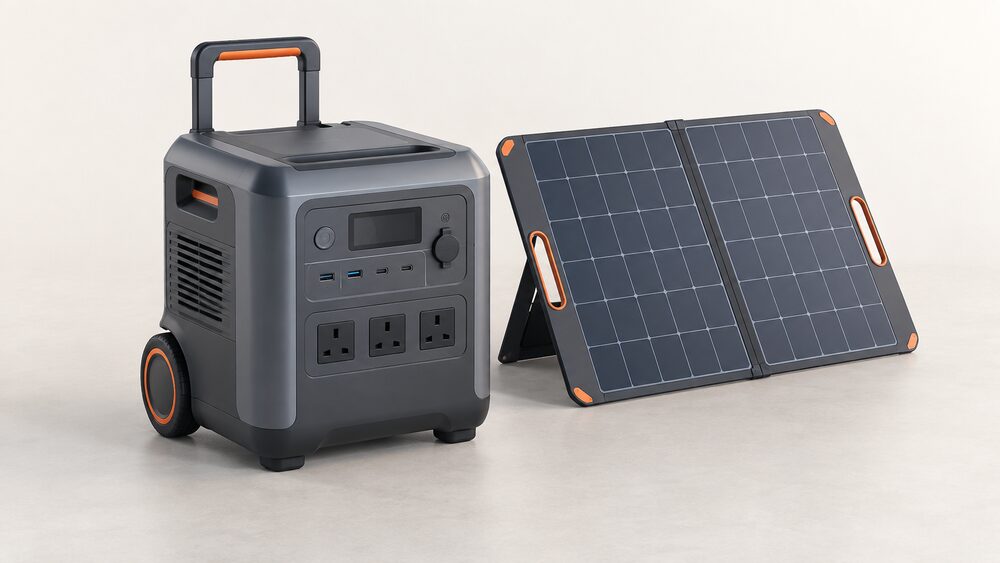
The SOLIX range: V1 wall charger, portable power stations and accessories
Anker SOLIX is a consumer energy brand rather than a charging specialist, and the V1 sits inside a catalogue that runs from wall-mounted storage to camping power banks. The V1 Smart EV Charger is the only fixed EV wallbox in the UK line3. Around it sit the X1 energy storage system, the Solarbank series, the Power Dock, and a long list of portable power stations including the C1000, C300X, F2000, F3000 and F3800 families4.
The accessories matter because they define what the ecosystem can do. The Anker SOLIX Alternator Charger is a vehicle-to-power-station device, compatible with Anker SOLIX portable power stations and described as compatible with 99% of RVs and gas vehicles, supplied with a 7m battery connection cable and a 100A fuse wire9. The EV Charging Adapter works in the opposite direction, letting a power station draw from an EV charger10. Cables are not always included: Anker states the car charging and solar charging cables for the C300X can be purchased separately, and that the C300X strap is sold separately too11.
The buying picture is uneven across the range. The Solarbank 4 E5000 Pro is listed at £1,699.00, reduced from £2,129.00 including 20% VAT, and a bundle with one BP5000 expansion battery at £2,998.00, reduced from £3,728.007. The E10 system is sold on the Anker SOLIX US site with the price loading dynamically and no UK price shown13. The F3800 maker page is marked Sold Out8. For a household, the practical point is that the V1 is the fixed, wired part of a range whose other components move in and out of availability, and whose prices are published per product rather than as a system.
The V1 smart charger: variants, power ratings and what each suits
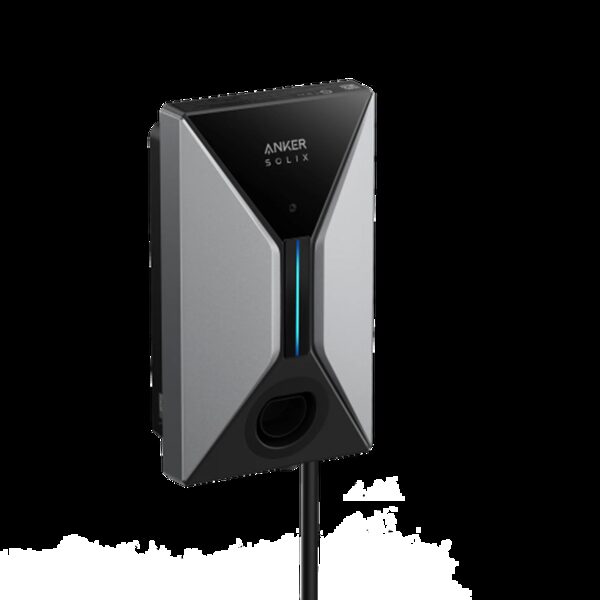
Anker describes the V1 as a bespoke product line covering single and three-phase charging at 7.4kW, 11kW and 22kW, in cable and socket versions1. The published specification detail is fullest for the cable version: 7.4kW maximum rated output, 230V, 32A, single-phase plug, with single-phase charging supported up to 7.4kW (32A)2.
The two body types answer a straightforward question. A cable version has the lead attached, so nothing needs to be carried; a socket version has no cable, and the vehicle's own lead is used. Zapmap describes the same split in general terms, with home chargers available either with a tethered Type 1 or Type 2 cable that plugs straight into the car, or with a Type 2 socket for use with the vehicle's charging cable14. Anker's cable version ships with an integrated 5m charging cable, a rotatable charging gun holder and an RFID card2.
| Variant | Output | Supply | Cable |
|---|---|---|---|
| Cable version | 7.4kW max rated2 | 230V, 32A single-phase2 | Integrated 5m2 |
| Socket version | 7.4kW specification2 | Not stated | None included2 |
| Range options | 7.4kW, 11kW, 22kW1 | Single and three-phase1 | Cable and socket1 |
One limit is worth stating plainly. Anker confirms the V1 does not support coordination between multiple EV chargers or the automatic distribution of power among multiple units2. A two-car household running two V1s should not expect them to share a supply intelligently. The charger does comply with The Electric Vehicles (Smart Charge Points) Regulations 2021 (UK), which is the baseline requirement for a domestic charge point sold in Britain2. The wider rules are set out in the smart charge point regulations, and the differences between tethered and untethered units in types of home EV charger.
Solar and storage charging: how the V1 works with Anker's ecosystem
The solar claim is the headline. Anker states the V1 supports electric vehicle charging with 100% solar power, or via hybrid charging using solar power, battery storage and the grid2. The same page carries a saving claim of up to 58% annually on charging costs with Anker Intelligence Smart Charging, and a separate claim of saving up to 25% more every year when synced with the Anker SOLIX X11.
Both figures are the maker's own and are not independently verified here. What is verifiable is the hardware condition behind them: solar charging requires an Anker SOLIX Smart Meter or a Shelly smart meter, and the smart features require the V1 to be paired with a compatible smart meter or integrated with a supported Anker energy storage system1. Without one of those, the solar-aware behaviour has nothing to read.
The X1 is the system the V1 is most closely tied to. Anker states that connecting the X1 with the Anker SOLIX EV Charger creates a home micro-grid for increased energy independence, and that the X1 integrates with portable power stations and Solarbank5. The X1 scales to up to 6 batteries per system, up to 6kW / 30kWh, and supports third-party off-grid solar charging5.
This is a narrower ecosystem than it first appears. Other makers in the same space make broader compatibility claims: SolaX states its smart charger can charge an electric vehicle with 100% clean solar energy and is capable of utilising 100% renewable energy, and that its bidirectional charger unlocks full-scale V2X capabilities15. AlphaESS states its chargers, paired with SMILE-G3 energy storage systems, form a comprehensive PV-storage-charging ecosystem18. SolarEdge states its ONE charger can respond to utility signals and work in sync with a solar and battery system, enabling participation in demand response or virtual power plants19. Anker's equivalent integration is real but bounded to its own named systems. For the household question of what solar charging involves, see charging an EV from solar panels.
Which storage systems the V1 pairs with, and the one-V1-per-system limit
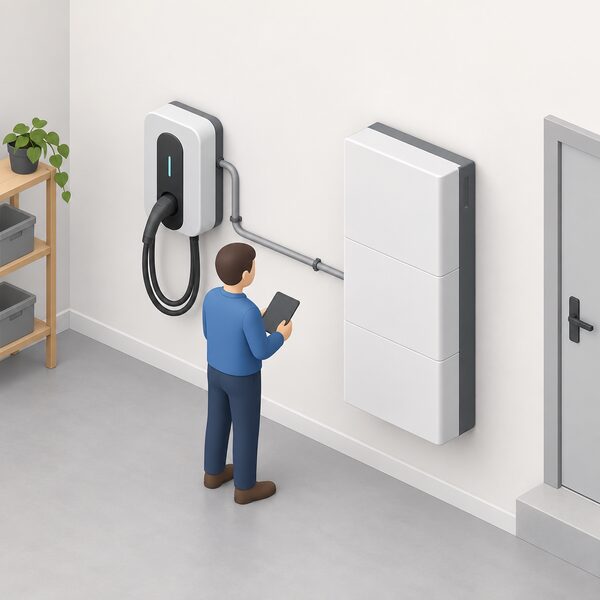
Anker names the systems the V1 integrates with: the Anker SOLIX X1 Hybrid System (A5102 / A5103), the Anker SOLIX Power Dock (AE100), and the Anker SOLIX Solarbank Series (A17C1 / C2 / C3 / C5). The same statement carries the constraint that each system supports a maximum of one V1 unit2.
That single sentence shapes what a household can build. One storage system, one wallbox. A property wanting two charge points cannot run both from the same Anker battery, and the charger itself will not coordinate power between two units2. The limit is a design decision rather than a technical fault, but it is the kind of detail that only surfaces at the quotation stage.
The storage side scales further than the charging side. The X1 takes up to 6 batteries per system, up to 6kW / 30kWh6. The Solarbank 4 E5000 Pro carries a 10-year warranty, against a stated 15-year product lifespan7. The E10 system is sold as a power module and battery combination with a Power Dock, and carries 37 reviews on its product page13. For comparison, SolaX states its A1 HYBRID G2 works with T-BAT-SYS-HV-5.0 battery modules and can scale to as much as 80kWh total storage in parallel configurations20, and describes a broader ecosystem of batteries, hybrid inverters, EV charging and smart energy tools21.
The practical reading is that the V1 is a good fit for a household already committed to Anker storage, and a partial fit for one that is not. The charger will still charge a car from the grid on a standard supply. It will not deliver the solar-matching behaviour that justifies the ecosystem premium unless the meter and the storage are there too. The general case for pairing a car with a home battery is covered in EV charging alongside a home battery.
Specifications and installation details: cable, holster, wiring and operating range
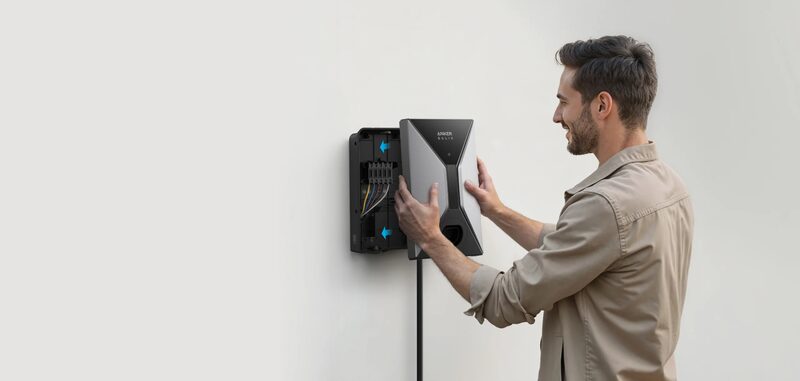
The installation detail Anker publishes is unusually specific for a consumer wallbox. The backplate has three wiring entries, at the top, bottom and rear, which gives an installer options on cable routing1. The charging holster is 13.5cm wide and rotates, described as a way to gain extra parking space1. The unit carries IK10 impact and IP55/IP65 weather-resistant ratings for indoor and outdoor use, with IK10 described as the highest possible impact rating1. The operating range is stated as -30°C to 50°C1.
| Specification | Value |
|---|---|
| Wiring entries | 3 (top, bottom, rear)2 |
| Holster | 13.5cm wide, rotatable2 |
| Impact rating | IK102 |
| Weather rating | IP55 / IP651 |
| Operating temperature | -30°C to 50°C1 |
| Connector | Universal Type 22 |
| Communications | Wi-Fi and Bluetooth1 |
One requirement sits outside the box. Anker states an external RCD Type A (30mA) is required, in accordance with local regulations1. That is a supply-side protection device, not something built into the charger, and it affects the consumer unit work at installation. The reasoning behind that requirement is set out in what RCD protection does an EV charge point need, and the wider process in home EV charge point installation.
For contrast, SolaX describes its smart charger as integrating terminal blocks for simple wiring and separating power and communication lines, and as suitable for indoor and outdoor installation15. The V1's three entries and rotating holster are the equivalent practical concessions to awkward sites. Anker does not publish a UK installed price for the V1, so costs are installer-quoted.
Safety and vehicle compatibility: leakage detection and connector coverage
Anker states the V1 has Type A and DC 6mA detection protecting against AC and DC leakage, and that it works with 99.9% of PHEVs and BEVs, supporting single and three-phase charging1. The connector is a universal Type 22. The 99.9% figure is the maker's own compatibility claim and is not independently tested here.
Independent certification is the stronger signal. BSI describes Kitemark certification for electric vehicle supply equipment as demonstrating the safety, security, quality and reliability of chargers, and meeting legislative, market access, specifier and compliance requirements22. On connectors specifically, BSI guidance covers ensuring that plugs, sockets and connectors fit securely and are compatible with various EVs, with tests for repeated use durability, thermal management and contact resistance23. The V1's compliance with the Smart Charge Points Regulations is stated by Anker2; a Kitemark is not claimed on the pages reviewed.
On connector type, the NICEIC advises that the electrician will confirm what type of connector is compatible with the vehicle24. That is the practical check for any household: the Type 2 connector covers the great majority of UK cars, but the vehicle's own inlet is the deciding factor. The connector landscape is explained in EV connectors and cables, and the certification framework in EV charge point safety and standards.
Two further safety points sit with the wider ecosystem rather than the wallbox. SolaX lists protections on its bidirectional charger including over-current, over-temperature, over-voltage, under-voltage, lightning surge, short circuit, leakage current, relay weld, overload and ISO insulation verification17, a reminder that protection lists vary between makers and are worth comparing directly. And the V1's own leakage detection covers the charger, not the vehicle or the fixed wiring.
Costs, savings claims and the wider SOLIX buying picture
Anker publishes no UK installed price for the V1, so the cost of a fitted unit is installer-quoted. What the maker does publish is a set of saving claims attached to the charger: up to 58% annually on charging costs with Anker Intelligence Smart Charging, and up to 25% more saved every year when synced with the Anker SOLIX X11. Both are the maker's figures, presented without a stated baseline tariff or mileage, and neither is independently verified here.
The wider SOLIX price list is more concrete. The Solarbank 4 E5000 Pro is listed at £1,699.00, reduced from £2,129.00 including 20% VAT, and the bundle with one BP5000 expansion battery at £2,998.00, reduced from £3,728.007. Those are published retail prices with the VAT position stated on the Solarbank. The E10 system shows no UK price, with the US site loading dynamically13. The F3800 is marked Sold Out8.
Warranty terms across the range vary enough to check per product. The V1 carries a 3-year warranty with a claimed 8-year service life2. The Solarbank 4 E5000 Pro carries 10 years against a stated 15-year lifespan7. A refurbished C1000 power station carries a 6-month warranty25. Anker SOLIX states up to 5-year warranties across the store, alongside a 30-day return or exchange window3. The E10 and RFID card pages both list a 30-day money-back guarantee and lifetime customer support26.
For a household weighing independence, the position is this. The V1 keeps a car on mains electricity and, unless the meter and storage are in place, on grid power at whatever tariff applies. Solar self-consumption depends on Anker's own storage and metering, remote features depend on broadband and Anker's cloud, and the solar-matching behaviour is bounded to one charger per storage system. The charger is a competent grid unit with an ecosystem option attached; the ecosystem is where the independence, and the dependence, actually sit. The broader picture is in EV charging and household energy independence.
Sources26 cited
- Anker SOLIX UK store, Anker SOLIX, 2026-09-17
- Anker SOLIX V1 Smart EV Charger (Cable Version), Anker SOLIX, 2026-09-19
- Anker SOLIX Smart EV Charger V1, Anker SOLIX, 2026-09-17
- Anker SOLIX EV Charger RFID Card, Anker SOLIX, 2026-09-19
- Anker SOLIX X1, Anker SOLIX, 2026-09-19
- Anker SOLIX X1 Energy Storage System, Anker SOLIX, 2026-09-19
- Anker SOLIX Solarbank 4 E5000 Pro, Anker SOLIX, 2026-09-19
- Anker SOLIX F3800, Anker SOLIX, 2026-09-19
- Anker SOLIX Alternator Charger, Anker SOLIX, 2026-09-19
- Anker SOLIX F3000 with PS400 Bifacial Portable Solar Panel, Anker SOLIX, 2026-09-19
- Anker SOLIX C300X Portable Power Station, Anker SOLIX, 2026-09-19
- Anker SOLIX C300X Portable Power Station (US), Anker SOLIX, 2026-09-19
- Anker SOLIX E10 Power Module, Battery and Power Dock, Anker SOLIX, 2026-09-19
- Home charging guide, Zapmap, 2025-06-19
- SolaX EV chargers, SolaX Power, 2026-09-17
- SolaX Smart EV Charger, SolaX Power, 2026-09-17
- SolaX integrated heating solution, SolaX Power, 2026-09-17
- AlphaESS SMILE EVCT11 EV charger, AlphaESS, 2026-09-17
- SolarEdge ONE EV Charger, SolarEdge, 2026-09-17
- SolaX A1 Hybrid G2 and battery storage, SolaX Power, 2026-09-09
- SolaX home solar batteries and backup, SolaX Power, 2026-04-16
- Powering trust in EV charging with BSI Kitemark certification, BSI, 2026-09-17
- What makes BSI Kitemark certified EV chargers a smarter choice, BSI, 2026-09-17
- Electric vehicle charger installation and maintenance, NICEIC, 2025-08
- Anker SOLIX C1000 Refurbished, Anker SOLIX, 2026-09-19
- Anker SOLIX E10 with Power Dock, Anker SOLIX, 2026-09-19
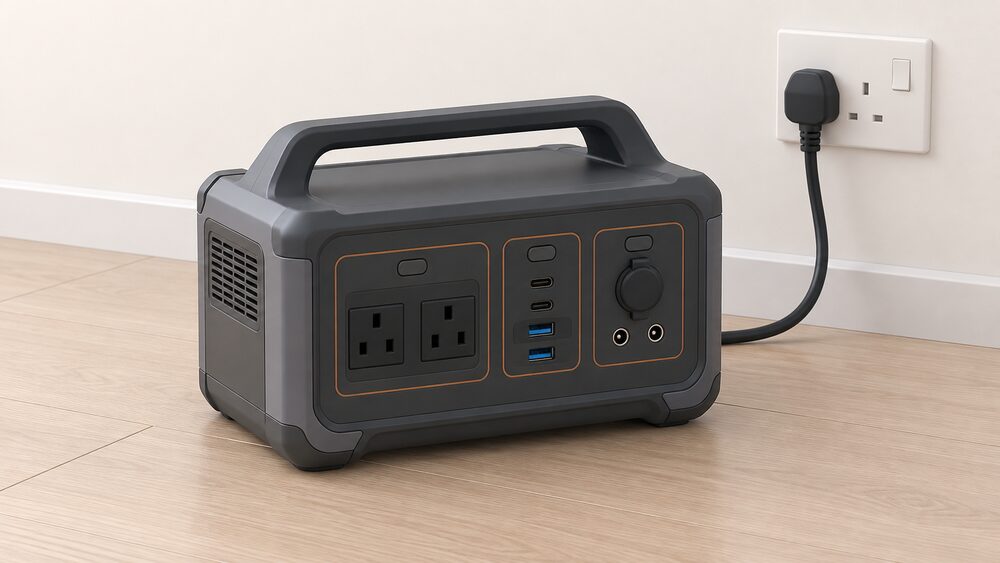 Anker SOLIX portable power stations and home backup batteriesAnker SOLIX covers two very different kinds of backup: portable power stations you can carry, and whole-home batteries wired into the house.
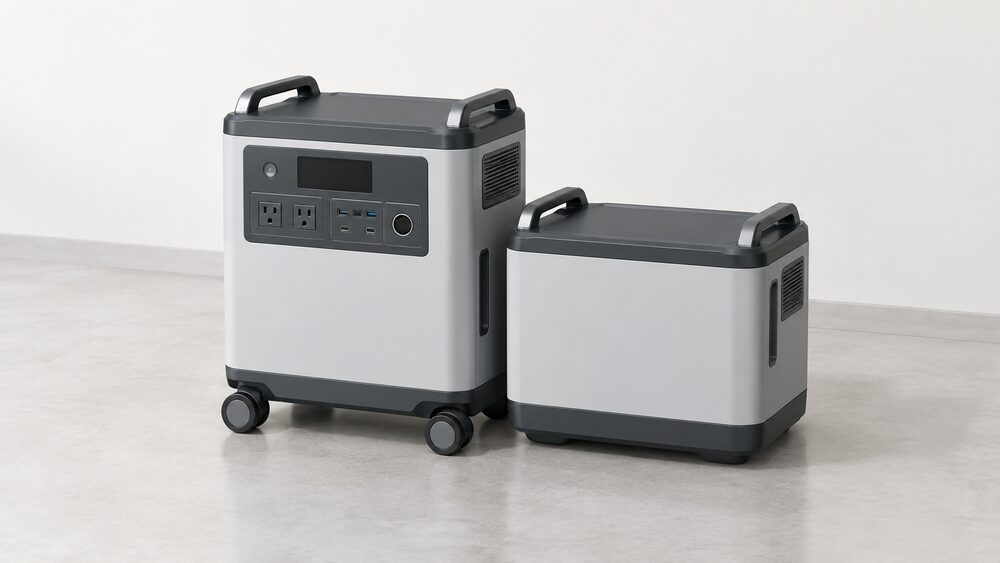 Anker SOLIX F3800 Plus home backup batteryHow much power does the Anker SOLIX F3800 Plus give you in a blackout, and how long will it last?
 Anker SOLIX F3000Can the Anker SOLIX F3000 run a British home?