
In this guide
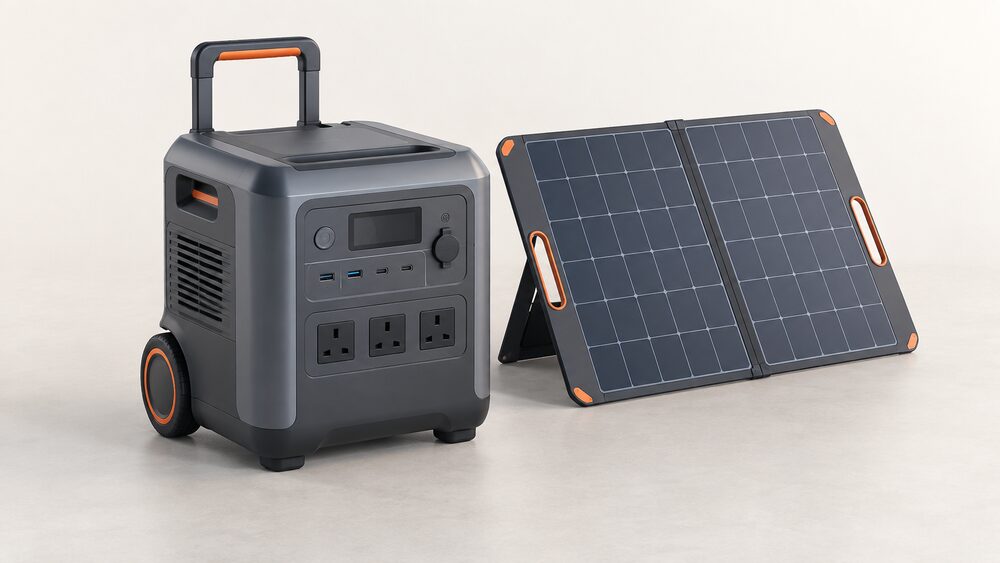
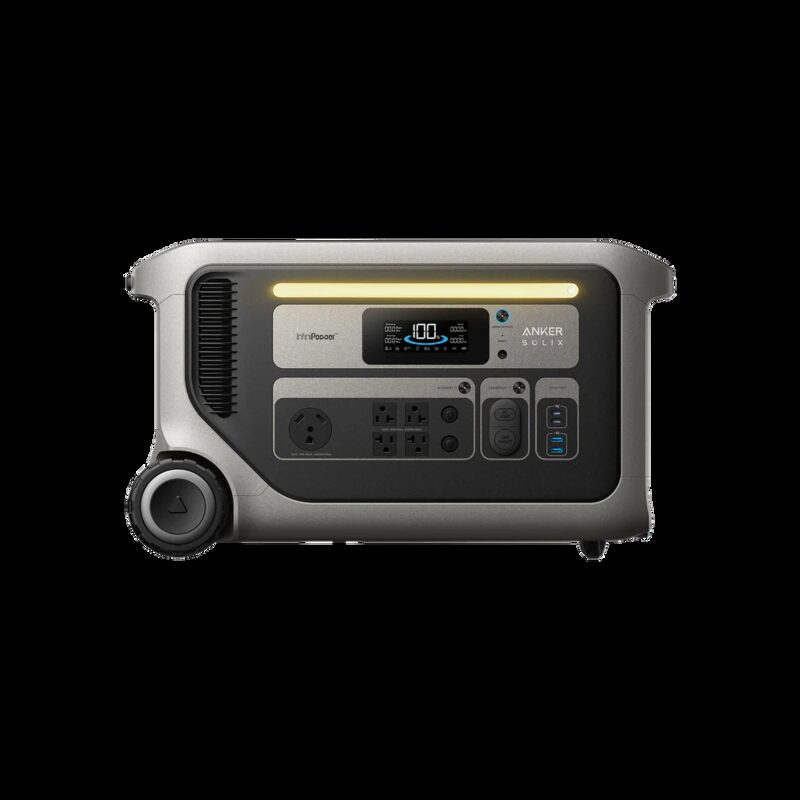
The Anker SOLIX F3000 is a portable power station with a 3,072Wh lithium iron phosphate (LFP) battery, 3,600W of continuous AC output and a 7,200W surge rating1. It is expandable: Anker lists a base capacity of 3 to 12kWh, and states that with expansion batteries the system reaches 24kWh, which the company describes as over a week of backup2.
The critical fact for a UK reader is the voltage. A single F3000 provides 120V output only, and Anker states that 240V output requires two units connected with a double voltage hub4. That is a North American specification. UK homes run on a 230V nominal supply with Type G sockets, so the F3000 is not a plug-in home battery for a British house in the way a plug-in battery system is. It is a portable appliance, bought for camping, off-grid use or North American backup, and it sits outside the UK's installed battery framework.
This page sets out what the F3000 is, what it can run, how it recharges, and what a UK household would need to accept before buying one.
What the F3000 is: a 3,072Wh LFP portable power station
The F3000 is built around LFP chemistry, which Anker gives as the battery type, with a cell capacity of 51.2V / 60Ah / 3,072Wh1. LFP is the chemistry most home storage products now use, and it is the reason the cycle rating is high: Anker states 4,000 cycles for the F3000, and separately describes a 10-year lifespan under its InfiniPower branding1. Cycle life is normally quoted to a retained-capacity threshold, and Anker does not state one for this model. For comparison, Anker rates the F3800 at 3,000 cycles to at least 80% battery capacity5.
The unit is not only an AC box. Anker lists a 60V 120A maximum DC input port, a low-PV input of 11 to 60V at 17A maximum and 800W, an Anderson DC output at 13.4V 30A, USB-C ports at up to 100W each and USB-A ports at 12W each1. There is also a SurgePad rating of 4,860W, which Anker lists separately from the 7,200W AC surge figure1. The two numbers describe different things: SurgePad is Anker's own rating for the unit, while the AC surge figure applies to the 120V 30A TT-30R output, which Anker rates at 3,600W maximum1.
For a household thinking about independence, the F3000 is a self-contained store: no installer, no grid connection, no metering. What it is not is a substitute for a fixed home battery. It cannot be wired into a consumer unit, it cannot be registered for grid services, and it does not reduce a standing charge. Its independence is the independence of a charged box in a cupboard, and it lasts as long as the load drawn from it.
Capacity and expansion: 3.84kWh base, up to 26.9kWh or 53.8kWh
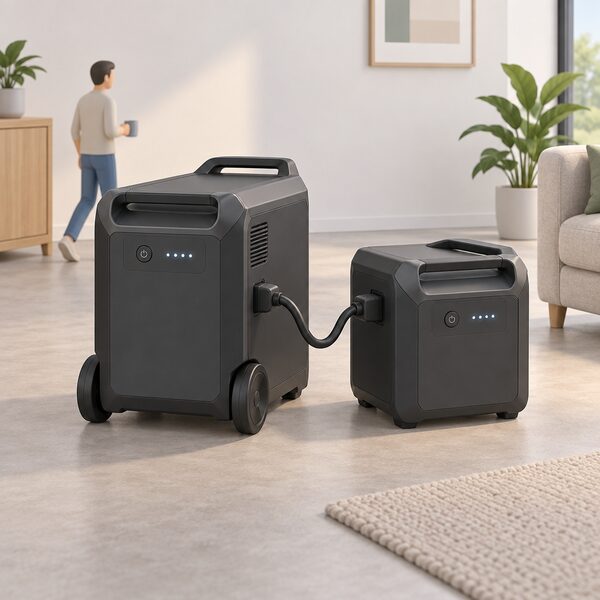
The F3800 Plus starts at 3.84kWh and expands to 26.9kWh, or up to 53.8kWh for days-to-week-long backup5. The F3000 starts at 3,072Wh and expands to 24kWh, which the maker describes as over a week of power7. The F3800 takes up to six expansion batteries of 3.84kWh each9, and the C2000 Gen 2 expands to 4kWh10.
Anker lists the F3000 as having an expandable capacity of 3 to 12kWh, and states that a single unit powers lighting and a fridge for a day, expandable to 24kWh for over a week2. The arithmetic of the expansion is set out in Anker's own bundle listings: an F3000 with one expansion battery is given as 6,144Wh, and an F3000 with three expansion batteries as 12,288Wh1. The BP3000 expansion battery is described as expanding the setup to 24kWh, with Anker claiming 80 hours of outage-proof energy at that capacity4.
| Configuration | Nominal capacity | Anker's stated use |
|---|---|---|
| F3000 alone | 3,072Wh1 | Lighting and fridge for a day3 |
| F3000 + 1 expansion battery | 6,144Wh1 | Not stated |
| F3000 + 3 expansion batteries | 12,288Wh1 | Not stated |
| Expanded setup | up to 24kWh3 | Over a week, 80 hours of outage-proof energy3 |
The expansion batteries carry their own warranty: Anker describes the BP3000 as covered by a 5-year full-device warranty4. That matters because the expansion path is where the cost sits. A 24kWh F3000 setup is three or more batteries plus the hub and cabling, and it is still a 120V system.
The wider Anker range shows where the F3000 sits. The F3800 starts at 3,840Wh and expands to 26.9kWh with up to six expansion batteries of 3,840Wh each, and the F3800 Plus is listed as starting at 3.84kWh and expanding to 53.8kWh5. The C2000 Gen 2 expands to 4kWh7. Capacity alone does not make any of these a UK home battery, and the capacity and usable capacity distinction applies to all of them.
Power output: 3,600W continuous, 7,200W surge
Anker gives the F3000 a continuous output of 3,600W and an AC surge power of 7,200W2. The output ports are split: the TT-30R port is rated 120V, 30A maximum, 60Hz, 3,600W maximum, while the NEMA 5-20R output is rated 2,400W maximum2.
The surge rating is what lets the unit start a motor load, such as a fridge compressor or a power tool, that draws far more than its running wattage for a moment. Anker's own SurgePad figure of 4,860W sits below the 7,200W AC surge figure, and the two are not reconciled in the listings1.
For scale, Anker's other models show how the range steps. The F3800 is listed at 6,000W with 120V and 240V dual voltage per unit, the C2000 Gen 2 at 2,400W continuous with a 4,000W peak, and the F2000 at 2,200W continuous with a 3,600W peak8. The F3000's 3,600W continuous rating is enough for a kettle, a microwave or a circular saw one at a time, but not for a whole house's simultaneous loads. The relationship between continuous rating and what a battery can actually deliver is covered in power ratings and C-rate.
Recharging: 2,400W solar, 3,600W AC and 6,000W combined input
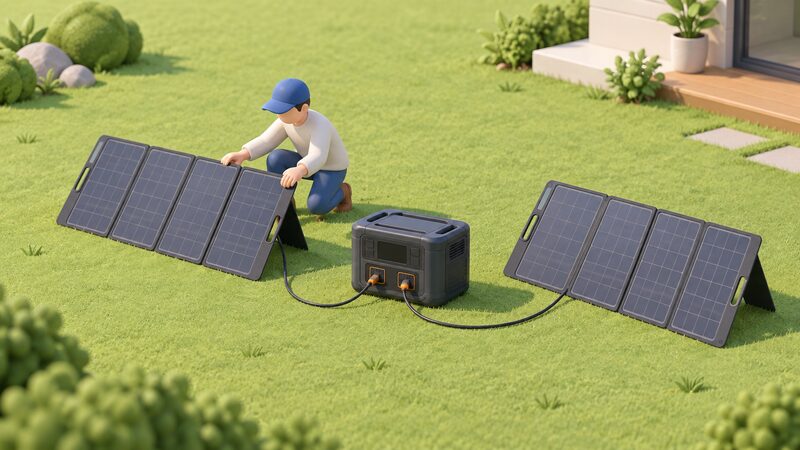
Solar is the headline input. Anker states the F3000 supports up to 2,400W of solar input across dual-voltage 60V and 165V inputs, fully charging in under 2 hours with optimal sunlight2. One Anker page puts the same claim at 1.5 hours1. Both are maker figures under ideal conditions, and the 60V and 165V inputs are separate, so panels must be matched to the right one.
AC input is where the UK position becomes awkward. Anker lists AC input through the EV Charging Adapter at 230V, 18A maximum, 3,600W, 50Hz, and separately at 120V, 15A maximum1. The 230V figure is the one that matches a European supply, but it arrives through an EV connector rather than a domestic socket. The documents also disagree on the maximum AC input, giving both 3,600W and 1,800W2.
Combined recharging is the fastest route: Anker states the F3000 combines a fuel generator and solar for 6,000W of recharging, and notes this requires an expansion battery2. Grid and solar can run at the same time, with solar prioritised and the grid making up the remainder5.
Runtime examples: what it runs and for how long
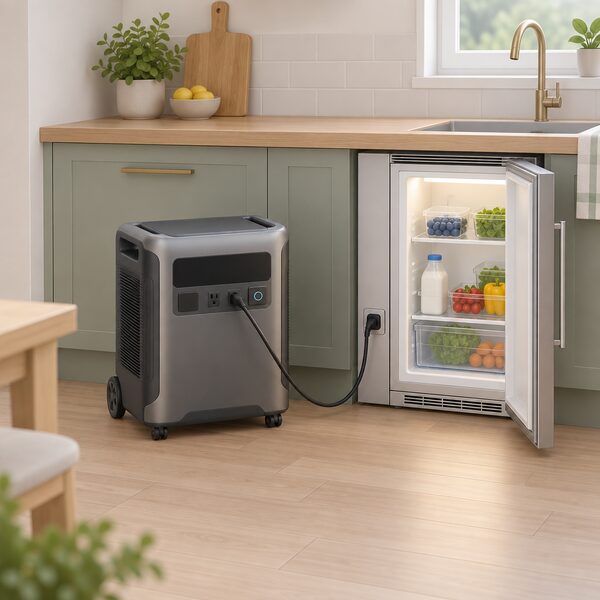
Anker publishes a table of example loads for the F3000, and the spread shows how much the answer depends on the appliance1:
| Load | Draw | Anker's stated runtime |
|---|---|---|
| LED lights | 4W | 467 hours1 |
| Wi-Fi router | 14W | 133.4 hours1 |
| Portable coffee maker | 140W | 17 hours1 |
| TV | 105W | 17.7 hours1 |
| Drill | 600W | 4.5 hours1 |
| Microwave | 800W | 3.25 hours1 |
| Lawn mower | 1,200W | 2.3 hours1 |
| Chainsaw | 1,400W | 2 hours1 |
| Kettle | 2,200W | 1.2 hours1 |
| Camera | 13.4Wh | 183.4 recharges1 |
The fridge figure is the one most households ask about, and Anker gives it twice in different forms. One listing states that a single F3000 can power a 190W fridge for 42 hours2. Another states up to 5 days of AC standby or 2 days of cooling an 8 cubic foot fridge, which describes a different duty cycle6. Both are maker estimates. Real fridge runtime depends on ambient temperature, how often the door opens and how the compressor cycles, and a UK under-counter fridge is not the same appliance as an 8 cubic foot North American model.
The pattern across the table is straightforward: low-draw electronics run for days, heating appliances run for hours. A kettle at 2,200W empties the battery in about an hour of boiling, and a 3,072Wh store cannot heat a home. For a household weighing what a battery can carry through an outage, the backup power and EPS page sets out how fixed systems handle the same problem.
Backup use: 20ms changeover, standby and pass-through charging
Anker does not publish a changeover time for the F3000 itself. The figures in the range sit at 10ms or 20ms: the C2000 Gen 2 is listed at 10ms UPS, the C300 and C300X at 10ms, the C800 at 20ms, the F1200 at under 20ms, the F2600 at under 20ms, and the F3800 Plus at 20ms when plugged into a 120V wall outlet with no generator13. The F3000's own backup claim is different in kind: Anker states it supports up to 5 days of AC standby or 2 days of cooling an 8 cubic foot fridge6.
Pass-through charging is a genuine feature. Anker states the F3000's aviation charging port supports 3,600W pass-through charging, so the unit can recharge while running appliances, and separately that it can fast charge and power devices at 3,600W full speed without shutting down3. That means the F3000 can sit between a wall supply and a load, passing power through and topping itself up.
There is also a self-consumption mode. Anker states that solar energy is transmitted through the F3000 and a Bi-Directional Inlet Box into the main panel, distributing power across multiple household loads4. That is a North American panel arrangement, and it is the closest the F3000 comes to behaving like an installed battery. It still depends on the grid for the panel it feeds, and it does not remove the household from a supplier.
A 120V product: what UK households should know before buying
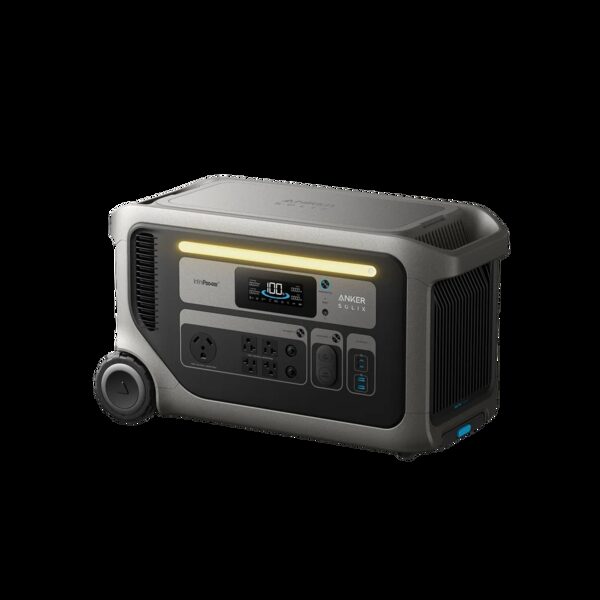
This is the section that decides the purchase. A single F3000 provides 120V output only, and Anker states that 240V output requires two F3000 units connected with a double voltage hub, described as plug-and-play with no electrician needed4. UK homes use a 230V nominal supply and Type G sockets, so the F3000's TT-30R and NEMA 5-20R outlets do not match a British plug without adapters, and adapters do not change the voltage.
The AC input side is equally specific. The EV Charging Adapter is stated as only for a Type 1 connector, SAE J17724. Type 1 is the older single-phase connector; most UK home charge points use Type 2, so the adapter will not fit them. The 230V, 18A, 3,600W, 50Hz rating on that input is the one figure that matches a European supply, and it arrives through a connector most UK households do not have2.
The generator compatibility note is also North American: Anker states the F3000 works with most 120V gas generators on the market if they have a TT-30 plug or adapter11. A UK household with a 230V generator has no matching input.
What this means for independence is narrow but real. The F3000 can run a fridge, lights, a router and small tools from its own battery, recharged from solar panels with no grid connection at all. It cannot be wired into a UK consumer unit, cannot be registered with a network operator, and cannot offset a household's imported electricity in the way an installed battery does. A UK buyer is buying a portable appliance, and the plug-in and balcony storage page covers the products actually designed for British sockets.
Warranty, certifications and buying terms
Anker lists the F3000 with a 30-day money-back guarantee, a hassle-free warranty and lifetime customer support, and states the unit is UL9540 certificated3. UL9540 is a North American safety standard for energy storage systems; it is not the UK or EU framework, and it does not by itself satisfy UK installation standards. The 10-year lifespan claim sits under Anker's InfiniPower branding rather than as a stated warranty term1.
The expansion battery carries a clearer term: Anker describes the BP3000 as covered by a 5-year full-device warranty4. Elsewhere in the range, the F3800 is described as backed by a 5-year warranty, the F3800 Plus as a 5-year warranty, and a refurbished F3800 as carrying a 6-month warranty5. The F2000 refurbished listing offers lifetime customer support3. The pattern is that new units carry multi-year cover and refurbished units carry shorter terms, which is worth checking on any listing before purchase.
Prices are not published in the material available here, so the F3000 should be treated as retailer-quoted, and any UK purchase will carry import and shipping considerations that a domestic product does not. The protective cover is listed as designed exclusively for the F3000 and carries the same 30-day money-back guarantee8.
"Stores free solar or off-peak power with the optional Power Saver Kit (sold separately)."
The Power Saver Kit is the one accessory that points at household running costs rather than camping. Anker states it stores free solar or off-peak power, is compatible with the F3000, and is sold separately rather than included1. Anker's bill-saving claims around the F3000 are based on a $0.5 per kWh peak rate and 80% daily cycling in California, with a setup of the F3000, two expansion batteries and 2,400W of solar panels1. Those assumptions are North American, and the payback claim of as little as 2 years rests on them1. For UK tariff stacking, the smart tariffs page covers how the numbers are actually worked out here.
Sources19 cited
- Anker SOLIX F3000 Portable Power Station, Anker SOLIX, 2026-09-19
- Anker SOLIX F3000 Expansion Battery, Anker SOLIX, 2026-09-19
- Anker SOLIX F3000 with 400W Bifacial Solar Panel, Anker SOLIX, 2026-09-19
- Anker SOLIX BP3000 Expansion Battery for F3000, Anker SOLIX, 2026-09-19
- Anker SOLIX F3800, Anker SOLIX, 2026-09-19
- Anker SOLIX F3000, Anker SOLIX, 2026-09-19
- Anker SOLIX C2000 Gen 2 Expansion Battery with 400W Solar Panel, Anker SOLIX, 2026-09-19
- Anker SOLIX F3000 Protective Cover, Anker SOLIX, 2026-09-19
- Anker SOLIX F1200 (PowerHouse 757), Anker SOLIX, 2026-09-19
- Anker SOLIX C300X Portable Power Station, Anker SOLIX, 2026-09-19
- Anker SOLIX F3000 Power Saver Kit with 410W Rigid Solar Panel, Anker SOLIX, 2026-09-19
- Anker SOLIX F2000 Refurbished, Anker SOLIX, 2026-09-19
- Anker SOLIX C2000 Gen 2, Anker SOLIX, 2026-09-19
- Anker SOLIX C300 Portable Power Station (Refurbished), Anker SOLIX, 2026-09-19
- Anker SOLIX C800 Portable Power Station, Anker SOLIX, 2026-09-19
- Anker SOLIX F2600 Portable Power Station, Anker SOLIX, 2026-09-19
- Anker SOLIX F3800 Plus Expansion Battery with 400W Solar Panel, Anker SOLIX, 2026-09-19
- Anker SOLIX F3800 Plus with 400W Bifacial Solar Panel, Anker SOLIX, 2026-09-19
- Anker SOLIX F3800 Refurbished, Anker SOLIX, 2026-09-19
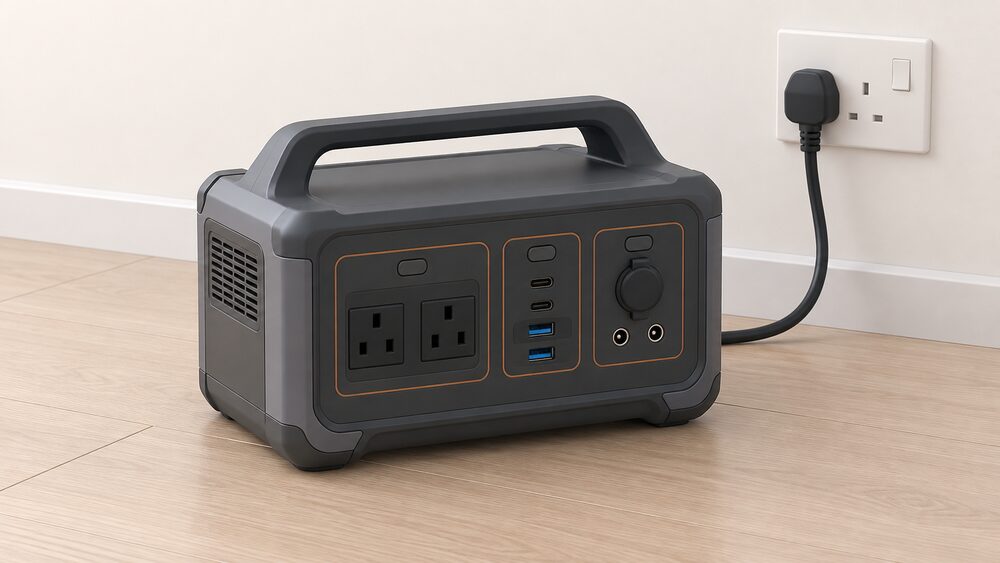 Anker SOLIX portable power stations and home backup batteriesAnker SOLIX covers two very different kinds of backup: portable power stations you can carry, and whole-home batteries wired into the house.
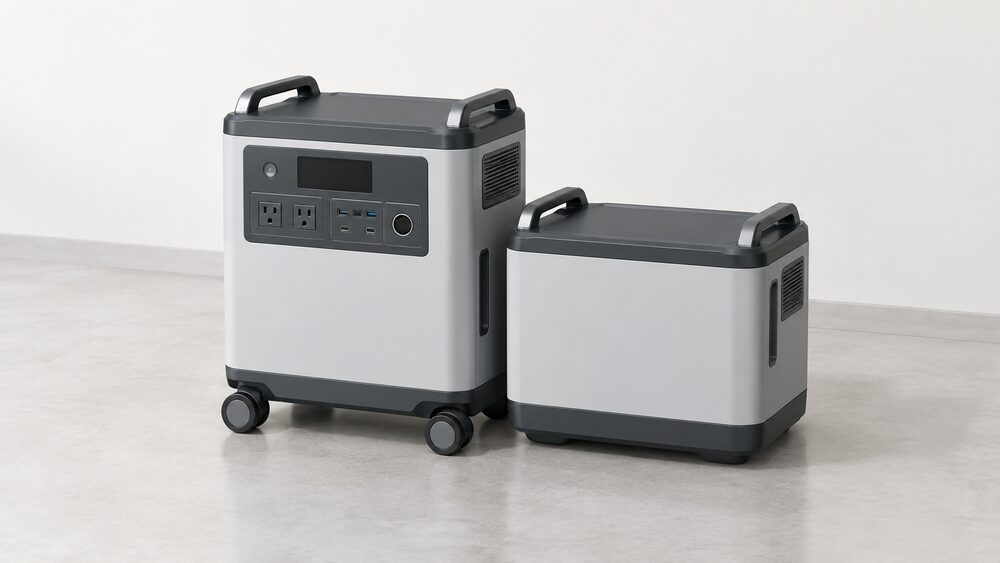 Anker SOLIX F3800 Plus home backup batteryHow much power does the Anker SOLIX F3800 Plus give you in a blackout, and how long will it last?
 Anker SOLIX EV chargersAnker's SOLIX V1 is a home wallbox that can charge your car using solar power, battery storage or the grid.