
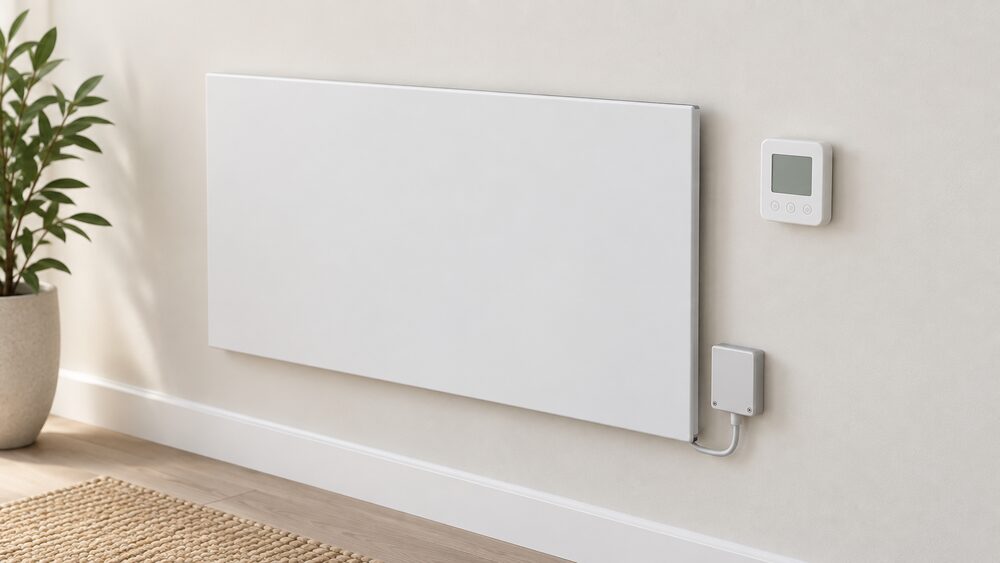
In this guide
A Herschel thermostat is the control layer for Herschel infrared heating: it reads room temperature and switches the heater on and off to hold a setpoint. Herschel sells these controls separately from most of its panels, and the range splits into hard-wired units such as the iQ MD2 and wireless packs such as the iQ T2, which pairs a T2 thermostat with an R2 receiver. The MD2 is a 16 amp wired thermostat that carries up to 3.6 kW of Herschel heaters1. The T2 pack controls up to 2 kW at 230V on one electrical circuit2.
The controls exist because most Herschel panels have no thermostat of their own. The Krystal panel, for example, is controlled by hard wiring to one of Herschel's iQ thermostats, purchased separately3. Only some products, such as the Select Portable Infrared Heater 500W, carry an in-built thermostat for simple temperature control4.
Two constraints shape everything below. Herschel states that its iQ controls will only work with Herschel heaters, and that attempted use with any other heater brand will invalidate the warranty1. App control runs through the Smart Life app on a 2.4GHz wifi network, which introduces a dependence on broadband and a third-party app that hard-wired control does not have5.
What a Herschel thermostat does and why the heaters need one
Infrared panels are electric heaters that warm surfaces and people directly rather than the air, and without a thermostat they simply run at full output whenever they are switched on. A Herschel thermostat adds the sensing and switching layer: it measures room temperature and breaks the supply once the setpoint is reached. Herschel's own range is built around this, with the iQ MD2, iQ T2, iQ R3, T-BT, T-BTLED, T-MTLED, T-PL and T-MKS covering different wiring and mounting situations1.
The reason the controls are sold separately is that Herschel's panel range is not uniform. The Krystal 600 to 1000W panel is controlled by hard wiring to an iQ thermostat bought alongside it3. The Select Portable Infrared Heater 500W instead has an in-built thermostat providing simple temperature control, which the maker states makes it fully compliant with European energy saving regulation, Lot 204. The Summit 2600W non-remote model can be used with external thermostat controllers such as the iQ MD2, giving thermostatic and app control12. The Comfort ceiling tile heater is listed as easy to install and control using Herschel's iQ thermostats or existing building management controls13.
That last point matters for anyone specifying controls across a building: Herschel's controls are not the only route, and a ceiling tile installation can sit on a building management system instead. For a domestic installation, the practical question is which Herschel control matches the heater's receiver and the wiring available.
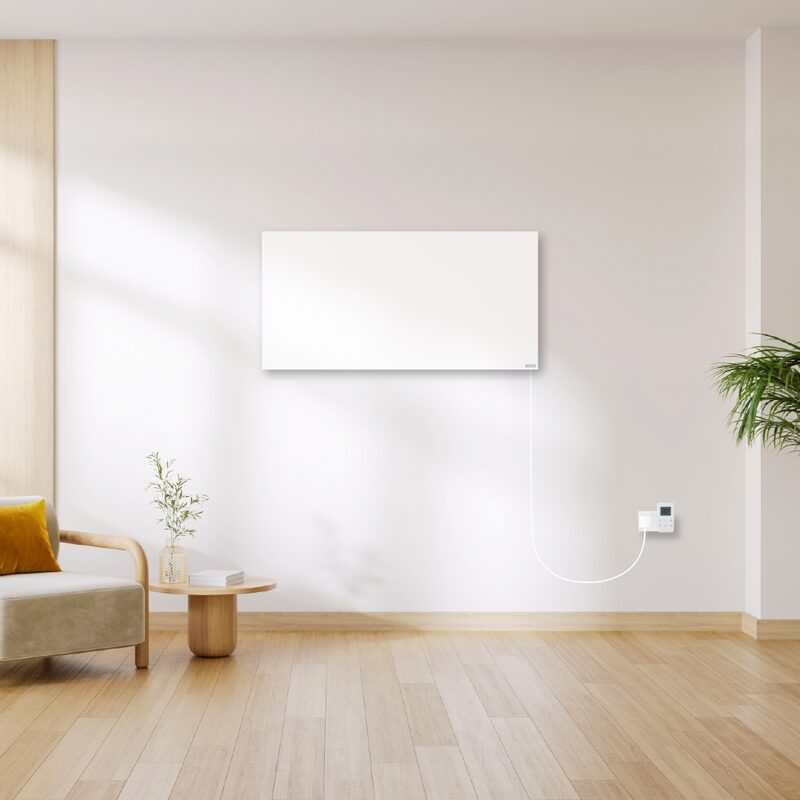
Herschel iQ MD2 Wired Thermostat: specification and price
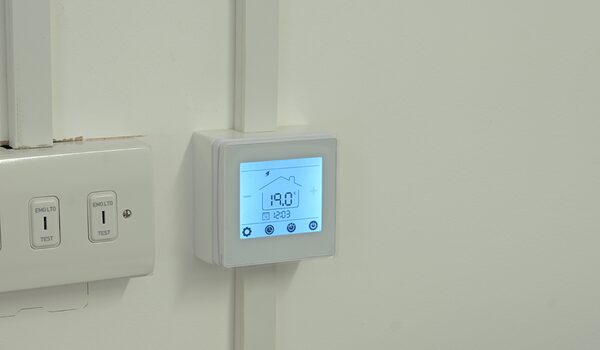
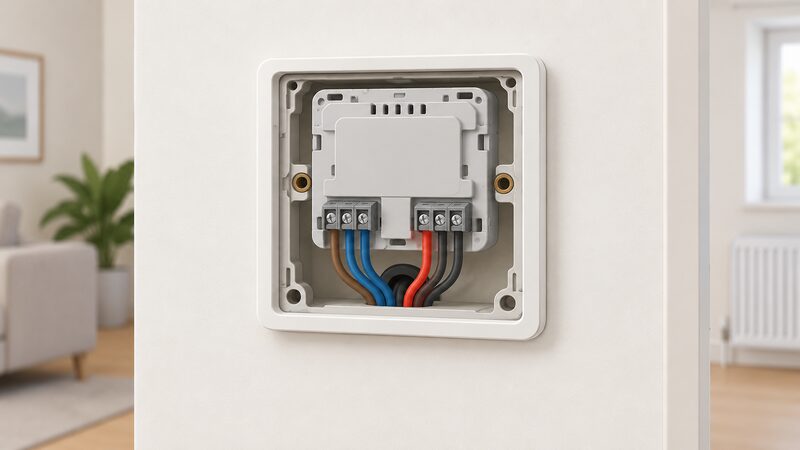
The MD2 is the hard-wired option. It is a 16 amp thermostat enabling up to 3.6 kW of Herschel heaters to be connected, and it is wired directly to the mains circuit and to the heaters, requiring recessing into the wall1. That recessing is the defining practical difference from the wireless units: the MD2 needs a back box and a mains feed at the point of installation, so it suits a new circuit or a planned installation rather than a retrofit where the wall is finished.
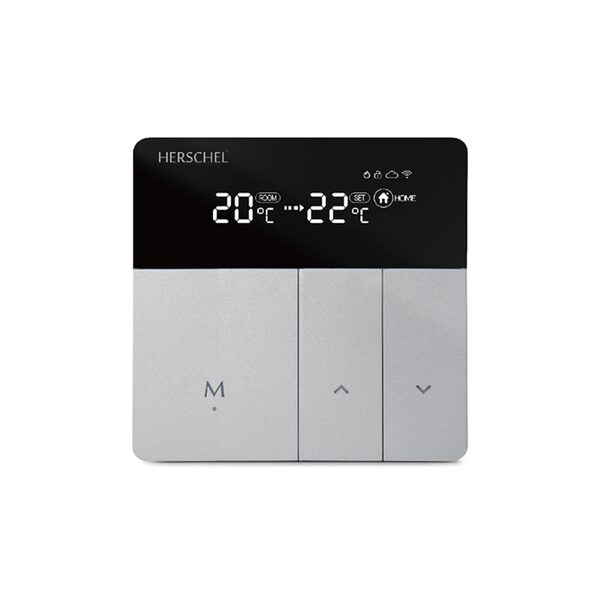
Herschel lists it as suitable for commercial applications such as hotels, care homes, student accommodation and let properties, which reflects the load it can carry and the wired reliability rather than any domestic restriction1. It communicates on the 2.4GHz wifi band1.
On certification, Herschel lists EN60730-1&2-9 for EU and UK electrical safety, EN62479 and EN50663 for electromagnetic compatibility, IEC62321 for restriction of hazardous substances, and EN300220-1&2, EN300328 and EN301489-1;3;17 for radio emissions, plus RCM compliance for Australia and New Zealand as a low risk appliance1.
Two limits are stated plainly. The MD2 thermostat is not compatible with Remote models1. And attempted use with any other heater brand will invalidate the warranty1.
Herschel iQ T2 Wireless Thermostat Pack: specification and price
The Herschel iQ T2 Wireless Thermostat Pack is the wireless counterpart and the one most domestic installations use. It incorporates one T2 thermostat and one R2 Receiver2. The receiver is what the heaters connect to, and the T2 communicates with it by radio rather than by cable, which is why the product is sold as wireless even though the R2 Receiver itself is wired into the heater circuit.
The T2 will control up to 2 kW (at 230V supply) of Herschel Infrared heaters on one electrical circuit2. That is a lower ceiling than the MD2's 3.6 kW, and it is the figure that decides how many heaters can sit behind one thermostat and receiver. The radio frequency is 433 MHz, and WiFi is enabled via the R2 Receiver rather than in the thermostat itself2. The energy saving features listed are Open Window and Adaptive Start2. Compatibility is closed: "Herschel controls will only work with Herschel heaters."2
The R2 receiver itself has a setpoint range of 5 to 35°C and is listed for use with the T2 thermostat2. Multiple R2 receivers can be paired with a T2, which is how a single thermostat can serve more than one circuit14.
| Control | Type | Load or circuit limit | Setpoint range | Price |
|---|---|---|---|---|
| iQ MD2 | Wired, 16 amp | up to 3.6 kW1 | Not stated | Not stated |
| iQ T2 pack | Wireless, T2 plus R2 receiver | up to 2 kW at 230V per circuit2 | 5 to 35°C, 0.5°C steps2 | Not stated |
| iQ R3 | Wireless controller | Not stated | 5 to 35°C6 | £54.0015 |
| T-BT | Battery wireless | Not stated | 5 to 40°C7 | £69.0015 |
| T-PL | Plug-in wifi | Not stated | 5 to 37°C8 | £79.0015 |
| iQ T-MKS | Mains wifi, silver | Not stated | 5 to 45°C9 | £89.0015 |
| T-MTLED | Mains wifi, LED control | Not stated | Not stated | £102.0010 |
Wired or wireless: which suits which home
The choice between the MD2 and the T2 pack is mostly about wiring and load, not about features. A wired thermostat needs a mains connection and a recessed mounting point, and it can carry up to 3.6 kW1. A wireless pack needs the receiver wired into the heater circuit but leaves the thermostat free to sit anywhere within radio range, and it carries up to 2 kW per circuit2.
Herschel states that all of its thermostats can operate without wifi, and describes the range as easy to use with energy-saving functionality and WiFi-free operation available across it15. That is the point at which the wired and wireless distinction stops mattering for resilience: a T2 talking to an R2 by 433 MHz radio works whether or not the household has broadband, and only the app features need the network.
Battery life is a consideration on the battery-powered units. Herschel states that the T-BT and T2 should give a full heating season's operation on a fresh set of 1.5V alkaline batteries, and that poor RF contact can raise consumption up to four times normal14. That is a maintenance item rather than a fault, but it is worth knowing before choosing a battery thermostat for a hard-to-reach wall.
The T-BT is rated 4.13 out of 5 based on 8 customer ratings on Herschel's own controls page15. The T-BTLED is a battery powered wireless thermostat designed to work exclusively with Herschel Select XLS LED heaters with their built-in SMART-R receiver11.
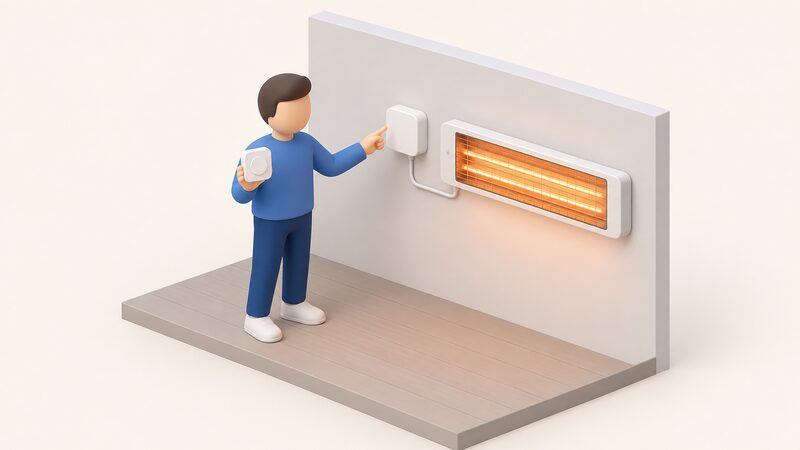
App, voice and smart control through the SmartLife App
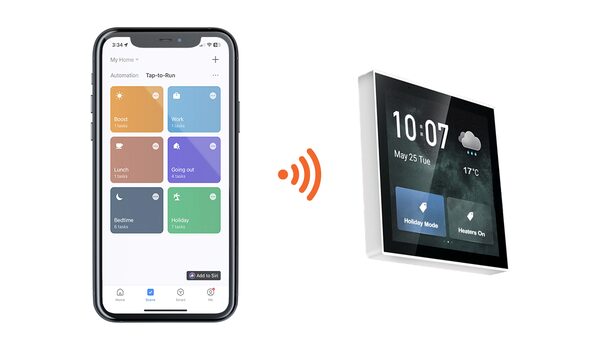
App control on Herschel controls runs through the Smart Life app, and it is not universal across the range. The T2 pack lists Smartlife App Control and voice control that works with Alexa and Google Assistant when paired with the SmartLife App2. The iQ R3 is programmed only via the Smart Life app, communicates on 2.4GHz wifi, and can be controlled by voice using Alexa or Google Assistant through the same app6. The T-PL plugin wifi thermostat and the T-MTLED both list Smartlife App Control and the same Alexa and Google Assistant pairing8. The iQ T-MKS mains powered wifi thermostat in silver lists the same voice control arrangement9. The PIR sensor also lists Smartlife App Control17.
One control does not join in. Herschel states that the T-BT is not wifi enabled and therefore cannot pair with the Smart Life app14. It is a radio thermostat only.
Pairing is the common failure point, and Herschel has published guidance on it. The root cause of app pairing problems is the phone and the thermostat failing to connect successfully to the same 2.4GHz local wifi network5. A wireless thermostat cannot be managed on a network extender, where attached devices are treated as guests, so the thermostat and app must be paired and operated on the main network5. Normal local wifi conditions, meaning a good 2.4GHz signal and a router that does not have too many simultaneous connections, are what the system needs18.
Voice control does not require a local smart speaker. Herschel states that no local Alexa or Google device is needed to run the commands, just the app18.
Compatibility limits and the warranty condition
The compatibility rule is the single most important thing to understand before buying a Herschel control. Herschel states that its iQ controls will only work with Herschel heaters2. The T-PL will only work with Herschel XLS heaters and cannot be operated with any other brand of infrared heater8. The T-BT works exclusively with Herschel XLS heaters with a built-in SMART-R receiver and is not compatible with any other brand7. The T-MTLED carries the same restriction10. The iQ T-MKS repeats that Herschel iQ controls will only work with Herschel heaters9.
The warranty condition follows from that. The MD2, the T2 pack, the R3, the T-BT, the T-MTLED and the iQ T-MKS all state that attempted use with any other heater brand will invalidate the warranty1. The T2 pack and the R3 both carry a 2 year warranty2.
The PIR sensor has a different kind of limit. It works with all Herschel app-enabled thermostats but must be used in conjunction with a Herschel thermostat, and it will not control heating on its own17.
On the wider range, Herschel states that its thermostats incorporate Lot 20 compliant energy-saving features such as Open Window technology and Adaptive Start, along with full app control, geofencing and motion sensors19. Herschel also states that its infrared heaters and control products are certified to national safety standards14.
"Attempted use with any other heater brand will invalidate the warranty."
Installation and what owning Herschel controls means for energy independence
Installation differs sharply between the two main routes. The MD2 is wired directly to the mains circuit and to the heaters and requires recessing into the wall1. The T2 pack needs its R2 receiver wired into the heater circuit, while the T2 thermostat itself is free-standing2. On the panel side, Herschel states that Select XLS panels with built-in SMART-R receivers are installed on individual fused spurs, that XLS controllers draw power independently from the panels, and that a single XLS thermostat can be placed in the room14. Multiple heater panels can be paired to a single thermostat using the standard pairing procedure on the panel instructions20.
For energy independence, the picture is mixed and worth stating plainly. The heaters and the controls run on electricity from the grid, so a Herschel system keeps a household dependent on an electricity supplier and on the mains supply. What the controls change is how much of that electricity is used and when. Herschel's own guidance states that with thermostat control a household is likely to require 5 hours running a day or less, especially with two 600 Watt heaters21.
The dependence that the controls add is digital. App scheduling, energy monitoring and voice control run through the Smart Life app, a 2.4GHz wifi network and, for voice, Amazon or Google services2. Herschel states that all of its thermostats can operate without wifi, so local control at the thermostat survives a broadband outage15. The T-BT has no wifi at all14. A household that wants the heating to work regardless of the internet can have that, but it gives up the app features to get it.
How thermostat control affects infrared running costs
The Energy Saving Trust's position is that a well-controlled infrared system will probably cost less to run than standard electric panel heaters, and that infrared might also be cheaper to run than storage heaters or electric underfloor heating depending on how it is controlled, though it notes there is little research available to confirm this22. That is the independent framing: control is the variable, not the technology alone.
Herschel's own comparison page states that Herschel Infrared is cheaper to run than storage heaters, and that with thermostat control a household is likely to require 5 hours running a day or less, especially with two 600 Watt heaters21. That is a maker's claim about its own products and should be read as such.
The general principle is well established outside infrared. Standalone electric heaters tend to be more energy efficient if they have thermostatic controls that switch off at a set temperature, and a separate plug-in thermostat can be bought as an upgrade23. Home Energy Scotland states that room thermostats and heating controls allow a household to set and maintain the temperature and make sure it is warm for the times of day people are at home, and switched off to save electricity when they are not24. The Planning Portal's self-build sustainability guidance advises installing smart systems that control lighting, heating and cooling based on occupancy and time of day25. Approved Document L requires that each room should be provided with thermostatic room controls, in new dwellings or when a heat generator such as a boiler is replaced in an existing dwelling26.
Smart Energy GB notes a limitation of smart thermostats generally: they can be expensive and have an installation cost, and having one means tracking only the heating, so electricity and gas usage cannot be watched in the same place27. A smart thermostat controls heating and helps manage how central heating is set and adjusted28. A wireless thermostat usually sends a signal to a receiver connected to the boiler, which then tells the boiler when to turn the heating on or off, without a direct wired connection28. Netatmo notes that a wireless thermostat needs no complex installation and can be installed more flexibly than a wired one, but must be linked to its receiver29.
For a Herschel system the practical conclusion is that the thermostat is what converts a fixed-output panel into a controlled heat source, and that the running cost depends on the setpoint, the schedule and the room's heat loss rather than on the control brand. Herschel's controls are also not the only option for every product: the Comfort ceiling tile heater can run on existing building management controls13, and the Select XLS LED panel carries independent light only control19.
Sources29 cited
- Herschel iQ MD2 Wired Thermostat, Herschel Infrared, 2026-08-26
- iQ R2 Receiver Unit, Herschel Infrared, 2026-08-26
- Krystal 600 to 1000W Infrared Panel Heater, Herschel Infrared, 2026-08-26
- Select Portable Infrared Heater 500W, Herschel Infrared, 2026-08-26
- Problems Pairing Thermostats with the Smart Life App, Herschel Infrared, 2025-04-24
- Herschel iQ R3 Controller, Herschel Infrared, 2026-08-26
- T-BT Wireless Thermostat, Herschel Infrared, 2026-08-26
- T-PL Plugin Thermostat, Herschel Infrared, 2026-08-26
- Herschel iQ T-MKS Mains Powered Thermostat Silver, Herschel Infrared, 2026-08-26
- Herschel SmartLED Controls T-MTLED Mains Powered WiFi Thermostat, Herschel Infrared, 2026-08-26
- Herschel SmartLED Controls T-BTLED Battery Powered Wireless Thermostat, Herschel Infrared, 2026-08-26
- Summit 2600W, Herschel Infrared, 2026-08-26
- Comfort Infrared Ceiling Tile Heater, Herschel Infrared, 2026-08-26
- Customer Service FAQs, Herschel Infrared, 2026-02-24
- Heating Controls, Herschel Infrared, 2026-03-18
- Select XLS LED Infrared Panel Heater, Herschel Infrared, 2026-09-16
- PIR Sensor, Herschel Infrared, 2026-08-26
- Enabling Alexa and Google Home, Herschel Infrared, 2025-04-24
- Select XLS LED Front Lit Infrared Panel Heater, Herschel Infrared, 2026-08-26
- Herschel Infrared, Herschel Infrared, 2026-07-08
- Storage Heaters Comparison, Herschel Infrared, 2022-05-19
- Infrared Heating Explained, Energy Saving Trust, 2026-03-13
- Energy Efficient Heaters, Uswitch, 2026-07-01
- Make Winter Feel Like Summer, Home Energy Scotland, 2026-09-20
- Self Build Homes Sustainability, Planning Portal, 2026
- Approved Document L, Conservation of Fuel and Power, Volume 1 Dwellings, HM Government, 2026-09-17
- Ultimate Energy Saving Tips Guide, Smart Energy GB, 2026-04-24
- What Is a Smart Thermostat, Smart Energy GB, 2026-08-19
- Wireless Thermostat, Netatmo, 2026-09-20
 Herschel InfraredHerschel Infrared is the UK's largest infrared heater maker, selling panels, outdoor heaters and controls direct, with warranties of 5 to 10 years and no registration required.
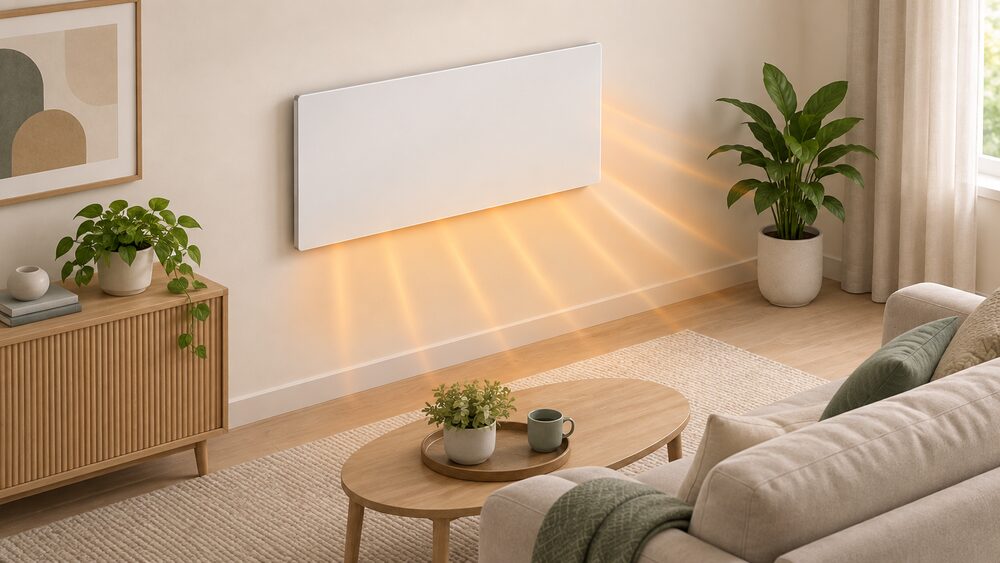
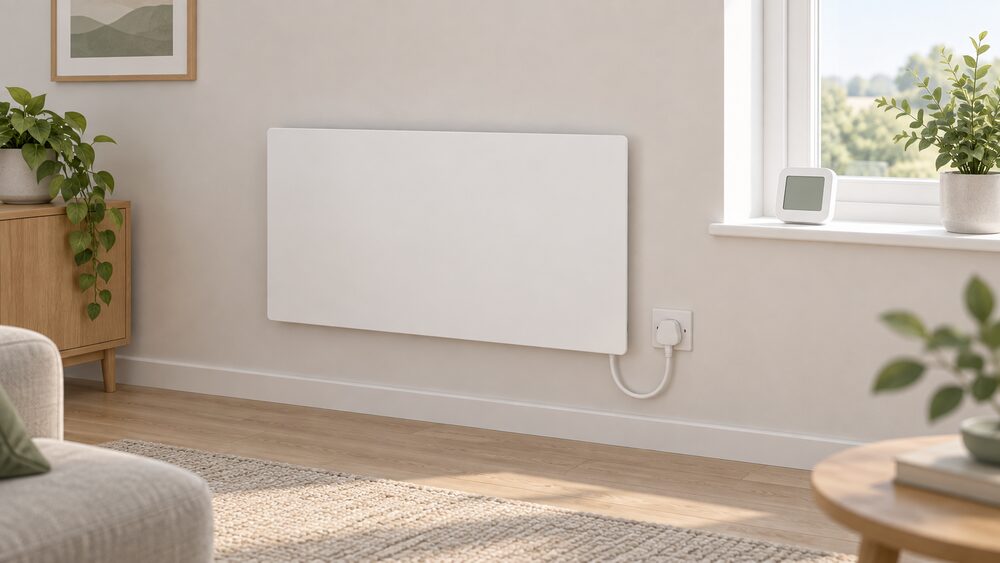 Herschel Select XLS infrared panel heaterHerschel Select XLS panels warm you and the room directly, like the sun, rather than heating the air.