
In this answer
Short answer
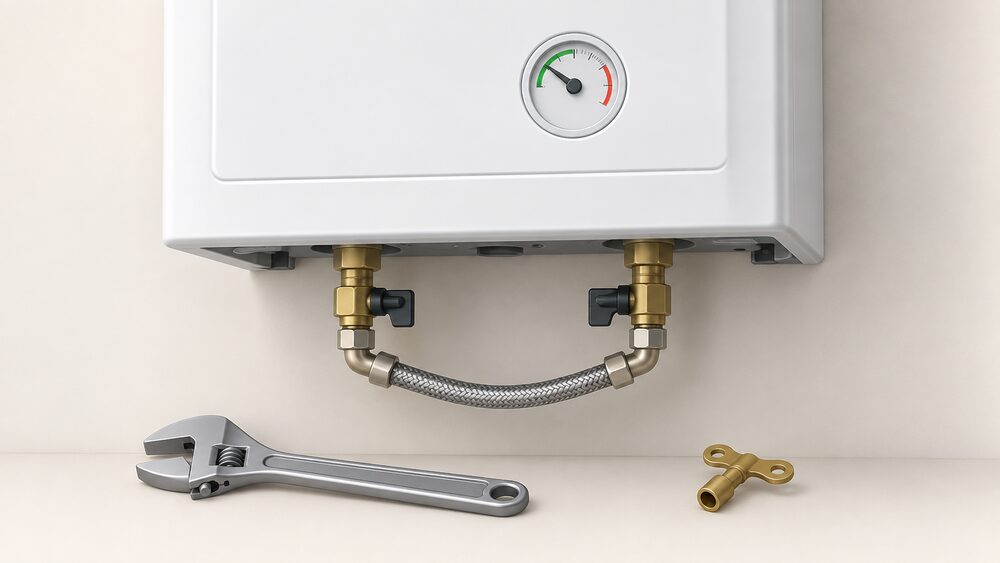
A sealed central heating system runs at pressure, and when that pressure falls the boiler stops behaving. The target is a cold reading of 1 to 1.5 bar on the gauge, and most boilers should operate between 1 and 1.5 bar when cold1. Below 1 bar the boiler may need repressurising, and on a modern boiler the system will typically shut down as a safety measure if pressure gets too low2.
Repressurising is a householder task on most combi and system boilers, done through a filling loop: a component, often a braided hose, that connects the central heating system to the mains water supply3. The job is a matter of turning off the boiler, opening two valves, watching the gauge and closing the valves again at the right figure. Older combis may use a filling key instead of a loop, and the sequence differs slightly.
What follows covers the pressure figures, when to act, how the filling loop works, the step by step method, the filling key alternative, and what it means when pressure will not stay put. It also sets out where the limits of DIY lie, because a boiler that keeps losing pressure has a cause that topping up does not fix.
What boiler pressure should be: 1 to 1.5 bar when cold
The figure that matters is the cold reading, taken with the heating off. Most boilers should operate between 1 and 1.5 bar when cold, and the recommended range is usually given as 1 to 1.5 bar when cold1. Citizens Advice gives the same band, advising that the pressure is set between 1 and 1.5 bar7. One independent guide puts the gauge target at around 1.5 bar, and notes that below 1 the boiler will not work properly, with error messages or a loss of heating and hot water1.
Not every source uses the same band. One energy supplier's guidance says the gauge should sit around the 1.5 bar reading8. That sits within the maker and consumer-body figures, and it is worth reading the two together: the 1 to 1.5 bar band is the cold filling target, while a reading that rises with the heating running is the normal expansion described below. Where a boiler has its own stated figure, the manual takes precedence, and checking it is the first step of any repressurising job9.
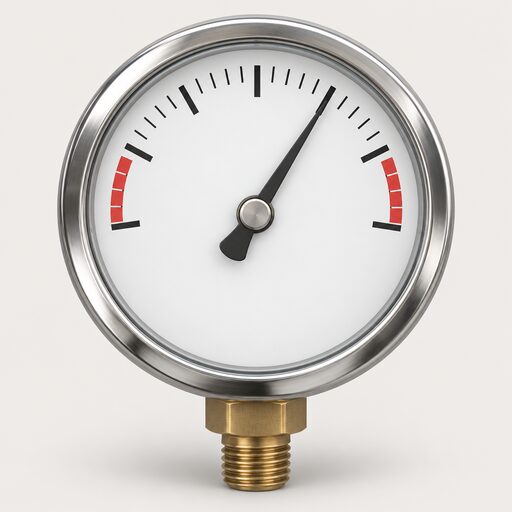
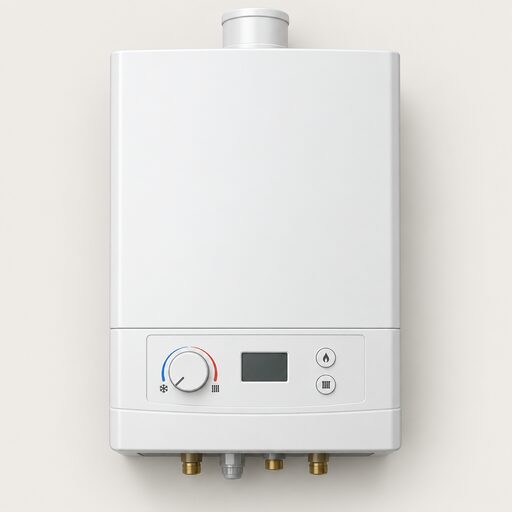
The gauge itself is usually a round dial on the front of the boiler or under the control panel, and on older boilers it may sit underneath among the pipes10. Some models show pressure digitally through the controls instead. Reading it cold, before the heating has run, is what makes the figure comparable with the target band.
For a household, this is the one number that governs whether the heating runs at all. It is also the number that reveals a slow leak: a system that holds 1.5 bar for months is sealed, while one that falls to 1 bar repeatedly is losing water somewhere.
When to repressurise: below 1 bar on the gauge
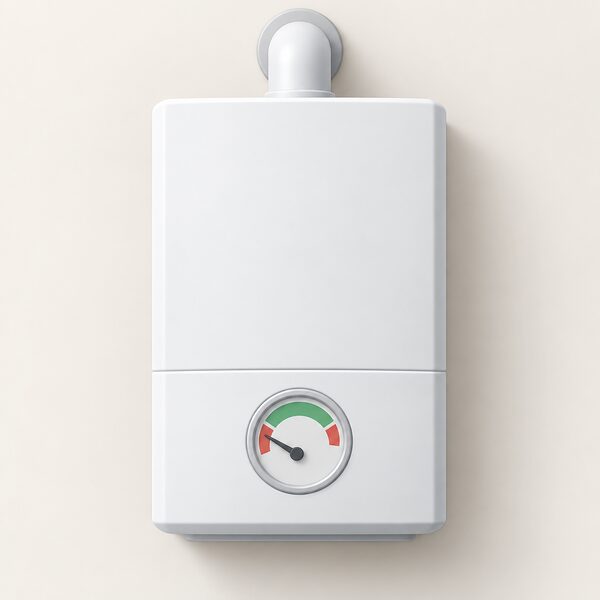
The trigger is a cold reading below 1 bar. One independent guide states that where the pressure drops below 1.0 bar the boiler might need repressurising4, and a maker's guidance says the same: if the pressure drops below 1.0 bar, it needs repressurising11. Citizens Advice frames it as an instruction rather than a judgement, advising that if the pressure is below 1 bar the householder should follow the manufacturer's guide to repressurise the boiler7.
Below that threshold the effects show up quickly. One independent guide notes that below 1 bar the boiler will not work properly and error messages or a loss of performance follow1. A maker's guidance describes the safety response: if the pressure in a modern boiler gets too low, the system will typically shut down as a safety measure2. Another maker's guide adds that below 1 bar the heating will not work effectively12.
Pressure loss has a short list of ordinary causes. It can happen after radiators have been bled and need the pressure reset, when the heating has been off for a very long time, or because of a leak13. Bleeding radiators is itself a common reason for a drop, which is why the two jobs sit together: after bleeding, the boiler gauge is checked for system pressure and topped up through the filling loop if it is too low14. If you have not bled the radiators recently and the pressure has fallen anyway, the loss is coming from somewhere else.
A single top-up after bleeding is routine. Repeated top-ups over weeks are not, and point to the section on persistent pressure loss below.
What the filling loop is and how it works
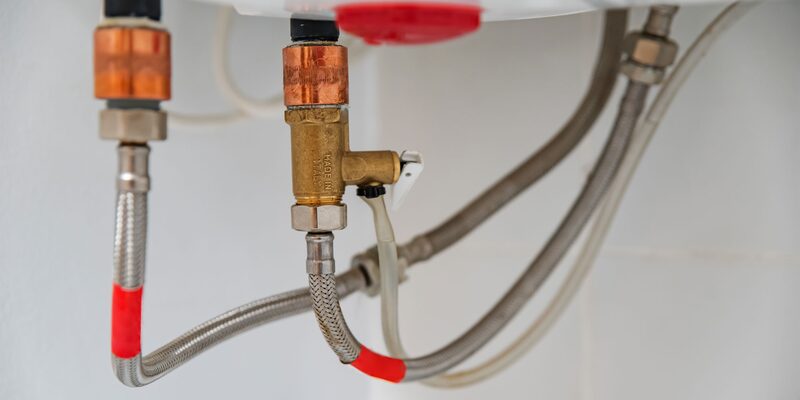
A filling loop connects the central heating system to the mains water supply, and is often a braided hose3. It is the route by which fresh water enters a sealed system that has lost volume. There are two arrangements: an internal loop or an external loop, and knowing which one a boiler has determines how the valves are reached13.
Location varies with boiler type. The loop is usually located under the boiler, and on a heat or system boiler it may be near the cylinder15. For a combi, the best way to refill is using the filling loop, usually located underneath or near the boiler16. Some makers fit the loop on the underside of the casing with two tap connections at either end, one small blue handle and one small black handle on the NCB-CE and NCB300 models17. On the LCB700 combi the loop sits near the top right of the boiler with two small black tap handles17.
The loop works by bridging mains pressure into the heating circuit. Opening both valves lets mains water flow in and the system pressure rise; closing them isolates the two again. That isolation is the point of the design, and it is why the closing step matters as much as the filling step.
Step by step: turning off the boiler, opening the valves and watching the gauge
The sequence below follows maker guidance. Always begin the process of repressurising a boiler by checking the boiler manual, because the valve arrangement differs between models9.
- Turn off the boiler and wait for it to cool down completely2.
- Identify the filling loop and the pressure gauge, and make sure the gauge is visible while you reach the loop18.
- Turn both filling loop handles to match the direction of the pipe. Water should be heard flowing18.
- Watch the gauge as the pressure rises. Aim for the ideal cold pressure, typically around 1.0 to 1.5 bar3.
- At about 1.2 bar, shut off both valves5.
- Make sure the handles are fully closed, then turn the boiler back on and observe it18.
The order matters for two reasons. Turning the boiler off first means the gauge is reading cold pressure rather than expansion, and it means the system is not heating while fresh cold water enters it. Checking that the gauge is visible before opening anything avoids the common mistake of filling blind and overshooting.
On the closing step, Ideal Heating suggests turning the valve by 90 degrees to make sure it is closed, or checking whether the handle is aligned with the pipe, which means it is open and needs closing13. A handle sitting along the pipe is open; across it is closed.
Worcester Bosch publishes videos covering how to find out which repressurisation method a boiler uses, and how to repressurise its system and regular boilers, which is useful where the manual has been lost20.
Boilers with a filling key instead of a loop
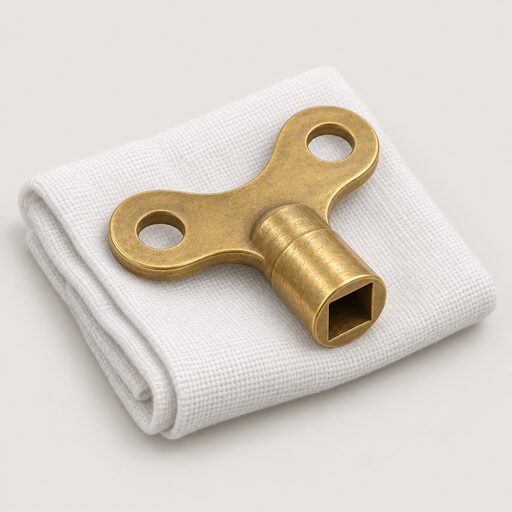
An older combi boiler might have a filling key rather than a filling loop21. The method is different in detail but the same in principle: a key opens a passage between the mains and the heating circuit, and the gauge is watched until the target is reached.
The maker's instruction is to insert the filling key into the keyhole and unlock it, then turn the valve next to the key until water flows through it9. The key is put into the unlock position and the valve turned using a spanner or wrench21. As with a loop, the boiler is off and cool, the gauge is watched, and the key is returned to its locked position and the valve closed once the pressure is right.
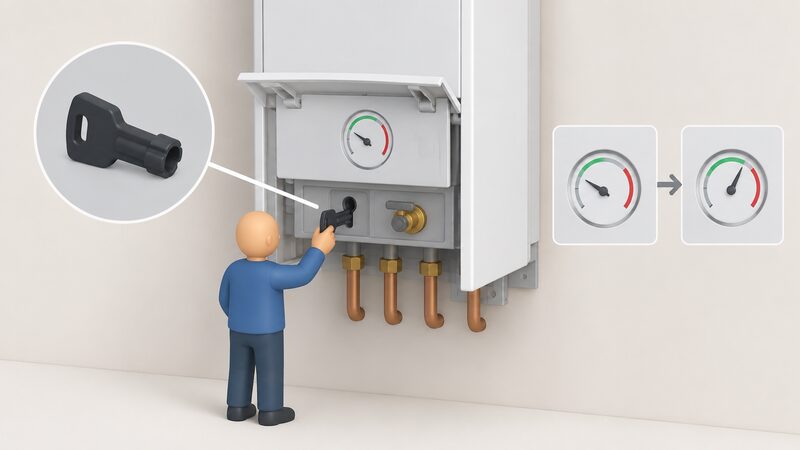
Two practical points apply to key-filled systems. The key is a specific part for the model, and a misplaced key is a common reason households cannot top up at all. And because the key arrangement is older, the boiler is more likely to be at the stage where pressure loss has a mechanical cause, such as a worn component, rather than a one-off drop after bleeding.
If pressure keeps dropping or rises too high

A system that needs topping up once after bleeding is behaving normally. A system that needs it repeatedly is telling you something.
On the low side, the threshold for calling an engineer is clear: if boiler pressure keeps dropping below 1 bar despite adjustments, it is time to contact an engineer5. The same guidance gives the upper limit: pressure rising above 2.5 to 3 bar despite adjustments also warrants a call5. Between those figures, the causes an engineer would investigate include the expansion vessel, whose pressure is checked and repressurised if it is too low, using a foot pump22.
On the high side, the remedy a householder can apply is bleeding the radiators, with the central heating switched off and radiators cool enough to handle23. Bleeding removes trapped air and drops the system pressure. It is not normally dangerous to run high: the system is protected by a pressure relief valve, and most systems shut down if pressure gets too high5.
Pressure rising when the heating is on is a different matter and is expected. As the boiler heats the water within the central heating system, the increased temperature causes the hot water to expand, and that raises the pressure24. The cold reading is the one to judge the system by.
What low pressure costs, and what it does not
The evidence on the consequences of low pressure is not unanimous, and both positions are worth stating. One independent guide says low pressure is not dangerous but can be problematic, because the boiler will not work as efficiently as it should, costing more on heating bills, with possible damage to the heating system if the underlying cause is not resolved13. A maker's guidance says low boiler pressure causes the boiler to work harder when heating the home, meaning more energy is used, which could result in energy bills increasing, but that it will not damage the boiler or reduce its lifespan2.
Read together, the two agree that efficiency suffers and bills can rise, and disagree on whether the boiler itself is at risk. The practical position is that a system sitting below 1 bar is not delivering heat properly, and the cause of the loss is the thing to resolve.
For a household's energy independence, this is a small but real point of control. Repressurising is one of the few boiler tasks a householder can complete without a callout, and it restores heating without waiting for an engineer. What it does not do is remove dependence on the gas grid, on a supplier, or on the boiler manufacturer for parts and for the warranty terms that govern who may work on the appliance. A boiler that needs repeated top-ups moves straight back into dependence on a Gas Safe registered engineer, and the expansion vessel check is squarely in that category22.
Where the pressure problem sits alongside a boiler that has locked out, the reset procedure is a separate task, covered in how to reset a boiler after a lockout. If the boiler has stopped entirely in cold weather, the wider checklist is in how to prepare a home for winter, and where a condensate pipe has frozen, thawing a frozen condensate pipe covers the safe method. For the pressure target in more detail, see what is the ideal boiler pressure.
Sources24 cited
- How to keep your boiler working in cold weather, Which?, 2025-12-11
- Why is my boiler losing pressure, Ideal Heating, 2026-09-17
- Repressurise boiler, Fuse Energy, 2026-06-29
- Common heating mistakes and how to avoid them, Which?, 2026-01-16
- Boiler pressure: everything you need to know, EDF Energy, 2026-09-17
- What to do if your boiler breaks down at Christmas, Which?, 2025-12-12
- Getting your broken boiler repaired or replaced, Citizens Advice, 2024-08-16
- Energy saving tips for the home, Confused.com, 2025-10-14
- How to repressurise a boiler, Vaillant, 2026
- What pressure should your boiler be?, Uswitch, 2024-11-13
- What should my boiler pressure be set at, Baxi, 2026-09-17
- Boiler pressure, Fuse Energy, 2026-07-10
- What should your boiler pressure be, Which?, 2025-09-16
- How to bleed a radiator, Uswitch, 2026-09-04
- Boiler FAQs, Ideal Heating, 2026-09-17
- How to drain a combi boiler, Viessmann, 2022-04-05
- Navien support FAQs, Navien, 2026
- Boiler loses pressure: what to do, Viessmann, 2022-05-31
- What do I do if my boiler has no pressure, Vaillant, 2026
- Boiler repressurisation videos, Worcester Bosch, 2026-09-20
- How to repressurise a combi boiler, Viessmann, 2022-03-24
- When does a boiler need its first service, Viessmann, 2022-04-05
- How to fix high boiler pressure, Baxi, 2026-09-17
- What pressure should my boiler be, Vaillant, 2026
 Boiler PressureIf the needle on your boiler has crept up or dropped, what should it read when the heating is off, and what counts as too high or too low?
 Bleed a RadiatorThe step-by-step method for bleeding a radiator, the tools needed and the order to work through a house.
 The Full Boilers and Heating GuideWhich boiler suits your home, and when is it worth swapping the old one?
 Thaw a Frozen Condensate PipeHow to identify a frozen condensate as the cause of a boiler lockout, the safe way to thaw the external pipe and how to restart the boiler afterwards.
 Flow TemperatureTurning down your boiler flow temperature can cut your gas bill, but how low can you go before the house feels cold?
 Condensing BoilersCondensing boilers squeeze extra heat out of the gas they burn by turning the steam in their waste gases back into water.