
Short answer
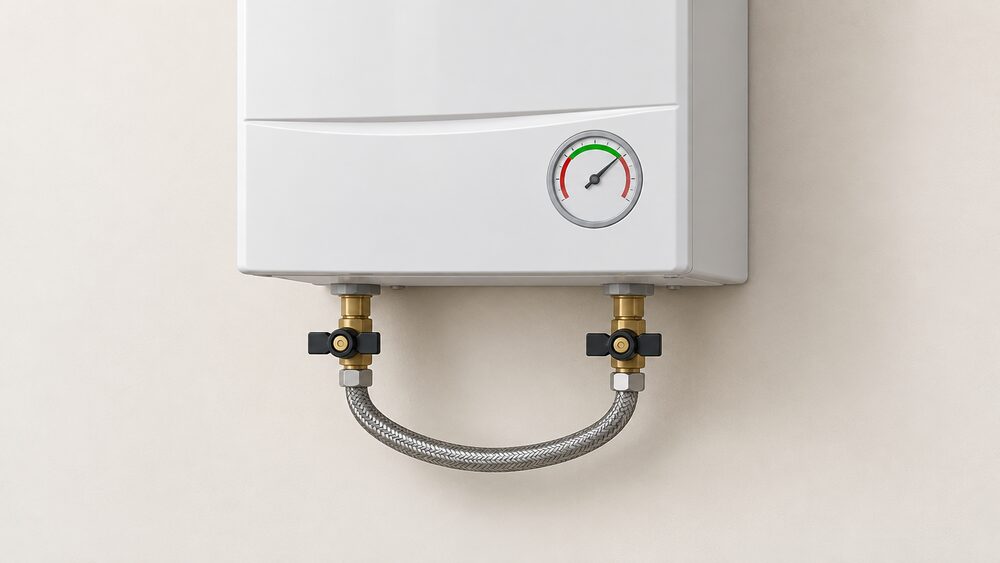
The ideal boiler pressure is between 1 and 1.5 bar on the gauge when the system is cold and switched off. That is the figure most makers and independent guides give for a sealed central heating system, and it is the reading to set the system to rather than the one you see while the heating is running1.
Pressure is not a fixed number. Water expands as it heats, so a sealed system that reads 1.0 to 1.5 bar cold will climb once the boiler fires. One maker states the rise is around 0.5 bar, so a system might sit closer to 2 bar while active2. That movement is normal and expected, not a fault.
What matters is the cold reading, because that is the only one you can compare against a maker's stated range. A cold system below 1 bar has lost water and will not run efficiently; a cold system well above its range has too much. Both are correctable, and neither usually means the boiler itself has failed.
Why pressure matters in a sealed central heating system
A modern gas boiler and a combi both run as sealed systems: the water inside is held under pressure and recirculated, not fed from a tank in the loft. That pressure is what pushes water to every radiator in the house, and it is why the gauge exists.
When pressure falls below 1 bar, the system stops working as designed. One maker states that below 1 bar the heating will not work effectively5, and another that a reading below one bar means the boiler has lost pressure6. Low pressure can also stop hot water being produced at all, alongside other boiler faults9. On a modern boiler, the system will typically shut down as a safety measure if pressure gets too low2.
At the other end, pressure should generally stay below 2.5 to 3 bar5. A reading of 3 bar or higher, often shown in the red zone on the gauge, is the clearest sign of overpressure and points to the pressure relief valve7. Worcester's oil boiler warranty terms require a sealed primary system to be connected with all joints capable of sustaining up to 3 bar, which shows where the equipment's design limit sits10.
Pressure fluctuates for ordinary reasons: natural expansion and contraction, bleeding radiators, leaks, a faulty expansion vessel, or simply overfilling5. The gauge is therefore a diagnostic tool as much as a setting. A household that checks it cold once a month knows its system's baseline, and can tell the difference between normal movement and a genuine loss of water.
Reading the gauge: cold versus hot
The single most common source of confusion is comparing a hot reading against a cold target. They are different measurements and should not be judged against the same number.
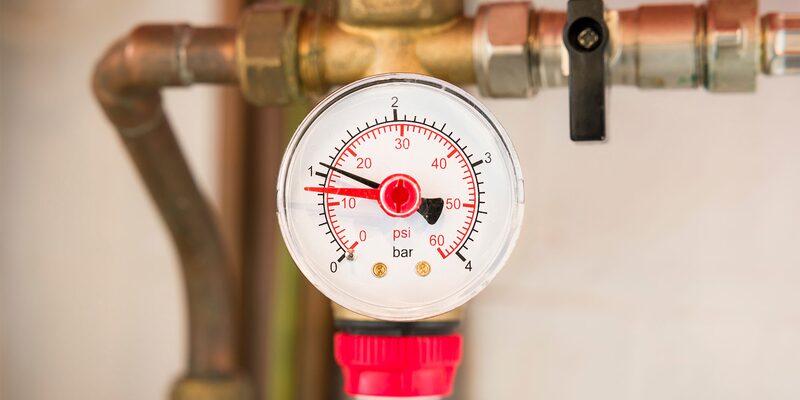
When the boiler is off or cold, the pressure should read between 1 and 1.511. One maker's guidance for bleeding radiators repeats the same band: the boiler should read between 1 to 1.5 bar of pressure when the central heating is cold12. A leak guide from a supplier gives the same normal reading of between 1 and 1.513.
Once the heating is on, the water in the system heats up and the pressure rises naturally through thermal expansion5. One maker states it should increase by around 0.5 bar, so it might sit closer to 2 bar while active2. Another gives around 2 bar when the heating is on as normal for most boilers14.
Some sources give a wider band. One independent guide states that when the system is cold the reading is usually between 1.0 and 2.0 bar on many boilers, while noting that the manufacturer's instructions should always be checked4. A consumer guide gives 1 and 2 bar as the range15, and a maker gives 1.0 to 2.0 bar as generally ideal10. These are not contradictions so much as different makers' tolerances: the 1 to 1.5 bar band is the tighter, more common target, and the wider 1 to 2 bar band accommodates boilers designed to run a little higher.
The practical rule is to read the gauge when the system is cold, compare that figure against the maker's stated range, and treat the hot reading as a separate observation. If the cold reading is right, the hot reading almost always is too.
Repressurising: the target when filling
When a cold system has dropped below 1 bar, the fix is to add water through the filling loop. The target is about 1.5 bar, not the top of the gauge.
The sequence is straightforward. Turn off the boiler and wait for it to cool down completely, check the filling loop attachments are secure, then open both valves and watch the gauge until it reaches the operating range, close the valves and turn the boiler back on2. One maker's guidance for high pressure gives the same target after any adjustment: the gauge should be around 1.5 bar8.
Independent guidance is looser on the exact figure. One consumer guide describes opening the filling loop taps until the desired pressure is reached, usually around one bar16. That is a lower target than the makers give, and it reflects the bottom of the acceptable band rather than the middle of it. Filling to 1.5 bar leaves more margin before the system falls back below the 1 bar threshold.
Ideal's system boilers are described as fully pressurised and filled via a mains cold water connection17, which is the arrangement most sealed systems use. A system filter is separately described by the same maker as improving boiler efficiency18, though that is a separate component from the pressure circuit.
When pressure drops or rises: what it signals
A gauge that moves is telling you something. The direction and speed of the change narrow down the cause.
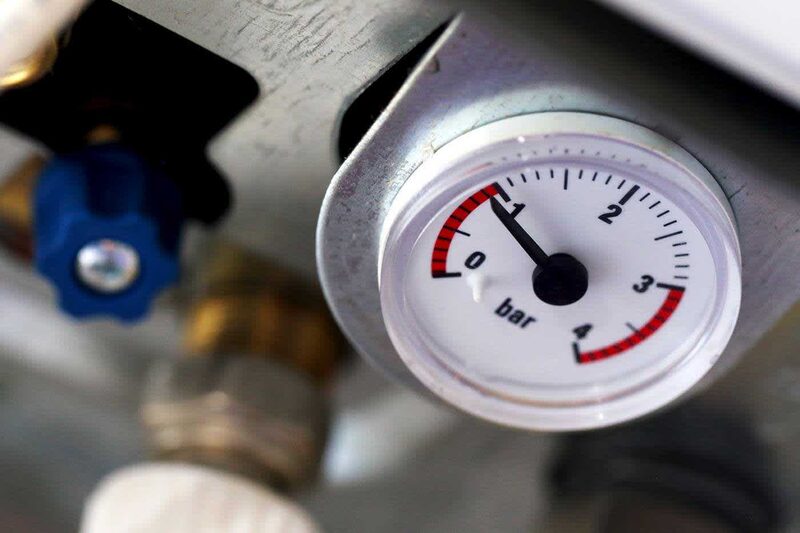
A slow, steady fall over months is usually minor: water lost through small leaks in pipes, radiators or valves, a faulty expansion vessel or pressure relief valve, or water removed when radiators are bled19. Bleeding radiators is a routine task, and the pressure drop afterwards is expected rather than a fault. A rapid pressure drop is different: it is usually a sign of a leak in the system, particularly if it happens when the boiler is on19. If the pressure has suddenly dropped, it may be that a major leak in the system has occurred20.
On the rising side, a gauge reading of 3 bar or higher, often indicated in the red zone, is the most obvious sign of high boiler pressure7. That points to the pressure relief valve, which is designed to release water before the system is damaged. Worcester's warranty terms for oil boiler heat exchangers require all joints in a sealed primary system to sustain up to 3 bar10, which is the design ceiling the relief valve protects.
A modern boiler will have a pressure gauge indicating whether pressure is high, adequate or low, and a screen that flashes an error code6. That makes diagnosis easier than reading a needle alone. A gauge dropping below 1 bar is itself the problem signal21, and a system that will not hold pressure after filling needs an engineer rather than another top-up.
For a household, the gauge is one of the few parts of a heating system that can be monitored without tools. Checking it cold, knowing the baseline, and recognising the difference between normal expansion and a genuine loss is the whole of the routine. Everything beyond that, from a faulty expansion vessel to a leak under a floor, is a job for a Gas Safe registered engineer.
Sources21 cited
- How to make your boiler energy efficient, Ideal Heating, 2026-09-17
- Why is my boiler losing pressure, Ideal Heating, 2026-09-17
- What to do if your boiler breaks down at Christmas, Which?, 2025-12-12
- How to keep your boiler working in cold weather, Which?, 2025-12-11
- Troubleshooting tips, OFTEC, 2026-09-20
- What pressure should my boiler be?, Vaillant, 2026
- Boiler overpressure valve, Fuse Energy, 2026-06-22
- How to fix high boiler pressure, Baxi, 2026-09-17
- My boiler is working but I have no hot water, Viessmann, 2022-03-31
- Boiler pressure, Fuse Energy, 2026-07-10
- No heating, no hot water checklist, EDF Energy, 2026-01-08
- How to bleed a radiator, Vaillant, 2026
- How to fix a boiler leak, OVO Energy, 2025-01-06
- Why does my boiler keep losing pressure, Intergas Heating, 2026-06-11
- Common heating mistakes and how to avoid them, Which?, 2026-01-16
- Common boiler problems and repair costs, Which?, 2025-09-17
- Ideal system boilers, Ideal Heating, 2026-09-17
- Ideal System Filter, Ideal Heating, 2026-09-17
- Boiler pressure: everything you need to know, EDF Energy, 2026-09-17
- Why is my boiler losing pressure?, Vaillant, 2026
- Why boilers break down in cold weather, Navien, 2026-03-03
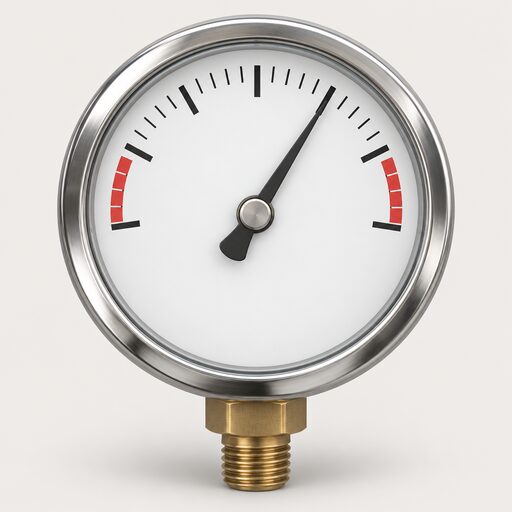 Boiler PressureIf the needle on your boiler has crept up or dropped, what should it read when the heating is off, and what counts as too high or too low?
 Flow TemperatureTurning down your boiler flow temperature can cut your gas bill, but how low can you go before the house feels cold?
 High Temperature Heat PumpsHigh-temperature heat pumps deliver flow temperatures of roughly 65 to 80°C, close to boiler levels, so existing radiators can often stay in place.
 Thermostat and Room TemperaturesWhat temperature should a thermostat be set to, and does it differ from room to room?
 ErP Control Classes I to VIIIWhich boiler control class is yours, and what does the number actually mean?
 The Full Boilers and Heating GuideWhich boiler suits your home, and when is it worth swapping the old one?