
In this answer
Short answer
Boiler age is rarely printed on the front of the appliance. It is held in the serial number, in the paperwork left at installation, or in the manufacturer's records, and the quickest route depends on which of those you still have. Ideal directs householders to the installation manual first, because the installer will have completed the Benchmark Certificate found inside it, and to customer service with the serial number if the paperwork has gone1. Baxi points to the instruction manual, the serial number, or customer support2.
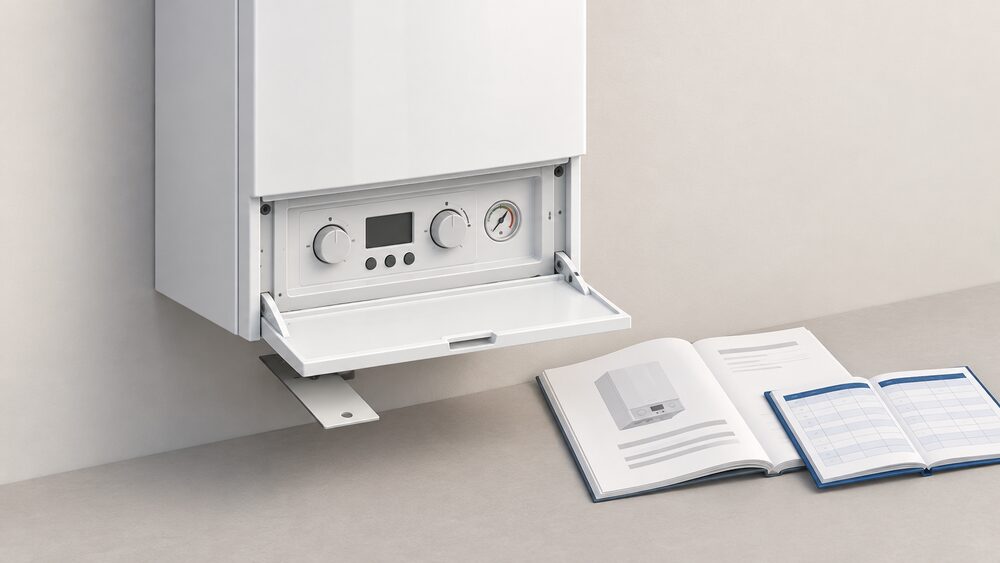
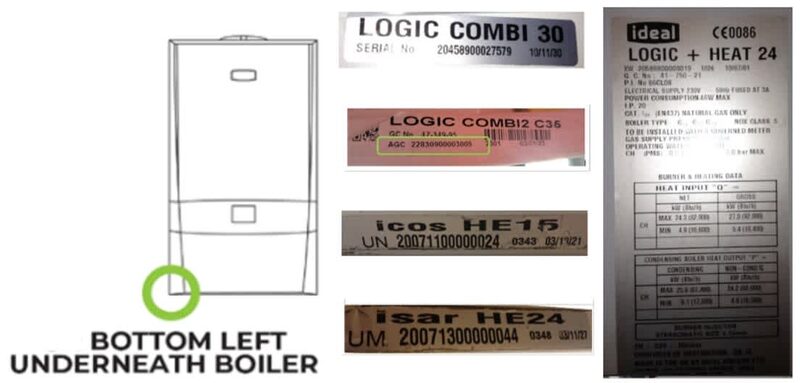
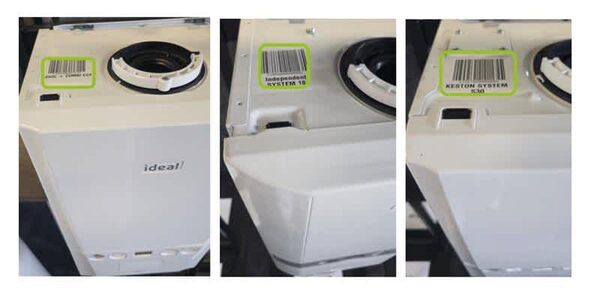
The serial number itself is the most reliable single item. Ideal says it can be found either underneath or on top of the boiler3. Baxi says it is usually on the drop down panel on the front of the appliance, and that some boilers have a tag underneath which slides out2. Vaillant refers to a 28 digit serial number found on the control panel of the boiler and in the benchmark logbook4.
Age matters because it is the first filter on whether replacement belongs in a household's plan. Baxi states a boiler should last from 10 to 15 years if serviced annually and looked after properly5. Independent guidance puts the replacement conversation at the same point: consider a new boiler if yours is 10 to 15 years old, frequently has issues or breaks down a lot6.
Where the age is written: the serial number and its date
The serial number is the identifier every other route depends on. Its position varies by make and by whether the boiler is wall hung or floor standing. Ideal places it underneath or on top of the boiler3. Baxi places it usually on the drop down panel on the front of the appliance, with a tag underneath that slides out on some models2. Vaillant describes a 28 digit serial number on the control panel of the boiler and in the benchmark logbook the installer completes4.
Not every serial number can be read as a date by the householder. Viessmann is the clearest example of a maker that publishes a decoding rule: the year of manufacture can be found on the type plate of the boiler or in a report from the flue gas inspector, and the eighth digit of the 16 digit number gives the age9. That is a maker-specific convention, not an industry standard, and it should not be assumed to apply to another brand.
Intergas takes a different approach again, pointing to the warranty card or to the plate at the bottom of the appliance for the year of manufacture10. Where a maker publishes no decoding rule, the serial number is not something to interpret at home: it is the reference used to look the age up.
The industry database: checking age by serial number
Baxi states plainly that boiler age can be found through the industry database using the boiler's serial number5. The same wording appears across Baxi's service, servicing and boiler-care pages, which makes it the maker's standard answer rather than a one-off note11. In practice this means the householder supplies the serial number and the age comes back from a record rather than from a calculation.
This is the point at which a household's independence from the manufacturer becomes visible. The database is a maker and industry resource, not something a household owns or controls, and it is the reason a serial number is worth photographing and keeping before any paperwork is lost. A boiler with no readable serial number and no paperwork is genuinely harder to date, and the fallback is the make and model plus whatever service history exists.
Paperwork that dates the install: manual and Benchmark Certificate
The Benchmark Certificate is the document that fixes an installation to a date. Ideal states that the installer will have completed the Benchmark Certificate, which will be found inside, and that the installation manual is the first place to check1. The certificate is not optional paperwork: building regulations guidance for England says that when works have been completed the installer should produce a commissioning certificate such as a Benchmark certificate and notify the local authority building control department, either directly or through a Competent Person Scheme, with the local authority supplying a completion certificate17. The Welsh Government's building regulations guidance for boilers and heating covers the same ground for Wales18.
The Health and Safety Executive's gas safety material, published by the HHIC, sets the same expectation at commissioning: the installer completes the Benchmark commissioning documentation to confirm that cleaning has been done19. That matters for dating because the certificate is completed at the point of installation, so its date is the installation date.
Where the certificate has been lost, the manual, any service records and the manufacturer's own file are the remaining routes. For work supported by the Boiler Upgrade Scheme, installers are required to keep all documentation relied upon in voucher applications and redemption applications for six years from the date the application was properly made20. That retention duty sits with the installer, not the household, but it means a recent installation may be traceable through the installer even when the household's own copy has gone.
Contacting the manufacturer with the make, model and serial number
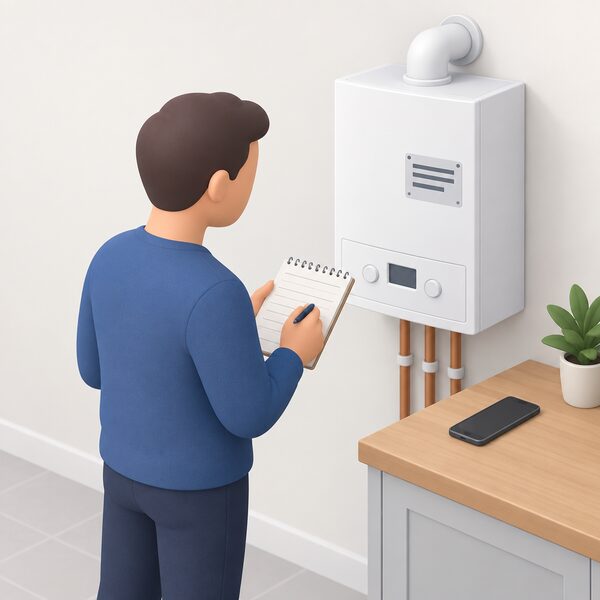
Independent guidance is direct about the fallback: check the boiler make, model and serial number and contact the manufacturer to ask the boiler's age21. Ideal publishes a customer service number for exactly this purpose, 01482 498 660, and states that with the serial number to hand the team can tell you how old your boiler is3. Baxi's equivalent route is customer support, alongside the manual and the serial number2.
Have three things ready before making contact: the make, the model and the serial number. The make and model narrow the search; the serial number identifies the individual appliance and its production run. Where the serial number cannot be read, the make and model plus any installation or service date still give the manufacturer something to work with, though the answer will be less precise.
"you can check the boiler make, model and serial number and contact the manufacturer to ask the boiler's age."
What the age tells you about efficiency and replacement timing
Age is a proxy for efficiency, and the sources converge on a similar picture without agreeing on a single threshold. Older boilers, particularly those over 10 to 15 years old, often operate at 60 to 80% efficiency7. Boilers over 25 years old can be as little as 60% efficient, or G-rated, compared to modern condensing boilers8. An older boiler, especially one over 10 years old, may be operating at significantly lower efficiency7.
The replacement thresholds published by different organisations vary, and the variation is worth understanding rather than resolving. The Consumer Council for Scotland's advice page asks whether a boiler is more than 10 years old22. Uswitch suggests that if a boiler is over fifteen years old, it could be time to replace it, and that if higher energy bills start after 10 years this could indicate low efficiency21. Uswitch's new boiler cost guide puts the trigger at 10 to 15 years old, frequent issues or repeated breakdowns6. The oil heating trade body OFTEC advises that if the boiler is over 15 years old, it may be worth replacing23. The UK and Ireland Fuel Distributors Association takes a lower line still, stating that if a boiler is over six years old, replacing it with a modern condensing boiler can significantly improve energy efficiency24. Fuse Energy's guidance frames the same point as a rule of thumb: if a boiler is over 10 years old and experiencing issues, replacement is generally recommended7.
For a household, the practical reading is that age alone is not a verdict. A well maintained boiler inside the 10 to 15 year band may still be performing, while one outside it with rising bills and repeated faults is a different proposition. What age does is set the point at which the question is worth asking, and it feeds directly into the wider planning sequence for a home, from where to start on energy improvements through to setting a target for the home.
Does boiler age affect my home's EPC rating?

The EPC is an assessment of the property, not a record of the boiler's age, so there is no field in which a boiler's date of manufacture is entered. Age matters indirectly: an older, less efficient boiler drags on the heating performance the assessment captures, and the efficiency figures above show how wide that gap can be8.
Where age and EPC interact most concretely is in grant eligibility, and there the requirement is about the certificate rather than the boiler. For the Boiler Upgrade Scheme, the property owner must have an EPC that is no more than 10 years old25. Independent guidance on the scheme states the same requirement: a valid energy performance certificate less than ten years old for the property26. The scheme's own audit evidence list, which installers may be asked to supply, includes copies of EPCs and EPC site notes alongside proof of address, proof of ownership, MCS certificates, utility bills or fuel delivery receipts, photographs of the previous and installed heating systems, purchase receipts or quotes, and total building heat loss calculations25.
For a household working through the sequence, the EPC is therefore a document to check the date on before assuming it will support an application, and the boiler's own age is a separate question answered from the serial number and the paperwork. Both belong in the paperwork worth keeping from any heating work.
Where the age check fits in a wider plan
Dating a boiler is a diagnostic step, not a decision. It establishes whether replacement is a live question, and it does so cheaply, from a serial number and a certificate, before any assessment or quotation is commissioned. The limits are real: the industry database and the manufacturer's records are held by others, a lost serial number narrows the options, and the published replacement thresholds range from six years to fifteen depending on who is speaking.
What the check delivers is a date, and a date is what turns a vague sense that the boiler is old into something that can be planned around. From there the useful next steps are the ones that establish the rest of the picture: a home energy assessment for the fabric and the heating system together, and a whole house plan where the boiler decision sits alongside insulation, controls and any move away from gas. Households weighing that last question against other measures can compare the options in solar, a battery or a heat pump.
Sources26 cited
- Ideal boiler FAQs, Ideal Heating, 2026
- Baxi error codes explained, Baxi, 2026-09-17
- Ideal boilers product range, Ideal Heating, 2026-09-17
- Vaillant guarantee terms and conditions, Vaillant, 2026
- How long does a boiler last, Baxi, 2026-09-17
- New boiler cost guide, Uswitch, 2024-11-06
- When to replace a boiler, Fuse Energy, 2026-07-10
- Home energy efficiency: the basics, ivie, 2025-02-17
- Viessmann services and support FAQ, Viessmann, 2022-10-18
- Intergas support apps, Intergas Heating, 2026-09-17
- How does a system boiler work, Baxi, 2026-09-17
- What happens at a boiler service, Baxi, 2026-09-17
- How often should I have my boiler serviced, Baxi, 2026-09-17
- Baxi servicing, Baxi, 2026-09-17
- Benefits of a boiler service, Baxi, 2026-09-17
- Getting the best boiler service, Which?, 2025-09-17
- Boilers and heating: building regulations, Planning Portal, 2026
- Building regulations: boilers and heating, Welsh Government, 2026-09-17
- HHIC gas safety guidance, HHIC, 2026-09-17
- Boiler Upgrade Scheme guidance for installers, Ofgem, 2026-04-28
- How long does a boiler last, Uswitch, 2024-11-13
- Upgrading and replacing your boiler, Centre for Sustainable Energy, 2026-06
- Heating checks for oil households, OFTEC, 2026-08-13
- Help and advice for consumers, UKIFDA, 2026-01-29
- Boiler Upgrade Scheme guidance for property owners, Ofgem, 2026-04
- What is the Boiler Upgrade Scheme, Which?, 2025-10-22
 Boiler WarrantiesHow long does a boiler warranty actually last, and what do you have to do to keep it?
 Registering a WarrantyGetting a new boiler covered for longer usually means registering it quickly, often within a month of installation, or the long guarantee drops to a year.
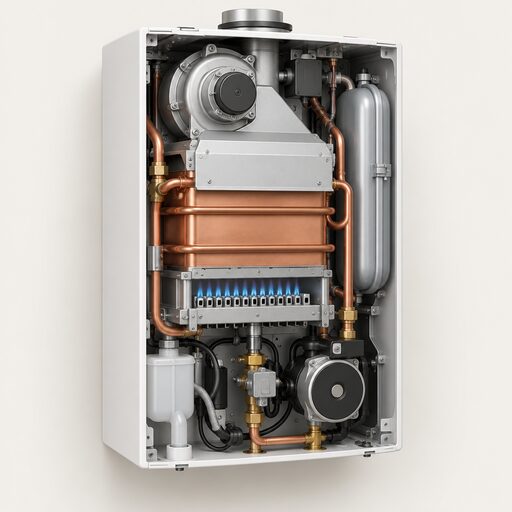 Servicing and MaintenanceWhat an annual gas or oil boiler service covers, the intervals manufacturers specify, the link between servicing records and warranty validity, and what servicing means for a household's energy independence.
 The Full Boilers and Heating GuideWhich boiler suits your home, and when is it worth swapping the old one?
 Boiler SizingWhat size boiler does your home actually need, and does the number of bedrooms or radiators decide it?
 Efficiency and ErP RatingsWhat do boiler efficiency ratings like A to G actually mean, and how do they compare with the older SEDBUK scores?