
In this guide
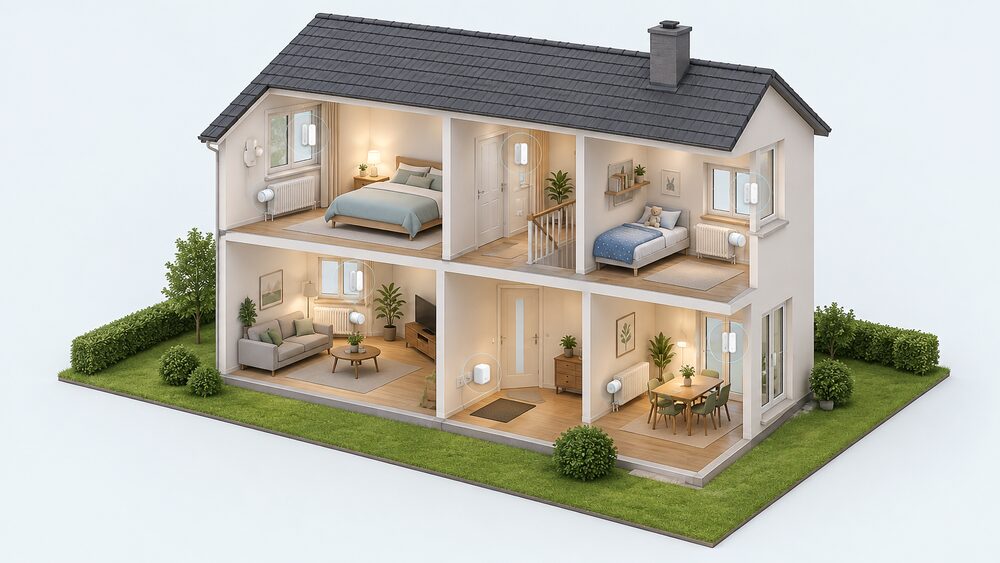
Homematic IP is a consumer smart-home system built around a gateway, a free app and a catalogue the maker puts at more than 80 smart devices1. It covers heating control, window and door contacts, switch and meter units, wall thermostats, cameras and doorbells. The household buys the hardware and owns it; the app is free, and the maker states that servers sit in Germany and that the system operates without collecting personal data2.
For energy independence the system sits in a particular place. It gives a household room-by-room control of heating, its own measurement of what individual appliances draw, and a direct read of the electricity meter through an optical interface, without waiting on a supplier's app3. What it does not do is remove dependence: the heating it controls is usually gas from the grid, remote access runs through the maker's cloud, and the radio protocol is proprietary, so devices work with each other and with the maker's gateway rather than with any hub.
The strongest published claim is on heating. The maker states that demand-based heating profiles and intelligent window-open detection can reduce heating costs immediately and noticeably, and puts the figure at up to 33% when radiator thermostats are combined with window and door contacts, depending on user behaviour, building conditions and heating system5. That is a maker claim with conditions attached, not an independent measurement.
The range: more than 80 smart devices
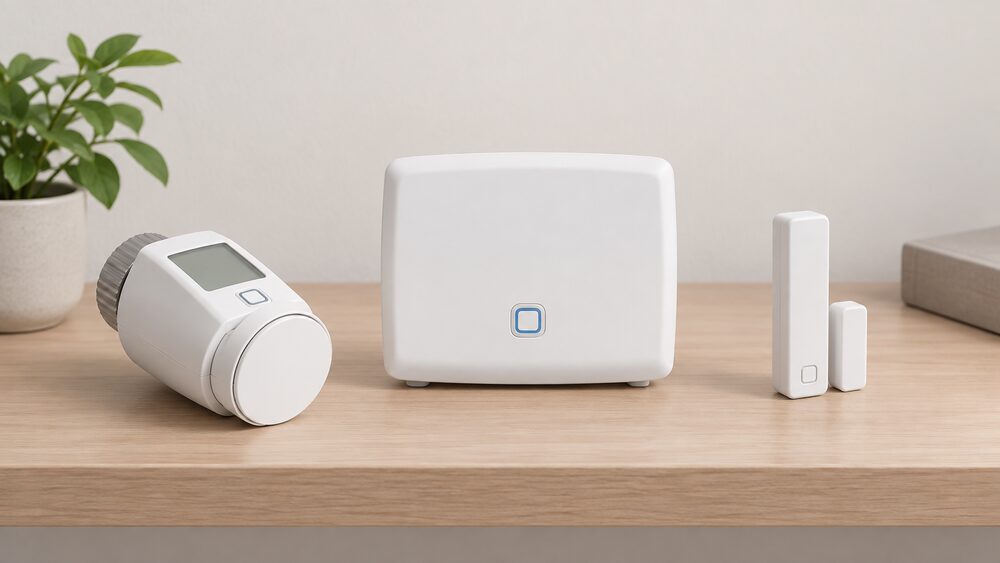
The catalogue divides into heating and climate control, security and monitoring, and switching and metering. On heating there are radiator thermostats in basic, UK and compact plus forms, wall thermostats with humidity sensing, a glass wall thermostat, a glass wall thermostat with a CO₂ sensor, wired underfloor heating controllers and wired temperature and humidity sensors9. On security there are optical window and door contacts, a window handle sensor and alarm sirens that pair with them14. On metering there are pluggable switch and meter units, flush-mounted switching actuators with metering, and a switching and measuring cable rated IP44 for outdoor use16.
The system scales in tiers. The Heating Starter Set basic is described as an entry into a small smart home with up to 20 Homematic IP wireless devices19. The Home Control Unit supports up to 350 devices, including a maximum of 120 wireless products, and the maker guarantees full functionality at that level in standard household distribution with up to three access points; teaching more is technically possible but not officially supported20. Push-to-Pair connects up to five devices quickly without a full setup routine21.
Two hardware families exist side by side. Wireless devices communicate by radio, with typical open area ranges of 400 m for the Access Point, 380 m for the Multi IO Box and 300 m for the smart meter interface7. Wired devices run on a separate bus and need their own access point: the wired underfloor heating controller and the wired temperature and humidity sensor both require the wired access point plus the central wireless Access Point to operate12. The Home Control Unit can also work with the CCU3 to bring older Homematic devices into the same system, and with the wired access point to control wired devices20.
Security and data: AES-128 encryption, VDE certification and servers in Germany
The maker states that communication between the Homematic IP app, the smart home devices and the Homematic IP Cloud is encrypted with AES 1286. The system is described as developed in Germany and VDE-certified, with the certification confirming tested protection mechanisms against unauthorised access for IT security in residential and commercial properties2. The Home Control Unit carries VDE certification in the areas of protocol, IT and data security, and the maker states that VDE has certified the smart home system for the seventh time in a row20. The wired power supply unit carries the VDE mark for compliance with national and international standards and statutory protection requirements24.
On data, the position is stated consistently across product pages: servers are located in Germany, no personal data is ever requested, and no personal data is collected except for the IP address6. The Home Control Unit page adds that no registration or user account is necessary and that in offline mode all settings, measurement data and automations are saved locally9. The support pages repeat that the Homematic IP Cloud operates exclusively on German servers25.
"The system operates without collecting personal data and uses server locations in Germany."
That is a meaningful difference from systems whose remote functions depend on an account and a cloud profile. It is not the same as local-only operation. The Access Point route uses the free cloud service for app access, so remote control, push notifications and away-from-home scheduling pass through the maker's infrastructure. The Home Control Unit offers a local mode, but the two routes are not identical in what they can do.
How it helps cut heating costs: demand-based profiles and window-open detection
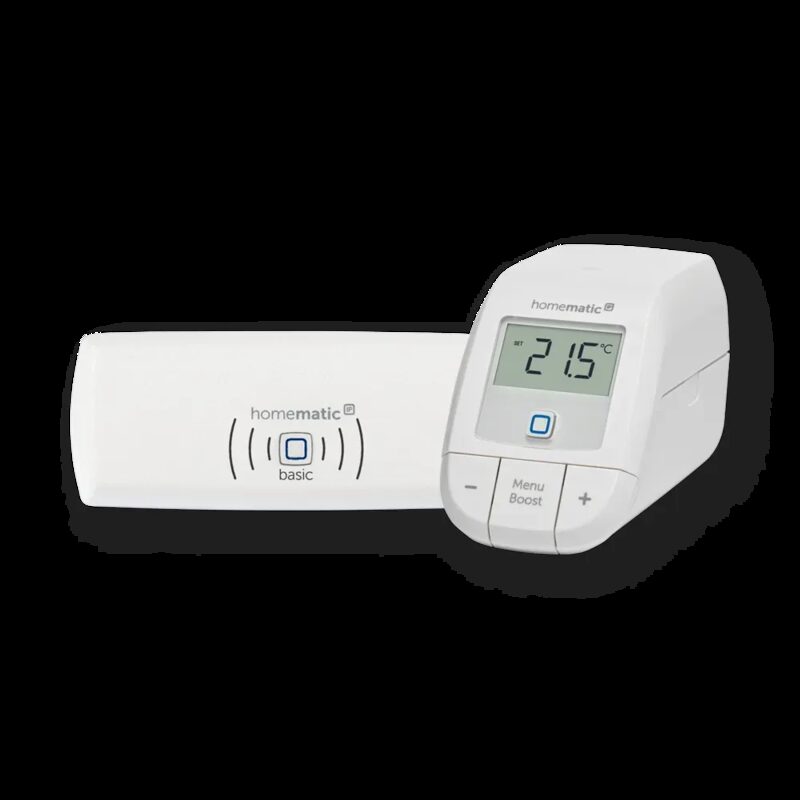
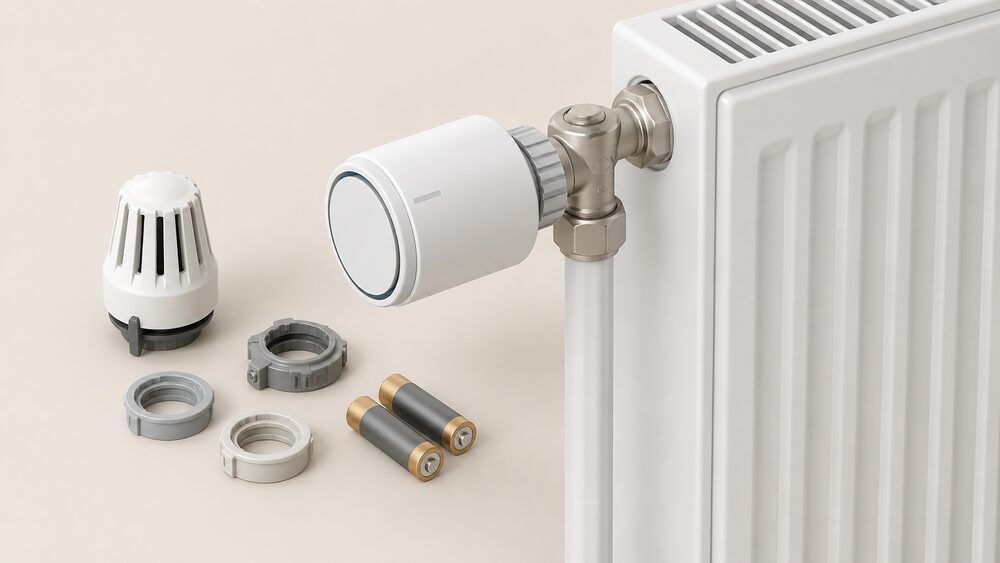
The saving mechanism is not a more efficient boiler. It is scheduling and avoidance. The maker states that demand-based heating profiles and intelligent window-open detection can reduce heating costs immediately and noticeably2. Radiator thermostats can be adjusted manually at the device, through the app and by voice command, with programmable heating profiles per room, remote access from a smartphone, open-window detection, holiday mode and integration into smart home systems26.
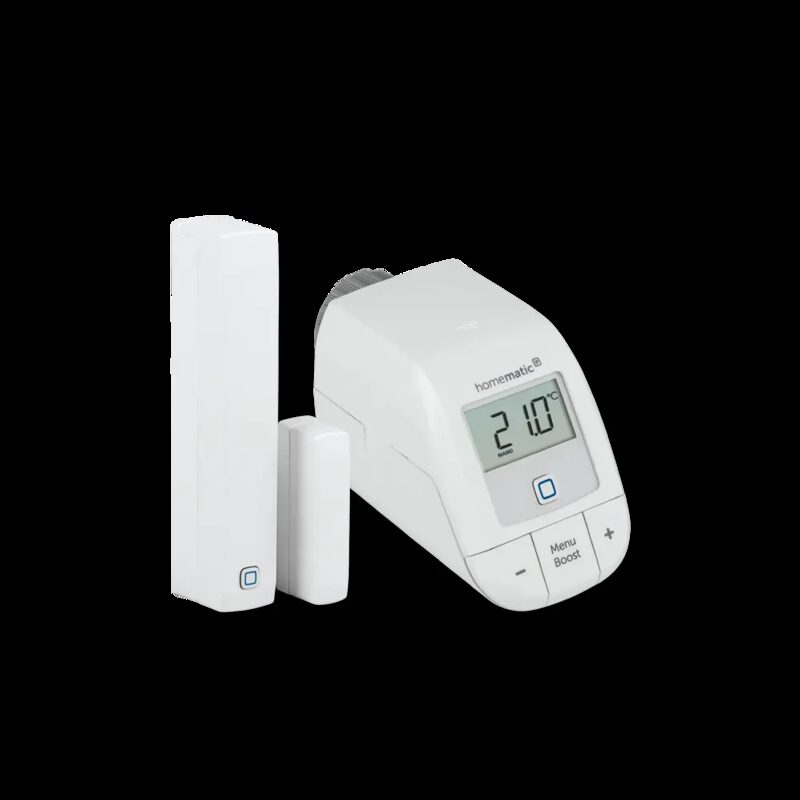
Window-open detection works two ways. With a window and door contact fitted, the contact detects the open window and switches off the heating or triggers an alarm, and the radiator thermostat reduces output on that signal14. Without a contact, detection is triggered by a sudden drop in temperature in the room, whereupon the thermostat reduces heating output19. Wall thermostats with humidity sensors lower the temperature during ventilation on the same principle27. Wireless window contacts detect opening and closing and adjust room temperature automatically30.
The 33% figure appears across several product pages with the same conditions: in combination with window and door contacts and depending on user behaviour, building conditions and heating system5. The Heating Starter Set basic states up to 33% energy savings19. The conditions matter more than the number. A well-insulated home with a modern condensing boiler and a household already heating only occupied rooms has less to gain than a poorly controlled one.
Two further pieces of the maker's guidance bear on running costs. Hydraulic balancing is described as a way to distribute heat evenly through a system, with a control algorithm expected to be made available through a free firmware update from the end of October 202633. Separately, the maker shows how to connect a wall thermostat with a switching actuator to control electric heating systems, which extends the same scheduling logic to resistive heating rather than gas30.
The Access Point (HMIP-HAP) and core hardware specifications
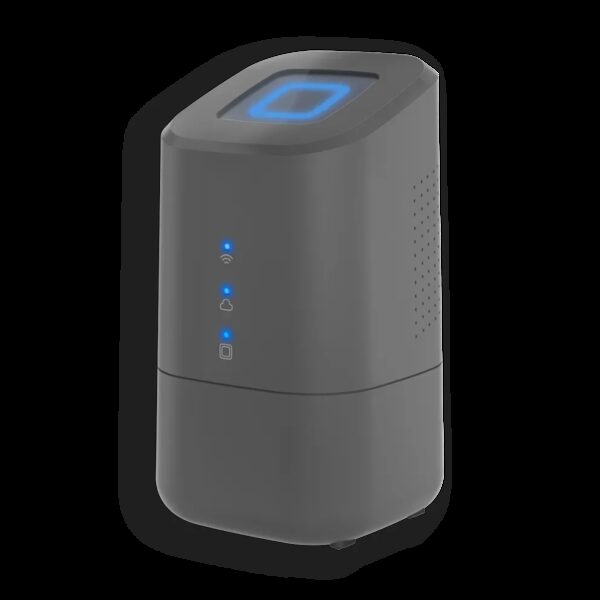
The Access Point is the gateway most households start with. It is listed as HMIP-HAP with product reference 140887A0, and the anthracite variant as HmIP-HAP-A with reference 160275A07. A separate Access Point basic carries the short description HmIP-WLAN-HAP-B and reference 160954A019. The unit runs on 5 VDC from a plug-in mains adapter accepting 100 to 240 V at 50 Hz, connects over Ethernet at 10/100 MBit/s with Auto-MDIX, measures 118 x 104 x 26 mm, and has a typical open area radio range of 400 m7.
| Device | Model or reference | Key specification |
|---|---|---|
| Access Point | HMIP-HAP, 140887A0 | 5 VDC, 10/100 MBit/s, 400 m open area7 |
| Access Point, anthracite | HmIP-HAP-A, 160275A0 | Same unit, anthracite finish7 |
| Access Point basic | HmIP-WLAN-HAP-B, 160954A0 | 100 to 240 V/50 Hz adapter input19 |
| Home Control Unit | Up to 350 devices | Maximum 120 wireless products20 |
| Smart meter interface | HmIP-ESI-IEC, 159672A0 | 39 x 109 x 29 mm, 100 g with batteries3 |
| Multi IO Box | 230 V/50 Hz | 380 m typical open area range22 |
| Flush switching actuator and meter | 142721A0 | 230 V/50 Hz, wireless17 |
Ingress protection is IP20 across the range, including the Access Point, Home Control Unit, smart meter interface, Multi IO Box, radiator thermostats, wall thermostats, window contacts, glass wall thermostats, window handle sensor and wired power supply unit7. IP20 means the enclosure is protected against solid objects such as a finger, and has no protection against water. These are dry indoor devices. The one exception in the range is the switching and measuring cable for outdoor use, rated IP4418.
Smart meter integration and energy monitoring
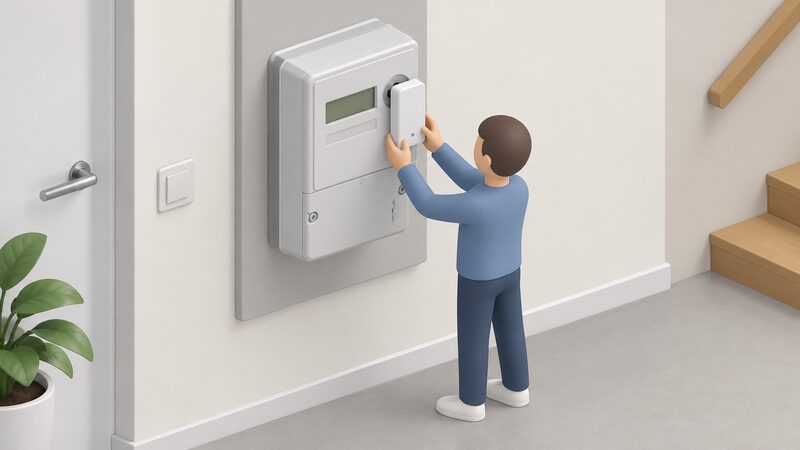
The interface for smart meters is the part of the range that speaks most directly to energy independence. It is a wireless device that attaches magnetically to the optical data interface of the smart meter, reading consumption at the meter rather than through a supplier's app or an in-home display3. It measures 39 x 109 x 29 mm, weighs 100 g including batteries, runs on two 1.5 V AA cells with a typical battery life of five years, and has a typical open area radio range of 300 m3. It operates between 5 and 35 °C3.
Operation requires one of three routes: the Access Point with the free smartphone app and free cloud service, the CCU3 central control unit with its local WebUI interface, or a partner solution from a third party3. The CCU3 route keeps the data local. The Access Point route puts it through the cloud.
Around the meter interface sit the metering devices. The pluggable switch and meter and the flush-mounted switching actuator and meter both measure consumption of whatever is plugged into or wired through them, and both are wireless16. The Home Control Unit adds an EEBUS interface for integrating energy devices such as a heat pump, air conditioning and a wallbox, so larger loads can be brought into the same view20.
The wider context is that the UK smart meter rollout still has more than 26 million homes for suppliers to reach, so not every property has a meter with an accessible optical port34. Where one exists, the Homematic IP interface reads it directly. Where it does not, the pluggable and flush-mounted meters still give appliance-level data. Ofgem's research on heat networks found that billing transparency is a major user need, building trust in the system and enabling consumers to potentially reduce their costs, which is the same argument for reading your own meter35.
Cloud security certificate update: firmware required for video doorbell and outdoor camera
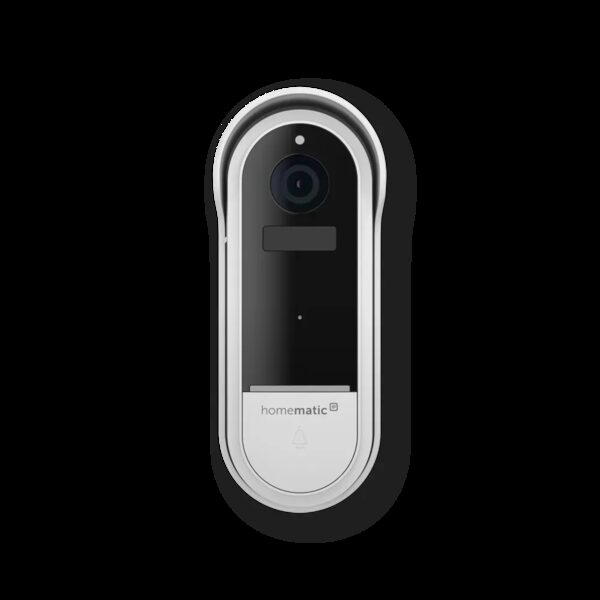
The maker states that an update to the cloud security certificate on or after 20 September 2026 will require a firmware update for the Homematic IP video doorbell and rechargeable outdoor camera6. The date has passed at the time of writing, so any household running those two devices should expect to need the update for cloud functions to keep working.
The app side updates through the usual stores. The maker names app version 2.4.0 on iOS and 2.4.3 on Android for the advanced routing feature, both updatable through the respective app store if automatic updates are enabled25. Device firmware is normally delivered through the app once the gateway is online.
This is the clearest illustration of the dependence the system carries. A certificate change on the maker's side reaches into hardware in the home and requires action there. Local heating control and local switching keep working without it; camera and doorbell functions that rely on the cloud do not.
What's next in the app: alarm zones, doorbell groups, private mode and multi-view
The app is the control surface. The maker describes devices organised into rooms, groups and automations, with secure access while on the go, push notifications and display of measurements such as temperatures and status indicators, and the app itself is free2. Voice control runs through Amazon Alexa and Google Assistant on the glass wall thermostat, the CO₂ sensing variant and the Home Control Unit in online mode10.
Security functions extend through the same app. Window and door contacts work with a Homematic IP alarm siren to trigger a loud alarm when a window or door is opened, and the window handle sensor does the same14. The temperature and humidity sensor with display adds a ventilation recommendation in the app32.
Camera features are scheduled in two waves. The maker lists five features for a Q4/2026 app update: custom alarm zones, doorbell group integration, door opening from live view, room view access and adjustable outdoor camera light brightness25. Three further features are listed for Q2/2027: central private mode control, central alarm notification management and a multi-view of up to four live feeds25. These are announced, not shipped, and the dates are the maker's own.
For a household weighing independence, the balance is straightforward. Homematic IP gives local radio control of heating and switching, a direct optical read of the electricity meter, appliance-level metering, and a data position that keeps servers in Germany and collects no personal data beyond the IP address2. What remains is dependence on the maker's cloud for remote access and app functions, on a proprietary radio protocol for device compatibility, on gas or electricity from a supplier for the heat and power being controlled, and on the manufacturer for firmware, including the certificate-driven update that reached the doorbell and camera in September 20266. The Home Control Unit's offline mode and the CCU3 route reduce the cloud element; they do not remove the rest.
Sources35 cited
- The most beautiful way to heat, Homematic IP, 2026
- What is Homematic IP, Homematic IP, 2026
- Interface for smart meters, Homematic IP, 2026
- Save money, Homematic IP, 2026
- Radiator thermostat basic, Homematic IP, 2026
- Home Control Unit, Homematic IP, 2026
- Access Point, anthracite, Homematic IP, 2026
- Starter Set Heating, Homematic IP, 2026
- Home Control Unit, anthracite, Homematic IP, 2026
- Glass wall thermostat, Homematic IP, 2026
- Glass wall thermostat with CO2 sensor, Homematic IP, 2026
- Wired underfloor heating controller, 10 channels, 24 V, Homematic IP, 2026
- Wired temperature and humidity sensor, indoor, anthracite, Homematic IP, 2026
- Window and door contact, optical, Homematic IP, 2026
- Window handle sensor, Homematic IP, 2026
- Pluggable switch and meter, Homematic IP, 2026
- Switching actuator and meter, flush mounted, Homematic IP, 2026
- Switching and measuring cable, outdoor, Homematic IP, 2026
- Heating Starter Set basic, Homematic IP, 2026
- Multi IO Box, Homematic IP, 2026
- Push-to-Pair, Homematic IP, 2026
- Radiator thermostat UK, Homematic IP, 2026
- Radiator thermostat compact plus, Homematic IP, 2026
- Wired power supply unit, 4 A, Homematic IP, 2026
- FAQs, Homematic IP, 2026
- Control heating, Homematic IP, 2026
- Wall thermostat with humidity sensor 2, Homematic IP, 2026
- Wall thermostat with humidity sensor, anthracite, Homematic IP, 2026
- Wall thermostat with switching output, brand switches 230 V, anthracite, Homematic IP, 2026
- Basic climate control, Homematic IP, 2026
- Window and door contact, optical, anthracite, Homematic IP, 2026
- Temperature and humidity sensor with display, indoor, anthracite, Homematic IP, 2026
- Hydraulic balancing, Homematic IP, 2026
- How to get a smart meter, Smart Energy GB, 2026
- Domestic consumer views on heat networks, Ofgem, 2026
 Homematic IP Heating ControlsHomematic IP thermostats and radiator valves for UK homes: what the range covers, what runs without the internet, and where the cloud dependence sits.
 Home Assistant for Home Energy MonitoringCan Home Assistant show what your smart meter and solar panels are doing in one place?
 Homematic IP CCU3 Central Control UnitDoes your Homematic IP setup keep working when the internet goes down?