
In this comparison
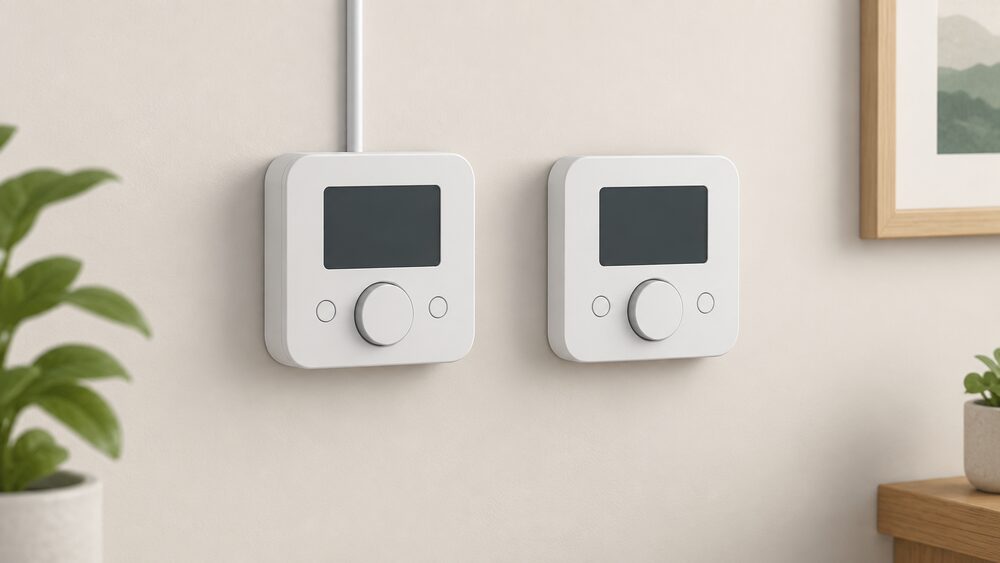
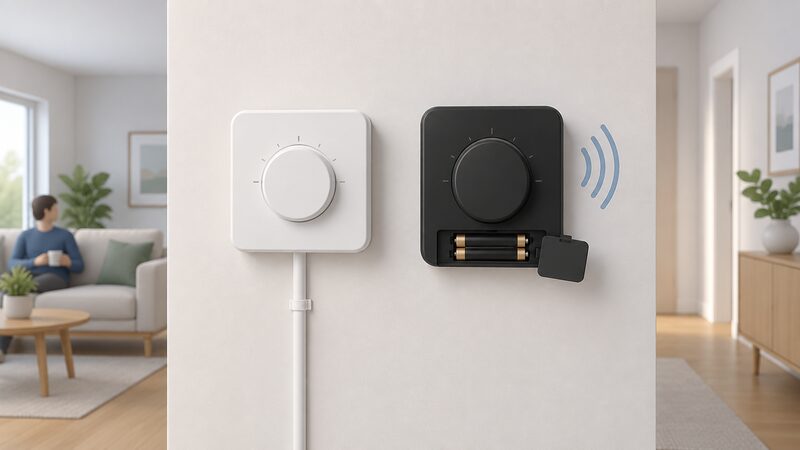
The Heatmiser neoStat and neoAir are two room thermostats from the same zoning family, and the difference between them is mostly about wiring. The neoStat is a mains powered thermostat with a volt free switch, while the neoAir is a battery powered wireless unit that needs no mains feed at the wall1. Both talk wirelessly to the neoHub, which connects to the home broadband router and supports up to 32 zones2.
That single distinction drives everything else. A neoStat suits a room where a mains cable already reaches the wall, or where one can be run during a refurbishment. A neoAir suits an extension, a retrofit or a listed interior where chasing cables into walls is impractical, and it is sold as a complete wireless solution1. Underfloor heating kits from Nu-Heat are offered with a choice of a wired neoStat or a wireless, battery powered neoAir, with the option to upgrade to smart control3.
Neither thermostat is a heating system in itself. Both are zone controls that decide when a zone calls for heat, and both depend on a wiring centre, a boiler or heat pump, and the wider system around them. What they change is how much of that system a household can see and steer room by room.
neoStat and neoAir at a glance
The two thermostats share a family resemblance in software and a sharp difference in hardware. The neoStat is described by Heatmiser as a mains powered thermostat with a volt free switch, and the neoAir as a complete wireless solution1. The neoStat Touch is 230v powered, which the maker presents as making it ideal for replacing existing mains powered thermostats5. The neoAir V3, in both white and black, is listed as a battery powered programmable thermostat9.
| neoStat | neoAir | |
|---|---|---|
| Power | Mains powered, volt free switch1 | Battery powered9 |
| Mounting | Hard wired11 | Wireless, no mains at the thermostat1 |
| Battery life | Not applicable6 | Over 12 months, maker stated4 |
| Remote sensor | Air and/or floor12 | Air or floor9 |
| Air sensor types | TSP-C and PSB-C or CTN-C12 | TSP-C and PSB-C or CTN-C10 |
| Switching differential | Not published for the neoStat V3 | 0.5 °C to 3 °C, adjustable9 |
| Smart control | Via neoHub+12 | Via neoHub+9 |
| Wiring centre | Not applicable | UH8-RF v29 |
The neoStat Touch and neoStat Pro both carry an accuracy figure of +/- 1 °C, and the neoStat Touch uses a 2.4 GHz RF frequency5. The neoAir V3 offers an adjustable switching differential between 0.5 °C and 3 °C, which lets the installer set how far the room temperature must drift before the zone calls for heat9. That is a comfort and cycling setting rather than an efficiency claim, and it matters most on underfloor heating, where the slab responds slowly.
Both models can use remote sensors. The neoStat can be used with a remote air and remote floor sensor, and the neoStat Pro adds floor and air temperature probes plus a built-in humidity sensor1. The neoAir V3 takes an air or floor sensor9. Remote sensing lets the thermostat read the room or the floor where it matters rather than the wall it is mounted on.
Where each model fits: which rooms suit which
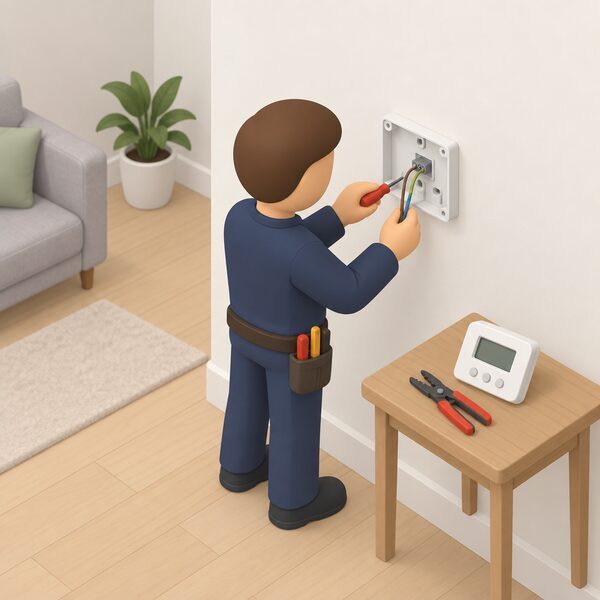
Heatmiser describes both the neoStat and neoAir as perfect for the new build and retrofit market, with the neoAir particularly suited to extensions or where a mains cable has not been installed for the thermostat13. That is the practical dividing line. In a new build or a full refurbishment, the cable route is open and a neoStat can be wired in as part of the first fix. In an extension added to an existing house, or a retrofit where floors and walls are finished, the neoAir avoids the disruption of running a new mains feed.
The neoAir is also the model that carries its own radio switching. The neoAir system includes an RF switch, enabling wireless control of the boiler and pump, avoiding the need to run cables3. That means a neoAir zone can be added without a wired connection back to the wiring centre, which is what makes it viable in a room where the floor has already been laid.
For underfloor heating, the choice is often made at kit level. The LoPro Lite OneZone kit and the ClipTrack OneZone screed kit are both sold with a choice of a wired neoStat or a wireless, battery powered neoAir, with the option to upgrade to smart control3. The neoAir V3 pairs with the UH8-RF v2 wiring centre9. Nu-Heat describes its neoStats as high quality, hard wired programmable thermostats, and notes that a neoStat wireless thermostat is installed like any other wired underfloor heating room thermostat and is suitable for any project11.
Upgrades follow the same logic. Heatmiser states that a three core wired thermostat can be easily upgraded to the neoStat, and that homes with no thermostat or a wireless thermostat can install a neoAir linked to the two channel or eight zone wiring centre7. In most situations, wired thermostats can be easily upgraded to neoStats without the need for any additional wiring16.
Smart home integration, including SmartThings
Both thermostats are dumb terminals until a hub is added. The neoHub connects to the home broadband router and wirelessly to the neoStats in the home, and it processes over the air firmware updates for all connected devices1. Each neoStat thermostat also acts as a repeater on the network, helping to eliminate range issues1. The neoAir can join the mesh network but does not relay signals, and it communicates directly by RF to the receiver, so the neoHub is not required for heating to operate7.
That last point is the one households should hold on to. A neoAir zone can heat without a hub and without an internet connection, because the radio link runs between the thermostat and its receiver. The hub adds app control, scheduling from a phone and voice integration, but it is not in the path of the basic heating call.
On 11 May 2026, IMI Heatmiser announced that its neo smart control system is now integrated with SmartThings by Samsung, bringing neo into the Samsung smart home ecosystem8. The neo range also works with Apple HomeKit, Amazon Alexa and Google Home, and the neoApp is available on iOS and Android17. The neoStat Touch supports voice commands with Amazon Alexa, Google Assistant or Apple HomeKit through the neoHub18. Google Home compatibility is listed for the neoStat, neoAir and neoStat-e via the neoHub19.
Hub generation matters. The neoStat Touch and neoStat Pro are both listed as not compatible with the neoHub first generation, and the neoStat-HC pairs to the neoHub Gen 2 and is not compatible with the neoHub Gen 15. A household buying a current neoStat Touch or Pro alongside an older hub would need to check the hub generation before assuming app control will work.
What the neo system means for household energy independence
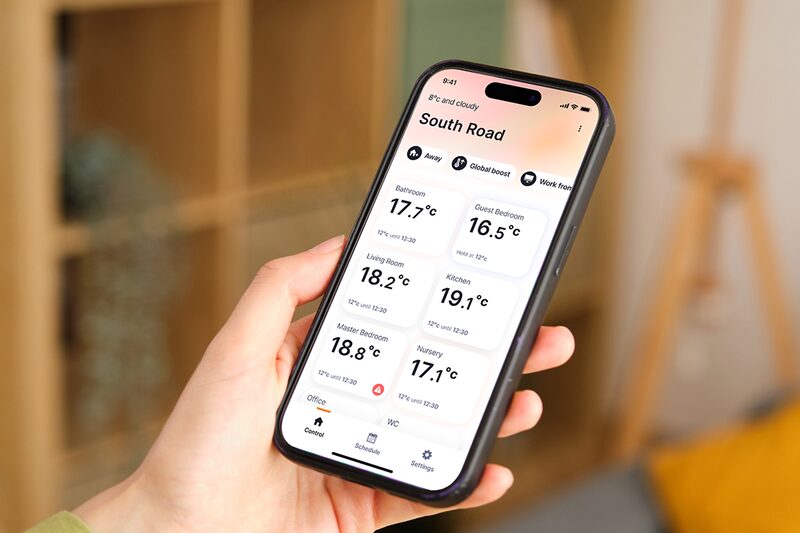
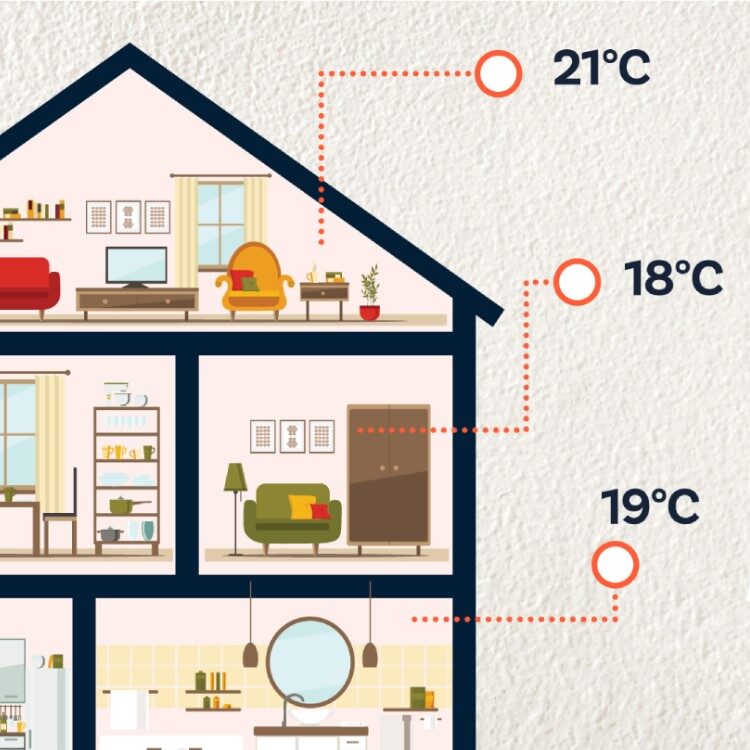
Zoning is the point of the neo range. The neo thermostats support multiple zone control, giving the benefit of controlling each room individually16. Each individual neoStat in the property can be controlled via a smartphone or tablet, and features include holiday and temperature hold, soft touch operation and energy saving Optimum Start15. Optimum Start is also listed on the neoStat-HC7. The neoStat and neoAir communicate wirelessly to the neoHub to offer a reliable and scalable network system13.
For a household, that means heat can be directed to the rooms in use rather than the whole house. The independence this buys is local and partial. The controls decide which zones call for heat and when; they do not generate heat, and they do not remove the home's dependence on gas, electricity or a heat pump. A neoAir zone can keep working through its RF switch without the hub, so a broadband outage does not stop the heating, but app control and voice control do depend on the hub, the router and the maker's cloud service.
The range is built to sit on more than one heat source. The neoStat range is described as fully compatible with solar, heat pump and most boiler technologies, and the neoStat Touch and neoStat Pro are compatible with solar, heat pump or boiler based technology when linked with the Heatmiser Neo System20. The neoStat Pro offers passive room cooling via reverse cooling technology with air or ground source heat pump systems21. The neoStat-HC is a heating and cooling fan coil thermostat, and for two pipe systems a system-wide switch in the neoApp moves between heating and cooling7.
Where a household has a heat pump, solar thermal or PV, that breadth matters: the same wall device can serve a system that changes over the year. Where the home is on a gas boiler, the benefit is narrower and rests on scheduling and zoning rather than on the heat source. The independent evidence base for smart zoning savings is thin. A National Energy Action publication from 2017 set out to establish heating costs for households with the Honeywell evohome, Heat Genius and Heatmiser neo smart thermostats, which places the neo range among the systems studied rather than singling it out22.
Renting and smart controls: what landlords and tenants should know
The neoAir is the model that fits a rented home most easily, because it is battery powered and wireless and needs no new mains wiring at the thermostat, avoiding the fabric alterations that tenancy agreements commonly restrict. Smart control of it still depends on a neoHub being added. The wider rules on metering and alterations continue to apply: guidance for renters on smart meters states that it is recommended that you let your landlord know before you make the change, and that where a home is rented, changes should be discussed with the landlord, as each meter may form part of the tenancy agreement23. In Wales, the Optimised Retrofit Programme funds the installation of smart technologies so tenants can best control their energy use, which places some social landlords rather than tenants in charge of what is fitted25.
Public funding has been used to put smart controls into social housing. The Optimised Retrofit Programme in Wales included funding for the installation of smart technologies so tenants can best control their energy use26. The Warm Homes Nest scheme in Wales is designed around individual properties, so there is no standard package of measures, and eligible measures have included a new boiler, a central heating system, or loft insulation, with some packages including newer technologies such as solar panel PVs, air source heat pumps and external wall insulation27. In Northern Ireland, the Northern Ireland Sustainable Energy Programme is an energy efficiency programme for domestic and non-domestic customers28. In Scotland, proposed changes to building regulations energy standards set out notional building specifications combining a gas boiler and PV, or improved fabric with ventilation heat recovery and PV where the dwelling is heated by any other means29.
For a landlord, the practical questions are who holds the app account, what happens to the hub when a tenancy ends, and whether the heating can be run without the app. Because the neoAir can heat through its RF switch without the hub, a tenant is not left without heating if the hub or the account is removed. The controls themselves remain part of the property's heating system, and any change to that system is a matter for the landlord and the installer.
Faults, guides and who to contact
Heatmiser publishes user guides for the neoStat V1 and V2 and for the neoAir V1 and V2, and a combined neoStat V2 and neoAir V2 quick user guide30. These cover the everyday settings and the common issues, and they are the first thing to check before calling anyone out. Nu-Heat also maintains a troubleshooting page for thermostats30.
For a fault that the guide does not resolve, the maker or the installer who supplied the system is the first point of contact. Faults on the wider heating system, such as the boiler, the pump or the wiring centre, sit with the installer who fitted them rather than with the thermostat maker. Where a home has a prepayment meter and the issue is with topping up or using the meter, the supplier is the contact, and the network operator handles loss of supply or a faulty meter32. For a suspected gas leak, the National Gas Emergency Service should be contacted immediately on 0800 111 99933.
Northern Ireland households have a separate set of contacts. NIE Networks runs a customer helpline on 03457 643 643 for 24/7 support in reporting a loss of electricity supply, and its connection team can be reached on the same number34. Powercheck is a web application NIE Networks developed to provide real-time fault information, released as a beta version36. For keypad meter problems, the supplier handles topping up and usage, while NIE Networks handles a loss of power or a faulty meter32.
Sources36 cited
- Heatmiser neo overview, Heatmiser, 2026
- Additions to Heatmiser neoStat range, Heatmiser, 2025
- LoPro Lite underfloor heating kit OneZone, Nu-Heat, 2026
- neoAir joins the neo family, Heatmiser, 2016
- neoStat Touch, Heatmiser, 2025
- neoStat Pro, Heatmiser, 2025
- Heatmiser neo FAQ, Heatmiser, 2018
- IMI Heatmiser neo now integrated with SmartThings by Samsung, Heatmiser, 2026
- neoAir V3 White Thermostat, Nu-Heat, 2026
- neoAir V3 Black Thermostat, Nu-Heat, 2026
- Nu-Heat thermostats, Nu-Heat, 2025
- neoStat V3 White Thermostat, Nu-Heat, 2026
- Take control of your heating, Ambiente UFH, 2024
- ClipTrack OneZone screed kit, Nu-Heat, 2026
- Nu-Heat smart controls, Nu-Heat, 2025
- Nu-Heat programmable dial thermostats, Nu-Heat, 2024
- Exclusive smart thermostat reveal at Installer Show 2024, Heatmiser, 2024
- Google Home Heatmiser neo setup FAQ, Heatmiser, 2018
- neoStat-HC smart fan coil thermostat, Heatmiser, 2025
- Heating your house the smart way (CP788), National Energy Action, 2017
- Smart meters for renters, Smart Energy GB, 2026
- What happens to my smart meter when I change supplier, Smart DCC, 2023
- How to get a smart meter, Smart Energy GB, 2026
- £150 million for insulation, clean energy and carbon reduction in social homes, Welsh Government, 2021
- Warm Homes Nest scheme annual report 2022 to 2023, Welsh Government, 2023
- Northern Ireland Sustainable Energy Programme annual report published, Utility Regulator, 2026
- Scottish Building Regulations proposed changes to energy standards, Scottish Government, 2021
- Thermostat troubleshooting, Nu-Heat, 2026
- Omnie Home USB coordinator, Omnie, 2026
- Meter reading and keypads, NIE Networks, 2026
- Find out if your energy meter is faulty, Citizens Advice, 2026
- Most popular FAQs, NIE Networks, 2026
- Help to select a connection, NIE Networks, 2026
- Powercheck, NIE Networks, 2026
- Temporary power outages for keypad customers, NIE Networks, 2026
- New wireless control joins the Uflex range, Grant UK, 2022
 Electric Radiator ControlsElectric heaters cost far more to run than gas, so the controls really matter.
 Smart Thermostats ExplainedWhat does a smart thermostat actually do, and is it worth it?
 Air-to-Air Heating and CoolingAir-to-air heat pumps deliver warm air through indoor fan units rather than hot water to radiators.
 Types of Air ConditioningPortable, wall-mounted, multi-room or ducted: which air conditioning suits your home?
 Controls and Wi-FiWhich air conditioning controls work without the internet, and which need Wi-Fi?
 Warm Air Heating SystemsWarm air heating works by pushing heated air through vents in your floors or walls.