
In this comparison
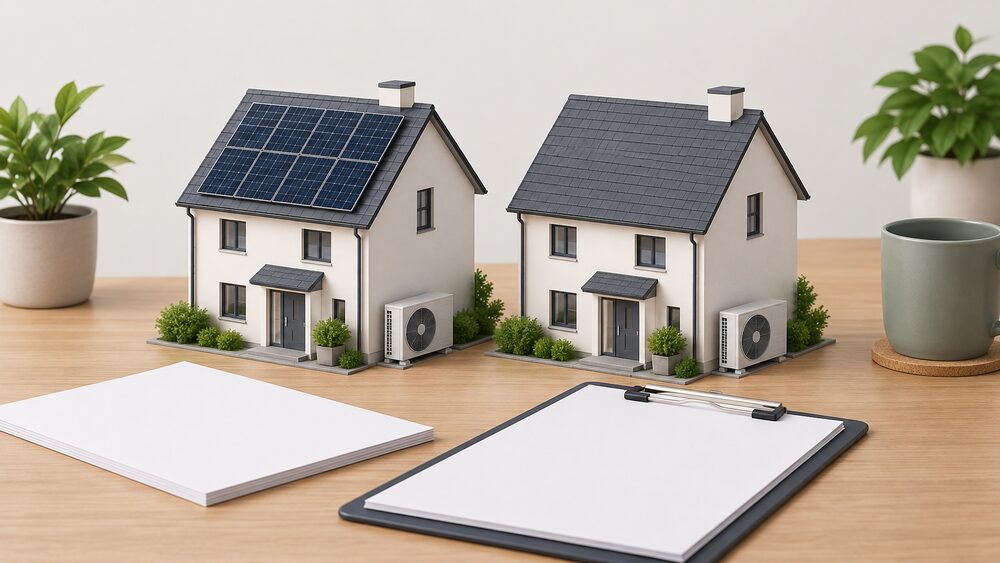
The difference between Option 1 and Option 2 in the Future Homes Standard is a difference in the notional specification a developer must beat, not a choice a buyer makes at the kitchen table. Option 1 is broadly an existing 2021 notional home with the boiler replaced by a heat pump, and it adds solar PV panels, a wastewater heat recovery system, increased airtightness and a decentralised mechanical ventilation system. Option 2 is the same specification but without the PV and without the wastewater heat recovery1.
Both routes end in the same place: a home that is zero-carbon-ready, with low carbon heating and no fossil fuel heating. The government has not stated which of the two it prefers1. The choice matters because it changes what a buyer sees on the roof, what the home costs to run, and what the developer has to build.
Option 1 and Option 2: what the choice means for a new home
The two options are compliance routes under the same standard. A developer demonstrates that a dwelling performs at least as well as a notional specification, and the notional specification differs between the options. Option 1 carries solar PV, a wastewater heat recovery system, increased airtightness and a decentralised mechanical ventilation system. Option 2 drops the PV and the wastewater heat recovery and keeps the rest1.
The practical consequence for a household is the roof and the running costs. A home built to the Option 1 notional specification has on-site generation; one built to Option 2 does not, and meets the same carbon and energy targets by other means. The Environmental Audit Committee has recommended that the Future Homes Standard require developers to fit solar PV as standard where it is possible, which would narrow the gap between the routes if adopted2.
The regulations are proposed to apply to all new homes, including those that were exempted from the 2021 standards1. That removes a set of carve-outs that previously allowed some dwellings to be built to a lower bar. The standard is intended to deliver homes that are zero-carbon-ready6.
Cost evidence from the consultation stage put the non-domestic impact of the two options close together: a 2.1% cost increase for option 1 or 1.9% for option 2 for an air-conditioned office3. That is a non-domestic building figure, not a house price, and it is the only published comparison of the two routes by cost.
For a household's energy independence, the difference is real but partial. An Option 1 home generates some of its own electricity and recovers heat from wastewater; an Option 2 home does neither by default. Both remain connected to the grid and dependent on a supplier for whatever they do not generate or store. Neither option as specified includes battery storage, so generation is used in the home or exported rather than kept.
The timetable: from transition period to full compliance

The dates have moved more than once, and the current position is firmer than the earlier statements. The updates to Parts L and F of the Building Regulations 2010 come into force on 24 March 2027 for most properties4. A later implementation date of 24 September 2027 applies to higher-risk buildings5. From 24 March 2028, all developers will need to comply4.
Earlier government statements pointed elsewhere. The government stated on 15 May 2024 that the Future Homes Standard would come into force in 20257, and a January 2026 press release referred to implementation in early 20268. The 2023 consultation proposed a 6-month or up to 12-month period between legislation being laid and coming into force, followed by a 12-month transitional period3. The Hub's own planning assumption, published in June 2025, was legislation laid before Parliament in December 2025, coming into effect December 2026, and a 12-month Transitional Arrangement Period running to December 2027, with mass scale building to the standard from mid-20289.
| Milestone | Date | Applies to |
|---|---|---|
| Regulations come into force | 24 March 2027 | Most properties4 |
| Regulations come into force | 24 September 2027 | Higher-risk buildings5 |
| Full compliance required | 24 March 2028 | All developers4 |
| Hub planning assumption, effect | December 2026 | Hub planning only9 |
| Hub planning assumption, transition ends | December 2027 | Hub planning only9 |
The transition period is the part that catches buyers out. A 12-month transition period means a home whose application was submitted before the commencement date can still be built to the previous rules for a further year, so two homes completed on the same street in 2028 can meet different standards. The 2023 consultation described the arrangement as either a 6 or 12 month period between the laying down of the legislation and the date it comes into force, with a 12 month transitional period, as used for Part L 20211.
Heat pumps as a whole-system solution, not a swap for a boiler
Central to the standard is the move away from fossil-fuel boilers to low carbon heating systems, often in the form of heat pumps10. The government's position is explicit: fossil fuel heating will not meet this standard, including hydrogen-ready and hybrid boilers3. Heat pumps will become the primary heating technology for new homes11.
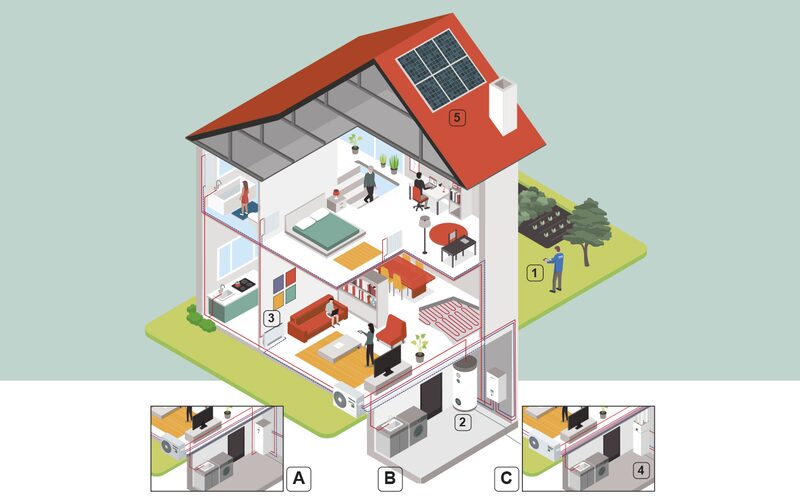
The Hub's guidance stresses viewing heat pumps as a whole-system solution rather than a simple replacement for traditional heating technologies10. That distinction is the difference between a like-for-like swap and a design exercise covering fabric, emitter sizing, flow temperature and ventilation. The Hub has published Heat Pumps: Hints and Tips for Architects and Architectural Technologists, launched on 29 January 2026, to support that design work12.
"highlights the importance of viewing heat pumps as a whole-system solution rather than a simple replacement for traditional heating technologies"
The system boundary matters for households because a heat pump in a new build is not a standalone appliance decision. The Boiler Upgrade Scheme guidance requires that a funded heat pump or biomass boiler provide both space and hot water heating and be capable of meeting the full space heating and hot water heating demands of the property13. That is the same principle applied to retrofit funding: the heating system has to cover the whole demand, not part of it.
For energy independence, a heat pump shifts a home's heating from gas to electricity. That reduces direct dependence on the gas network and on imported gas, and increases dependence on the electricity grid and on whatever generates the electricity. Where the home also has solar PV, as under the Option 1 notional specification, part of that electricity demand can be met on site during daylight hours1.
The Future Homes Hub: who is coordinating the housebuilding transition
The Future Homes Hub is the body coordinating the industry side of the transition. It operates under a terms of reference from the Department for Levelling Up9, and the Future Homes and Buildings Standards consultation is run by the Department for Levelling Up, Housing and Communities3. Two bodies, the Future Homes Implementation Board and the Embodied Carbon Implementation Board, are administered by the Hub14.
David Thomas, Chief Executive of Barratt Redrow, is Chair of the Future Homes Hub14. The Future Homes Implementation Board is co-chaired by MHCLG and Matthew Pratt at Barratt Redrow14, and was set up to facilitate the successful delivery of Future Homes Standard 2025 by anticipating, identifying and monitoring the key issues and actions required15. An earlier account described the Board as co-chaired by Catherine Adams (DLUHC) and Matthew Pratt (Redrow), bringing together industry leaders and key stakeholders15.
The Hub's workstreams include heat pumps, covering forecasting numbers and scaling up skills and supply chain, and providing guidance and information for site managers, designers, assessors and installers16. It has also published a heat pump design guide for architects12 and runs an evidence review workshop programme examining the implications of different options for meeting the standard when delivered at scale9.
The Hub is also leading work with lenders and valuers to provide the data needed to ensure lending criteria and valuation reflect the design and performance of new homes16. That work matters to anyone buying a low-carbon home, because a valuation that does not recognise the specification affects what a mortgage will support.
For a household, the Hub is not a regulator and does not set the rules. It is an industry coordination body working with government. Its publications and webinars are the practical route by which builders, designers and installers learn what compliance will require.
Measuring progress: the metrics companies will report on
Compliance under the standard is measured through a set of performance metrics. The government has decided to retain the existing metrics, TER, TPER and FEE, for setting performance requirements under the Future Homes Standard for new dwellings17. The proposed metrics are the target primary energy rate, the target emission rate, and, only for new homes, the target fabric energy efficiency rate3.
The Hub is developing metrics which companies will report on to track progress6. That is a separate exercise from the regulatory metrics: the regulatory set determines whether a dwelling complies, while the reporting set is intended to show how the sector as a whole is moving.
The Home Energy Model replaces SAP as the assessment method, and during the dual running period either the HEM or SAP 10.3 system can be used for compliance with the Future Homes Standard17. Solar is handled differently from the other elements, as described in the government response to questions 7 and 8 of the consultation17.
| Metric | Applies to | Status |
|---|---|---|
| Target emission rate (TER) | New dwellings | Retained17 |
| Target primary energy rate (TPER) | New dwellings | Retained17 |
| Target fabric energy efficiency rate (FEE) | New homes only | Retained17 |
| Company progress metrics | Industry reporting | In development6 |
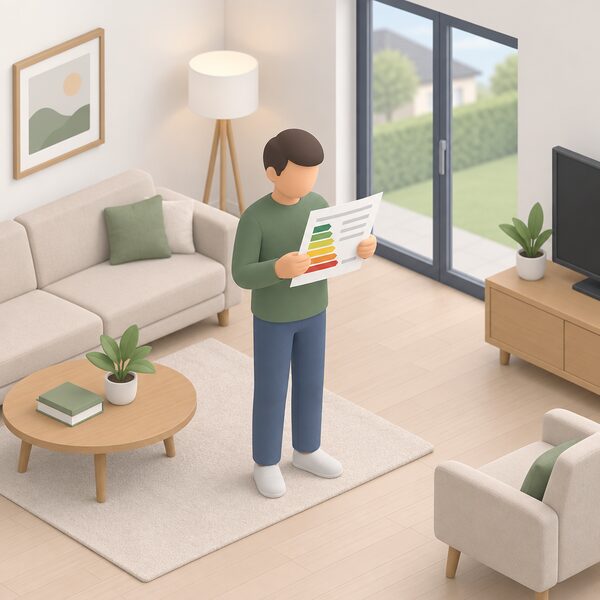
A household reading an EPC or a compliance certificate for a new home will encounter these metrics indirectly. The energy assessment behind the certificate is produced using the Home Energy Model or SAP 10.3 during the dual running period, and the metrics determine whether the dwelling meets the standard rather than describing how it will feel to live in.
Lending and valuation: making the market recognise low-carbon homes
A home that meets the standard is not automatically valued as one. The Hub is leading work with lenders and valuers to provide the data needed to ensure lending criteria and valuation reflect the design and performance of new homes16. Until that data flows through to valuation practice, a low-carbon specification may not be reflected in what a mortgage lender will advance.
The evidence base for that work is developing. The Future Homes Hub Whole Life Carbon Benchmarking Study 2025 analysed 48 detailed Whole Life Carbon assessments submitted by 17 industry partners18. Of the assessments submitted through the Hub tool, only 4 used product-specific Environmental Product Declarations, under 1% of the carbon impact18. That is a measure of how thin the product-level data still is.
The Future Homes Standard Phase 1 Network-to-Emitter Impact Report covers a range of low carbon HVAC technologies which could be specified within new homes once the standard has been introduced, reviewing each option's benefits and considerations19. Its recommendations include addressing competency within the industry, learning from the 2021 Building Regulation update, and addressing the cost of electricity19.
The cost of electricity is the point that bears most directly on a household's running costs and on its energy independence. A home heated by a heat pump and generating its own electricity is exposed to electricity prices rather than gas prices, and to the standing charges and network costs that sit on an electricity bill. The report's inclusion of electricity cost as a recommendation is a recognition that the standard's running-cost case depends on it.
Practical support for homebuilders starting their heat pump journey
The support available to builders is largely guidance and programme funding rather than a grant per home. The Hub's article on starting the heat pump journey shares practical insights for homebuilders beginning that work10. The Future Homes Standard Essentials set out seven critical actions to help homebuilders and their advisors to de-risk delivery, with small and medium-sized enterprise homebuilders a primary focus for the campaign6.
The Heat Pump Ready Programme is the government's funded route. Stream 1, Phase 2 supported the development and trial of solutions and methodologies for the optimised deployment of domestic heat pumps at high density20. Stream 2 supported the development of tools, technologies and processes to overcome specific barriers to domestic heat pump deployment21. Neither stream funds individual homes; both fund the methods and tools that make deployment at scale work.
The Hub has also published a heat pump design guide for architects and architectural technologists, launched on 29 January 202612. The Future Homes Standard Implementation Board's heat pump workstream covers forecasting numbers and scaling up skills and supply chain, and providing guidance and information for site managers, designers, assessors and installers16.
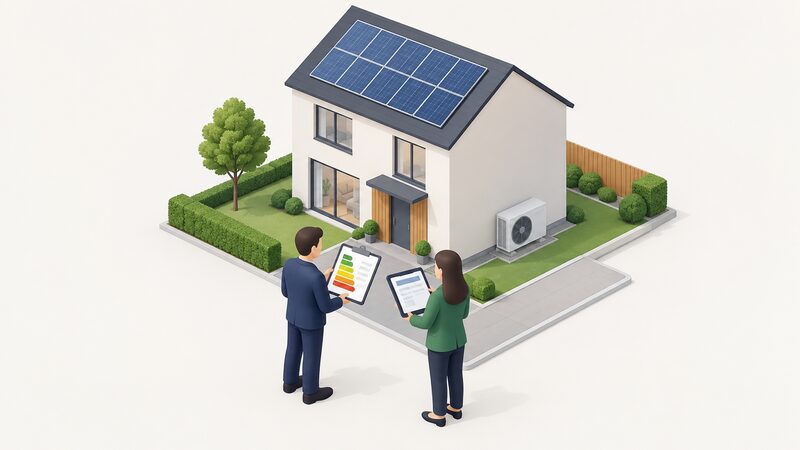
For a household buying a new home, this support structure determines what the builder is likely to have done before completion: a designed system rather than a substituted appliance, with the emitter sizing and ventilation considered together. It does not guarantee a particular outcome in any individual home, and the compliance route chosen by the developer determines whether solar PV and wastewater heat recovery are part of the specification.
Where the two options leave a household's independence
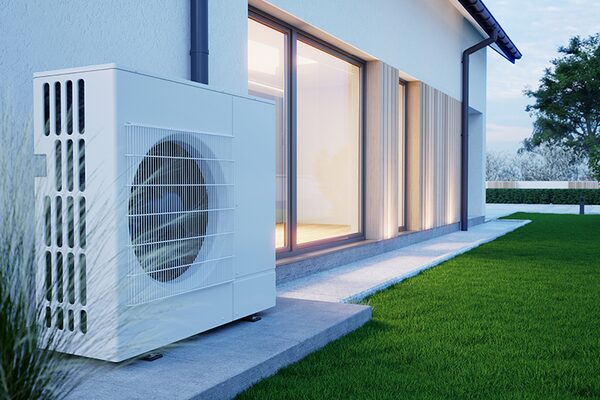
Both options deliver a home that is zero-carbon-ready and heated without fossil fuels6. Neither delivers a home that is off the grid. The remaining dependencies are the electricity network, a supplier, and the price of electricity, which the industry's own impact report identifies as a recommendation to address19.
The Option 1 specification adds on-site generation and wastewater heat recovery to the notional home1. That reduces the amount of electricity a household buys, and it reduces the share of heating and hot water demand that depends on external supply. It does not remove the connection, and without storage the generation is used when it is produced or exported.
The dates are the other thing a buyer needs. A home completed before 24 March 2027 is not built to the standard, and a home completed under the transition period may not be either4. The confirmed dates are 24 March 2027 for most properties, 24 September 2027 for higher-risk buildings, and 24 March 2028 for full compliance4.
Sources21 cited
- The Future Homes Standard consultation has landed, Future Homes Hub, 2023-12-14
- Solar panels set to be standard on new homes and buildings, Solar Energy UK, 2023-12-14
- The Future Homes and Buildings Standards: 2023 consultation, GOV.UK, 2026-09-17
- What the Future Homes Standard means for homeowners, NICEIC, 2026-04-23
- What the Warm Homes Plan and Future Homes Standard mean for installers, NICEIC, 2026-04-22
- Get Future Homes Standard ready, Future Homes Hub, 2026-03-04
- The Future Homes Standard: research briefing, House of Commons Library, 2024
- Families to save in biggest home upgrade plan in British history, GOV.UK, 2026-01
- Refining the Future Homes Standard 2025: evidence review workshop, Future Homes Hub, 2022-12-02
- Starting the heat pump journey: lessons for homebuilders, Future Homes Hub, 2026-09-07
- Building for 2050: low cost, low carbon homes, GOV.UK, 2022-12-05
- New architect-focused heat pump design guide launched, Future Homes Hub, 2026-01-29
- Summary of updates to Boiler Upgrade Scheme guidance, Ofgem, 2023-12
- New homes net zero transition plan, Future Homes Hub, 2025-04-29
- Meeting update: Future Homes Standard Implementation Board, Future Homes Hub, 2024-01-30
- The Future Homes Standard: a mission-driven approach, Future Homes Hub, 2025-06-06
- Home Energy Model replacement for SAP, GOV.UK, 2026-02-10
- A new era of carbon transparency, Future Homes Hub, 2025-11-25
- Future Homes Standard Phase 1 Network-to-Emitter Impact Report, BEAMA, 2026-09-20
- Heat Pump Ready Programme: information, GOV.UK
- Heat Pump Ready Programme: Stream 1 Phase 2 projects, GOV.UK
 Future Homes StandardWill your new build still have a gas boiler, and when do the new rules actually start?
 Future Homes Standard FabricWill a new home be cheaper to heat than an older one?
 New Build Homes and EnergyWhat heating will a new build actually have, and will it be a heat pump rather than a gas boiler?
 Panels by Home TypeCan your house have solar panels, and how many will fit?
 Choosing Heating by Home TypeWhat heating can you actually have in a flat, a park home, a listed building or a new build?
 AC-Coupled vs DC-CoupledCan you add a battery to your existing solar panels without swapping the inverter, and does one kind waste more of your solar power than the other?