
In this guide
Pylontech is one of the most widely installed battery brands in UK homes, and it is a name most householders meet second-hand: on an installer's quote, in a case study, or on the compatibility list of an inverter they already own. The company sells two distinct families into the UK. The US series is a rack battery, sold in 5kWh modules, and it is the unit that appears in a long run of British solar and storage installations. The Force range is a higher-voltage modular stack, and the Force H3 is built from FH10050 modules of 5.12 kWh each, reaching 34.01 kWh usable in a seven-module configuration1.
The brand's UK position is unusual in one respect. Pylontech does not publish a UK price list, and much of what makes its batteries compliant and compatible in Britain arrives through the inverter rather than the battery. Firmware 3.12.17.R, released in 2025, adds battery compatibility with the Pylontech Force H3 and fulfilment of the requirements for PSTI and G100 for the UK on the SMA Sunny Boy Smart Energy1.
For a household, that shapes what independence a Pylontech battery actually delivers. It stores your own generation and shifts it into the evening, but it depends on an inverter, on a compatible protocol, on a network operator's approval, and on a manufacturer whose UK presence is largely through distributors and installers rather than a direct sales channel.
Who Pylontech are, and how long they have been in storage
Pylontech is a dedicated energy storage manufacturer rather than a general electricals business with a battery line bolted on. Its Force H1 and H2 documentation dates to at least 2022, when the company was publishing gross battery capacities for the stack, including 7.10 kWh for a two-module H2 arrangement and 24.86 kWh for a seven-module H1 arrangement6. That is a record of shipping product in the modular high-voltage segment for several years.
The company's own news pages record two third-party recognitions in 2026: recognition by Wood Mackenzie as a Grade A BESS integrator in July, and consecutive recognition on the BloombergNEF Energy Storage Tier 1 List in August1. Both are the manufacturer's own announcements of listings compiled by other organisations, so they are worth reading as the maker's account of its standing rather than as the listing bodies' own pages.
In the UK, the practical evidence of Pylontech's presence is in installations rather than in a brand campaign. Installers have been fitting Pylontech batteries into British homes since at least November 2018, when a 3kW system in Chichester was completed with a GoodWe hybrid inverter and Pylontech batteries, followed by a run of installations through 2019 and into 2021 across Hampshire, Sussex and London. Those systems used 7.2kWh and 9.6kWh of Pylontech storage, in both hybrid and AC-coupled arrangements.
That history matters for a household weighing the brand. A battery maker with a decade of UK installations behind it has a body of installed systems, spare parts and installer familiarity that a newer entrant does not. It does not, on its own, tell you anything about warranty service in year eight.
The range at a glance: US series and Force
Pylontech's UK-facing range splits by system voltage, and that split decides which inverter a household can use.
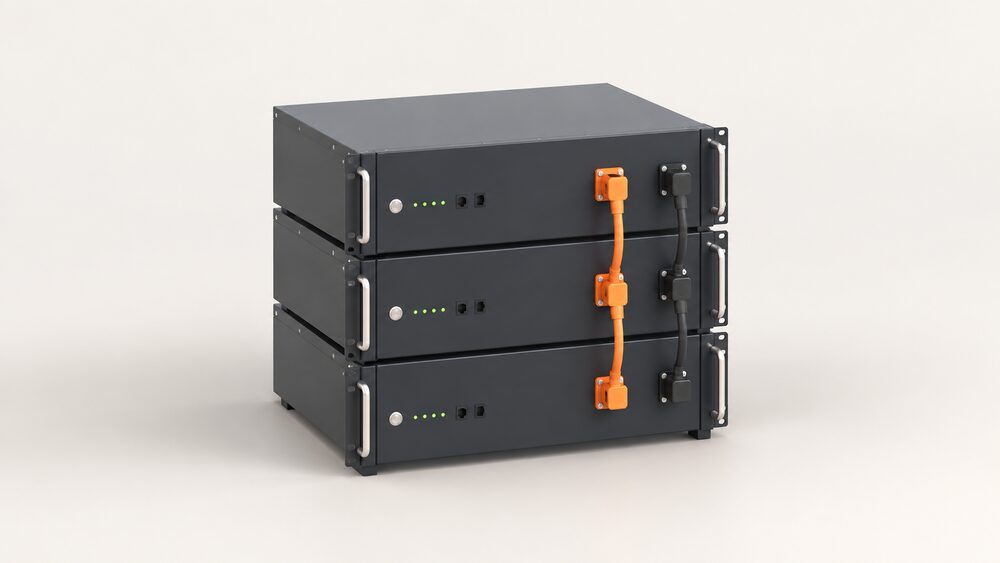
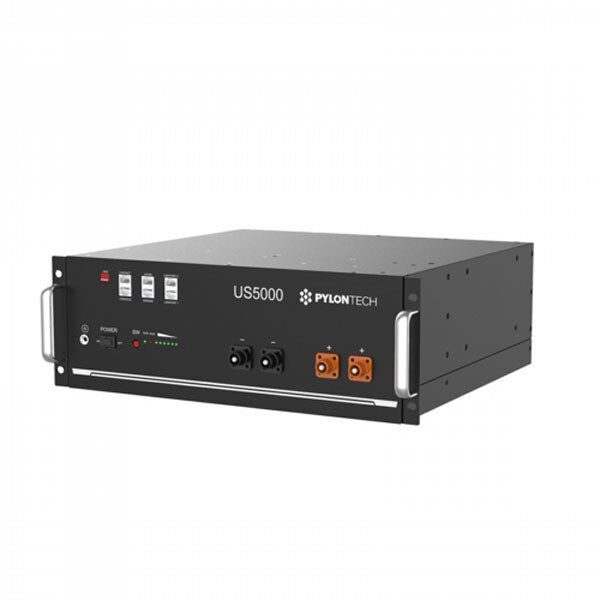
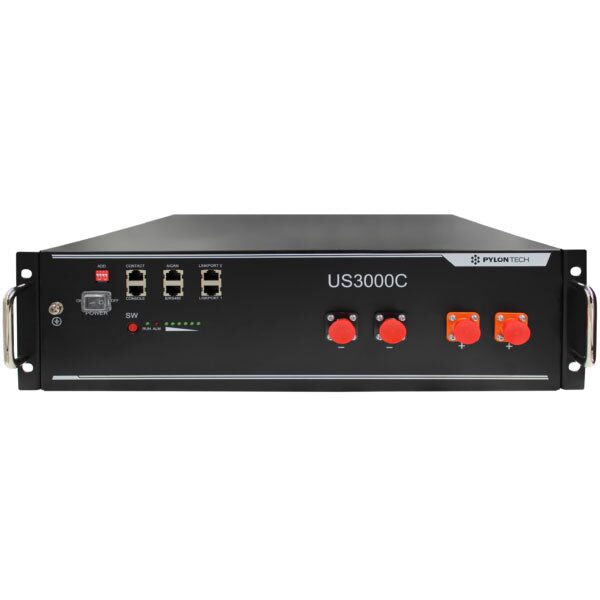
The US series is a rack battery. It is the format that appears in the UK case studies, and it is sold in 5kWh modules. The US5000 is the unit most often quoted, listed by a UK distributor at £920.00 including VAT, with delivery kerbside and a £35+ VAT delivery charge covering up to four identical units4. Prices for the same unit have been listed differently by different distributors, so a household should treat any single listing as indicative rather than as a market price.
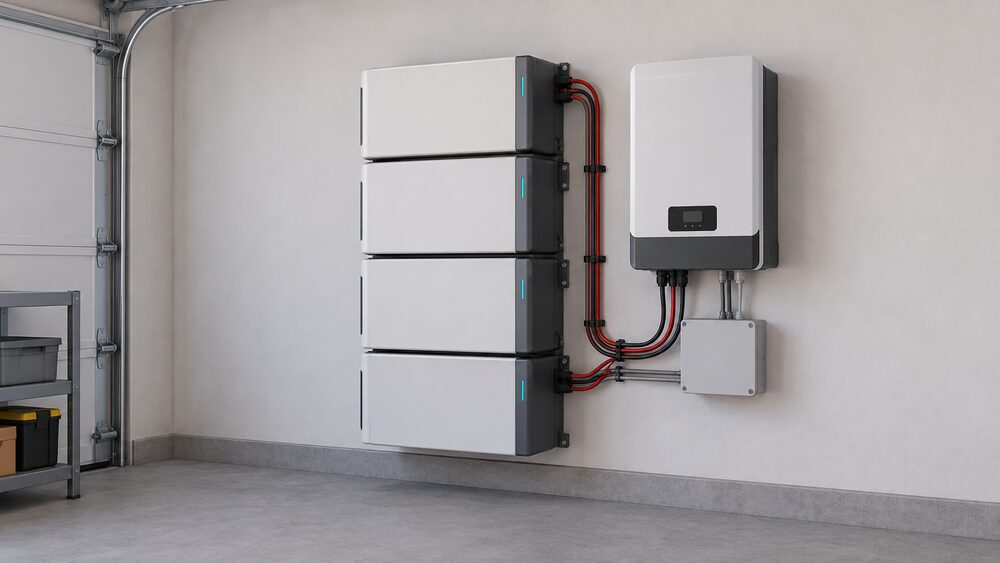
The Force range is a modular high-voltage stack. The Force H3 is built from FH10050 modules, each of 5.12 kWh, and in a seven-module configuration the maker gives a battery system capacity of 35.84 kWh and a usable capacity of 34.01 kWh2. The gap between the two figures is the difference between what is installed and what the system will actually deliver.
| Family | Format | Module or unit | Capacity | Notes |
|---|---|---|---|---|
| US series | Rack battery | US5000, 5kWh module | Sold in 5kWh units4 | Low-voltage hybrid and AC-coupled inverters |
| Force H1/H2 | High-voltage stack | H1 and H2 modules | 7.10 kWh gross for 2 x H2; 24.86 kWh gross for 7 x H16 | Earlier Force generation |
| Force H3 | High-voltage stack | FH10050, 5.12 kWh | 35.84 kWh system, 34.01 kWh usable in 7 modules2 | Remote maintenance and maximum scalability listed as features2 |
The Force H3's maker page lists maximum scalability and remote maintenance among its features2, and a comparable high-voltage stackable datasheet from another maker describes the same design idea as modular design with flexible sizes7. The pattern across the segment is consistent: a base module, repeated to reach the capacity a house needs.
US series: the rack battery familiar from UK solar installs
The US series is the part of the range a UK householder is most likely to encounter, because it fits the low-voltage hybrid and AC-coupled inverters that British installers have been fitting for years. The installation record shows the pattern: a 4.7kW system in Portsmouth in June 2019 with a 9.6kWh AC-coupled Pylontech battery system, a 4.72kW SolarEdge system in Worthing in October 2019 with a GoodWe AC-coupled battery inverter and 7.2kWh of Pylontech storage, and an 8.64kW installation in Chichester in February 2021 with 9.6kWh of Pylontech storage.
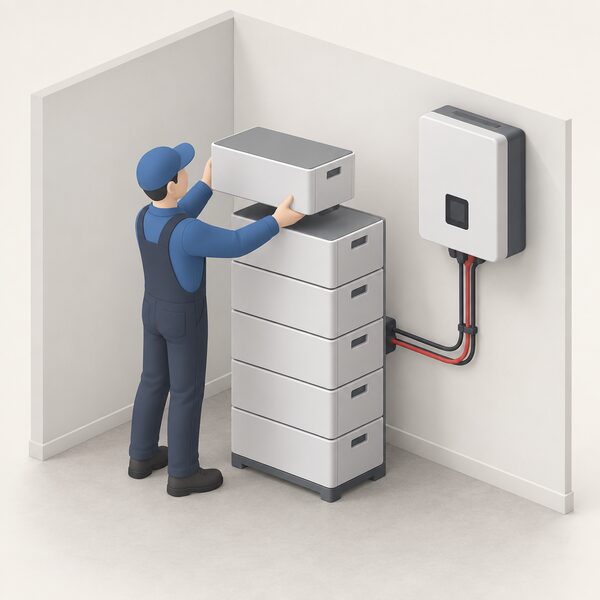
The rack format is what makes those systems expandable. A 5kWh module can be added alongside existing units rather than replacing them, which is why the same battery appears at 7.2kWh in one installation and 9.6kWh in another. For a household that started with a smaller array and later wanted more evening coverage, that is the practical advantage of the format.
The US series is also the part of the range with a published UK retail figure. The US5000 is listed at £920.00 including VAT by a UK distributor, delivered kerbside, with a £35+ VAT delivery charge covering up to four identical units4. That is a supply price for the battery alone, not an installed price, and it excludes the inverter, mounting, cabling, labour and any electrical work. Adding a battery to an existing solar system has been estimated to increase the upfront cost by around £2,000 to £6,000 for sufficient capacity for typical UK rooftop systems8, which is the figure a household should hold in mind when comparing a supply price against a quote.
Force range: modular stackable storage and the Force H3
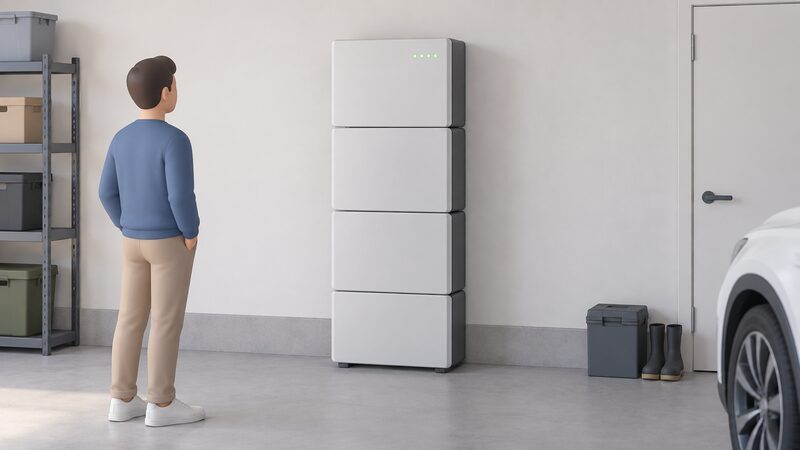
The Force range is Pylontech's high-voltage answer, and the Force H3 is the current generation. Its maker page gives the module as the FH10050 at 5.12 kWh, and in a seven-module configuration the battery system capacity as 35.84 kWh with 34.01 kWh usable2. The difference between those two numbers is the portion of the nominal capacity the system will not release in normal operation, and it is the usable figure that matters when sizing against evening demand.
Two features are listed on the maker page that bear on how the system is lived with: maximum scalability and remote maintenance2. Scalability means the stack can be extended by adding modules rather than replacing the whole battery, which is the same principle the US series applies at low voltage. Remote maintenance means the maker or installer can reach the system without a site visit, which is convenient but also a dependence: it requires the system to be connected and reachable.
The Force H3's UK support runs through the inverter. SMA's Sunny Boy Smart Energy lists battery compatibility with the Pylontech Force H3 from firmware 3.12.17.R, released in 20251. That is the pairing that makes the battery usable in a UK installation on that inverter, and it is the reason the firmware release matters as much as the battery specification.
For a household, the Force range suits a larger installation with higher evening demand, where a single 5kWh module would cycle too hard. The trade-off is that high-voltage stacks are less forgiving of inverter choice than the low-voltage rack format, so the compatible inverter list narrows the options.
Firmware and compliance: PSTI and G100 in the 3.12.17.R release
UK compliance for a home battery is not a single certificate held by the battery. It is a combination of the battery, the inverter and the firmware running on the inverter, and Pylontech's UK position illustrates that clearly.
Firmware 3.12.17.R, released in 2025, is the release that adds fulfilment of the requirements for PSTI and G100 for the UK on the SMA Sunny Boy Smart Energy1. The same release adds battery compatibility with the Pylontech Force H3, along with SMA Backup 3P Kit and 1P support, backup reserve configuration and external passive WIFI antenna support3.
The two standards do different jobs. G100 governs how a generation or storage system behaves on the network, limiting export and managing connection, and it is the standard a network operator will ask about. PSTI is the product security regime for connectable products, and it is the reason a battery with an app or a network connection has to meet security requirements at all. Comparable digital security certification work in the UK, such as the BSI Kitemark for EV chargers, is built around the UK Smart Charge Regulation and ETSI EN 303 6459, which shows the shape of the regime a connected battery now sits inside.
Installation standards sit alongside these. Domestic batteries are expected to be installed in compliance with the latest version of the quality and installation standards, including MCS, PAS 63100 and PAS 203511. In Northern Ireland, a G99 fast track connection application requires a compliance certificate with test results12. A household should expect the installer to hold these documents, not the battery alone.
Pylontech's standing: Tier 1 recognition and Grade A BESS status
Pylontech's own news pages report two recognitions in 2026: recognition by Wood Mackenzie as a Grade A BESS integrator in July, and consecutive recognition on the BloombergNEF Energy Storage Tier 1 List in August1. Both are the manufacturer's announcements of third-party listings.
Tier 1 status in energy storage is a widely used shorthand for bankability, and other makers use the same language on their own pages. Trina Storage describes itself as a Tier 1 BESS Provider and a Tier 1 Energy Storage Manufacture13. The label is therefore a category several manufacturers claim, and it is worth reading as an indicator of scale and financing confidence rather than as a quality ranking of domestic products.
What the recognition does not do is tell a household anything about the specific unit in its garage. Tier 1 listings are compiled at company and project level, and they speak to the maker's ability to deliver large-scale storage. A domestic rack battery is a different product, sold through a different channel, and its performance depends on the inverter it is paired with, the installation standard it was fitted to, and how it is cycled.
The chemistry behind the range is the mainstream one for home storage. Pylontech's batteries are lithium iron phosphate, the same chemistry other makers describe on their domestic product pages, where LFP is given as the battery type with a cycle life of 6,000 cycles on a 100 Ah nominal capacity unit14. LFP is the dominant chemistry in this segment for reasons of thermal stability and cycle life rather than energy density.
What a Pylontech battery means for household energy independence
A Pylontech battery does one thing well for independence: it lets a household use its own generation after the sun has gone. Uswitch data puts the self-consumption rate at 70% with a 10kWh battery for a household with solar16. Without storage, generation exported at the moment it is produced is worth the export rate rather than the import rate it displaces.
The dependence that remains is substantial and worth stating plainly. The battery needs an inverter, and the inverter decides what the battery can do. It needs a network connection approval, and in Northern Ireland a G99 application requires a compliance certificate with test results12. It needs an installer working to MCS, PAS 63100 and PAS 203511. Where the system has remote maintenance or an app, it depends on a network connection and the maker's servers.
The battery also depends on the inverter's protocol support. Fogstar states that 99% of popular inverters are supported by its batteries via the Pylontech Protocol, and lists Victron, Sofar, SunSynk, Solis, GoodWe and Growatt among supported inverters17. That is a competitor's page describing the reach of Pylontech's protocol, and it is a useful measure of how far the standard has spread: a Pylontech battery is not tied to one inverter brand.
Backup is a separate question from storage. Victron states that the combination of Victron products with Pylontech lithium batteries has been tested and certified by both companies' R&D departments, and that the pairing covers off-grid, grid backup and self-consumption energy storage systems5. Backup therefore comes from the inverter and its changeover arrangement, not from the battery, and only some pairings provide it.
"The combination of Victron products with Pylontech lithium batteries has been tested and certified by the Victron and Pylontech R&D departments."
The battery's own protection behaviour is worth knowing. Pylontech's compatibility documentation states that if charging voltage rises above 54V, battery protection will turn on, and that when the battery discharges to 44.5V or less, battery protection will turn on, with the discharge current limit set to 0A at 47V and the inverter turning off5. Those are the thresholds at which the battery stops rather than damages itself, and they are set by the battery management system rather than by the householder.
Adding a Pylontech battery to an existing solar installation
Adding storage to panels already on the roof is a normal route, and UK council-run buying schemes say so directly. South Norfolk and Broadland's Solar Together Norfolk scheme invites households that already have solar panels to register to have battery storage added to their existing panels to maximise the benefits of the system18. Birmingham's Switch Together scheme carries the same wording19.
The practical constraint is the existing inverter. A low-voltage hybrid or AC-coupled inverter suits the US series, which is why the UK installation record shows Pylontech rack batteries on GoodWe hybrid and AC-coupled inverters. A high-voltage hybrid inverter is needed for the Force range, and the Force H3's UK support runs through the SMA Sunny Boy Smart Energy from firmware 3.12.17.R1. Where the existing inverter is a plain string inverter with no battery input, an AC-coupled battery inverter is added alongside it.
Cost is the other constraint. Adding a battery to a solar PV system has been estimated to increase the upfront cost by around £2,000 to £6,000 for sufficient capacity for typical UK rooftop systems8. That sits above the £920.00 inc VAT supply price of a single US50004 because it covers the inverter, mounting, cabling, labour and certification.
The wider context is that battery installations in the UK are overwhelmingly going onto homes that already have solar. In the first half of 2026, 92% of battery installations went onto properties with solar panels, alongside almost 150,000 certified installations20. Solar panels are suitable for anywhere in the UK21, and there are over 1.5 million domestic solar installations in the country22, so the retrofit route is the mainstream one rather than the exception.
Where a Pylontech battery's independence stops
The limits are worth setting out as firmly as the benefits.
The battery cannot be chosen independently of the inverter. Compatibility is inverter-specific and firmware-specific, and the Force H3's UK support is tied to a particular firmware release on a particular inverter1. A household that buys a battery first and looks for an inverter afterwards has the order wrong.
The battery does not provide backup on its own. Backup comes from the inverter and its changeover arrangement, and Victron's certified pairing with Pylontech covers off-grid, grid backup and self-consumption systems5, which means the capability exists in some configurations rather than all.
The battery depends on a network operator's approval. In Northern Ireland, a G99 fast track connection application requires a compliance certificate with test results12, and installation standards including MCS, PAS 63100 and PAS 2035 apply across the UK11.
The battery depends on a supply chain and a service route. Pylontech sells into the UK through distributors and installers rather than a direct channel, and the US5000's published UK figure is a distributor listing with kerbside delivery4. Service, warranty and spares therefore run through the installer and the distributor rather than through a manufacturer's own UK operation.
Finally, the battery depends on the grid it is trying to reduce reliance on. It charges from solar or from off-peak grid electricity, and it discharges into a home that remains connected. Self-consumption of 70% with a 10kWh battery16 is a real gain in independence, and it is also a statement that roughly a third of consumption still comes from elsewhere.
Sources22 cited
- Sunny Boy Smart Energy, SMA, 2026-09-20
- Force H3, Pylontech, 2026-09-17
- Sunny Boy Smart Energy (DE), SMA, 2025-07
- Pylontech US5000 5kWh Solar Battery, TradeSparky, 2026-09-17
- Pylontech compatibility, Victron Energy, 2026-09-17
- xStorage Home 3P brochure, Eaton, 2022-05
- High Voltage Stackable Batteries datasheet, GivEnergy, 2026-09-17
- Could solar panels save you £500 a year?, Which?, 2026-06-17
- BSI Kitemark Certification for EV Chargers, BSI, 2026-09-17
- BSI Kitemark Certification for EV Chargers (CA), BSI, 2026-09-17
- WHSHF wave 3 scheme guidance addendum, Department for Energy Security and Net Zero, 2026-06
- What you need to start your G99 application, NIE Networks, 2026-09-19
- Trina Storage, Trina Solar, 2026-01-28
- Livoltek low-voltage residential battery, Livoltek, 2026-09-10
- Livoltek AC-coupled all-in-one ESS battery, Livoltek, 2026-09-10
- Britain's homes with solar panels reap £40 million during the heatwave, Uswitch, 2026-06-28
- Fogstar Energy ESR51.2 supported inverters, Fogstar, 2026-09-19
- Solar Together Norfolk, South Norfolk and Broadland Council, 2026-09-17
- Switch Together Birmingham, Birmingham City Council, 2026-01-27
- UK Solar Roadmap, Department for Energy Security and Net Zero, 2025-06
- Time of use tariffs explained, Which?, 2026-04-23
- Industry welcomes plug-in solar progress, Solar Energy UK, 2026-06-16
 Pylontech battery modules in UK home systemsThinking about a Pylontech battery for your home?