
In this guide
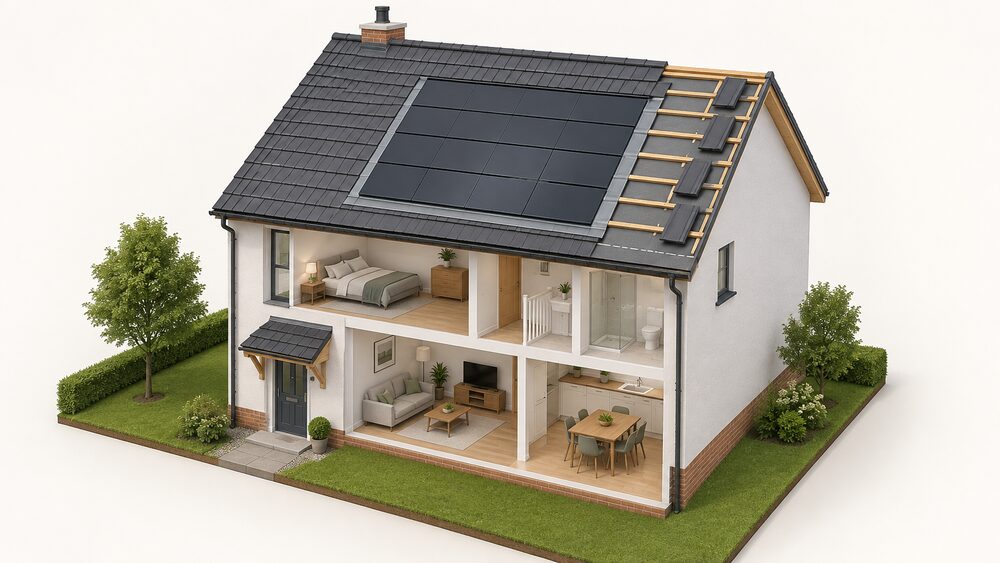
Marley SolarTile is a roof-integrated solar panel rather than a panel bolted to rails above the roof. Marley describes it as a solar roof tile that acts as a roof covering while also generating renewable energy, and as an integrated solar PV system for pitched roofs in which the panels replace an area of standard tiles or slates1. It comes as a complete kit including all required flashings and mounts, and is designed to be an integral part of the roof: weathertight, low maintenance and compatible with all roof tiles and slates3.
Two panel outputs are published: 335Wp and 445Wp5. The 335Wp panel measures 1000mm wide by 1686mm high by 69mm thick, with an aperture area of 1.622m² and 60x2 monocrystalline silicon cells1. The 445Wp All Glass panel measures 1134mm across the roof by 1722mm up the roof by 70mm thick, with an aperture area of 1.885m²1. Panels sit with 5mm spacing between tiles1.
The commercial case rests on three published terms: a 15-year system guarantee covering compatibility and weathertightness, a 25-year panel efficiency guarantee, and a fire rating of Broof (T1, T2, T3, T4) to EN 13501-51. Marley states that professional roofers require no special tools or additional skills to install it, and that installation times of less than one hour per kWp can easily be achieved6.
A roof-integrated panel, not a panel on rails
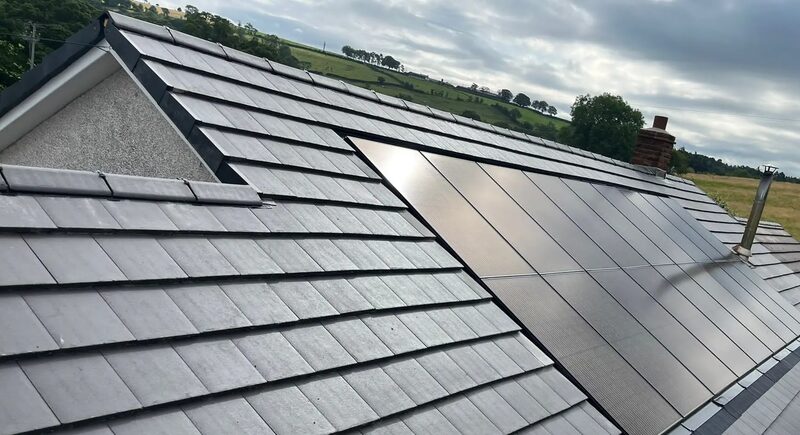
The distinction matters for how the product behaves. An on-roof array sits above the covering on rails, leaving a gap beneath the modules. SolarTile replaces standard tiles or slates within the roof plane, so the covering and the generator are the same layer2. Marley states that because in-roof solar tiles are fixed to rafters and battens, there are no gaps for wind to get underneath and so they are extremely secure7. The Energy Saving Trust makes the same point in plainer terms: solar roof tiles are fitted to your roof instead of normal tiles, so the solar installation does not affect the look of your roof8.
Marley's own framing is that the panels sit within the roof, creating a more unified appearance while reducing the number of standard tiles otherwise needed2. The system is supplied as a kit with fixings and flashings, and Marley states that every element has been tested together for compatibility and compliance3. That is a different proposition from buying modules and a mounting system separately and relying on the installer to confirm they work together.
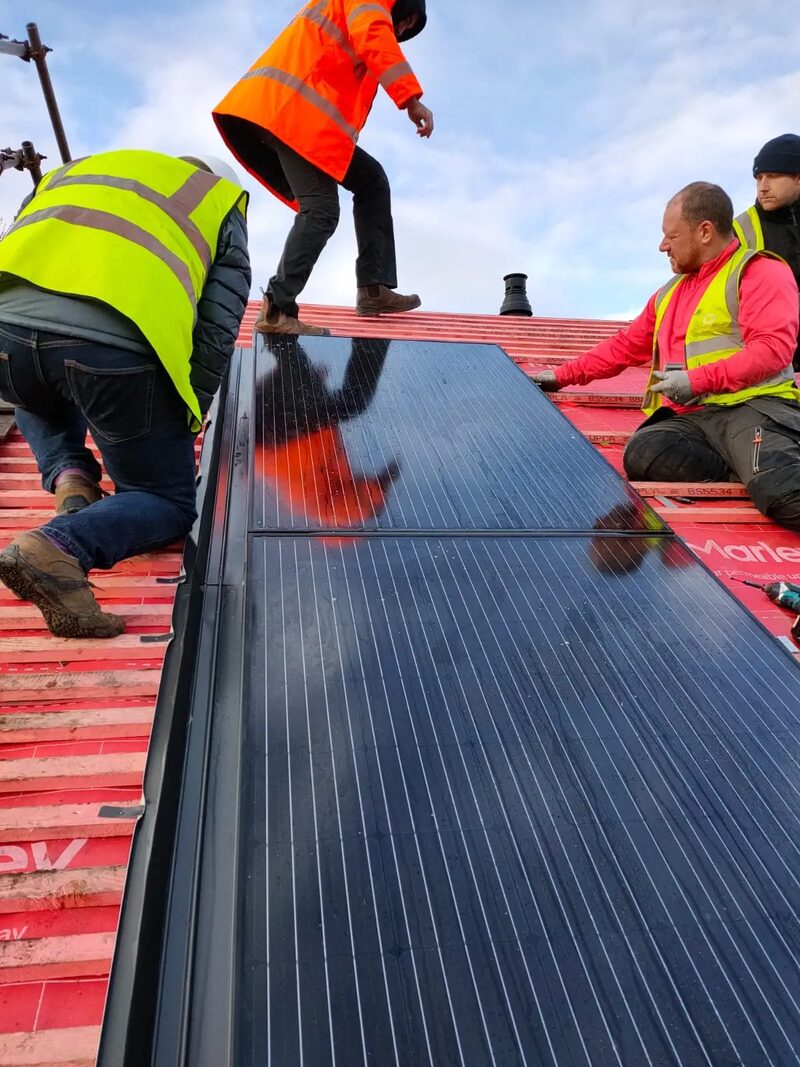
The trade-off is access. Because the tiles are the roof covering, work on them is roofing work, and the sequence runs the other way from an on-roof array: Marley states that since SolarTile is an integrated system, it is installed before the roof tiles go in place, avoiding any chance of roof damage during installation6. For a household, that means the sensible moment to consider it is when the roof is being built or replaced, not as an addition to a finished roof. The wider comparison between the two approaches is set out in roof-integrated vs on-roof solar panels and solar panels vs solar roof tiles.
The Marley and Viridian connection
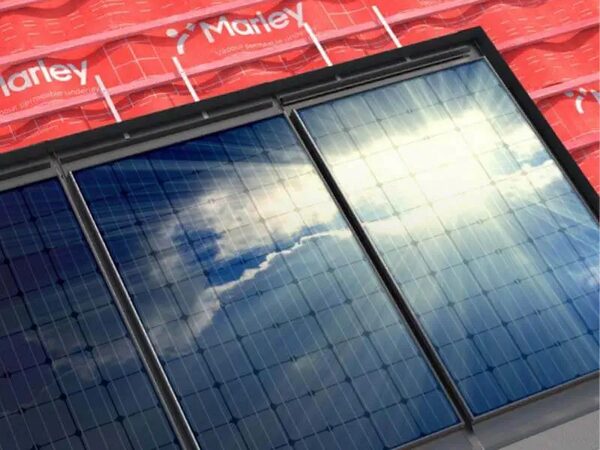
Marley presents SolarTile as its own product, sold within its own roof system and carrying its own guarantees. Marley states that its solar tiles are supplied across the UK, and that SolarTile can be used as a fully integrated element of its comprehensive roof system10. The company also states that roof-integrated photovoltaic panels are compatible with its entire range of roof products12.
Viridian Solar is a separate business. Independent trade reporting describes Viridian Solar as a UK-based manufacturer of roof-integrated solar modules13. The two names appear in the same market and the same product category, and no supply or manufacturing relationship between them is recorded, so no such relationship should be assumed from the similarity of the product type.
What a householder can rely on is what Marley publishes under its own name: the specification, the fire certification, the guarantee terms and the technical support route. Those are Marley's commitments, and they are the ones that would be enforced if a roof leaked or a panel underperformed. The company's own product page carries the model-level figures, and its support pages carry the installation and compatibility rules1.
Marley's wider renewable offer extends beyond the tile. The company describes a full system incorporating Marley SolarTile roof tiles, an inverter unit, storage batteries and an electric vehicle charger, and lists roof-integrated SolarTile, solar inverter and battery storage among its renewable solutions14. That matters for independence: the tile is the generating layer, but the inverter and any battery determine how much of the output a household can use on site rather than export. Those components are covered in solar inverters and adding battery storage to a solar system.
Specifications: 335Wp and 445Wp panels
The published range covers two panels, and the figures below are Marley's own for each named model.
| Specification | 335Wp SolarTile | 445Wp SolarTile All Glass |
|---|---|---|
| Peak power | 335Wp1 | 445Wp1 |
| Width | 1000mm1 | 1134mm across roof1 |
| Height | 1686mm1 | 1722mm up roof1 |
| Thickness | 69mm1 | 70mm1 |
| Aperture area | 1.622m²1 | 1.885m²1 |
| Cell type | Monocrystalline silicon, 60x21 | Not stated |
| Max power voltage | 34.7V Vmpp1 | Not stated |
| Max power current | 9.7A Impp1 | Not stated |
| Power temperature coefficient | -0.38% /°C1 | -0.29% /°C1 |
| Voltage temperature coefficient | Not stated | -0.25% /°C1 |
| Wind resistance | 5.32kPa1 | Not stated |
| NOCT | 44°C1 | Not stated |
| Panel spacing | 5mm between tiles1 | 5mm between tiles1 |
Two things stand out. First, the 445Wp All Glass panel is physically larger in both directions, so it is not simply a higher-output version of the same footprint: the aperture area rises from 1.622m² to 1.885m²1. Second, the temperature coefficients differ, with the All Glass panel losing less output per degree of cell heating at -0.29% /°C against -0.38% /°C1. On a hot roof, that difference compounds across an array.
Marley states that the system enables solar arrays to be arranged in any shape or size, and that tiles can be installed individually or in an array1. One documented project, a seven-panel array in the south of England, was calculated to give the homeowner a total power output of 2.34 kilowatt15. For one case study, panel power is given as both 335Wp and 410Wp; the two figures are unresolved. How panel figures translate into a system size is covered in solar panel sizing and reading a solar panel datasheet.
How it fits the roof: battens, no counter battens
SolarTile attaches directly to the roof battens9. Marley states that there is no need for counter battens or additional undertrays, and no need for extra battens, adhesive flashing or fireproofing materials3. The panels use push-fit connections for a weather-tight and secure fixing12.
The base requirement is a standard roof construction with roof battens in place and a continuous functional underfelt that terminates in a gutter3. That is a normal pitched roof build-up, which is why the product suits both new-build and re-roofing work. Marley states that SolarTile is suitable for new-builds or re-roofing projects, and separately that it suits new-build and retrofit projects1. It is also suitable for installation on low-pitch roofs1.
The sequence is the practical constraint. Because the tiles replace the covering, they go on before the surrounding roof tiles, which Marley states avoids any chance of roof damage during installation6. On a re-roof, that means stripping the covering and installing the solar area as part of the same job rather than as a later addition. On a retrofit where the covering stays, the tiles cannot simply be dropped in without opening up the roof.
Marley states that the entire roof-integrated solar system can be installed to satisfy NHBC Technical Requirements, and that the 445 range has been assessed and approved by the BBA (British Board of Agrément) as being fit for its intended use1. Those are the documents a builder or building control officer would look for. Roof loading and building regulation considerations generally are covered in building regulations and roof loading for solar panels.
Fire certification and weather performance
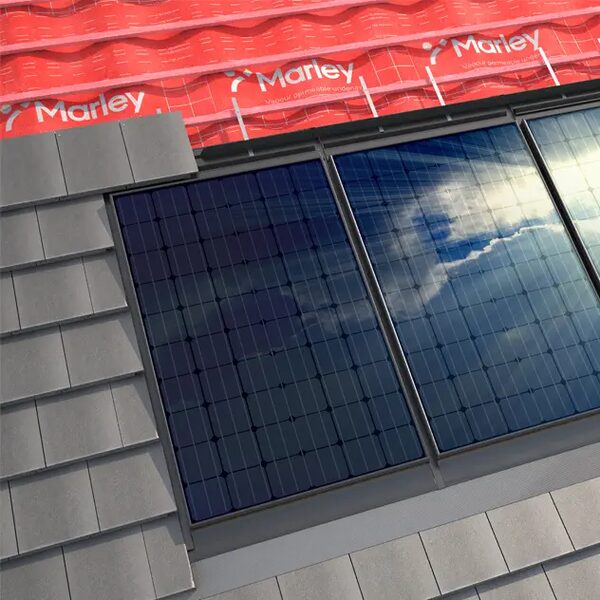
SolarTile carries a fire rating of Broof (T1, T2, T3, T4) to EN 13501-51. In the European roof-covering classification system, BROOF(t4) indicates the highest performance and FROOF(t4) the lowest17. Marley states that MCS 012 requires both the panel and the mounting kit to be tested together as a system to achieve the required BRoof(t4) fire classification, and that every element of SolarTile has been tested together for compatibility and compliance18.
That combined-testing point is not a formality. Government research published in February 2026 records that PV modules on a roof classified as BROOF(t2) enhance fire spread, and a separate experiment above plastic roof tiles achieved a classification of BROOF(t4) when classified in BS EN 13501-5 without PV panels installed17. The lesson is that a roof's rating with panels fitted is not the same as the rating of the bare covering, which is why the panel and mounting system have to be assessed as a pair.
"both the panel and the mounting kit must be tested together as a system to achieve the required BRoof(t4) fire classification"
Weathertightness is the other half of the claim. Marley describes SolarTile as weathertight and low maintenance, and the 15-year system guarantee specifically covers compatibility and weathertightness1. The wind resistance figure published for the 335Wp panel is 5.32kPa1. Because the tiles are fixed to rafters and battens with no gaps for wind to get underneath, Marley describes them as extremely secure7.
Fire safety in solar installations more broadly, including DC isolation and the risks that apply to any PV array, is covered in solar PV safety. The industry's own account of how safety evidence should be presented is set out by Solar Energy UK20.
Compatibility with the Marley roof system and other coverings
Marley states that SolarTile is compatible with all roof tiles and slates, with all Marley roof coverings, and with its entire range of roof products4. The roofing kits work with all Marley tiles and are compatible with slates, and the product is suitable for installation on slate roofs16. Marley states that all its roofing tiles are compatible with the Marley Roof System, and that its extensive range of roof tiles is fully compatible with the rest of that system9.
Documented projects show the range in practice. One case study records SolarTile panels working seamlessly with Edgemere interlocking slate tiles, in a full system combining those tiles with 335Wp SolarTile panels11. Another records compatibility across concrete, clay or slate21. The Lincoln Clay Interlocking Pantile is listed as compatible with Marley SolarTile22.
| Roof covering | Compatibility with SolarTile |
|---|---|
| Marley concrete, clay and slate coverings | Compatible across the entire Marley range12 |
| Slate roofs | Suitable for installation on slate roofs12 |
| Edgemere interlocking slate tiles | Worked seamlessly in a documented project11 |
| Lincoln Clay Interlocking Pantile | Listed as compatible22 |
| Concrete, clay or slate generally | Recorded as compatible in a case study21 |
The practical reading is that a householder specifying a Marley roof has a wide choice of covering around the solar area, and the solar tiles can be arranged in any shape or size within it1. Where the covering is not a Marley product, the compatibility statements are Marley's own and relate to its own range, so a specifier would need to confirm the surrounding covering separately. The general principles of mounting are covered in solar mounting systems and roof-integrated solar.
Guarantees: 15 years on the system, 25 on efficiency

The guarantee structure has two layers. The system guarantee runs for 15 years and covers compatibility and weathertightness1. Marley describes it as a market-leading 15-year system guarantee, and elsewhere as a 15-year guarantee, the longest on the market1. The panel efficiency guarantee runs for 25 years1.
The power warranty for the 335Wp panel is expressed as 90% of rated power at 10 years and 80% at 25 years1. The 445Wp All Glass panel carries a stronger schedule: Marley states that the power output guarantee for the 445-AG is improved to 95% of rated power at 10 years and 87% at 30 years1. That is a longer term and a higher retained output than the 335Wp panel, and it is one of the clearer differences between the two models.
The 15-year term also attaches to the wider roof system. Marley states that its roof tiles come with a 15-year guarantee, that SolarTile can be installed alongside the complete Marley Roof System with a 15-year warranty, and that a complete Solar Roof System is backed by a 15-year guarantee9. Case studies record the same term on completed projects, including a full roof system warranty and a 25-year efficiency guarantee on one scheme23.
For a household, the split matters. The 15-year system guarantee is a weathertightness and compatibility commitment, which is what protects the building fabric. The 25-year efficiency guarantee and the power warranty protect the generating performance. Degradation and warranty terms across the market are compared in solar panel warranties and degradation.
Installation, training and technical support
Marley states that professional roofers require no special tools or additional skills to install Marley SolarTile6. Installation kits are provided with everything needed to install the solar tiles, illustrated step-by-step instructions are provided with each kit, and comprehensive installer training is available3. The company states that it carries out comprehensive installation training for roofing contractors7.
That training is not only classroom-based. One case study records whole-day hands-on training and guidance on installing Marley SolarTiles from Marley staff on site24. Another records Marley providing practical help and training on site to support the installation phase25. On a further project, Marley's technical team devised a roofing specification and supported the project to completion, with Marley on hand through the installation process to support the homeowner and the roofing and electrical contractors15. Marley states it can work with installers to provide training when needed26.
On timing, Marley states that installation times of less than one hour per kWp can easily be achieved7. Independent guidance on solar installation generally is longer: Home Energy Scotland states that installation typically takes between one and two days, and the Energy Saving Trust states that an installer should take one to two days, longer if the system is more complex27. NICEIC reports that most installs take between two and four days, with extra time needed for scaffolding29. These figures measure different scopes: Marley's is the rate at which tiles go onto a prepared roof, while the independent figures cover a whole installation including scaffolding and electrical work.
Marley describes SolarTile as an almost maintenance free solution14. On specification support, Marley's technical team used the SAP (Standard Assessment Procedure) methodology to calculate the system requirements on one apartment project11. For Northern Ireland insulation schemes, the scheme managers listed are Energystore Ltd for Help to Insulate and Phoenix Energy via Refresh NI for Efficiency Plus30. The installation process from survey to handover is covered in solar panel installation.
Bird nesting, debris and the gap beneath the panel
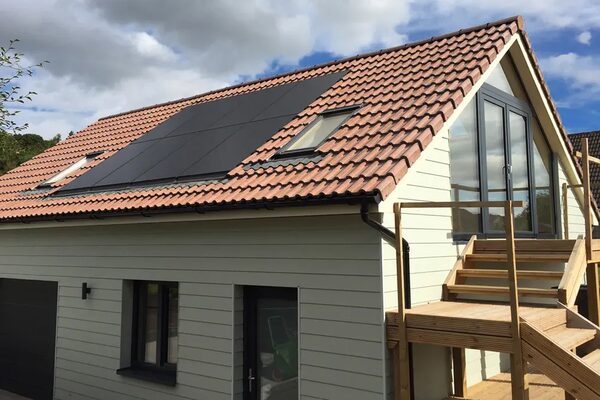
Integrated tiles leave no gap beneath the panel, and Marley states that this improves a roof's overall visual appeal and prevents birds nesting beneath the panels14. That is a direct contrast with on-roof arrays, where the space between module and covering is a known nesting site.
Independent guidance treats that space as a genuine risk. Which? states that birds' nesting material can be combustible and present a serious fire risk, and that birds and squirrels can damage connectors and wiring31. The same warning appears in two separate Which? publications, one from 2018 and one current, which suggests the problem has not gone away32.
"Birds' nesting material can be combustible and present a serious fire risk."
For a household weighing an integrated roof against an on-roof array, this is one of the concrete differences. The integrated design removes the void that birds use, and Marley states the system is almost maintenance free14. The counterpoint is that any fault in an integrated array is reached through the roof covering rather than from underneath, which is a roofing job. Maintenance and inspection generally are covered in solar panel maintenance and cleaning, and the specific problem of birds under arrays in pigeons under solar panels.
What an integrated solar roof means for energy independence
SolarTile generates electricity on the roof, and the Energy Saving Trust notes that solar roof tiles incorporate mini solar panel units to generate clean electricity from sunlight8. Marley states that the tiles are supplied across the UK and are available in the UK, promoted for use on re-roofing projects10. One documented project used Burton Roofing Supplies as the merchant15.
What the tile does for independence is straightforward: it produces power at the point of use, on the building, from a covering that has to be there anyway. What it does not do is remove dependence. The array still needs an inverter to convert DC to usable AC, and Marley's own renewable system pairs the tiles with an inverter unit, storage batteries and an electric vehicle charger14. Without a battery, output not used in the home at the moment of generation is exported. With one, more of it can be kept. Both routes are covered in solar inverters and adding battery storage to a solar system.
Grid dependence remains in every grid-connected case. A SolarTile roof is not an off-grid system, and a household connected to the network still draws from it at night and in winter, still needs a supplier, and still needs a connection agreement for export. The independence it delivers is partial: a reduction in imported units, not a severance from the grid. Off-grid arrangements are a different subject, covered in off-grid solar.
There is also a manufacturer dependence. The 15-year system guarantee and the 25-year efficiency guarantee are Marley's commitments, and the technical support route runs through Marley's own team1. The product is supplied as a kit with Marley's fixings and flashings, and the compatibility statements relate to Marley's own roof range3. That is normal for an integrated system, and it is worth stating plainly: the household's protection depends on a continuing relationship with one manufacturer and the roofing trade that installs its system. The broader picture is set out in solar panels and household energy independence and roof-integrated solar.
Sources32 cited
- Marley SolarTile product page, Marley, 2026-09-17
- Benefits of solar PV on re-roofing projects, Marley, 2026-08-21
- How do I install roof-integrated solar panel roof tiles, Marley, 2026-09-17
- Renewable solutions, Marley, 2026-09-17
- Lincoln Single Pantile, Marley, 2026-09-17
- Busting solar panel myths, Marley, 2022-06-09
- What are the benefits of integrated solar roof tiles, Marley, 2020-07-01
- Solar roof tiles, Energy Saving Trust, 2026-08-13
- Marley Roof System, Marley, 2026-09-17
- Solar FAQs, Marley, 2026-09-17
- Highgrove Apartment case study, Marley, 2026-09-17
- Which roof coverings are compatible with solar roof tiles and panels, Marley, 2026-09-17
- From anecdotes to evidence: why the UK solar industry must own its safety narrative, Solar Energy UK, 2026-04-22
- Solar roof tiles and solar batteries for build to rent, Marley, 2024-03-25
- Willett Way case study, Marley, 2026-09-17
- Solar install, Marley, 2026-09-17
- Fire safety of solar photovoltaic panels, full report, UK Government, 2026-01-07
- MCS compliance and roof-integrated mounting kits, Marley, 2026-09-17
- Fire spread over pitched roofs fitted with solar panels: summary, UK Government, 2025-12-22
- How safe are solar panels, Marley, 2026-09-17
- Bro Pedr Fardd case study, Marley, 2026-09-17
- Roof tiles, Marley, 2026-09-17
- Green Garth case study, Marley, 2026-09-17
- Ashington case study, Marley, 2026-09-17
- Burden Road case study, Marley, 2026-09-17
- Whole roof system helps tackle fuel poverty, Marley, 2024-03-04
- Solar panels, Home Energy Scotland, 2026-09-20
- Solar panel installation, Energy Saving Trust, 2026-09-07
- Solar panel installation, maintenance and repair, NICEIC, 2026-09-17
- NISEP list of schemes 2026-27, Utility Regulator Northern Ireland, 2026-04
- Solar panel problems and how to solve them, Which?, 2026-03-26
- Most common solar panel problems, Which?, 2018-08-01
 MarleyChoosing Marley roof tiles means picking between clay and concrete, and working out which style suits your roof.