
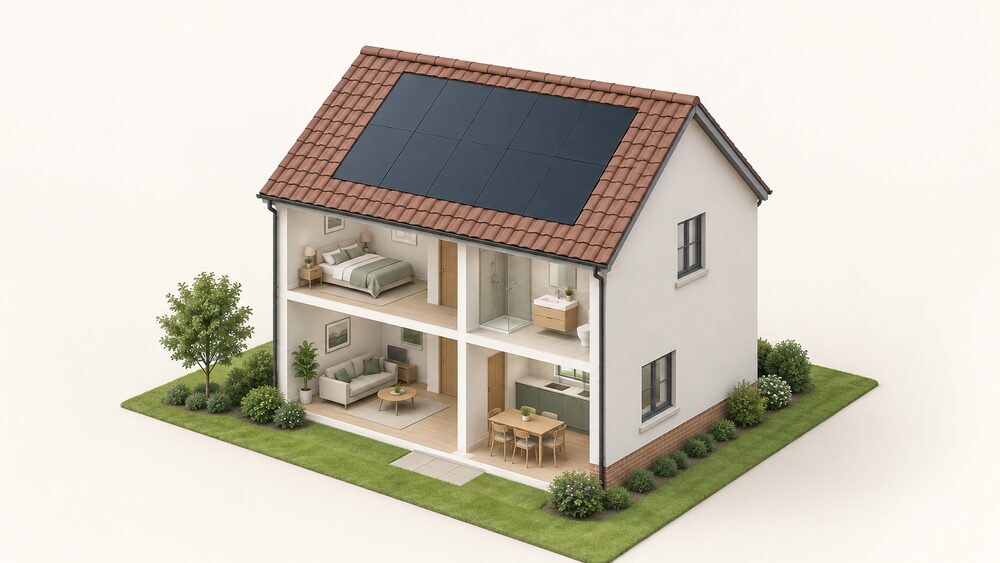
In this guide
Marley is a UK roofing manufacturer whose pitched roofing range covers clay and concrete tiles, underlays, battens, dry-fix fittings, ventilation and roof-integrated solar panels. The tile catalogue runs to more than 80 different roof tiles, in pantile, flat, interlocking and slate-look designs, and the company states that products are available for pitches as low as 12.5 degrees1. Tiles are sold as part of a single specification, the Marley Roof System, which the maker describes as a complete range of compatible pitched roofing products from a single trusted manufacturer2.
The solar side of the range is Marley SolarTile, a roof-integrated photovoltaic panel that acts as a roof covering while generating electricity3. It is compatible with the entire Marley roof product range, including clay and concrete tiles and cedar shingles and shakes, and with slates4. Marley supplies its solar tiles across the UK6.
For a household, the significance is that the roof covering and the solar array can be specified together, from one manufacturer, rather than as two separate purchases. What that does not change is the underlying dependence: a roof is still a roof, and a SolarTile array still needs an inverter, a grid connection and an electrical sign-off. The sections below set out what Marley makes, how the system fits together, and where the limits sit.
What Marley makes: clay and concrete tiles, underlays and solar roofing
The core of the range is clay tiles and concrete tiles, and the company frames the choice between them as the starting point for a specification1. Around the tiles sits the Marley Roof System, which the maker lists as JB Red roofing battens, Marley high-performance underlays, roof tiles in clay or concrete, timber shingles and shakes, renewable energy solutions, and dry-fix fittings and ventilation2. The complete roof system is described elsewhere as covering roof tiles, underlays, battens, ventilation products, SolarTile and fire safety products8.
The renewable energy element is not only the roof tile. Marley's renewable energy system solutions include solar roof tiles, solar batteries, solar inverters and an electric vehicle charger9. That matters for how a specification is drawn: the roof-integrated panel is one component in a chain that also includes storage and conversion equipment.
Solar roof tiles work by replacing regular roofing tiles with solar tiles that use photovoltaic cells to convert sunlight into electricity6. Independent guidance describes them as made from the same materials as solar panels, and notes they are sometimes referred to as solar slates or solar shingles10. The same independent source notes that manufacturers and installers may offer a waterproofing warranty for solar roof tiles, which is the point at which a roof covering and an electrical product overlap10.
For a household, the practical consequence is that the roof becomes an energy asset as well as a weatherproof envelope. It does not make the home independent of the grid: the array generates when the sun shines, and the home still draws from the network at other times unless storage is sized to cover the gap.
The range: more than 80 tiles in pantile, flat, interlocking and slate-look designs

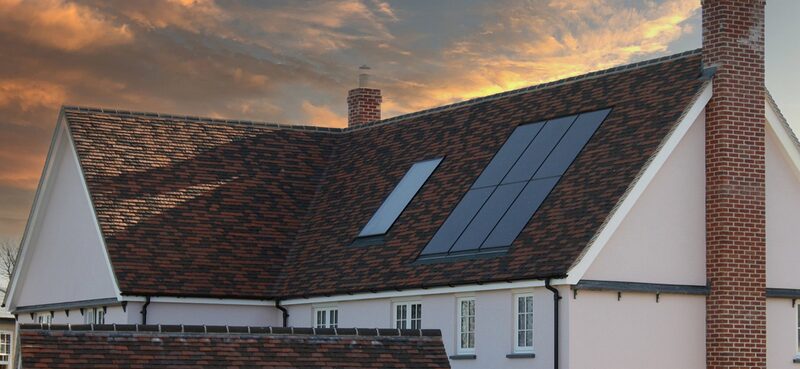
Marley's tile catalogue includes pantiles, flat and interlocking designs and products that mimic natural slate, with more than 80 different roof tiles to choose from1. The complete roof system is available in a variety of colours, profiles and formats2. That breadth is the point of the range: a specification can be matched to a street scene, a conservation context or a developer's standard house type without leaving the system.
The named products that appear across Marley's own project write-ups give a sense of the working range. The Duo Edgemere interlocking concrete slate tile appears in a Smooth Brown colourway on one scheme12. Ludlow Major and Modern concrete roof tiles were supplied in Smooth Brown on another13. The Mendip interlocking concrete roof tile in Smooth Brown appears on a third14. Edgemere interlocking slate tiles appear again on an apartment project, where SolarTile panels were described as working seamlessly with them15.
Two dated product developments are worth noting. The Lincoln interlocking clay pantile was launched by Marley in early 2016. The Roofing Sitework Guide was updated in 2019, adding the Eden easy-to-fix traditional pantile, the Universal Eaves Clip and Ashmore Dry Verge, and updated again in 2024 with instructions for installing SolarTile in regular and irregular arrays. Marley also states that Modern tiles are now being manufactured with two nail holes, with two-hole product starting to become available in early 2026.
| Product | Type | Colour or finish | Where it appears |
|---|---|---|---|
| Duo Edgemere | Interlocking concrete slate | Smooth Brown12 | Burden Road12 |
| Ludlow Major | Concrete | Smooth Brown13 | Westward Housing13 |
| Modern | Concrete | Smooth Brown13 | Westward Housing13 |
| Mendip | Interlocking concrete | Smooth Brown14 | Princess of Wales Court14 |
| Edgemere | Interlocking slate | Not stated15 | Highgrove Apartments15 |
Colours and profiles: from reds and browns to shades of grey
Marley describes its tile colours as ranging from reds and browns to various shades of grey1. That is a broad palette rather than a fixed set, and the named colourways in the project record cluster around one of them: Smooth Brown appears repeatedly, on Duo Edgemere, Ludlow Major, Modern and Mendip tiles12.
The reason colour matters beyond appearance is planning and street scene. A re-roof in a conservation area or on a uniform terrace is often constrained by what the surrounding roofs look like, and a range that spans reds, browns and greys gives more room to match. The profile matters for the same reason: pantiles, flat tiles, interlocking tiles and slate-look products read very differently on a elevation, and the choice is partly governed by how steep or shallow the slope is, as official guidance on pitched roofs notes16.
Profile also drives how the roof performs at its edges and junctions. Dry-fix ridge tiles and verges appear in Marley's own system descriptions, alongside ArcBox protection, as part of a complete pitched roofing specification17. Those components are where a roof most often leaks or lifts, and specifying them with the tiles keeps the responsibility for the whole assembly in one place.
For a household, colour and profile are the visible, planning-facing decisions. They do not change the thermal performance of the roof, which is set by the insulation and the U-value the roof must achieve, not by the tile above it.
Minimum pitch: tiles that work down to 12.5 degrees
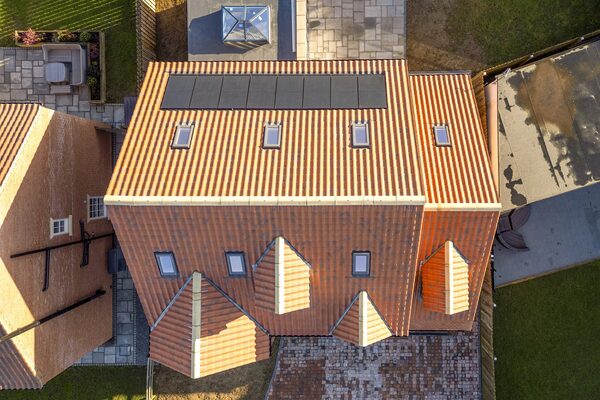
Marley states that products are available for pitches as low as 12.5 degrees, and that tiles are available for low-pitched roofs down to 12.5 degrees1. SolarTile is described as suitable for installation on low-pitch roofs3. That combination matters on shallow roofs, where a household might otherwise assume solar is not an option.
The regulatory line sits below that. Official guidance defines a flat roof as having a pitch of less than 10 degrees, in the context of flue outlet position tables, and the same definition appears in Welsh guidance19. Ofgem's ECO4 guidance describes flat roof insulation as applying with a possible pitch of up to approximately 10 degrees21. So a roof at 12.5 degrees is a pitched roof for these purposes, and a roof at 9 degrees is not.
Where a roof is being upgraded rather than replaced, the thermal requirement is separate from the tile. Approved Document L sets a maximum U-value of 0.16 W/m2.K for a pitched roof with insulation at ceiling level, and 0.15 W/m2.K for new thermal elements in extensions22. For a pitched roof of a dwelling, official guidance describes this as normally involving new or additional loft insulation, at least 250 mm of mineral fibre or cellulose fibre quilt laid between and across ceiling joists, or loose fill or equivalent23. More on the fabric side is at roof insulation and loft insulation.
The Marley Complete Roof System: tiles, cedar shingles and SolarTile in one specification
The Marley Roof System is presented as a single-source specification: underlays, battens, fire barriers, roof tiles, solar tiles, ventilation and accessories, with all elements of the roof system provided by the same manufacturer24. Roof covering options include clay and concrete tiles, Western Red Cedar shingles and shakes, and roof-integrated Marley SolarTile panels18. The complete roof system is described as running from the battens and underlay to the tiles, fixings and ventilation2.
The commercial argument Marley makes for this is accountability. On one council scheme, the client is described as benefiting from having just one source of supply for the entire roofing system, with Marley providing everything from the battens up and arranging deliveries to suit the build schedule12. On another, all elements of the roof construction could be specified together, including the solar panels17.
The technical argument is compatibility. Marley states that its extensive range of roof tiles is fully compatible with the rest of the Marley Roof System, and that all roofing tiles are compatible with the system1. SolarTile can be used as a fully integrated element of the comprehensive roof system6. As part of the Marley Roof System, SolarTile is described as fully compatible with the entire range of roofing products24.
For a household, a single-source roof system simplifies the question of who is responsible when something goes wrong at a junction between tile, underlay and solar panel. It also concentrates the specification in one manufacturer's technical literature, which is a benefit for consistency and a limitation for anyone wanting to mix components from different makers.
Marley SolarTile: roof-integrated panels compatible with all tiles and slates
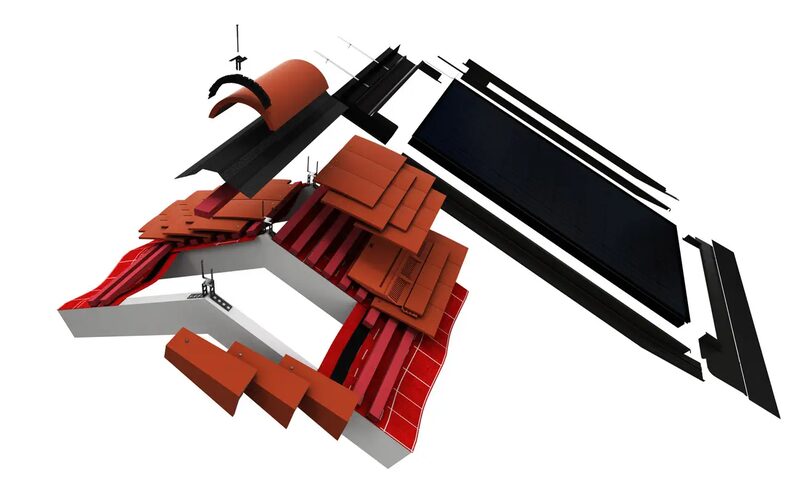
SolarTile is a roof-integrated photovoltaic panel that sits flush with the roof and is attached directly to the roof battens, replacing tiles or slates18. It is compatible with the entire Marley roof product range, including clay and concrete tiles and cedar shingles and shakes, and the roofing kits work with all Marley tiles and are compatible with slates4. Marley states that its integrated SolarTile system is compatible with all of its clay and concrete tiles7.
The compatibility record extends across tile types. One case study describes SolarTile as compatible with concrete, clay or slate, and with interlocking or plain tiles, machine or hand made26. Another records SolarTile integrating with Edgemere tiles and being integrated with the roof tiles27. A third describes the panels working seamlessly with Edgemere interlocking slate tiles15.
Independent guidance sets out what the format is good for. Solar roof tiles can cover the entire roof, almost to the edge, and then be accompanied with matching, non-solar tiles around the edges, or can be used to cover part of a roof10. They can be a good solution for getting the most out of the available space on angled roofs, roofs with eaves and other complicated roofs10. Official guidance from 2014 notes that solar tiles and slates can integrate seamlessly with new and existing roofs and are compatible with a wide range of roof tiles and slates28.
Marley describes SolarTile as suitable for new-builds or re-roofing projects, and for retrofit applications3. Because it replaces a section of roof tiles, the maker states it can simplify installation and keep costs down24. The dependence it creates is the same as any solar array: an inverter, a connection and an electrical sign-off, plus the grid itself for the hours when the roof is not generating.
Installation and dry fixing: what the system does for the roofer
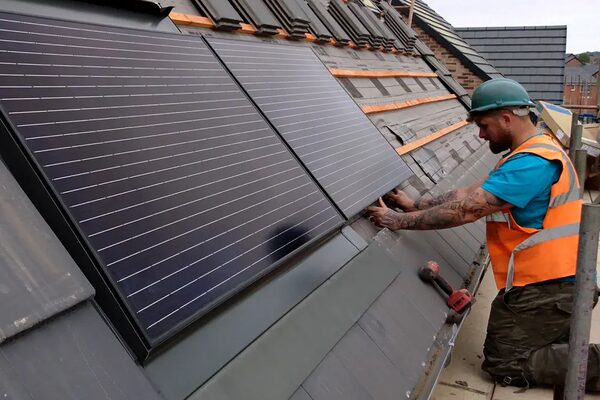
Marley tiles are described as designed for easy installation and dry fixing1. Dry-fix systems are mechanically fixed to the roof structure, which the maker states provides greater resistance to wind uplift8. SolarTile uses push-fit connections for a weather-tight and secure fixing4. The panels sit directly onto the battens and, in some cases, are fixed to the rafters and the battens7.
The division of labour on a solar roof is set out by Marley: the integrated system can be installed by a roofing contractor, and signed off by an MCS accredited electrical contractor7. Independent guidance on solar roof tiles makes the same point from the other direction, noting that a professional roofer can carry out the installation11. That split is what allows a roofer to remain the primary trade on a solar roof, with the electrical work handled separately.
The standards the work sits under are named. SolarTile is installed to BS 5534:2014+A2:2022, the code of practice for slating and tiling for pitched roofs and vertical cladding3. One complete pitched roofing scheme is described as meeting BS 5250:2021 on the management of moisture in buildings and BS 5534:2014+A2:2018 on slating and tiling17. Marley states that its products are designed to meet current building regulations and BS 5534 guidance18.
For comparison, other integrated systems publish their own minimum pitches: one maker lists a minimum pitch of 20 degrees and another 15 degrees29. Marley's 12.5 degree figure is the shallowest of those stated in the material reviewed here. Independent guidance on solar water heating notes that collectors are commonly positioned and fixed above roof tiles, with some systems integrated into the roof instead, which is the distinction between an on-roof panel and a roof-integrated one30.
Technical support, training and specification help for householders and installers
Marley's installer-facing resources include installation videos and instruction sheets, online or in-person courses, tile estimators, solar configurators, CAD drawings, BIM files and fixing specifications18. The company states it can work with installers to provide training when needed12.
The project record shows what that support looks like in practice. On one scheme, Marley provided training support to upskill the in-house installation team, and its technical experts supported the client through the system development with regular site visits27. On another, Marley worked with the client team on the initial specification and drawings, provided technical expertise on achieving the required power output from the solar panels and how that would translate into the final panel selection, and had experts present to help guide the installation team on the day26. A third records pre-specification guidance, NBS documentation and technical input to support funding requirements, plus on-site and remote support as needed13. A fourth records a training session hosted with the contractors before installation commenced, and a site visit to guide the installation team15.
On specification documents, Marley developed an NBS specification for a complete roof system including SolarTile PV arrays, concrete roof tiles, ridge, fascia and eaves systems14. Its technical team used the SAP (Standard Assessment Procedure) methodology to calculate system requirements on an apartment project15.
Independent guidance on installer competence sets the standard this support is meant to meet: installers are supplied with the means, through documentation, training and technical support, to competently carry out and notify installation, commissioning and servicing work in accordance with manufacturer's instructions25.
Sources30 cited
- Roof tiles, Marley, 2026
- Marley Roof System, Marley, 2026
- SolarTile, Marley, 2026
- Which roof coverings are compatible with solar roof tiles and panels, Marley, 2026
- Solar installation, Marley, 2026
- Solar FAQs, Marley, 2026
- Solar PV FAQs for social housing, Marley, 2021
- Lime Grove, Marley, 2026
- Solar roof tiles, solar inverter and solar battery for self-build, Marley, 2024
- Solar roof tiles, Energy Saving Trust, 2026
- Solar roof tiles, HIES, 2018
- Burden Road, Marley, 2026
- Westward Housing, Marley, 2026
- Princess of Wales Court, Marley, 2026
- Highgrove Apartments, Marley, 2026
- Building regulations for new roofs, Planning Portal, 2026
- Ashington, Marley, 2026
- Installer resources, Marley, 2026
- Approved Document L Volume 1 consultation version, Welsh Government, 2025
- Building regulations guidance Part J, Welsh Government, 2019
- ECO4 New Measures and Products Guidance v3.0, Ofgem, 2026
- Approved Document L2B, Welsh Government, 2020
- Building regulations for ceilings and floors, Planning Portal, 2026
- Whole roof system helps tackle fuel poverty, Marley, 2024
- HHIC installer guidance, HHIC, 2026
- Bro Pedr Fardd, Marley, 2026
- Miners Court, Marley, 2026
- UK Solar PV Strategy Part 2, UK Government, 2014
- Integrated buyers guide, GB-Sol, 2026
- Your home guide to solar water heating, OFTEC, 2026
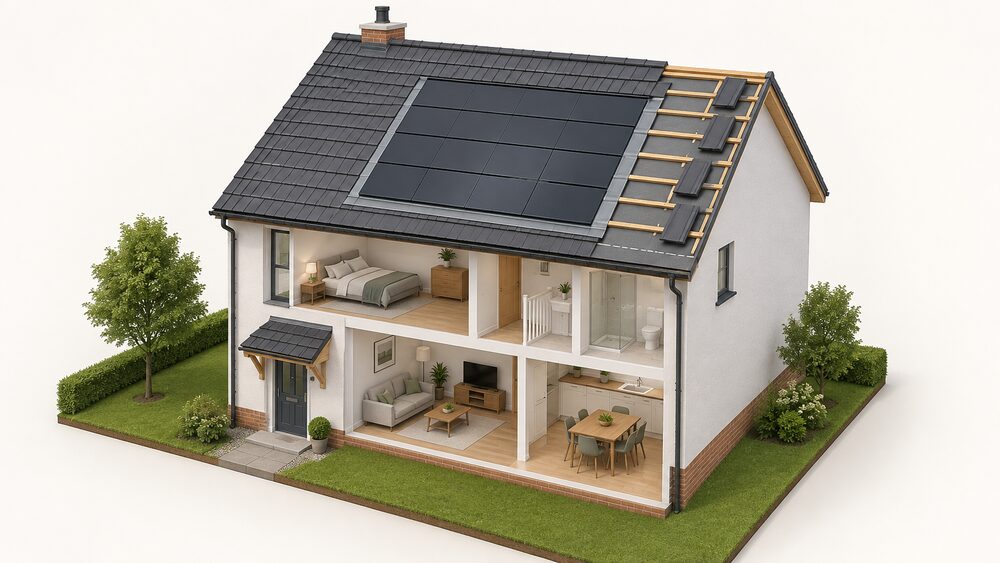 Marley SolarTileMarley SolarTile panels sit flush in the roof instead of on top of it, so they replace tiles rather than sit above them.