
In this answer
Short answer
Pigeons nest under solar panels because an on-roof array is mounted on rails, and the gap between the panel frame and the roof surface is a dry, sheltered ledge with a ready-made roof over it. The birds are not attacking the equipment; they are using the structure. The consequences are fouling, noise, and a documented fire risk, because independent guidance states that birds' nesting material can be combustible and present a serious fire risk, and that birds and squirrels can damage connectors and wiring1.
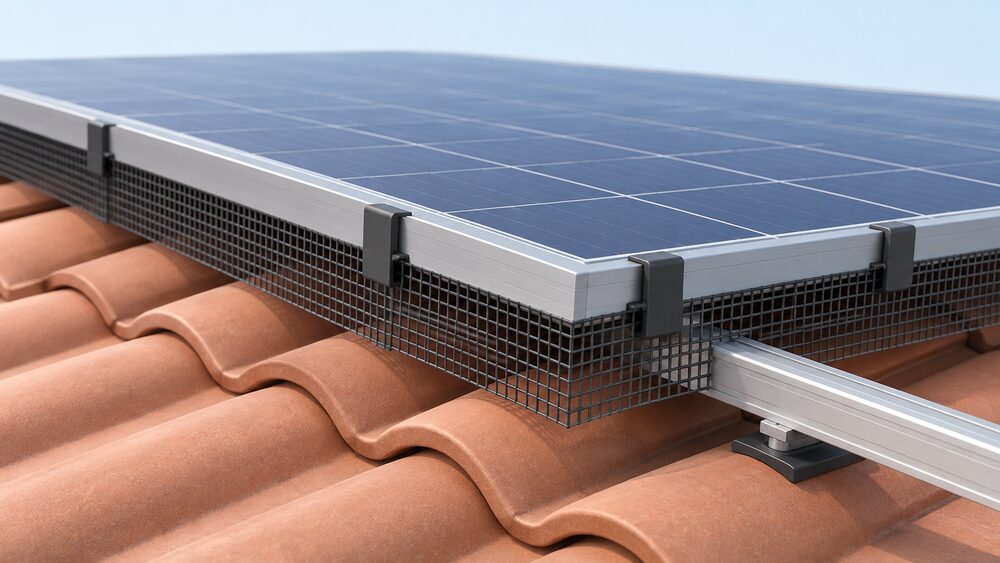
The fix is a physical one: close the gap. A purpose-made mesh skirt clipped around the perimeter of the array removes the ledge, and independent guidance recommends asking whether an installer provides bird netting at the outset, because pigeons love nesting under panels, it causes a mess, and it is harder to add later2. Adding that protection when the panels go on is significantly cheaper than retrofitting it afterwards3.
There is no published national price for pigeon proofing in the UK, so proofing is installer-quoted. What is documented is the cost of the adjacent jobs: professional solar panel cleaning typically starts at around £60 to £100 for a standard system, and cleaning costs range from around £4 to £15 per panel depending on access and how dirty the panels are4. The legal position on an occupied nest is the part most householders get wrong, and it is covered below.
Why pigeons nest under solar panels
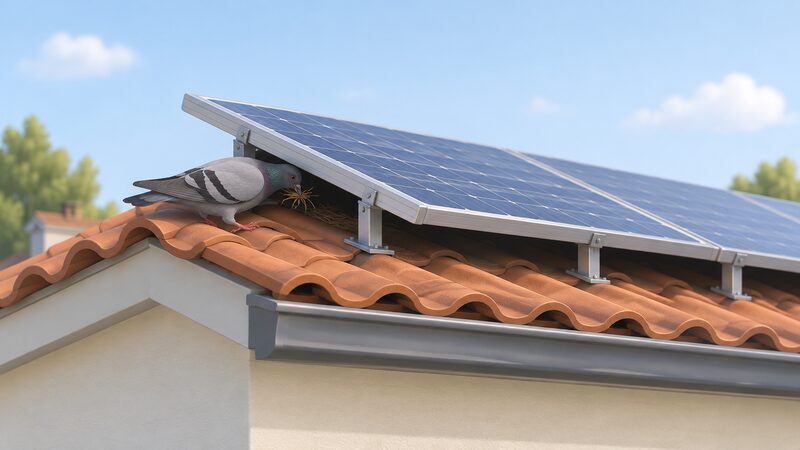
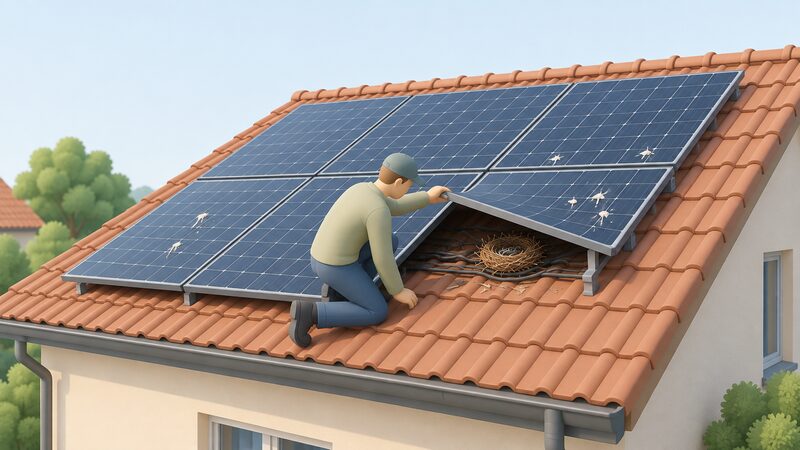
An on-roof solar array is not laid flat on the tiles. The panels sit on mounting rails fixed above the roof covering, which leaves a continuous void behind and beneath the array. That void is warm, dry, out of the wind and out of reach of most ground predators, which is close to an ideal nest site for a feral pigeon.
The alternative construction removes the problem at source. Independent guidance notes that roof-integrated panels are built into the roof, leaving no gaps for birds or rodents to get into, though they can be complex to retrofit1. That is the trade-off: an in-roof system has no void to proof, but it is a different installation, and retrofitting it is a bigger job than adding mesh to an existing array.
The planning framework treats roof-mounted and ground-mounted panels as the same category of equipment. Official guidance confirms that solar panels include roof-mounted solar panels as well as ground-mounted solar panels within the curtilage of residential accommodation6. Installing panels on a roof will often fall under permitted development rights, meaning an application for planning permission is not required provided certain limits and conditions are met7. Those conditions matter for the legal section below, because permitted development for solar typically carries a removal condition.
For a household, the nesting itself is the first sign of a loss of control over the installation. The array is on your roof, but the space behind it has been colonised, and the longer it is left the more material accumulates. The relevant maintenance routine is set out by independent guidance: checking your solar panels after rough or stormy weather, watching out for animals nesting near the panels, and scheduling annual inspections8.
Problems pigeons cause: damage, noise and droppings
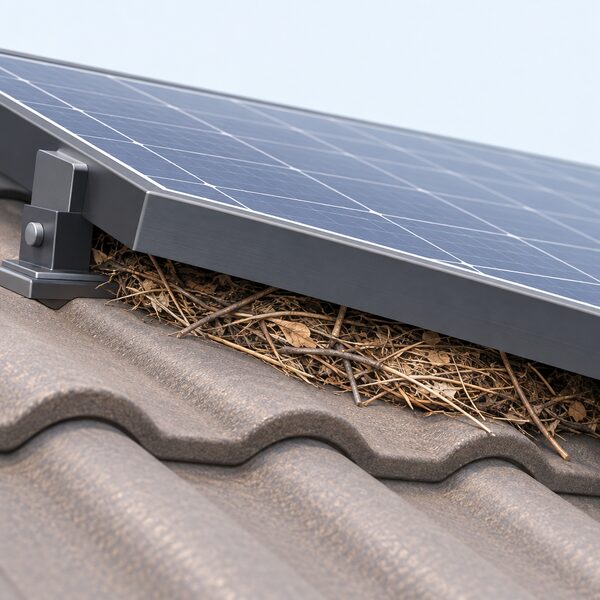
The headline risk is fire. Independent guidance states plainly that birds' nesting material can be combustible and present a serious fire risk, and that birds and squirrels can damage connectors and wiring1. Nesting material is dry, fibrous and packed into a confined space directly behind a live electrical installation, which is why this is treated as more than a nuisance.
The second effect is on generation. Dirty solar panels can reduce how much electricity solar panels generate as it affects how much sunlight reaches the panels4. Bird droppings are named among the causes of that build-up, alongside traffic pollution in urban areas and a build-up of salt near the coast1. A drop in output is not always obvious, because independent guidance lists weather conditions, dirt building up, or a change in the environment such as shading from trees or new structures among the possible causes, and notes a faulty DC string as another possibility1. Fouling is one candidate among several, not the automatic explanation.
The third is the fabric of the roof and the wiring. Independent safety guidance advises regular visual checks to identify any cracks, breaks, loose connections, and any cable damage caused by vermin and weathering9. Where such damage is found, the same guidance is unambiguous: if you see any, stop and report it immediately to your installer, as this presents an electric shock hazard4.
Noise and mess are the everyday complaints, and they are the reason most households act. Droppings accumulate on the roof covering, in gutters and on the ground below the array, and the birds return to the same site year after year unless the gap is closed.
Pigeon proofing options: mesh, clips and spikes
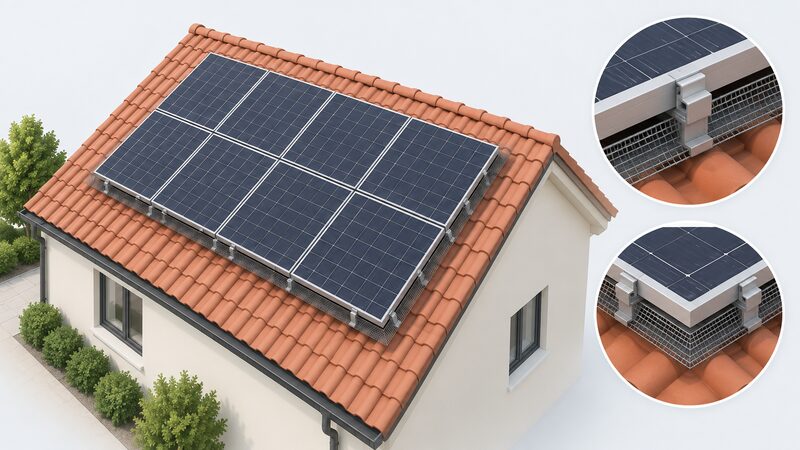
The established method is a mesh skirt: a purpose-made netting or mesh panel fixed around the perimeter of the array, closing the gap between the panel edge and the roof surface while leaving the panels themselves untouched. It is fitted with clips that grip the panel frame or the mounting rails, so no hole is made in the module.
That last point is the one to hold on to. Independent guidance states that panels should not be drilled when fitting bird or pest protection3. A fixing method that clamps rather than penetrates is what keeps the module's own integrity intact.
Spikes are the weaker option for this particular problem. They deter birds from landing on a surface, but the issue here is a void behind the array rather than a perch, and independent guidance is candid about the limits of the whole category: most bird or pest protection will not deter a determined squirrel or jackdaw, and should really be called pigeon protection only1. Mesh closes a gap; it does not exclude every animal.
The choice of panel construction also bears on the options available. Roof-integrated panels are built into the roof, leaving no gaps for birds or rodents to get into, but can be complex to retrofit1. Where an array is already on rails, mesh is the retrofit route.
Getting rid of an existing nest safely and legally
Two separate legal questions get confused here, and they have different answers.
The first concerns the birds. Wild birds, their nests and their eggs are protected while a nest is in active use, so an occupied nest under an array should not be removed. Once a nest is no longer in use, clearing it is a different matter, but the work sits under the panels and beside DC cabling, which is why the safety guidance above applies: cable damage caused by vermin should be identified by visual check, and any damage found should be reported to the installer immediately because it presents an electric shock hazard9.
The second concerns the panels. Permitted development for solar equipment typically carries a condition that the equipment is removed once it is no longer needed. Official guidance from several councils sets this out in near-identical terms: any solar panels no longer needed for micro-generation are removed as soon as is reasonably practicable10, equipment must be removed as soon as is practicable when no longer needed12, and panels should be removed as soon as possible when they are no longer needed13. The same condition appears in guidance stating that when no longer needed, equipment should be removed as soon as reasonably practicable14, and in a further formulation that solar panels no longer needed for micro-generation are removed as soon as is reasonably practicable15.
That condition is about the installation, not the wildlife, and it is worth knowing because it shapes how a roof is returned to its original state. Where a household needs to know whether permission is required at all, official guidance points to information on permitted development rights for installation, and how to apply for permission if you need it16. The position differs by nation and by designation: permitted development rights apply where the property is not in a Conservation Area, Article 4 Area or a Listed Building17, and the panels must not be installed on a building that is within the grounds of a listed building or on a site designated as a scheduled monument18. Ground-mounted installations face a further limit, where permission is required if there is already a stand-alone ground-mounted solar equipment installation within the grounds or gardens of the property11.
Costs: DIY kits versus professional proofing
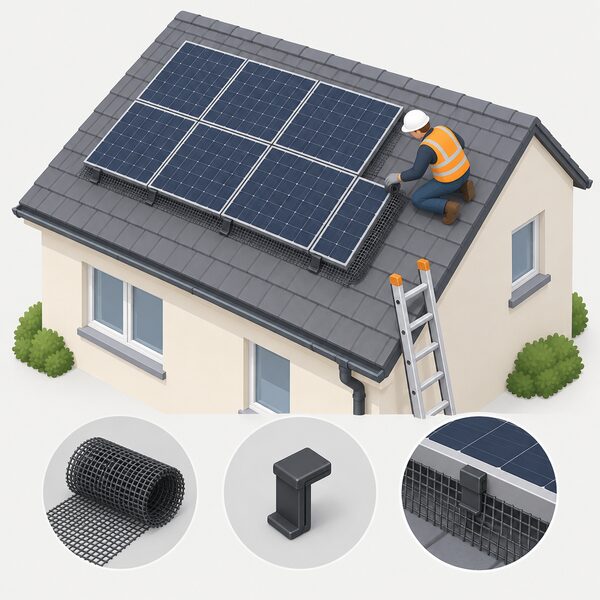
There is no published UK price for pigeon proofing, and no range is given here because none is documented. Proofing is installer-quoted, and the figure depends on the size and shape of the array, the pitch of the roof and how accessible the perimeter is.
What the evidence does establish is the direction of travel on timing. Adding wildlife protection when your panels are installed will be significantly cheaper than retrofitting3. Retrofitting means scaffolding or access equipment for a second visit, and the mesh has to be threaded around an array that is already fixed in place.
The adjacent costs that are documented give a sense of scale for the maintenance side of the problem. Professional solar panel cleaning costs typically start at around £60 to £100 for a standard system4, and cleaning costs range from around £4 to £15 per panel, depending on how easy they are to access and how dirty they are5. Solar panel cleaning kits are available online and from some hardware stores, typically costing around £10019. Those are cleaning figures, not proofing figures, and the two jobs are separate.
For context on the installation itself, independent guidance puts solar panels at around £7,0008, with a range of between £6,100 and £11,000 depending on the size of your property20, and a further range of around £4,600 to £8,000 based on panel quality and system size21. Plug-in solar panel devices that meet UK regulations cost from around £45022. None of these is a proofing price; they show what is at stake if an array is left unproofed and the installation has to be revisited.
| Item | Documented figure | Source |
|---|---|---|
| Pigeon proofing | Installer-quoted; no published UK figure | |
| Professional cleaning, standard system | Typically around £60 to £100 | 4 |
| Cleaning, per panel | Around £4 to £15 per panel | 5 |
| Cleaning kit | Around £100 | 19 |
| Wildlife protection at installation | Significantly cheaper than retrofitting | 3 |
Cleaning up after pigeons and checking for panel damage
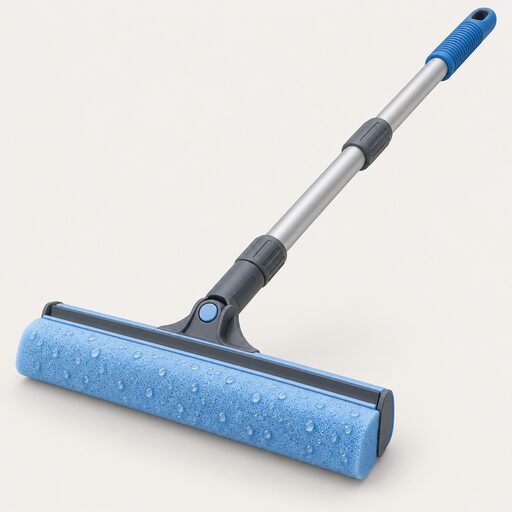
Cleaning and inspection are one job in practice, because the check happens while the roof is being looked at. Independent guidance sets out what to look for: check for signs of wear and tear, damage, water ingress, dirt build-up, bird droppings or lichen growth, arrange repairs if issues are identified, and clean panels if needed4.
The routine that catches problems early is periodic rather than constant. Independent guidance recommends checking your solar panels after rough or stormy weather, watching out for animals nesting near the panels, and scheduling annual inspections8. Independent safety guidance adds regular visual checks to identify any cracks, breaks, loose connections, and any cable damage caused by vermin and weathering9.
Not every mark on a panel is damage. Independent guidance notes that most panels have a self-cleaning coating which, when installed at a suitable angle, allows rain to clear dirt and debris9. Where a panel has cracked, the same guidance states this rarely happens after installation, and that if a crack is suspected it would most likely have been caused by impact1. Fouling is a cleaning problem, not a structural one.
The maintenance expectation overall is modest. Independent guidance states that solar panels are low-maintenance, and that the household needs to keep the panels reasonably clean and make sure that any shading is minimised, with the installer providing a maintenance guide23. Shading is worth watching alongside the birds, since independent guidance lists trees, chimneys and nearby buildings as the usual sources24.
Will pigeon proofing void my solar panel warranty?
The condition that matters is the drilling one. Independent guidance states that panels should not be drilled when fitting bird or pest protection3. A mesh system fixed with clips to the frame or rails leaves the module unpenetrated, which is the approach the guidance points to.
Beyond that, warranty terms are set by the manufacturer, and the specific conditions for a given panel are stated in that maker's own documents. General guidance does not substitute for them. What independent guidance does say about the category is worth repeating: most bird or pest protection will not deter a determined squirrel or jackdaw, and should really be called pigeon protection only1. A household expecting a general wildlife barrier should know that the product is narrower than the name suggests.
On the insurance side, the documented position is that solar panels are usually added to a home insurance policy as part of the buildings cover, and that a household should tell its insurer about the installation. Whether fouling, nesting or wiring damage is covered depends on the individual policy wording, and no standard position on pigeon damage specifically is set out in the available guidance.
The wider consumer protection picture is worth knowing when commissioning any of this work. Independent guidance describes a consumer protection guide covering how solar panel systems work and their benefits, as well as the costs associated with solar panel installs25. Where an installation was originally funded under a free solar panel scheme, a further condition applies: if panels are removed for a period, for example for roof maintenance, the householder would have to compensate the company for the missed FIT payments26. That is a cost that sits alongside any proofing or cleaning work on a leased array.
What this means for a household's energy independence
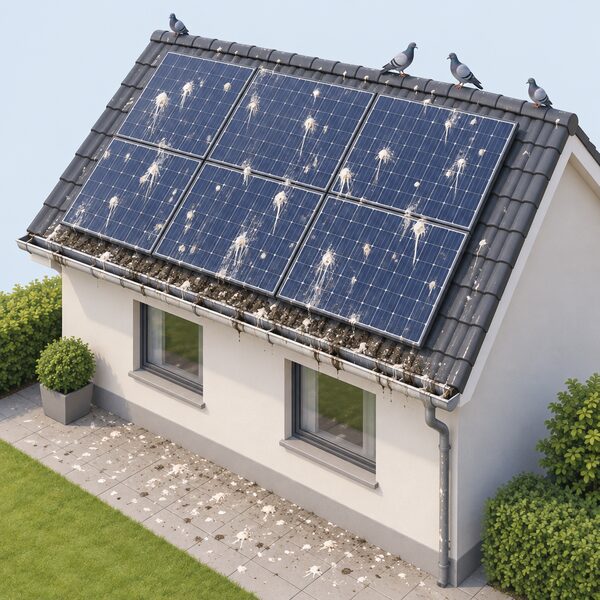
Pigeons under solar panels do not stop a system generating, but they erode two things a household is trying to build: the reliability of the installation and the household's control over it. Nesting material behind a live array is a documented fire risk, and vermin can damage connectors and wiring1. A household that has to call the installer back for cable damage, or that loses output to fouling it cannot safely clear, is more dependent on outside help, not less.
The independence argument for acting early is straightforward. A mesh skirt fitted at installation is significantly cheaper than retrofitting3, and it is the point at which the array is already being worked on. After that, the maintenance routine is a visual check after rough weather and an annual inspection8, which a household can schedule itself.
The dependence that remains is real and should be stated. The array is still connected to the grid, and independent guidance notes that solar panels will automatically switch off during a power cut, a safety feature that prevents electricity being exported to the network, usually restarting on their own once power returns27. Proofing does not change that. Nor does it change the fact that the panels, the mounting system and the warranty all belong to a manufacturer and an installer, and that any work under the array touching DC cabling is their territory rather than the household's4.
What proofing does deliver is that the roof stays a generating asset rather than becoming a wildlife site with an electrical installation attached. For a household working towards energy independence, that is the point: the equipment keeps doing the job it was bought for, and the household is not paying twice for the same roof.
Sources27 cited
- Solar panel problems and how to solve them, Which?, 2026-03-26
- How to choose a good solar installer, Low Carbon Hub, 2025-10-20
- Most common solar panel problems, Which?, 2026-09-20
- Solar panel cleaning and maintenance, Energy Saving Trust, 2026-08-25
- Solar panel myths: five common concerns debunked, Which?, 2026-06-09
- VAT energy saving materials: solar panels, HM Revenue & Customs, 2026-09-17
- Planning permission for solar equipment mounted on a house or a block of flats, Planning Portal, 2026-09-17
- How do solar panels work, Smart Energy GB, 2026-03-16
- Solar panels safety advice, Electrical Safety First, 2026-09-17
- Solar panels guidance, City of York Council, 2026-09-17
- Planning permission for solar panels, Bristol City Council, 2026-09-17
- Solar photovoltaics and planning in conservation areas, West Suffolk Council, 2026-09-17
- Solar panels, City of York Council, 2026-09-17
- Common queries about planning permission, Wiltshire Council, 2026-09-17
- Solar panels planning permission, Bath & North East Somerset Council, 2026-09-17
- Solar Together domestic planning guidance, Southampton City Council, 2026-09-17
- Installing solar panels at your home, Brighton & Hove City Council, 2026-09-17
- Solar panels planning permission checklist, Islington Council, 2026
- Make the most of your solar panels, Which?, 2026-08-12
- Make your home more energy efficient, Confused.com, 2026-07-06
- Solar panels, Uswitch, 2026-09-09
- Plug-in solar panels, Energy Saving Trust, 2026-09-17
- Solar photovoltaic (PV), MCS Certified, 2026-07-30
- Solar panel installation, Energy Saving Trust, 2026-09-07
- Consumer protection guidance, Solar Energy UK, 2026-09-17
- Free solar panels and solar buyback, Which?, 2026-03-26
- Planned power cuts, SSEN Distribution, 2026-09-19
 Panel Maintenance and CleaningWhat upkeep a domestic solar array actually needs: inspection intervals, cleaning, bird and debris protection, and checking fixings after storms, with the costs and the safety rules.
 Panel RecyclingWhat actually happens to a solar panel when it stops working, and what can a household do with one?
 Solar Panel CostsA typical UK home pays somewhere between four and eleven thousand pounds for solar panels fitted, with most landing in the middle.
 The Full Solar Panels GuideHow much do solar panels cost, and what could they save you each year?
 Solar Mounting SystemsWill your roof take the extra weight of solar panels, and will it still keep the rain out afterwards?
 Planning Permission EnglandMost homes in England can have solar panels fitted without planning permission, but does yours count as one of the exceptions?